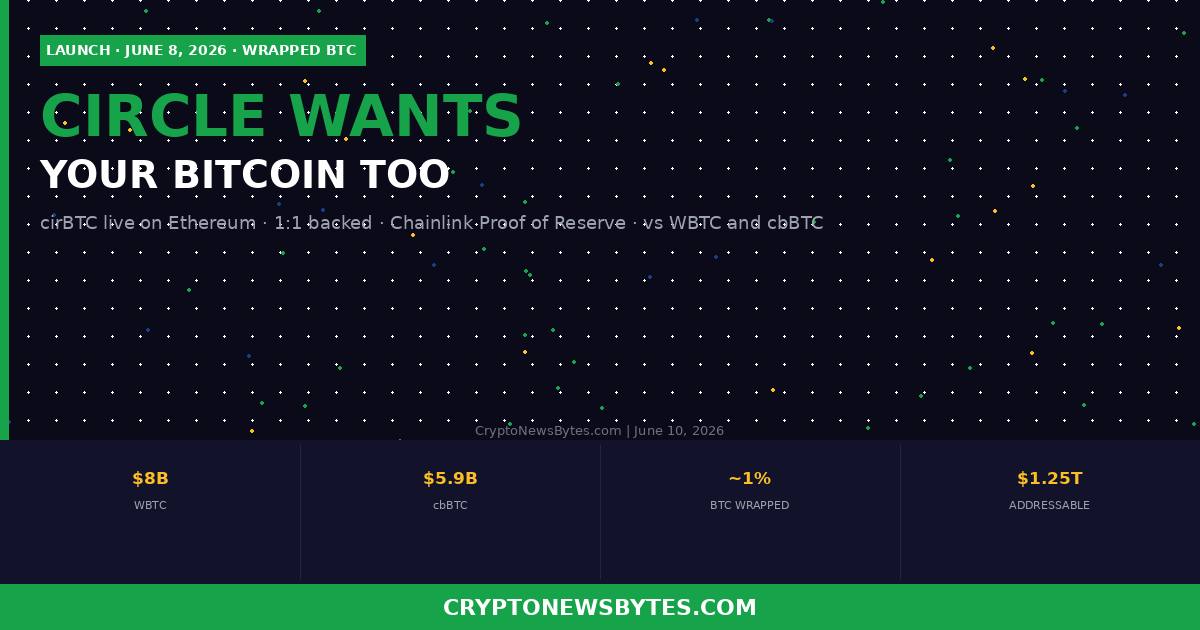
Circle, the company behind the $60 billion-plus USDC stablecoin, launched cirBTC on Ethereum on June 8, 2026: a wrapped Bitcoin token backed 1:1 by native BTC held in segregated, regulated custody and verified in real time through Chainlink Proof of Reserve. The product lets Bitcoin holders deploy their BTC wealth into DeFi: lending, decentralized exchanges, tokenized assets, and stablecoin strategies, without selling the underlying asset. It is also a direct declaration of war on the two incumbents that control the wrapped Bitcoin market: WBTC at roughly $8 billion in market capitalization and Coinbase’s cbBTC at approximately $5.9 billion.
The total synthetic Bitcoin market hovers between $12.5 billion and $13.5 billion, which sounds large until you realize it represents about 1% of Bitcoin’s total $1.25 trillion value. That is the actual story here. Circle is not fighting for a slice of a $13 billion market. It is betting that the addressable market is the other 99% of Bitcoin that currently sits idle, and that the thing keeping it idle is custody trust. Circle’s pitch to institutions: you already trust our infrastructure with $60 billion in USDC. Trust it with your Bitcoin.
The Three-Way Fight: How cirBTC Stacks Up
Wrapped Bitcoin tokens all do the same thing: lock native BTC with a custodian, issue an ERC-20 representation on Ethereum, and let that representation move through DeFi. The differences are entirely about who holds the Bitcoin and how you verify they actually have it. That is where the three products diverge sharply.
WBTC, the original and largest, is custodied primarily by BitGo, and its history is the reason this market has an opening. In 2024, BitGo’s plan to move WBTC custody into a joint venture involving Justin Sun triggered an industry backlash, MakerDAO votes to limit exposure, and Coinbase launching cbBTC specifically to capture the trust exodus. cbBTC grew to $5.9 billion on the back of Coinbase’s brand, but it comes with a trade-off that institutional allocators notice: Coinbase does not publish real-time proof of reserves for cbBTC, asking users to trust the exchange’s overall audited balance sheet instead.
Circle’s cirBTC attacks exactly that gap: native BTC in segregated, regulated custody, with reserves verified in real time through Chainlink Proof of Reserve. Segregated custody means the Bitcoin backing cirBTC is not commingled with other corporate assets. Real-time on-chain verification means you do not have to wait for a quarterly attestation to know the backing exists. In a category where custody transparency has not always been the default, Circle is making it the headline feature.
The Wrapped Bitcoin War: WBTC vs cbBTC vs cirBTC
June 2026 | Sources: CoinDesk, CoinGecko | @cryptonewsbytes
| Token | Market cap | Custodian | Proof of reserve |
|---|---|---|---|
| WBTC (2019) | ~$8B | BitGo + JV partners | Dashboard, trust questions since 2024 |
| cbBTC (2024) | ~$5.9B | Coinbase | No real-time PoR, exchange balance sheet |
| cirBTC (2026) | New | Segregated regulated custody | Real-time via Chainlink PoR |
Total synthetic BTC market: $12.5-13.5B, ~1% of Bitcoin’s $1.25T value | @cryptonewsbytes
Why Circle Is Doing This Now
Circle is a public company (CRCL) whose revenue is overwhelmingly tied to USDC reserve interest income, which makes it structurally exposed to Fed rate cuts. Every product that diversifies revenue away from pure stablecoin float matters to the equity story. cirBTC fits a deliberate expansion pattern: Circle has been building out payment networks, tokenization infrastructure, and now Bitcoin wrapping, each one converting its regulatory credibility and institutional trust into new product surface area.
The target customer is specific: institutions that focus their crypto allocation on Bitcoin and already know Circle through USDC. For a fund holding BTC that wants to earn lending yield, provide DEX liquidity, or post collateral in tokenized markets without selling, the choice of wrapper is a custody decision above all. Circle is betting that “the regulated stablecoin company with real-time proof of reserve” beats “the exchange” and “the custodian with the Justin Sun history” in that decision. Whether DeFi protocols adopt cirBTC liquidity fast enough to matter is the open question: WBTC’s incumbency in lending markets and DEX pairs is the moat Circle has to cross.
Frequently Asked Questions
What is Chainlink Proof of Reserve and why does it matter for cirBTC?
Chainlink Proof of Reserve is an oracle service that continuously verifies on-chain that the collateral backing a token actually exists in custody. For cirBTC, it means anyone can verify in real time that every cirBTC token is matched by native Bitcoin in Circle’s segregated custody, rather than relying on periodic attestations or trusting a company’s balance sheet. After the FTX collapse and the WBTC custody controversy, real-time verifiable backing has become the institutional standard demanded of wrapped assets.
Why would anyone wrap Bitcoin instead of just holding it?
Native Bitcoin cannot interact with Ethereum DeFi. Wrapping converts BTC into an ERC-20 token that can be lent for yield, used as collateral for borrowing, deployed as DEX liquidity, or posted in tokenized asset markets, all without selling the Bitcoin and triggering a taxable event or giving up the position. For long-term holders, wrapping turns an idle asset into a productive one. The trade-off is custody risk: you are trusting whoever holds the underlying BTC, which is exactly why the custody and proof-of-reserve differences between WBTC, cbBTC, and cirBTC are the entire competition.
Further Reading
Circle wrapping Bitcoin and JPMorgan tokenizing Treasuries are the same play from opposite directions: regulated institutions converting trust into on-chain product.
The same week Circle attacked the wrapped Bitcoin market, Bybit attacked IPO access. The financial supermarket race is on every front simultaneously.
Circle launching a Bitcoin product into the worst ETF outflow streak of 2026 says something about conviction in the long-term thesis.
This article is for informational purposes only and does not constitute financial advice. Sources: CoinDesk, 99Bitcoins, Circle announcement June 8 2026, CoinGecko. Published June 10, 2026.