
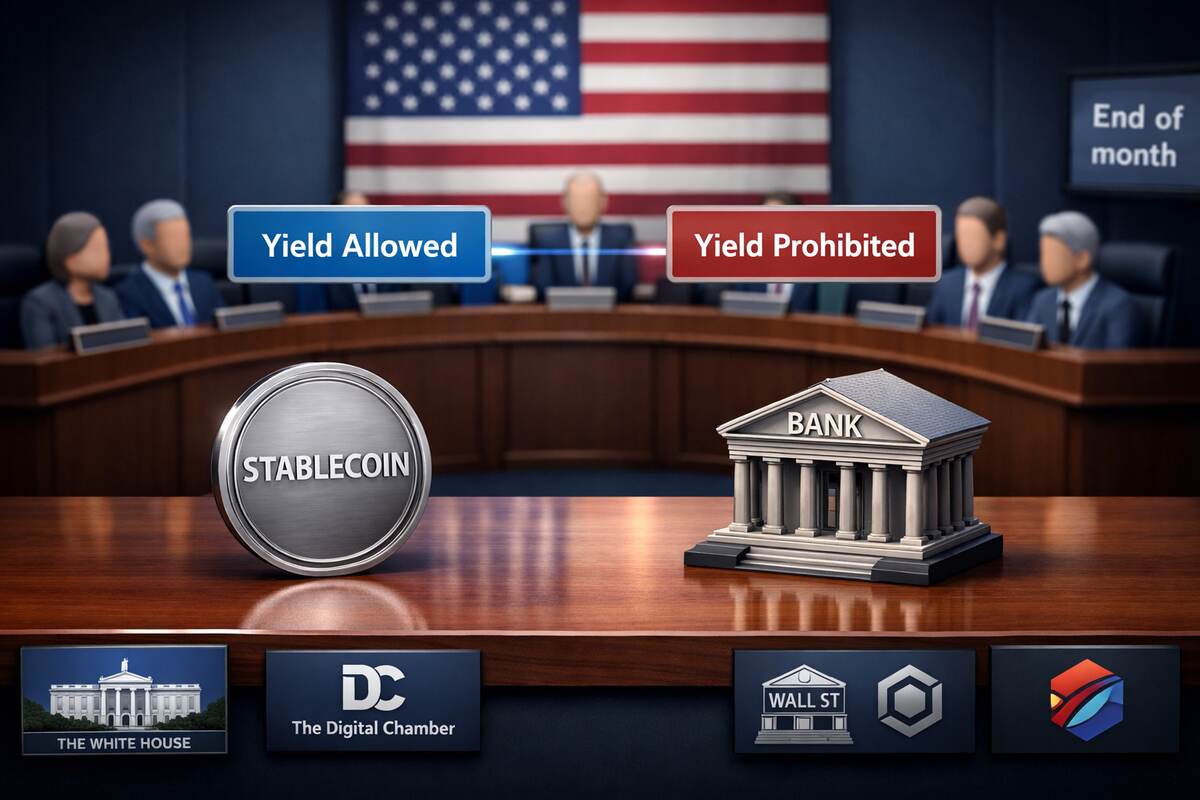
- Banks push to ban all stablecoin yields, while crypto firms accept limits on idle rewards but seek to keep activity-based incentives.
- U.S. lawmakers weigh the Digital Asset Market Clarity Act alongside the existing GENIUS Act as the White House urges a compromise.
A dispute over whether stablecoin users should be allowed to earn yield has become a central obstacle for U.S. lawmakers working on a Senate crypto market structure bill. The disagreement has hardened positions between major banks and digital asset firms, with the White House urging both sides to reach a limited compromise before the end of the month. At stake is how the law will treat rewards linked to stablecoin use and whether those rewards could undermine traditional bank deposits.
Senators, U.S. lawmakers and the battle over stablecoin yield
The current conflict is playing out around the Senate Banking Committee’s draft version of the Digital Asset Market Clarity Act, which is focused largely on securities issues in the crypto market. A planned hearing on the bill was derailed about a month ago after a last-minute dispute over a provision dealing with stablecoin rewards, and talks have stalled since then. The Senate Agriculture Committee has already moved its own version of the Clarity Act, covering commodities-related topics, through committee on a partisan vote. For the full Senate to approve any final package, however, U.S. lawmakers will need to secure enough Democratic support to reach the chamber’s 60-vote threshold, placing added pressure on negotiators to resolve the stablecoin question.
The political backdrop is complicated by last year’s Guiding and Establishing National Innovation for U.S. Stablecoins (GENIUS) Act, which currently governs stablecoin activity. The crypto industry has been operating under the GENIUS framework as it develops stablecoin products, while banks are now seeking to pull back some of those permissions through changes embedded in the pending Clarity Act. That effort has turned stablecoin yield into a flashpoint, even though some officials, including Trump crypto adviser Patrick Witt, argue that the Clarity Act was not originally designed as a stablecoin bill.
White House talks break down as banks reject all stablecoin rewards
In an effort to break the deadlock, the White House recently convened a meeting that brought together Wall Street banks and crypto executives, but the discussions ended without progress. Officials in President Donald Trump’s administration had urged participants to find common ground, yet the bank representatives refused to endorse any form of yield or reward for stablecoin users. Their position, laid out in a one-page document titled “Yield and Interest Prohibition Principles,” asserts that allowing such returns could weaken the deposit base that underpins the U.S. banking system. From their perspective, stablecoin rewards resemble interest-bearing accounts and risk pulling funds away from traditional institutions.
The banks have also asked for a two-year study of the impact of stablecoins on deposits, tying that research request to their broader push to bar yield. While that study proposal has been folded into the ongoing legislative discussions, it remains linked to the banks’ demand for a blanket prohibition on stablecoin rewards. According to people involved in the talks, bank representatives have shown little willingness to relax that stance, even after multiple rounds of meetings.
Patrick Witt, who advises Trump on crypto issues, told Yahoo Finance that the administration is still pressing both camps to make concessions and that another meeting could take place next week. He characterized the dispute as narrower than the overall legislative project, suggesting that the Clarity Act should only target “idle yield” on stablecoins rather than reshaping the broader framework established in the GENIUS Act. Witt called it “unfortunate” that a debate over a single feature of stablecoin products has slowed work on a bill intended to clarify the wider digital asset market.
Crypto industry seeks middle ground with conditional stablecoin rewards
On Friday, the Digital Chamber, a major industry trade group with members from both crypto and banking, responded by publishing its own principles document aimed at U.S. lawmakers. The paper, circulated to policymakers and obtained by CoinDesk, outlines a compromise under which the group would accept limits on some stablecoin rewards while preserving others that it views as essential to market functioning. The Chamber argues that its proposal narrows the scope of allowed returns in a way that should address banks’ concerns about direct competition with savings accounts.
Cody Carbone, the Digital Chamber’s CEO, said in an interview that his organization is prepared to surrender rewards that resemble interest on static stablecoin balances. Those products, he acknowledged, most closely mirror traditional deposit accounts and are at the center of banks’ objections. In his view, dropping yield for simple, idle holdings represents a substantial concession, given that those products are permitted under the existing GENIUS Act. Carbone emphasized that his members still want to offer rewards when users actively transact or contribute to network activity, insisting that those incentives serve different purposes than passive interest.
The Chamber’s document makes clear that it can accept the proposed two-year study on the impact of stablecoins on deposits, provided the research does not automatically trigger new regulations at its conclusion. Carbone framed that condition as part of the same compromise package, arguing that investigation and data collection are reasonable as long as they do not predetermine policy outcomes. He also stressed that, if no agreement is reached, the current legal structure under the GENIUS Act remains in force, meaning existing reward practices would continue unchanged.
From Carbone’s perspective, the banks’ insistence on a total ban leaves little room for progress. He warned that if they “do nothing” and keep pushing for a “blanket prohibition,” the legislative effort will stall and the status quo will persist. By contrast, he cast the Chamber’s recommendations as an attempt to “reset” negotiations and bring both financial sectors back to the table, arguing that the group’s mixed membership positions it as a realistic intermediary.
DeFi incentives and the role of U.S. lawmakers in shaping stablecoin policy
A central focus of the Digital Chamber’s paper is defending two specific types of stablecoin rewards: incentives for providing liquidity and rewards intended to encourage participation in a broader ecosystem. These scenarios are addressed in Section 404 of the Senate Banking Committee’s draft bill, and the Chamber contends they are particularly important for decentralized finance (DeFi) applications. In DeFi, liquidity providers supply assets to protocols so others can trade or borrow, and ecosystem participation often involves activities that help secure or govern networks. The industry argues that eliminating rewards for these functions would hinder core mechanisms that keep decentralized systems operational.
The Chamber is urging U.S. lawmakers to preserve these categories of incentives in the bill, arguing that they are distinct from passive interest on idle stablecoin holdings. The group maintains that such rewards compensate users for active contributions and risk-taking, rather than for simply parking funds, and therefore do not pose the same competitive threat to banks’ deposit bases. By separating these cases from static yield, the Chamber hopes to carve out a regulatory path that supports DeFi development while responding to some concerns from traditional finance.
At the same time, the White House has reportedly set an informal deadline, calling for a compromise by the end of this month. That timetable adds urgency to efforts by negotiators to re-start talks, which have been largely frozen since the 11th-hour dispute disrupted the Banking Committee’s hearing schedule. Carbone said he hopes the new position paper can serve as a catalyst to revive discussions and move the Clarity Act closer to a committee vote. If the Banking Committee eventually advances its version, likely along party lines, the measure would still need substantial support from Democrats on the Senate floor to pass the 60-vote threshold, a hurdle that makes bipartisan agreement on stablecoin yield even more important.
Key takeaways
- Banks want an outright ban on all stablecoin yield or rewards, citing risks to traditional deposits.
- The crypto industry is offering to give up interest-like returns on idle holdings but keep rewards tied to activity and DeFi.
- A two-year study on stablecoins’ impact on deposits is broadly acceptable to both sides, but automatic rulemaking afterward is contested.
- The dispute has delayed Senate Banking Committee action on the Digital Asset Market Clarity Act.
- Any final bill will require significant Democratic backing in the Senate, increasing pressure to resolve the yield issue.
Conclusion
The clash over stablecoin rewards has turned a technical provision in a broader crypto market bill into a major obstacle for U.S. lawmakers. Banks are resisting any form of yield, while the Digital Chamber is promoting a narrower framework that distinguishes passive interest from activity-based incentives, especially in DeFi. With the White House urging a resolution and the GENIUS Act still setting the baseline rules, the outcome of these negotiations will shape how stablecoins interact with the banking system and determine whether the Digital Asset Market Clarity Act can gather enough support to clear the Senate.
Disclaimer
The information provided in this article is for informational purposes only and should not be considered financial advice. The article does not offer sufficient information to make investment decisions, nor does it constitute an offer, recommendation, or solicitation to buy or sell any financial instrument. The content is opinion of the author and does not reflect any view or suggestion or any kind of advise from CryptoNewsBytes.com. The author declares he does not hold any of the above mentioned tokens or received any incentive from any company.
Featured image created by AI