⚡ Key Highlights
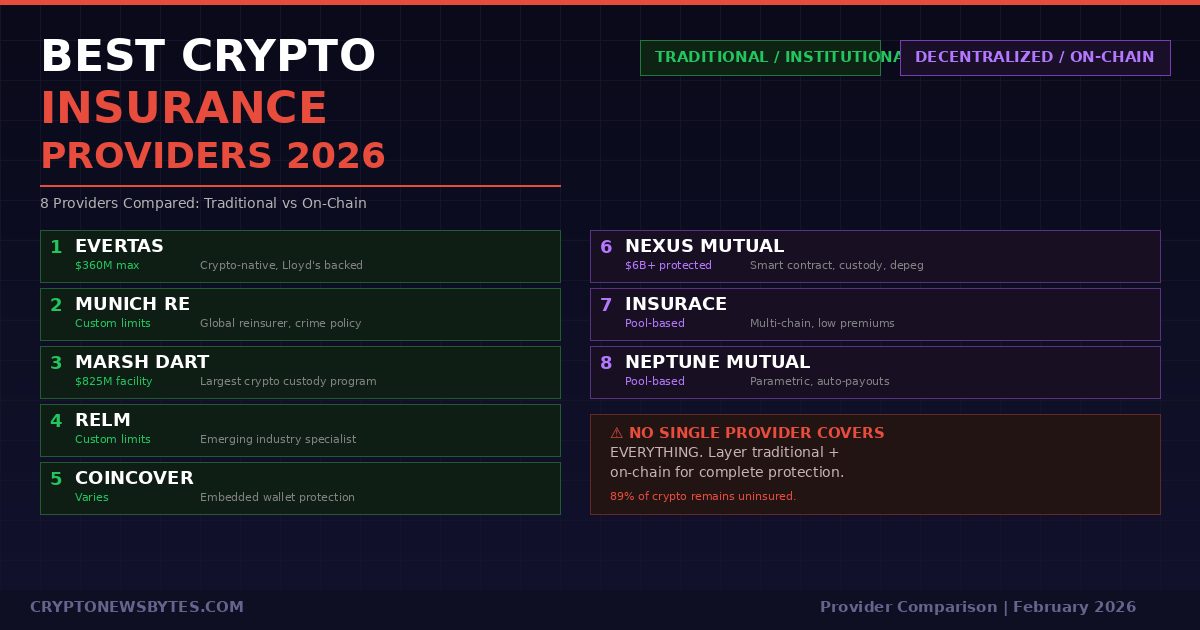
- This guide compares the best crypto insurance providers in 2026 across two categories: traditional/institutional insurers (Evertas, Munich Re, Marsh, Relm, Lloyd’s syndicates) and decentralized on-chain protocols (Nexus Mutual, InsurAce, Neptune Mutual)
- Evertas remains the only insurer built exclusively for crypto, offering up to $360 million in coverage through Lloyd’s-backed policies for custody, D&O, tech E&O, and business interruption
- Munich Re’s Digital Asset Protection suite includes a comprehensive crime policy specifically designed for custodians, exchanges, and DeFi protocols, covering both internal and external threats
- Marsh’s $825 million facility is the largest dedicated crypto custody insurance program in the world, backed by Lloyd’s syndicates and London-based international insurers
- Nexus Mutual leads on-chain insurance with over $6 billion in digital assets protected since 2019, covering smart contract hacks, custody failure, and stablecoin depeg events
- No single provider covers everything. Most crypto companies need a layered program combining traditional cyber/crime insurance with on-chain DeFi cover to eliminate gaps
- The decentralized insurance market is growing at 48.7% CAGR, from $2.36 billion in 2024 to a projected $3.51 billion in 2025
Best Crypto Insurance Providers in 2026: Who Actually Covers What
Finding the best crypto insurance providers in 2026 is harder than it should be. The market has over 80 companies operating across traditional insurance, specialist crypto underwriters, and decentralized on-chain protocols. Each covers different risks, serves different clients, and operates under fundamentally different models.
The biggest mistake crypto companies make when shopping for insurance is treating it as a single product. It is not. As we outlined in our cyber insurance for crypto deep-dive, cyber liability does not cover digital asset theft, and crime insurance does not cover data breaches. You need multiple policies from multiple providers, and choosing the wrong combination leaves dangerous gaps.
This guide evaluates the best crypto insurance providers across both traditional and decentralized categories, based on coverage scope, maximum policy limits, claims track record, and suitability for different types of crypto businesses.
Best Crypto Insurance Providers: Traditional and Institutional
Traditional crypto insurance providers operate through regulated insurance markets, typically backed by Lloyd’s of London syndicates, major reinsurers, or licensed insurance carriers. These providers offer the largest policy limits and the broadest coverage, but with higher premiums, longer placement timelines, and stricter underwriting requirements.
1. Evertas: The Crypto-Native Specialist
| Founded | 2017 (as BlockRe) |
| Headquarters | Chicago, IL |
| Max Coverage | Up to $360 million per policy |
| Backed By | Lloyd’s of London syndicates |
| Coverage Types | Theft/loss, D&O, property (miners/stakers), tech E&O, business continuity, business interruption |
Evertas is the first and only insurance company built exclusively to underwrite crypto and blockchain risk. It partners with your existing broker to place coverage through Lloyd’s syndicates, giving policies the financial backing of the world’s oldest insurance marketplace. Their team specializes in understanding crypto-specific risks that generalist underwriters cannot evaluate, including cold storage procedures, MPC wallet architectures, and DeFi protocol mechanics.
Best for: Institutional custodians, exchanges, mining operations, and any crypto company requiring large policy limits with Lloyd’s-grade backing.
Key differentiator: Evertas covers loss of private keys, which most traditional insurers exclude. They also cover DeFi and NFT-related risks, which remain challenging to insure elsewhere.[Benzinga]
2. Munich Re: Digital Asset Protection Suite
| Type | Global reinsurer (one of the world’s largest) |
| Key Product | Digital Asset Comprehensive Crime Policy |
| Target Clients | Professional custodians, digital asset trading platforms, financial institutions |
| Coverage | Digital asset crime (internal + external threats), liability from customer claims, extended coverage for third-party service provider breaches |
Munich Re brings the financial muscle of the world’s largest reinsurer to crypto insurance. Their Digital Asset Comprehensive Crime Policy is specifically designed to protect digital assets under custody and to cover liability against a wide range of threats, including both internal employee collusion and external hacking. The policy extends coverage to include breaches of external service providers, which is rare in the crypto insurance market.[Munich Re]
Munich Re also partnered with Marsh to create a hybrid cyber/crime policy for wallet technology providers. This combined approach addresses both data security risks and digital asset theft under a single policy, something few other insurers have been able to structure.
Best for: Large custodians and exchanges that need coverage from a globally recognized reinsurer for credibility with institutional clients.
3. Marsh: Digital Asset Risk Transfer (DART)
| Type | World’s largest insurance broker (part of Marsh McLennan) |
| Key Product | $825 million digital asset custody facility |
| EU Product | MiCAssure (tailored for MiCA compliance) |
| Coverage | Cold storage theft, MPC custody risks, physical natural perils, third-party physical theft, internal collusion |
Marsh is not an insurer but rather a broker. It acts as an intermediary that designs and places insurance programs across multiple carriers. Its Digital Asset Risk Transfer (DART) team, based in New York and London, has built the largest dedicated crypto custody insurance facility in the world at $825 million in capacity. This facility is backed by Lloyd’s syndicates and London-based international insurers.[Marsh]
Marsh also launched MiCAssure in 2024, a tailored insurance solution designed specifically for EU crypto-asset service providers navigating the Markets in Crypto-Assets Regulation (MiCA). This positions Marsh as the go-to broker for companies requiring regulatory compliance-linked coverage in Europe.
Best for: Large enterprises and financial institutions entering crypto custody that need a broker to design complex, multi-carrier programs.
4. Relm Insurance: Emerging Industry Specialist
| Type | Licensed insurer specializing in emerging industries |
| Specialization | Digital assets, space economy, AI, cannabis |
| Coverage | Crypto asset insurance, custody insurance, cyber, D&O, professional liability |
Relm positions itself as the leading insurer for emerging and innovative industries, with digital assets as a core focus. Unlike generalist insurers who treat crypto as a high-risk add-on, Relm’s entire business model is built around understanding novel risk categories. They emphasize the growing importance of demonstrating governance, risk management, and licensing as prerequisites for coverage eligibility, particularly as global regulation tightens under MiCA, GENIUS Act, and VARA.[Relm Insurance]
Best for: Mid-market crypto companies, innovative startups, and firms operating in multiple emerging sectors (digital assets plus AI, for example).
5. Coincover: Wallet and Exchange Protection
| Type | Centralized crypto protection provider |
| Focus | Crypto wallets, exchanges, smart contracts |
| Unique Feature | Insured crypto wallet with 100% replacement guarantee; “Protected by Coincover” stamp on partner exchanges |
Coincover takes a different approach from the institutional insurers listed above. Rather than selling policies directly to retail investors, it partners with crypto exchanges and wallet providers to offer embedded insurance protection. If you see the “Protected by Coincover” stamp on your exchange, your funds stored on that platform are insured against security breaches. Coincover also offers private key recovery and an insured crypto wallet where 100% of holdings are replaced in the event of a breach. Their private keys are stored in offline vaults, making online hacking virtually impossible.[Benzinga]
Best for: Exchanges and wallet providers wanting to offer embedded insurance to their users as a competitive differentiator.
Best Crypto Insurance Providers: Decentralized and On-Chain
Decentralized crypto insurance providers operate on blockchain networks using smart contracts, community governance, and pooled capital. They offer faster coverage, lower minimums, and no KYC requirements, but with smaller capital pools, less regulatory protection, and newer track records. The decentralized insurance market is growing rapidly, from $2.36 billion in 2024 to a projected $3.51 billion in 2025, a CAGR of 48.7%.
6. Nexus Mutual: The On-Chain Market Leader
| Blockchain | Ethereum |
| Assets Protected | Over $6 billion since 2019 |
| Claims Paid | Over $17 million |
| Token | NXM (members stake to provide underwriting liquidity) |
| Coverage Types | Protocol cover, ETH slashing cover, custody failure, stablecoin depeg |
Nexus Mutual is the largest and most established decentralized insurance protocol. It uses a mutual model where members pool funds to cover risks. Members stake NXM tokens to provide underwriting capital, and the community votes on claim validity. Over $6 billion in digital assets have been protected since its 2019 launch, with more than $17 million paid in claims.[Nexus Mutual]
What makes Nexus Mutual stand out among the best crypto insurance providers is its proven claims record and growing coverage scope. Beyond smart contract cover, it now offers custody failure protection, ETH staking slashing cover, and stablecoin depeg insurance. The platform has also expanded through partnerships, including one with InShare for alternative risk transfer solutions.
Best for: DeFi users, yield farmers, and protocols wanting on-chain cover for smart contract risks, staking, and custody.
Important note: Smart Contract Cover through Nexus Mutual is not a contract of insurance. Claims are decided by member voting, not by a regulated insurance process. This means less certainty compared to traditional insurance, but faster payouts and no underwriting requirements.
7. InsurAce: Multi-Chain, Low-Premium Coverage
| Blockchain | Multi-chain (Ethereum, BSC, Polygon, Avalanche, more) |
| Model | Decentralized mutual with portfolio-based risk diversification |
| Token | INSUR |
| Coverage | Smart contract vulnerabilities, stablecoin depeg, CEX risk, cross-chain bridge exploits |
InsurAce differentiates itself through multi-chain coverage and aggressively low premiums. The protocol uses portfolio-based risk diversification to optimize coverage costs, and its investment utilities complement cover costs, enabling near-zero premiums under optimal conditions. It covers risks across multiple blockchains, making it one of the more versatile decentralized options among the best crypto insurance providers.
Best for: DeFi users with positions across multiple chains who want broad coverage at the lowest possible cost.
8. Neptune Mutual: Parametric Insurance, No Claims Process
| Blockchain | Ethereum |
| Model | Parametric (automatic payouts based on predefined triggers) |
| Coverage | Smart contract vulnerabilities, exchange failures, protocol exploits |
Neptune Mutual uses a parametric model that eliminates the traditional claims assessment process entirely. When predefined conditions are met (such as a confirmed protocol exploit), payouts are triggered automatically in stablecoins. No personally identifiable information is required, no evidence of loss needs to be submitted, and no community vote determines your claim.
The protocol offers two coverage types: Dedicated Covers (tailor-made for specific project communities) and Diversified Covers (allowing liquidity providers to spread risk across multiple projects). Neptune Mutual also provides an SDK that lets DeFi apps integrate insurance features directly into their interfaces.
Best for: Users who want the fastest possible payouts with zero claims friction, and protocols wanting to embed insurance directly into their product.
Best Crypto Insurance Providers: Comparison Table
| Provider | Type | Max Coverage | Best For | Covers Asset Theft? | KYC Required? |
|---|---|---|---|---|---|
| Evertas | Traditional (Lloyd’s) | $360M | Institutional custodians, exchanges | Yes | Yes |
| Munich Re | Reinsurer | Custom (large) | Large custodians, financial institutions | Yes (crime policy) | Yes |
| Marsh (DART) | Broker | $825M | Enterprise, financial institutions | Yes (custody) | Yes |
| Relm | Licensed insurer | Custom | Mid-market, multi-sector startups | Yes | Yes |
| Coincover | Centralized protection | Varies by partner | Exchanges, wallet providers (B2B) | Yes (wallet-level) | Via partner |
| Nexus Mutual | Decentralized (Ethereum) | Pool-dependent | DeFi users, protocols, validators | Partial (custody cover) | Yes (membership) |
| InsurAce | Decentralized (multi-chain) | Pool-dependent | Multi-chain DeFi users | Partial (CEX cover) | No |
| Neptune Mutual | Decentralized (parametric) | Pool-dependent | Users wanting fastest payouts | Partial (exchange cover) | No |
How to Choose Among the Best Crypto Insurance Providers
Selecting from the best crypto insurance providers depends on four factors: what type of company you are, what risks you face, how much coverage you need, and what your budget allows.
🎯 Provider Selection Guide by Company Type
Centralized Exchange (CEX): Start with Evertas or Munich Re for crime/specie coverage (digital asset theft). Add a cyber liability policy for data breach protection. Use Marsh as your broker if you need coverage above $100 million.
DeFi Protocol: Nexus Mutual or InsurAce for smart contract cover. Consider Neptune Mutual if you want to embed parametric insurance directly into your protocol via their SDK. Supplement with traditional D&O and cyber liability through Relm or a Lloyd’s syndicate.
Crypto Custodian: Marsh’s $825 million facility was purpose-built for you. Layer with Munich Re’s Comprehensive Crime Policy for extended coverage including third-party service provider breaches.
Wallet Provider: Coincover for embedded user protection (gives your users visible “Protected by Coincover” assurance). Add Evertas for institutional-grade coverage of custodied assets.
Crypto Startup (Seed to Series B): Relm for comprehensive coverage from an insurer that understands emerging industries. Supplement with Nexus Mutual for any DeFi protocol interactions. Budget for cyber liability as a baseline. Refer to our complete crypto insurance guide for a step-by-step approach.
Lessons from 2025: Which Best Crypto Insurance Providers Would Have Helped?
Comparing the best crypto insurance providers against real-world incidents reveals critical gaps.
| Incident | What Happened | Provider That Could Have Helped |
|---|---|---|
| Step Finance ($40M stolen) | Device compromise led to treasury drain | Evertas (crime/specie), Munich Re (crime policy) |
| Bybit ($1.5B stolen) | Wallet UI compromise by DPRK Lazarus Group | Marsh facility (custody), but war exclusion risk from nation-state attribution |
| Figure Technology (2.5GB data stolen) | Social engineering via Okta SSO compromise | Any cyber liability insurer (Relm, Lloyd’s syndicate, standard cyber policy) |
| DeFi protocol smart contract exploit | Code vulnerability exploited for user fund loss | Nexus Mutual (protocol cover), InsurAce (multi-chain), Neptune Mutual (parametric) |
Best Crypto Insurance Providers: Frequently Asked Questions
📰 More on CryptoNewsBytes
- Crypto Insurance in 2026: Why the Industry’s Biggest Problem Is Not Hackers, It Is Having No Safety Net
- Crypto in 2026: $16B Market Coming, But 90%+ Still Uninsured
- Cyber Insurance for Crypto Firms: What’s Covered, What’s Not, and How to Lower Your Premiums
- Top 10 Cybersecurity Trends in Crypto & Blockchain 2025
- Figure Technology Data Breach: Hackers Dump 2.5GB Stolen Records
- Step Finance Hack: $40M Stolen, Platform Shuts Down Permanently
Sources: Marsh | Munich Re | Relm Insurance | Nexus Mutual | Benzinga | Tracxn | HeLa | Insurance Thought Leadership
Disclaimer: This article is for informational purposes only and does not constitute insurance, financial, or legal advice. All comparisons and evaluations are performed based on publicly available information at the time of writing. This is not sponsored content. CryptoNewsBytes has no affiliation, partnership, or financial relationship with any of the providers mentioned in this article. Inclusion in this list does not represent an endorsement, and rankings do not imply superiority. Coverage terms, exclusions, and premiums vary by provider and individual risk profile. Consult a licensed insurance broker with crypto-specific expertise for advice tailored to your business.