⚡ Key Highlights
- Parametric insurance for DeFi pays out automatically when predefined on-chain conditions are met, eliminating the traditional claims process entirely. No adjusters, no disputes, no waiting
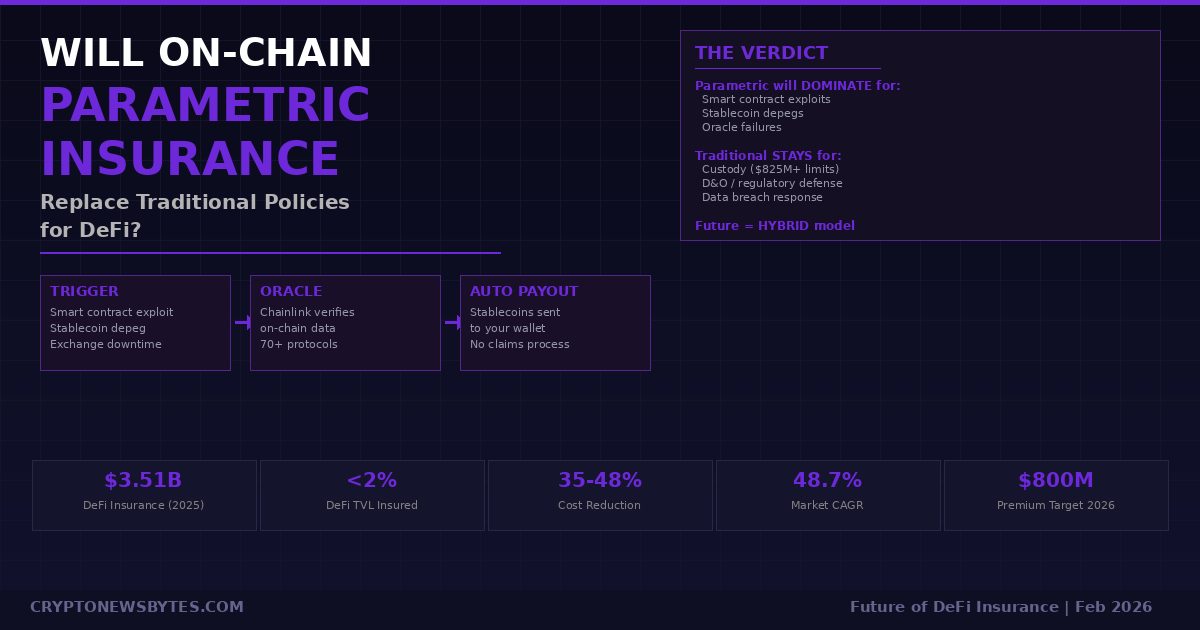
- The decentralized insurance market grew from $2.36 billion to $3.51 billion in 2025 alone, a CAGR of 48.7%. Industry projections suggest $5 to $8 billion in TVL by late 2026
- Less than 2% of total DeFi TVL is currently insured. Analysts project this could reach 8% to 12% penetration by 2027, driven by parametric models that reduce costs by 35% to 48% compared to traditional underwriting
- A peer-reviewed study published in the Journal of Banking & Finance (February 2026) found that DeFi insurance can complement or replace traditional coverage when basis and default risks are moderate
- Major traditional players are entering the space: Aon and Mapfre launched blockchain pilot programs settling claims on-chain, and Chainlink oracles now power over 70 decentralized insurance protocols
- The verdict: parametric insurance for DeFi will not fully replace traditional policies but will become the dominant model for standardized, measurable on-chain risks. Traditional insurance will remain essential for complex, subjective, and regulatory-dependent coverage
Will Parametric Insurance for DeFi Replace Traditional Policies?
Parametric insurance for DeFi represents a fundamentally different approach to protecting digital assets. Instead of filing a claim, proving a loss, and waiting for an adjuster’s decision, parametric policies pay out automatically when specific, verifiable conditions are met on-chain. A smart contract exploit is confirmed, a stablecoin depegs beyond a set threshold, an exchange goes offline: the trigger fires, the payout executes, and funds arrive in your wallet. No paperwork, no disputes, no human judgment required.
This model is growing explosively. The decentralized insurance market hit $3.51 billion in 2025, up 48.7% from $2.36 billion in 2024. Industry projections suggest $5 to $8 billion in total value locked by late 2026, and annual premium volumes could exceed $800 million, up from roughly $60 million today. Yet less than 2% of total DeFi TVL is currently insured, meaning the opportunity is massive and the current market barely scratches the surface.[CoinLaw]
The question is no longer whether parametric insurance for DeFi has a future. It clearly does. The real question is whether it can replace traditional insurance entirely, or whether the two models will coexist. This article examines the evidence.
How Parametric Insurance for DeFi Actually Works
Traditional insurance follows an indemnity model: you suffer a loss, file a claim, an adjuster evaluates the damage, and (if approved) you receive compensation for the actual loss. This process takes weeks or months, involves disputes, and requires trust in the insurer.
Parametric insurance for DeFi inverts this entire process. Here is how it works step by step:
Parametric Insurance for DeFi vs Traditional Insurance: Head-to-Head
| Factor | Parametric / On-Chain | Traditional Insurance |
|---|---|---|
| Claims process | Automatic (minutes) | Manual (weeks to months) |
| Transparency | Fully on-chain, auditable | Opaque policy language |
| Setup costs | 35-48% lower | Higher (underwriting, brokers) |
| Coverage limits | Pool-dependent (smaller) | Up to $825M (Marsh) |
| Basis risk | Yes (payout may not match actual loss) | No (indemnity matches loss) |
| Regulatory standing | Unregulated / gray area | Licensed, legally enforceable |
| Complex claims | Cannot handle subjective cases | Expert judgment available |
| D&O, regulatory | Not available | Available |
| KYC required | Often no | Always yes |
What Parametric Insurance for DeFi Does Well
The strengths of parametric insurance for DeFi align perfectly with certain categories of crypto risk:
Smart contract exploits. These are binary events (either the contract was exploited or it was not) that can be verified on-chain. Parametric triggers work perfectly here. Protocols like Nexus Mutual, Neptune Mutual, and InsurAce already cover this risk effectively.
Stablecoin depegs. A stablecoin dropping below a threshold is a measurable, objective event. Parametric policies can trigger automatically when price feeds (via Chainlink oracles) confirm the depeg, providing instant liquidity when users need it most.
Exchange downtime. Measurable through on-chain monitoring. If an exchange halts withdrawals beyond a specified duration, the parametric trigger fires.
Oracle failures. Oracle deviation beyond tolerance can be detected and verified on-chain, making it an ideal parametric trigger for protocols that depend on price feeds.
Micro-duration coverage. Blockchain smart contracts make it economically viable to offer coverage for periods as short as minutes or hours, something traditional insurance cannot do profitably. This enables use cases like per-ride insurance for ride-sharing, per-trade coverage for high-value transactions, and per-session DeFi yield farming protection.
Where Parametric Insurance for DeFi Falls Short
Despite its advantages, parametric insurance for DeFi has fundamental limitations that prevent it from fully replacing traditional insurance:
⚠️ Five Structural Limitations of Parametric DeFi Insurance
1. Basis risk. This is the most significant limitation. Parametric policies pay a fixed amount when a trigger fires, regardless of your actual loss. If a smart contract exploit causes you $5 million in losses but your parametric policy only pays $1 million, you absorb the $4 million gap. Traditional indemnity insurance pays your actual verified loss. A peer-reviewed study in the Journal of Banking & Finance (February 2026) confirmed that DeFi insurance works best when basis risk is moderate, but acknowledged it as a persistent structural challenge.[ScienceDirect]
2. Capital pool limitations. On-chain insurance pools are orders of magnitude smaller than traditional insurance capacity. Nexus Mutual has paid out over $17 million in claims. Marsh’s crypto custody facility offers $825 million. The Bybit hack alone was $1.4 billion. Decentralized pools cannot absorb catastrophic losses at the scale the industry now faces.
3. Regulatory void. Parametric DeFi insurance protocols operate outside regulated insurance frameworks. Smart Contract Cover from Nexus Mutual is explicitly “not a contract of insurance.” This means no regulatory backstop, no policyholder protection, and no legal recourse if the protocol fails or governance votes against your claim. Most jurisdictions require licensed entities with physical offices for insurance operations.
4. Cannot cover subjective or off-chain risks. D&O liability, regulatory defense costs, privacy lawsuits from data breaches, employment practices claims: these require human judgment, legal expertise, and regulated claims processes. Parametric triggers cannot evaluate whether a regulatory investigation has merit or whether a director breached fiduciary duty.
5. Limited actuarial history. As CoinDesk noted, quantitative risk modeling in DeFi remains in its formative stages. With only a handful of years of data and enormous differences across protocols, accurately pricing parametric coverage is difficult. Past exploits provide forensic insights but limited predictive power for new vulnerabilities.[CoinDesk]
The Hybrid Future: Parametric Insurance for DeFi Plus Traditional Coverage
The evidence points clearly toward a hybrid model, not a replacement. Here is how the market is likely to evolve:
🔮 The Emerging Market Structure
Parametric / on-chain will dominate for: Smart contract exploits, stablecoin depegs, oracle failures, exchange downtime, validator slashing, and any risk with clear, measurable, on-chain triggers. These will become embedded directly into DeFi protocols (buy insurance when you deposit, automatically covered while you farm).
Traditional insurance will remain essential for: Large-scale custody (hundreds of millions), D&O and executive liability, regulatory defense and compliance, data breach response and privacy lawsuits, crime/specie coverage for institutional custodians, and any risk requiring legal expertise or subjective judgment.
The convergence layer: Traditional insurers like Aon, Mapfre, and Munich Re are experimenting with on-chain settlement for claims under $1 million. Parametric protocols are seeking regulatory compliance. The long-term trajectory points toward hybrid products that combine on-chain automation with institutional backing. This is where the best crypto insurance providers are heading.
What This Means for Crypto Founders and DeFi Protocols
If you are building or running a crypto company, here is how to think about parametric insurance for DeFi within your broader risk management strategy:
For DeFi protocols: Embed parametric coverage into your product. Neptune Mutual offers an SDK that lets you integrate insurance directly into your interface. Users can buy cover when they deposit and be covered automatically while they interact with your protocol. This builds trust and differentiates you from competitors.
For exchanges and custodians: Parametric coverage is a supplement, not a replacement. Your primary coverage should be traditional crime/specie insurance through providers like Evertas, Munich Re, or Marsh. Layer parametric coverage on top for specific operational risks like oracle failures or DeFi interactions.
For individual DeFi users: Parametric protocols are your most accessible option. No KYC, coverage in minutes, and automatic payouts. Use Nexus Mutual for protocol and custody cover, InsurAce for multi-chain DeFi positions, and Neptune Mutual when you want the fastest possible payout with zero claims friction.
For institutional investors: Demand both. Require that any protocol or custodian you allocate to carries traditional insurance for custody and liability, plus parametric coverage for smart contract and operational risks. This layered approach, explained in our comprehensive crypto insurance guide, provides the most complete protection available.
Parametric Insurance for DeFi: Frequently Asked Questions
📰 More on CryptoNewsBytes
- Crypto Insurance in 2026: Why the Industry’s Biggest Problem Is Not Hackers, It Is Having No Safety Net
- Crypto in 2026: $16B Market Coming, But 90%+ Still Uninsured
- Cyber Insurance for Crypto Firms: What’s Covered, What’s Not, and How to Lower Your Premiums
- Best Crypto Insurance Providers in 2026: Evertas, Nexus Mutual, Marsh and More Compared
- $2.72B Stolen in 2025 Hacks: The Crypto Insurance Lessons Every Founder Needs
- Top 10 Cybersecurity Trends in Crypto & Blockchain 2025
Sources: CoinLaw | Journal of Banking & Finance | Chainlink | CoinDesk | Hedera | HeLa | Allied Market Research
Disclaimer: This article is for informational purposes only and does not constitute insurance, financial, or legal advice. All analysis is based on publicly available information at the time of writing. This is not sponsored content. CryptoNewsBytes has no affiliation, partnership, or financial relationship with any protocol or provider mentioned. Consult a licensed insurance broker or DeFi risk specialist for advice tailored to your needs.