⚡ Key Highlights
- Every major market now requires a crypto license to operate legally. The era of unregistered crypto businesses is over. Operating without a license means fines, bank account freezes, and criminal liability in most jurisdictions
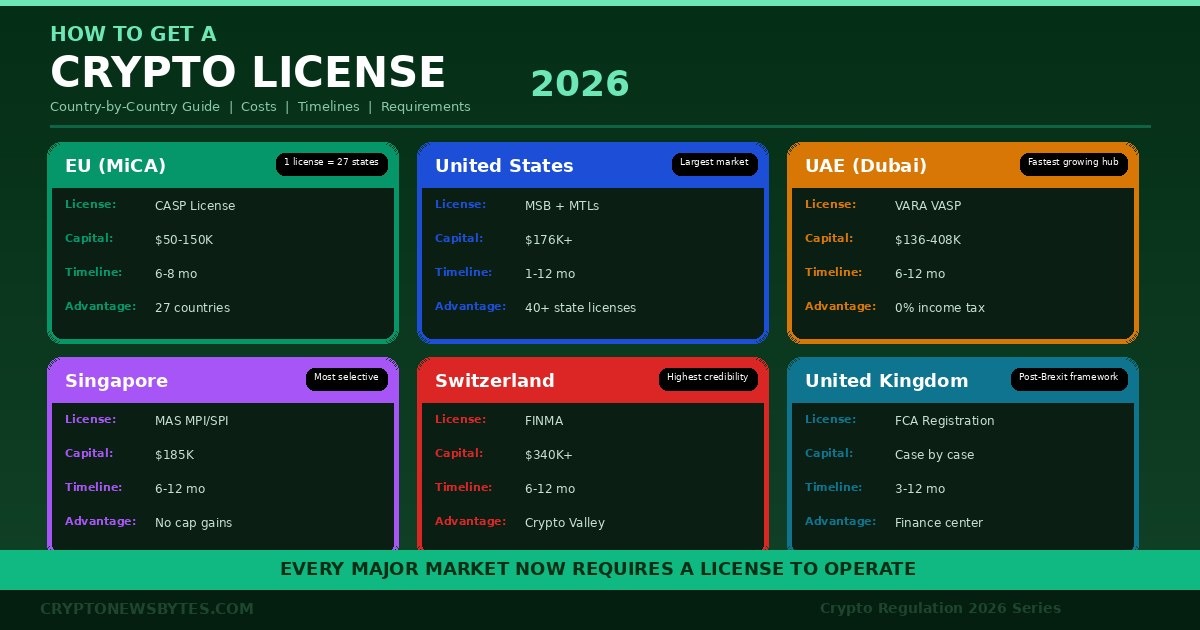
- The EU (MiCA CASP license) offers the best passporting: one license covers 27 countries and 450M customers. Cost: $50K-$150K capital + $200K-$500K+ in compliance setup. Timeline: 6-8 months
- The United States requires FinCEN MSB registration + state Money Transmitter Licenses (up to 40+ states). Total cost: $176K+ plus $137K/year. For stablecoin issuers, the GENIUS Act adds OCC charter requirements
- UAE (Dubai VARA) is the fastest-growing crypto hub. Two-stage licensing (ATI then VASP). Capital: AED 500K-1.5M ($136K-$408K). 0% personal income tax. Timeline: 6-12 months
- Singapore (MAS) under the Payment Services Act is the most efficient process: 6-12 months, no capital gains tax, clear rules. But approval rates are extremely selective
- Switzerland (FINMA) is “Crypto Valley” with 900+ blockchain companies in Zug. High credibility but complex licensing for exchanges. No capital gains tax for individual holders
- The cheapest entry points are Lithuania, Poland, and Czech Republic (from ~$8,000 in fees), but MiCA CASP requirements now apply with higher capital thresholds of $50K-$150K
How to Get a Crypto License: Why It Matters in 2026
If you are launching a crypto exchange, custody service, wallet, or token project in 2026, the first question is no longer “should I get a crypto license?” It is “which jurisdiction gives me the best combination of market access, cost, speed, and credibility?” Operating without a license is no longer a viable strategy. Every major market now has mandatory licensing, and enforcement is real: the EU has issued over 540 million euros in MiCA-related fines, and more than 50 firms have had licenses revoked.
This guide covers the practical steps, costs, timelines, and requirements for obtaining a crypto license in the jurisdictions that matter most: the EU under MiCA, the United States under the GENIUS Act and emerging CLARITY Act, the UAE, Singapore, Switzerland, and the UK.
The Master Comparison: Crypto License Requirements by Country
| Jurisdiction | License Type | Regulator | Capital Required | Timeline | Crypto Tax | Key Advantage |
|---|---|---|---|---|---|---|
| EU (MiCA) | CASP | National Competent Authority + ESMA | $50K-$150K | 6-8 months | Varies by country | Passporting: 27 countries |
| United States | MSB + MTL (per state) | FinCEN + State regulators | Varies by state (surety bonds $10K-$500K) | 1-12 months per state | Capital gains (up to 37%) | Largest market by volume |
| UAE (Dubai) | VARA VASP | VARA (Dubai) / FSRA (Abu Dhabi) | AED 500K-1.5M ($136K-$408K) | 6-12 months | 0% personal income tax | Tax-free + strategic location |
| Singapore | MPI / SPI License | Monetary Authority of Singapore (MAS) | SGD 250K ($185K) for MPI | 6-12 months | No capital gains tax | Clear rules, innovation-friendly |
| Switzerland | FINMA License | FINMA | CHF 300K+ ($340K+) for exchanges | 6-12 months | No capital gains (individuals) | Crypto Valley credibility |
| United Kingdom | FCA Registration | Financial Conduct Authority | No fixed minimum (assessed case by case) | 3-12 months | Capital gains (10-20%) | Financial center credibility |
| Hong Kong | SFC VATP + HKMA Stablecoin | SFC / HKMA | HKD 5M ($640K) | 6-12 months | No capital gains tax | Asia gateway + no crypto tax |
| Lithuania / Poland / Czech Republic | MiCA CASP | National regulators | $50K-$150K (MiCA minimum) | 6-8 months | 15% (LT), 19% (PL/CZ) | Low cost EU entry + passporting |
How to Get a Crypto License in the EU (MiCA CASP)
The EU is now the world’s most structured crypto licensing environment. Under MiCA, every company offering crypto services to EU residents needs a CASP (Crypto-Asset Service Provider) license. The hard deadline is July 1, 2026, after which unlicensed operators face fines up to 12.5% of annual turnover or forced shutdown.
Step-by-step process: Choose your home member state (Lithuania and Malta are cost-competitive first movers; Germany and France offer credibility). Incorporate a legal entity in that country with at least one EU-resident director and a physical office. Prepare a comprehensive application including a business plan, AML/KYC policies, cybersecurity framework, governance structure, and proof of capital. Submit to the National Competent Authority. Expect 6-8 months for review. Once approved, your CASP license passports across all 27 EU states plus the EEA, giving you access to 450 million customers without additional licensing.
Capital requirements by service: $50,000 for crypto transfer services, $125,000 for exchange or custody, and $150,000 for trading platform operators. Stablecoin issuers face additional requirements: EMTs require an e-money institution license, and ARTs need specific authorization with mandatory reserve audits. Token issuers must also publish a crypto-asset whitepaper meeting MiCA’s disclosure standards before offering any token to EU residents.
✅ EU Best Jurisdiction Picks for 2026
Lithuania: Cost-competitive, fast processing, established crypto community. Bank of Lithuania supervises CASPs. Corporate tax 15%.
Malta: “Blockchain Island” reputation. Malta Financial Services Authority. Strong DLT framework alongside MiCA.
Netherlands: First mover in MiCA implementation. DNB supervision. Strong banking relationships. Higher operating costs.
Germany: Maximum credibility. BaFin supervision. Largest EU economy. No capital gains tax for individuals holding crypto over 1 year.
How to Get a Crypto License in the United States
The U.S. licensing landscape is the most complex in the world. There is no single federal crypto license. Instead, you need multiple overlapping registrations depending on your service type.
For exchanges and brokers: Register with FinCEN as a Money Services Business (MSB), which takes 1-2 months. Then obtain Money Transmitter Licenses (MTL) in each state where you operate. Most states require separate applications, with timelines of 4-12 months per state. Coinbase and Gemini each hold licenses in 40+ states. New York’s BitLicense is the most demanding, with extensive compliance requirements and costs often exceeding $100,000 for the application alone. California’s new DFAL (Digital Financial Assets Law) adds another layer effective July 1, 2026.
For stablecoin issuers: The GENIUS Act creates a federal framework with OCC charter, bank subsidiary, or state license pathways. Minimum capital: $5M for de novo federal issuers. For the SEC vs CFTC jurisdiction split on exchanges and token classification, the CLARITY Act (pending Senate) will clarify registration requirements.
Total estimated cost: $176,000+ initial setup plus $137,000+ annually for a multi-state licensed operation. This is the highest cost entry point of any major market, but gives access to the world’s largest crypto trading volume.
⚠️ US Licensing Warning
Operating a crypto exchange in the U.S. without proper state licenses is a federal crime under money transmission laws. FinCEN MSB registration alone is not sufficient. Each state has separate requirements. The cost and complexity is why many startups choose to launch in the EU or Singapore first, then expand to the U.S. with revenue to fund multi-state licensing.
How to Get a Crypto License in the UAE (Dubai)
The UAE has emerged as the world’s fastest-growing crypto hub, with Dubai’s VARA (Virtual Assets Regulatory Authority) offering a modern regulatory framework that attracts major global operators. Binance, Bybit, and OKX all hold UAE licenses.
VARA licensing process (2026): Stage 1 is Approval to Incorporate (ATI), where you submit your business plan, governance structure, and compliance framework. Stage 2 is the full VASP License (FMP), which requires operational readiness, cybersecurity audits, and demonstrated capital adequacy. The preliminary MVP license stage is no longer the standard entry for new firms.
Capital requirements: AED 500,000 ($136K) for payment and transfer services, up to AED 1,500,000 ($408K) for exchange or custody activities. Companies providing multiple service types must hold capital for each. Net liquid assets must equal at least 1.2x monthly operating expenses.
Key advantages: 0% personal income tax, 0% capital gains tax, strategic timezone between Asia and Europe, and a rapidly growing customer base. Abu Dhabi’s ADGM and FSRA offer an alternative regulatory zone with its own framework.
Singapore: MAS Payment Services Act Licensing
Singapore’s Monetary Authority (MAS) provides one of the clearest and most respected crypto licensing frameworks through the Payment Services Act. The process is efficient (6-12 months) and the regulatory environment is innovation-friendly. No capital gains tax on crypto transactions.
License types: Standard Payment Institution (SPI) for smaller operators, Major Payment Institution (MPI) for larger operations with higher transaction volumes. MPI requires SGD 250,000 ($185K) in base capital. MAS expanded regulated services in 2024 to include custody and cross-border transfers.
Important caveat: MAS is extremely selective. Approval rates are significantly lower than in the EU or UAE. The quality and detail of your application, particularly around AML infrastructure and risk management, determines success. Engaging local compliance advisors is essentially mandatory.
Switzerland: FINMA and Crypto Valley
Switzerland (“Crypto Valley”) offers the highest credibility of any crypto jurisdiction, with 900+ blockchain companies concentrated in the canton of Zug. FINMA (Swiss Financial Market Supervisory Authority) provides clear guidance across multiple license categories.
For exchanges: A securities dealer or fintech license from FINMA is typically required, with capital requirements of CHF 300,000+ ($340K+). For simpler custody or wallet services, a fintech license allows accepting public deposits up to CHF 100 million with lower requirements.
Tax advantages: Individuals pay no capital gains tax on crypto held as personal assets. Corporate tax rates are 12-21% depending on canton. Zug offers particularly favorable conditions.
Choosing the Right Jurisdiction: Decision Framework
| Your Priority | Best Jurisdiction | Why |
|---|---|---|
| Maximum market access | EU (MiCA) | 1 license = 27 countries + 450M customers |
| Lowest tax burden | UAE (Dubai VARA) | 0% personal income + 0% capital gains |
| Highest trading volume | United States | World’s largest market despite highest compliance cost |
| Maximum credibility | Switzerland | FINMA reputation + Crypto Valley ecosystem |
| Lowest cost entry to EU | Lithuania | Competitive fees + MiCA passporting + 15% corporate tax |
| Asia-Pacific access | Singapore or Hong Kong | MAS clarity (SG) or SFC credibility (HK), both tax-friendly |
| Stablecoin issuance | US (GENIUS Act) + EU (MiCA) | Only two jurisdictions with comprehensive stablecoin frameworks. Dual compliance required for global reach |
The Universal Crypto License Checklist
Regardless of jurisdiction, every crypto license application requires these elements:
✅ What Every Regulator Wants to See
1. Legal entity incorporated in the jurisdiction with local directors and physical office (EU, UAE, Singapore all require this).
2. Detailed business plan covering operational model, revenue projections, fee structures, and market analysis.
3. AML/KYC program with transaction monitoring, suspicious activity reporting, sanctions screening, and a designated compliance officer (often required to be a local resident).
4. Cybersecurity framework including penetration testing, incident response plans, and data protection compliance (GDPR in the EU).
5. Capital adequacy meeting the jurisdiction’s minimum requirements, held in liquid assets.
6. Governance structure with fit-and-proper tested directors, segregation of client assets from company funds, and business continuity plans.
7. Client asset segregation policy demonstrating how customer funds and crypto assets are protected in the event of insolvency. This is increasingly important for crypto insurance eligibility as well.
Compliance Requirements That Apply Everywhere in 2026
Beyond getting the license, crypto companies face a growing set of compliance obligations that are now standard across all major jurisdictions:
Travel Rule compliance is now mandatory in the EU (under MiCA’s Funds Transfer Regulation), the US (Bank Secrecy Act), Singapore, and the UAE. Every crypto transfer above a threshold must include sender and receiver identity information. Companies need automated Travel Rule solutions (like Notabene, Chainalysis, or Sygna) integrated into their transaction processing.
Proof-of-reserves expectations are rising. After the FTX collapse, regulators in every jurisdiction expect exchanges and custodians to demonstrate reserve adequacy through regular third-party audits. MiCA requires ongoing reserve disclosure for stablecoin issuers; the GENIUS Act mandates monthly public attestations and weekly confidential reporting.
Cybersecurity audits are required in the EU (under DORA, the Digital Operational Resilience Act), the UAE (VARA mandates penetration testing), and increasingly expected by Singapore MAS and UK FCA. Annual penetration testing, incident response plans, and vulnerability assessments are baseline requirements.
Consumer disclosure rules are tightening. MiCA requires crypto-asset whitepapers for token issuers and clear risk disclosures for all services. The US is moving toward standardized disclosures through SEC rulemaking. All jurisdictions require transparent fee structures and clear warnings that crypto assets are not guaranteed.
Custody standards now mandate client asset segregation in the EU (MiCA Article 70), the UK (FCA rules), and increasingly in the UAE and Singapore. Client crypto must be held separately from company assets and be recoverable in the event of insolvency.
Banking and Operational Setup: The Hardest Part
For many crypto startups, obtaining the license is actually easier than the operational setup. Here are the practical challenges founders face:
Opening a compliant bank account remains the single biggest obstacle. Traditional banks remain cautious about crypto clients despite regulatory progress. Switzerland (Sygnum, SEBA), Germany (Solaris, N26 Business), and the UAE (Mashreq, RAK Bank) are among the more crypto-friendly banking markets. In the US, the OCC’s recent actions have improved bank access for licensed crypto companies, but many banks still require extensive due diligence. Budget 2-4 months for banking setup alone.
Fiat on/off-ramp partnerships require your own license or integration with licensed payment processors. Companies like MoonPay, Transak, and Wyre provide white-label solutions, but you still need to ensure your license covers the jurisdictions you serve.
Custody provider selection is critical for both compliance and insurance eligibility. Institutional-grade custodians (Fireblocks, BitGo, Anchorage, Copper) offer the security infrastructure regulators expect. Self-custody solutions require additional licensing scrutiny in most jurisdictions.
Corporate structuring for multi-jurisdiction operations typically involves a holding company in a favorable jurisdiction (BVI, Cayman, or Delaware) with operating subsidiaries in each licensed market. Legal structuring costs run $20,000-$100,000+ depending on complexity.
Common Reasons Crypto License Applications Get Rejected
Understanding why applications fail helps you avoid the same mistakes:
| Rejection Reason | What Regulators Found | How to Avoid It |
|---|---|---|
| Weak AML/KYC framework | Generic template policies without real transaction monitoring infrastructure | Invest in purpose-built AML software and hire a dedicated compliance officer |
| Insufficient capital | Capital not held in liquid form, or below minimum thresholds at time of review | Secure capital well before application. Keep it in approved liquid assets |
| No qualified compliance officer | No local resident with AML/compliance credentials on team | Hire or contract a local compliance officer before applying |
| Poor governance structure | Directors failed fit-and-proper tests, or no clear segregation of duties | Vet all directors for criminal/financial history. Document clear roles |
| Unclear token classification | Application did not clearly classify tokens as securities, commodities, or utility | Get legal opinion on token classification before applying. See SEC vs CFTC guide |
| Incomplete documentation | Missing whitepaper, business plan gaps, or untranslated documents | Use the universal checklist above. Engage local legal counsel for review |
2026 Trends Reshaping Crypto Licensing
The licensing landscape is not static. Several trends are changing what it takes to operate in 2026 and beyond:
Tokenized securities regulation is expanding rapidly. As traditional assets (stocks, bonds, real estate) move onto blockchain, crypto companies that handle tokenized securities need additional licensing under securities law (MiFID II in the EU, SEC registration in the US). This creates new licensing requirements beyond basic crypto exchange authorization.
Stablecoin oversight is tightening globally. The GENIUS Act in the US and MiCA in the EU now require dedicated stablecoin licensing separate from exchange or custody licenses. Singapore MAS has introduced its own stablecoin framework. Issuers need specific licenses in each market.
RegTech and AI compliance monitoring are becoming competitive advantages. Regulators increasingly expect automated transaction monitoring, AI-driven suspicious activity detection, and real-time reporting. Companies using solutions like Chainalysis, Elliptic, or TRM Labs are getting licensed faster because they can demonstrate sophisticated compliance infrastructure out of the gate.
On-chain compliance tools are emerging as a new layer. Zero-knowledge proof identity systems, on-chain KYC attestations, and smart contract-based compliance are being explored by regulators in Singapore, the UAE, and through EU innovation sandboxes. Early adoption of these tools may provide licensing advantages in forward-looking jurisdictions.
Cross-border passporting remains the EU’s biggest competitive advantage through MiCA. No other jurisdiction offers equivalent single-license market access. However, the GENIUS Act’s reciprocity provisions and potential future mutual recognition agreements could begin to bridge the US-EU gap in coming years.
Frequently Asked Questions
📰 Crypto Regulation 2026 Series
- The GENIUS Act Explained: What Every Crypto Company Needs to Know in 2026
- MiCA Regulation 2026: The Complete Compliance Guide for Crypto Companies
- GENIUS Act vs MiCA: The Complete Comparison for Crypto Companies
- SEC vs CFTC: Who Regulates What in Crypto After the CLARITY Act
- You are here: How to Get a Crypto License in 2026: Country-by-Country Guide
- Coming next: Crypto Tax Reporting 2026: CARF, DAC8, and Global Compliance Guide
🔒 Security & Insurance Series
Sources: InnReg | Gofaizen & Sherle | Lawrange | SB-SB | LegalBison | Gofaizen & Sherle (Jurisdictions) | Stalirov & Co | Legal Nodes
Disclaimer: This article is for informational purposes only and does not constitute legal, financial, or regulatory advice. Licensing requirements, costs, and timelines change frequently. All figures are estimates based on publicly available information as of March 2026. Consult qualified legal counsel in the relevant jurisdiction before applying for any license.