
⚡ Key Highlights
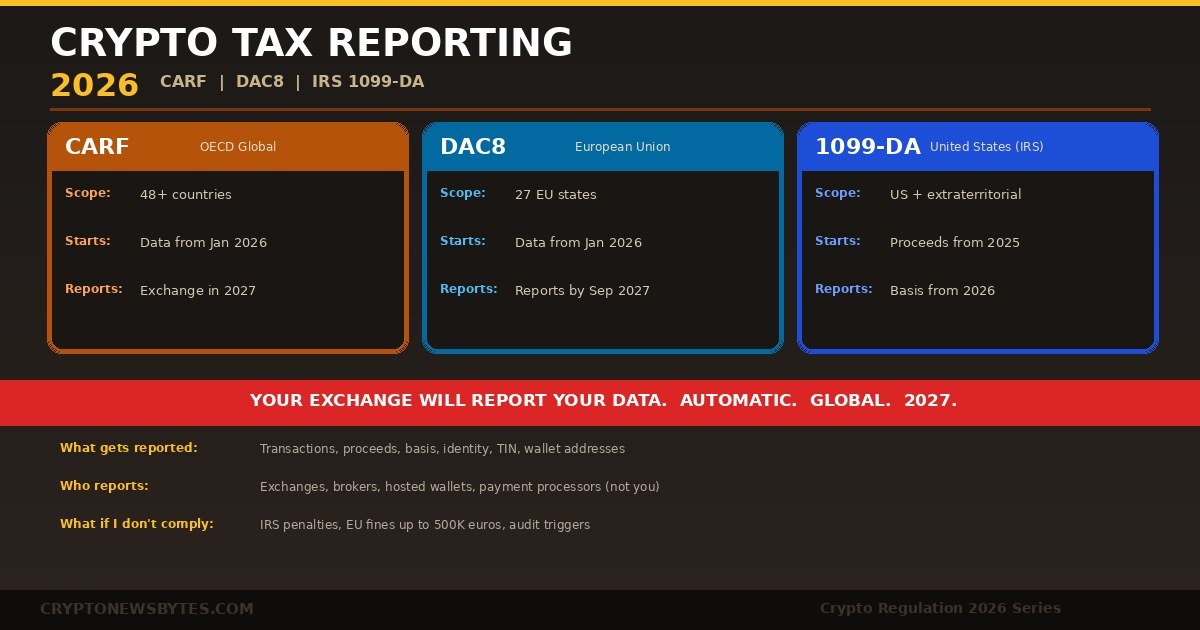
- Starting January 1, 2026, crypto tax reporting becomes automatic and global. Your exchange will report your transactions to tax authorities without you lifting a finger. The “Wild West” era of unreported crypto is over
- Three frameworks are converging: the OECD’s CARF (48+ countries collecting data from Jan 2026, exchanging from 2027), the EU’s DAC8 (all 27 EU states, data collection from Jan 2026, first reports by Sep 2027), and the US IRS Form 1099-DA (gross proceeds reported since 2025, cost basis mandatory from 2026)
- Who reports? Not you. Your exchange, broker, wallet provider, or any entity facilitating crypto transactions. They must collect your tax ID, residency, and report every transaction to their domestic tax authority
- What gets reported? Transaction type, gross proceeds, cost basis (from 2026), dates, quantities, wallet addresses (for transfers), and your personal identification including tax ID numbers
- DAC8 goes further than CARF: it includes penalties of $20,000-$500,000 for non-compliant providers and can restrict customer activity until proper reporting is in place
- The US does NOT participate in CARF/CRS but has its own regime through Form 1099-DA. However, the IRS has signaled it may join CARF for international exchange of crypto data
- If you have unreported crypto gains from prior years, the window to self-correct is closing. Once automatic exchange begins in 2027, tax authorities will cross-reference your filings with exchange data
Crypto Tax Reporting in 2026: Why Everything Changes Now
If you hold, trade, or earn crypto anywhere in the world, 2026 is the year your crypto tax reporting obligations fundamentally change. Three converging frameworks, the OECD’s Crypto-Asset Reporting Framework (CARF), the EU’s DAC8 directive, and the US IRS Form 1099-DA, are creating a global automatic reporting system that will make crypto tax evasion nearly impossible.
Starting January 1, 2026, crypto exchanges and service providers in 48+ countries began collecting user tax data under CARF. In the EU, DAC8 adds enforcement teeth with penalties up to 500,000 euros. In the US, brokers must now report cost basis alongside gross proceeds on the new Form 1099-DA. By 2027, tax authorities worldwide will begin exchanging this data with each other automatically. This article explains what each framework requires, who it applies to, and what you need to do to stay compliant.[European Commission]
The Three Frameworks: CARF, DAC8, and IRS 1099-DA Compared
| Feature | CARF (OECD Global) | DAC8 (EU) | IRS 1099-DA (US) |
|---|---|---|---|
| Scope | 48+ countries globally | 27 EU member states | United States (+ extraterritorial reach) |
| Data collection starts | January 1, 2026 | January 1, 2026 | January 1, 2025 (gross proceeds); Jan 2026 (basis) |
| First reporting/exchange | 2027 (exchange between tax authorities) | By September 30, 2027 | Early 2026 (for 2025 transactions) |
| Who reports | Reporting Crypto-Asset Service Providers (RCASPs) | RCASPs (same as CARF + additional EU requirements) | Brokers: exchanges, hosted wallets, kiosks, payment processors |
| What gets reported | Transaction type, gross proceeds, quantity, user identity, tax residency, TIN | Same as CARF + transfer data + wallet addresses | Proceeds, cost basis (from 2026), dates, asset type, quantity, holding period |
| Penalties | Set by each jurisdiction | 20,000-500,000 euros + activity restrictions | IRS penalties under sections 6721/6722 + backup withholding |
| DeFi coverage | Only intermediaries, not fully decentralized protocols | Potentially some DeFi platforms that facilitate transactions | Custodial brokers only (DeFi deferred pending further guidance) |
| International data sharing | Yes, automatic exchange between participating countries | Yes, between all EU states + CARF participants | Not yet (US may join CARF; currently uses FATCA model) |
CARF: The Global Standard for Crypto Tax Reporting
The Crypto-Asset Reporting Framework is the OECD’s answer to crypto tax evasion. Endorsed by the G20 and now committed to by 48+ jurisdictions, CARF creates a standardized system where crypto service providers report user transaction data to local tax authorities, who then automatically share that data with other countries.[OECD]
Who must report: Any individual or entity that as a business provides services to facilitate crypto-asset transactions. This covers exchanges, brokers, dealers, certain wallet providers, and any intermediary involved in buying, selling, or exchanging crypto. Fully decentralized protocols without an identifiable intermediary are excluded.
What gets reported: User identity (name, address, date of birth, nationality), tax identification number, tax residency jurisdiction, and for each transaction: the type (exchange for fiat, exchange for other crypto, transfer), gross proceeds, and quantity of crypto assets involved.
Timeline: Domestic legislative frameworks took effect from January 1, 2026 in most committed jurisdictions. Providers are collecting data now. First automatic exchange between tax authorities is targeted for 2027. Some jurisdictions (Switzerland, Cayman Islands) have already passed legislation. Others have pushed to 2028 or 2029.
DAC8: The EU’s Implementation of Crypto Tax Reporting
DAC8 is the EU’s version of CARF, but with additional enforcement provisions that make it more aggressive. Adopted by the Council of the EU in October 2023, DAC8 amends the existing Directive on Administrative Cooperation to include crypto-asset transactions. It applies to all 27 EU member states and is closely aligned with MiCA’s licensing requirements.[RSM]
Key differences from CARF: DAC8 includes penalties of 20,000 to 500,000 euros for non-compliant providers, something CARF leaves to individual jurisdictions. DAC8 also includes provisions to restrict customer activity at non-compliant providers, creating direct operational consequences. Additionally, DAC8 extends reporting to include transfer data and wallet addresses, going beyond CARF’s base requirements.
Timeline for EU companies: Data collection began January 1, 2026. First reports to domestic tax authorities are due within 9 months after the end of the first fiscal year, meaning by September 30, 2027 at the latest. Companies already licensed under MiCA as CASPs should already have much of the required KYC infrastructure in place, but DAC8 adds specific tax reporting obligations on top.
Important for non-EU platforms: DAC8 applies to any platform licensed in an EU member state, regardless of where the platform is headquartered. If Binance holds a license in Malta or Lithuania, it must report EU user data under DAC8 even though the company is based outside the EU.
IRS Form 1099-DA: US Crypto Tax Reporting
The United States takes a different path. Rather than joining the OECD’s CRS/CARF framework, the US created its own domestic reporting regime through Form 1099-DA, mandated by the 2021 Infrastructure Investment and Jobs Act.[IRS]
Phased implementation: For 2025 transactions (forms issued early 2026), brokers report gross proceeds only. For 2026 transactions onward, brokers must report both gross proceeds and cost basis for “covered securities” (digital assets acquired on or after January 1, 2026). Assets acquired before that date are “noncovered” and basis reporting is voluntary.
Who must file 1099-DA: Custodial digital asset trading platforms, hosted wallet providers, digital asset kiosks, and certain processors of digital asset payments. Notably, DeFi platforms and non-custodial services are deferred pending further IRS guidance.
The cost basis gap: This is the biggest practical problem. Brokers can only report basis for assets they have complete custody records on from acquisition to disposition. As soon as you transfer crypto between wallets, between exchanges, or engage in any on-chain activity outside the broker’s visibility, basis tracking breaks. Assets acquired before January 1, 2026 are grandfathered as noncovered. This means for many taxpayers, 1099-DA provides only a partial picture. Self-maintained records remain critical.
Transition relief: The IRS has provided penalty relief for good-faith efforts in 2025 reporting and extended backup withholding relief through 2026-2027. But this relief is temporary. Full enforcement is coming.
⚠️ US Taxpayer Warning
Even if your broker does not report cost basis (Box 1g blank on 1099-DA), you are still required to report all crypto transactions accurately on Form 8949 and Schedule D. The IRS may assume zero basis if none is reported, resulting in tax notices for the full proceeds amount. Maintain your own transaction records across all wallets and platforms.
What Crypto Tax Reporting Means for Different Users
Individual investors/traders: Your exchange will now report your activity directly to the tax authority in your jurisdiction. If you trade on a CARF/DAC8 compliant platform and live in a participating country, your domestic tax authority will receive detailed transaction records. If you have unreported gains from prior years, the window to voluntarily disclose is narrowing. Once automatic exchange starts in 2027, cross-referencing becomes routine.
Crypto companies and exchanges: If you operate a licensed crypto business, CARF/DAC8 compliance is now a licensing condition. You must implement due diligence procedures (collect TINs, verify tax residency), build reporting infrastructure (XML schema submission), and maintain records. In the EU, non-compliance triggers penalties of up to 500,000 euros and potential customer activity restrictions.
Stablecoin users: The IRS treats qualifying stablecoins differently. Brokers can use aggregate reporting for qualifying stablecoin transactions and specified NFTs, simplifying compliance for high-volume stablecoin users. Under CARF/DAC8, stablecoin transactions are reportable like any other crypto-asset transaction. The GENIUS Act and MiCA add separate compliance layers for stablecoin issuers.
DeFi users: Currently, CARF and 1099-DA primarily target intermediaries, not fully decentralized protocols. But this is a temporary gap, not a permanent exemption. Both the EU and US have signaled that DeFi reporting frameworks are coming. If you use DEXs, bridges, or yield protocols, you are responsible for self-reporting all transactions. The CLARITY Act includes mandated studies on DeFi that will inform future reporting rules.
What Exactly Must Be Reported (And What Is Not)
Understanding the reporting scope helps both investors and companies prepare. Here is what each framework requires:
Reportable transactions: Exchanges of crypto for fiat currency, exchanges of one crypto for another, transfers of crypto assets to other users or wallets (under DAC8), and dispositions through payment processors. Staking rewards and mining income are also reportable under IRS rules.
Reportable user data: Full name, address, date of birth, nationality, tax identification number (TIN), and jurisdiction of tax residency. Under DAC8, wallet addresses associated with transfers are also reported.
Reporting frequency: All three frameworks require annual reporting. There is no quarterly obligation under CARF or DAC8. However, the data collection is continuous: providers must capture information on every reportable transaction as it occurs throughout the year, then compile and submit annual reports to tax authorities.
Thresholds: CARF does not set a minimum transaction threshold; all reportable transactions must be captured regardless of size. Individual jurisdictions may apply de minimis rules. The IRS allows aggregate reporting for qualifying stablecoin transactions and specified NFTs, with a de minimis exception for certain small transactions.
What is NOT reported (for now): Fully decentralized protocol interactions without an identifiable intermediary, self-custody wallet transfers between your own wallets (though this is difficult to distinguish from transfers to others), and transactions on platforms in non-participating jurisdictions. These gaps are expected to narrow as frameworks evolve.
Compliance Challenges: Where It Gets Complicated
Implementing CARF/DAC8 is not straightforward. Several challenges are creating significant operational strain for crypto companies:
GDPR and data privacy tension. DAC8 requires collecting and sharing sensitive personal data (TINs, addresses, transaction histories) across borders. This creates direct tension with GDPR’s data minimization and purpose limitation principles. Companies must ensure they have lawful bases for processing this data, implement appropriate security measures, and manage data retention periods. The European Commission has acknowledged this tension but maintains that tax transparency obligations provide sufficient legal basis.
Cross-border complexity. A user in Germany trading on an exchange licensed in Lithuania, which is owned by a company headquartered in Singapore, creates a chain of reporting obligations across multiple jurisdictions. The exchange must report to Lithuanian authorities under DAC8, who then share data with German tax authorities. If the user also trades on a US platform, Form 1099-DA reporting runs in parallel. Reconciling data across these systems is a major compliance burden.
DeFi and non-custodial wallets. CARF targets intermediaries, but DeFi protocols often have no identifiable reporting entity. Users swapping tokens on Uniswap or providing liquidity on Aave generate taxable events that no third party reports. The responsibility falls entirely on the individual, creating an enforcement gap that tax authorities are keen to close.
Cost basis reconstruction. For the IRS 1099-DA, the cost basis gap is the biggest practical problem. Brokers can only track basis for assets that never left their custody. The moment crypto moves between wallets or chains, the basis trail breaks. Users must maintain their own records, and the IRS may assume zero basis for unreported amounts, creating phantom tax liability.
Reputational risk for exchanges. Non-compliance carries more than just fines. Exchanges that fail to meet CARF/DAC8 obligations risk losing their crypto license, banking relationships, and institutional client trust. In a market where compliance is becoming a competitive differentiator, reporting failures can be existential.
The Global Timeline: When Data Exchange Goes Live
| Date | What Happens |
|---|---|
| Jan 1, 2025 | US brokers begin reporting gross proceeds on Form 1099-DA |
| Jan 1, 2026 | CARF data collection begins in 48+ countries. DAC8 goes live in all 27 EU states. US brokers begin mandatory cost basis reporting on 1099-DA |
| Early 2026 | US taxpayers receive first 1099-DA forms for 2025 transactions |
| Sep 30, 2027 | DAC8 first reports due to EU tax authorities. CARF first automatic exchange between participating countries begins |
| 2027-2028 | Additional countries join CARF. US may begin participating in international data exchange |
| 2028-2029 | Late adopters (some Asian, Latin American, and African jurisdictions) begin CARF exchanges |
How to Prepare: Crypto Tax Reporting Compliance Checklist
✅ For Individual Investors
1. Ensure your exchange accounts have accurate, up-to-date KYC information including your tax identification number and correct tax residency country.
2. Maintain your own transaction records across ALL wallets and platforms. Do not rely solely on exchange-provided data.
3. Use crypto tax software (Koinly, CoinTracker, Blockpit, TokenTax) to aggregate transactions from multiple platforms and calculate gains/losses.
4. If you have unreported crypto gains from prior years, consult a tax advisor about voluntary disclosure before automatic exchange begins in 2027.
5. For US taxpayers: expect Form 1099-DA from your broker. Reconcile it with your own records. Report any discrepancies on Form 8949.
✅ For Crypto Companies
1. Implement CARF/DAC8 compliant due diligence procedures for all users (TIN collection, tax residency verification, self-certification forms).
2. Build or license reporting infrastructure that can generate the required XML schema format for tax authority submissions.
3. For EU-licensed CASPs: align DAC8 reporting with your existing MiCA compliance infrastructure. Many KYC requirements overlap.
4. For US brokers: ensure Form 1099-DA generation capability for 2026 transactions including cost basis for covered securities.
5. Budget for compliance: the reporting infrastructure, legal review, and ongoing audit costs typically run $50,000-$200,000+ for mid-size platforms.
Frequently Asked Questions
📰 Crypto Regulation 2026 Series
- The GENIUS Act Explained: What Every Crypto Company Needs to Know in 2026
- MiCA Regulation 2026: The Complete Compliance Guide for Crypto Companies
- GENIUS Act vs MiCA: The Complete Comparison for Crypto Companies
- SEC vs CFTC: Who Regulates What in Crypto After the CLARITY Act
- How to Get a Crypto License in 2026: Country-by-Country Guide
- You are here: Crypto Tax Reporting 2026: CARF, DAC8, and IRS 1099-DA Guide
🔒 Security & Insurance Series
Sources: European Commission (DAC8) | OECD (CARF 2025 Update) | IRS (Final Regulations) | IRS (1099-DA Instructions) | RSM | TAINA | Blockpit | Camuso CPA
Disclaimer: This article is for informational purposes only and does not constitute tax, legal, or financial advice. Tax obligations vary by jurisdiction and individual circumstances. Consult a qualified tax professional for advice specific to your situation.