⚡ Key Highlights
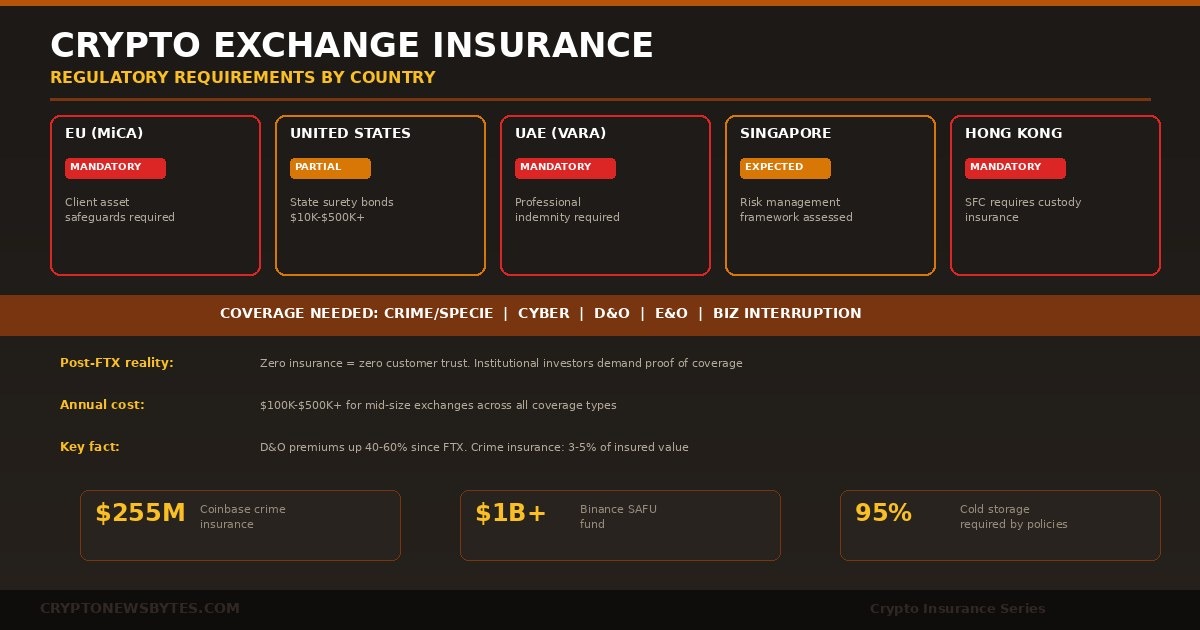
- In 2026, crypto exchange insurance (or equivalent financial safeguards) is becoming a licensing requirement in most major markets. Japan, South Korea, Hong Kong, and the UAE now mandate insurance or dedicated reserve funds. The EU and UK require strong prudential safeguards that often include insurance
- Important distinction: Crypto exchange insurance is NOT deposit insurance like FDIC. It typically means cyber/hack coverage, crime/fidelity bonds, self-funded protection reserves, or mandatory liability reserves. No jurisdiction offers government-backed deposit protection for crypto
- Japan leads globally with new legislation requiring exchanges to hold dedicated liability reserves ($12.7M-$255M based on trading volume), with insurance policies allowed as a substitute for cash reserves. This responds directly to the DMM Bitcoin hack ($305M) and Mt. Gox collapse
- The EU’s MiCA does not mandate insurance directly but requires minimum capital (50K-150K euros), 25% of fixed overheads in own funds, client asset segregation, and adequate safeguards for custody. MiCA compliance effectively pushes exchanges toward insurance
- In the US, there is no federal insurance mandate. State money transmitter licenses require surety bonds ($10K-$500K+). The GENIUS Act focuses on stablecoin reserves in insured deposits, not exchange insurance broadly
- Even where not legally required, insurance is a competitive necessity. Coinbase ($255M crime insurance), Binance (SAFU $1B+), and Bitget ($300M+ Protection Fund) set the market standard
Crypto Exchange Insurance: Why Regulators Now Demand It
Crypto exchange insurance has become one of the most urgent topics in the industry after the first half of 2025 saw over $3.1 billion in crypto losses. The Bybit hack ($1.46 billion), the DMM Bitcoin theft ($305 million), and hundreds of millions in DeFi exploits have pushed regulators worldwide to require that exchanges demonstrate they can make customers whole when things go wrong. Combined with the lingering trauma of FTX’s $8 billion customer fund shortfall with zero insurance, every major jurisdiction is now mandating insurance or equivalent protections.
But crypto exchange insurance does not mean what many users think. There is no government-backed deposit insurance for crypto like FDIC for bank accounts. Instead, it refers to a mix of private coverage types, self-funded reserves, and regulatory capital requirements that collectively protect customer assets. The question “does my crypto exchange have insurance?” has become one of the most common due diligence questions from both retail and institutional users in 2026.
This guide maps the specific crypto exchange insurance requirements across eight major jurisdictions, explains the five types of protection regulators accept, breaks down what coverage exchanges actually need, and provides case studies of exchanges that got it right and catastrophically wrong. For background on the broader market, see our comprehensive crypto insurance guide.
What “Insurance” Actually Means for Exchanges
Before diving into country requirements, understand the different types of protection regulators accept:
Cyber/hack insurance covers losses from external cyberattacks, data breaches, and system intrusions. This is the most critical coverage for exchanges handling customer assets in hot wallets. Premiums are high (3-5% of insured value) and capacity is limited.
Crime/fidelity bonds protect against internal threats: employee theft, fraud, and unauthorized access. Post-FTX, this coverage is increasingly scrutinized.
Mandatory liability reserves are dedicated emergency funds exchanges must hold proportional to trading volume or customer assets. Japan is pioneering this model with reserves ranging from $12.7M to $255M.
Self-insurance via protection funds involves exchanges allocating trading fees to a ring-fenced compensation fund. Binance’s SAFU ($1B+), Bitget’s Protection Fund ($300M+), and OKX’s reserves are prominent examples. Not traditional insurance, but serve a similar purpose.
Proof-of-Reserves (PoR) and segregated custody are increasingly paired with insurance. PoR provides verifiable proof that an exchange holds claimed assets, while segregation ensures customer funds are legally separate from company operations. Neither is insurance per se, but regulators increasingly expect both as part of the overall crypto exchange insurance and safeguards framework.
What Is NOT Covered (by any exchange insurance)
Market value decline or crypto price volatility, user errors (sending to wrong addresses), rug pulls by token issuers, losses from DeFi protocols accessed through the exchange, sanctions or regulatory seizure, and Ponzi-scheme-related losses. Insurance protects against operational failures and criminal acts, not market risk. This is a critical distinction that many retail users misunderstand when they see “insured” on an exchange’s website.
Crypto Exchange Insurance Requirements by Country: 2026 Snapshot
| Jurisdiction | Mandatory? | Key Requirements | Regulator | 2026 Status |
|---|---|---|---|---|
| Japan | YES | Liability reserves ($12.7M-$255M based on volume). Insurance can substitute cash reserves. Cold storage + segregation | FSA | Bill submitted to parliament 2026. Post-DMM Bitcoin + Mt. Gox. One of the strictest globally |
| South Korea | YES | Compulsory insurance vs hacks/operational failures. Separate user accounts, external audits, reserves | FSC/FIU | Under Virtual Asset User Protection Act. Full enforcement ramping up |
| EU (MiCA) | EQUIVALENT | Min capital (50K-150K euros), 25% fixed overheads, segregation, insurance/comparable guarantees for custody | NCAs + ESMA | Fully operational. Transitional ends mid-2026. MiCA Art. 70 covers custody |
| United States | PARTIAL | No federal mandate. State MTLs: surety bonds $10K-$500K+. NY BitLicense highest standard. GENIUS Act: stablecoin reserves in insured deposits | FinCEN + states | CLARITY Act emerging. CA DFAL July 2026 |
| Hong Kong | YES | Mandatory insurance for client virtual assets under VATP guidelines. Custody insurance required | SFC/HKMA | Operational. Stablecoins Ordinance adds requirements |
| UAE (Dubai) | YES | Professional indemnity + client asset protection. VARA V2.0 rulebooks specify requirements | VARA | Evaluated during FMP licensing stage |
| Singapore | EXPECTED | Payment Services Act: cybersecurity, segregation, resilience. Insurance part of risk management framework | MAS | Not mandated but expected in licensing review |
| United Kingdom | EMERGING | FCA proposals: client asset segregation, resilience, insurance/bonds in final rules | FCA | Final policy mid-2026. “Same risk, same rule” approach |
Key pattern: Japan and South Korea lead with explicit insurance/reserve mandates. The EU and Singapore use prudential capital requirements. The US relies on state-level bonds with no federal mandate. Hong Kong and UAE require insurance as a licensing condition. The UK is phasing in requirements through 2026.
What Coverage Types Do Exchanges Need?
The specific crypto exchange insurance stack depends on your jurisdiction, size, and customer base, but most licensed exchanges in 2026 need all five of the following:
Crime/specie insurance covers theft of crypto from hot wallets, cold storage, or during transfers. Most critical, hardest to obtain. Coinbase carries $255M. Premiums: 3-5% of insured value. This is the coverage that directly compensates for hacked customer assets and is the single most important policy for any exchange handling custody.
Cyber liability covers data breaches, ransomware, system failures. Essential given massive KYC data holdings under CARF/DAC8 reporting. Cyber insurance runs $50K-$300K+ annually. With exchanges now reporting user data to tax authorities across 48+ countries, the liability from a KYC data breach is enormous.
Directors & Officers (D&O) protects leadership from regulatory investigations, lawsuits, fiduciary claims. Post-FTX premiums up 40-60%. Critical as SEC and CFTC enforcement rises. Directors of exchanges face personal liability if found to have breached duties to investors.
Professional indemnity (E&O) covers negligence, trade execution errors, platform failures. Required by VARA and FCA. Increasingly important as exchanges offer more complex products (derivatives, staking, lending) where operational errors can cause significant customer losses.
Business interruption covers lost revenue during outages from cyberattacks or technical failures. A major exchange outage during a volatile market event can cost millions in lost trading fees and customer goodwill.
| Coverage Type | Annual Cost (Mid-Size) | What It Protects | Required By | Availability |
|---|---|---|---|---|
| Crime / Specie | 3-5% of insured value | Theft from hot/cold wallets, transfers | Japan, HK, UAE, MiCA (implicit) | Limited capacity; specialist only |
| Cyber Liability | $50K-$300K+ | Data breaches, ransomware, system failures | All jurisdictions (expected) | Widely available |
| D&O Insurance | $50K-$200K | Regulatory investigations, lawsuits, fiduciary claims | US (practical), EU, UK | Available but premiums +40-60% post-FTX |
| Professional Indemnity (E&O) | $30K-$100K | Negligence, execution errors, platform failures | VARA, FCA, MiCA (custody) | Available |
| Business Interruption | $20K-$80K | Lost revenue from outages | Optional (recommended) | Available, often bundled with cyber |
📋 Decision Framework: Does Your Exchange Need Insurance?
You definitely need it if: You hold customer assets in custody (hot or cold), you operate in Japan/South Korea/Hong Kong/UAE (mandatory), you are applying for or hold a MiCA license (prudential requirement), or you serve institutional clients (they will require proof of coverage).
You likely need it if: You hold US state MTLs (surety bonds required), you operate in Singapore/UK (strong expectation), or you are seeking banking partnerships (banks increasingly require insurance as a counterparty condition).
You may defer if: You are a non-custodial DEX with no customer asset holding, or you are pre-revenue and pre-licensing (but budget for it immediately as you scale). Even non-custodial platforms should consider D&O coverage given the regulatory landscape.
Benefits and Challenges of Meeting These Requirements
Benefits: Insurance builds institutional trust, now the primary competitive differentiator. Institutional allocators require proof of coverage before onboarding. Insurance enables licensing and passporting (MiCA covers 27 EU states). Reduces FUD after industry hacks. Demonstrates maturity to banking partners.
Challenges: Premiums are expensive (crime: 3-5% of insured value). Capital lockup reduces flexibility. Coverage capacity is limited. Claim processes can take months. Smaller exchanges face disproportionate costs.
Emerging trend: Voluntary transparency as competitive weapon. Kraken publishes PoR audits, Bitget maintains a $300M+ public Protection Fund, OKX publishes monthly reserve reports. This transparency combined with insurance creates a trust stack that differentiates compliant exchanges.
Crypto Exchange Insurance Case Studies: Who Got It Right?
| Exchange | Protection Type | Coverage | Incident | Customer Impact | Outcome |
|---|---|---|---|---|---|
| Binance | SAFU self-insurance | $1B+ | $40M hack (2019) | Zero loss | SAFU covered 100%. Trust maintained |
| Coinbase | Traditional crime policy | $255M | No major breach | Protected | Industry gold standard. Enabled NASDAQ listing |
| Bitget | Protection Fund | $300M+ | No major breach | Protected | Rapid Asian market growth via trust |
| DMM Bitcoin | Insufficient | Inadequate | $305M hack (2024) | Massive loss | Triggered Japan FSA reserve legislation |
| FTX | None | $0 | $8B missing (2022) | Total loss | Changed global regulation permanently |
Binance SAFU (right): Hacked for $40M in 2019. The SAFU fund, established in 2018 by allocating 10% of trading fees, covered all user losses without any customer impact. Now exceeding $1B+, it is publicly auditable. This self-insurance model directly inspired Japan’s proposed liability reserve framework. Lesson: building reserves proactively is the only strategy that works. You cannot buy crypto exchange insurance after the hack.
Coinbase crime insurance (right): $255M crime insurance through a consortium of traditional insurers. Explicitly disclosed to users and cited in institutional sales materials. Coinbase also holds customer USD in FDIC-insured bank accounts. This dual protection and transparency is a key reason it remains the preferred exchange for US institutional custody and helped secure its NASDAQ listing.
Bitget Protection Fund (right): Maintains a $300M+ publicly visible Protection Fund as self-insurance. Combined with regular PoR audits, this voluntary transparency has helped Bitget grow rapidly in competitive Asian markets, demonstrating that even mid-tier exchanges can build meaningful crypto exchange insurance without access to traditional markets.
DMM Bitcoin (wrong): Lost $305M (48.2 billion yen) in May 2024 through a hack traced to a third-party service provider. Insufficient insurance and reserves meant customers could not be made whole immediately. This single incident directly triggered Japan’s FSA to draft mandatory liability reserve legislation. Lesson: third-party risk needs insurance as rigorous as direct custody risk.
FTX (catastrophic failure): Zero insurance, zero reserves, zero protection fund for $8B in missing customer funds. No crime insurance, no fidelity bonds, nothing. The absence of any financial safeguards enabled fraud to go undetected and ensured customers bore the full loss. FTX is the defining failure that reshaped the entire crypto exchange insurance landscape. Every regulator now demands protections as a direct result.
Future Outlook: Crypto Exchange Insurance in 2027
Convergence toward mandatory protections. Inspired by FATF recommendations and Basel’s capital treatment of crypto exposures, more jurisdictions will adopt Japan’s reserve model or MiCA-style requirements. By 2027, operating a licensed exchange without crypto exchange insurance or equivalent reserves will be the exception. Countries currently without mandates are drafting frameworks based on MiCA and FATF templates.
Hybrid models dominate. The most resilient exchanges will combine traditional insurance (crime, cyber, D&O) + self-insurance funds (SAFU-style) + PoR transparency + emerging on-chain DeFi coverage. This layered approach matches risk types to optimal coverage mechanisms.
AI monitoring reduces costs. Real-time anomaly detection flagging suspicious withdrawals before assets leave reduces actual losses, claims, and premiums. Exchanges investing in prevention technology see direct insurance cost benefits.
MiCA maturity + GENIUS Act rollout. MiCA transitional period ends mid-2026, requiring full custody safeguards. GENIUS Act pushes stablecoin services toward banking-grade insurance. CLARITY Act may add specific crypto exchange insurance provisions for Digital Commodity Exchanges.
Insurance capacity expands. Lloyd’s syndicates, Aon, and Mapfre are entering the market with $100B+ capacity. This will reduce premiums 20-40% by 2028 as the market matures from a specialty niche into a standard commercial insurance line.
Frequently Asked Questions
📰 Crypto Insurance & Security Series
- Crypto Insurance in 2026: Why the Industry’s Biggest Problem Is Not Hackers
- Best Crypto Insurance Providers in 2026 Compared
- $2.72B Stolen in 2025: Crypto Insurance Lessons Every Founder Needs
- Cyber Insurance for Crypto Firms: What’s Covered and What’s Not
- Smart Contract Insurance: How to Protect Your DeFi Protocol
- You are here: Does Your Crypto Exchange Need Insurance? Requirements by Country
- NFT Insurance: Can You Insure Digital Art and Collectibles?
- Crypto Insurance Claims: What Gets Paid and What Gets Denied
- Will Parametric Insurance for DeFi Replace Traditional Policies?
🏛 Regulation Series
Sources: FXStreet (Japan FSA) | Crypto.news | Relm Insurance | NAIC | Woodruff Sawyer | TRM Labs
Disclaimer: This article is for informational purposes only and does not constitute insurance, legal, or financial advice. Requirements vary by jurisdiction and change frequently. Consult qualified brokers and legal counsel for your exchange.