
⚡ Key Points
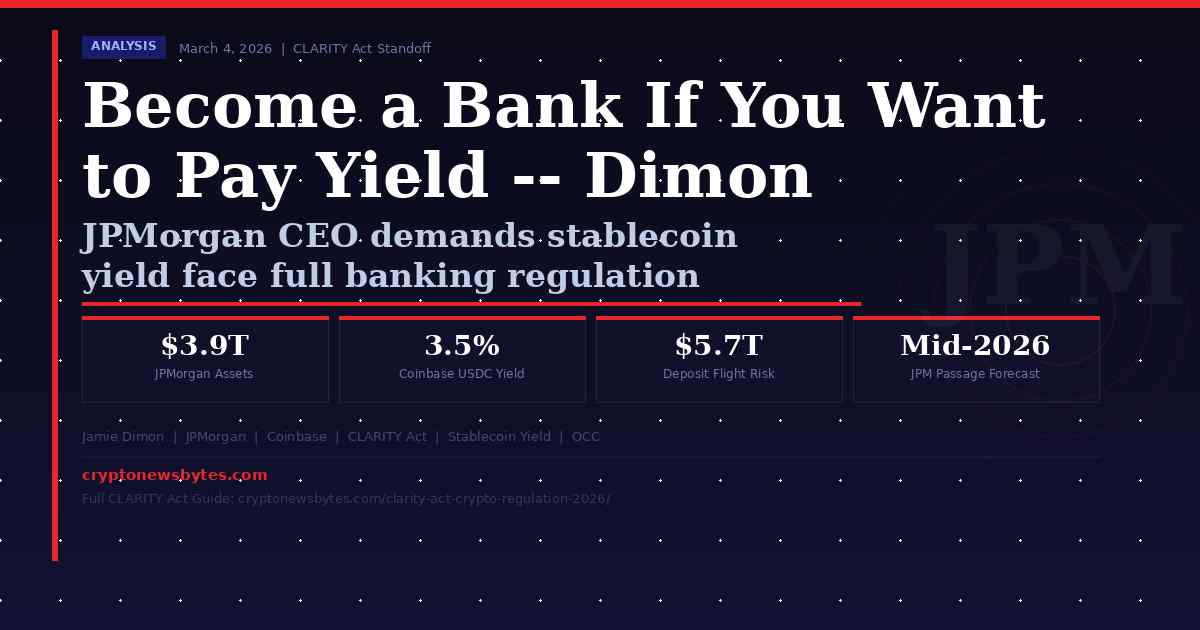
- JPMorgan CEO Jamie Dimon told CNBC that crypto firms paying yield on stablecoin balances are operating as banks — and should be regulated as such, with full capital, insurance, and lending requirements.
- Dimon’s proposed compromise: transaction-based rewards are acceptable; yield on idle balances is not — drawing a line the crypto industry flatly rejects.
- The White House Crypto Council fired back directly, calling Dimon’s argument “deceit” — saying stablecoin issuers don’t lend deposits like banks do, so bank-level regulation doesn’t apply.
- The OCC opened a 60-day comment period on stablecoin issuer supervision — a regulatory move running parallel to the CLARITY Act’s Senate progress.
- In a striking contradiction, JPMorgan’s own analysts forecast the CLARITY Act passing by mid-2026 and described it as a “positive catalyst” for tokenization and institutional crypto adoption.
- Coinbase currently pays approximately 3.5% yield on USDC balances — the product at the centre of the entire dispute — and withdrew support for the bill in January when the Senate draft targeted it.
Three words. That is how Jamie Dimon framed the entire CLARITY Act stablecoin standoff on CNBC on March 3, 2026: “level playing field.” If crypto platforms want to pay yield on balances, the JPMorgan Chase CEO argued, they should face the same capital requirements, FDIC insurance obligations, anti-money-laundering rules, and community lending mandates that banks do. The White House fired back the same day, calling that argument “deceit.” And JPMorgan’s own analysts — apparently unbothered by their CEO’s public battle with the crypto industry — published a forecast calling CLARITY Act passage a “positive catalyst” and predicting it clears Congress by mid-2026.
It is a striking position for a CEO whose views on crypto have shifted considerably over the years. Dimon once called Bitcoin a “fraud” and said “if I was the government, I’d close it down” — yet JPMorgan has simultaneously built out Kinexys, its own blockchain platform, launched JPMD (a dollar deposit token on Coinbase’s Base chain), and now finds itself issuing stablecoins of its own. On stablecoin yield specifically, however, Dimon is drawing a hard line — and that line is currently the single biggest obstacle between the CLARITY Act and a Senate floor vote.
This is the stablecoin yield fight explained — who is arguing what, why the stakes are this high, and what the three-way standoff between Dimon, the White House, and the crypto industry means for the CLARITY Act’s path to becoming law. For the full news story on Trump’s direct intervention in the standoff, see our Trump vs. Banks news update.
What Dimon Actually Said: The “Level Playing Field” Argument
Dimon’s position on stablecoin yield is more nuanced than a simple “ban it.” Speaking on CNBC on March 3, 2026 — the same day Trump posted on Truth Social — the JPMorgan CEO drew a careful distinction between two types of crypto rewards.
“We want a level playing field. If you’re going to be a bank and take deposits and lend money, you should be regulated like a bank. We have no problem competing with stablecoins. We just want the same rules.”
— Jamie Dimon, JPMorgan Chase CEO, CNBC, March 3, 2026Dimon said he has no objection to crypto companies offering transaction-based rewards — perks tied to activity, similar to airline miles or cashback on spending. What he objects to is yield on idle balances — paying users interest simply for holding stablecoin in a wallet or platform account. His argument: that is functionally a deposit product, and deposit products carry systemic risk that justifies banking regulation.
The Bank Policy Institute — the lobbying body representing JPMorgan and other major U.S. banks — has put a hard number on the risk: unrestricted stablecoin yield could trigger up to $5.7 trillion in deposit flight from conventional bank accounts. Community banks, which rely heavily on retail deposits for lending, have been the most vocal in Congress about this risk.
The White House Fires Back: “That’s Deceit”
The Trump administration did not let Dimon’s framing stand unchallenged. Patrick Witt, Executive Director of the White House Crypto Council, responded directly — and bluntly.
“Stablecoin issuers don’t lend out deposits. The bank analogy is deceit. Banks take deposits and lend them out — that’s the systemic risk that requires capital requirements and FDIC insurance. Stablecoin issuers hold reserves. They are not the same thing, and regulating them the same way would kill the product.”
— Patrick Witt, Executive Director, White House Crypto Council, March 2026Witt’s rebuttal goes to the heart of the structural difference between a bank and a stablecoin issuer. A bank takes deposits, lends most of them out, and keeps a fraction in reserve — creating a maturity mismatch that is the classic source of bank runs and systemic risk. A stablecoin issuer, under the GENIUS Act framework, holds 1:1 reserves in cash or short-term U.S. Treasuries. There is no lending, no maturity mismatch, and therefore — the White House argues — no justification for bank-equivalent capital and insurance requirements.
The question the White House does not fully answer: does paying yield on those reserves change the risk profile? That is precisely the question the Senate Banking Committee is wrestling with — and has not yet resolved.
The Standoff in Plain English: What Each Side Wants
| Party | Position on Stablecoin Yield | What They Want in the CLARITY Act |
|---|---|---|
| JPMorgan / Bank lobby | Ban yield on idle balances; allow transaction rewards only | Senate Banking draft yield ban extended to service providers |
| Coinbase / Crypto industry | Yield is a product feature, not a deposit; should be permitted | Remove the yield ban entirely from the Senate draft |
| White House | Stablecoins are not banks; bank analogy is misleading | Pass the bill quickly; resolve yield question without killing the product |
| Senate Banking Committee | Undecided — markup date still unconfirmed | TBD — reconciling bank lobby pressure with White House urgency |
| Community banks | Existential threat; $5.7T deposit flight is not theoretical | Hard yield ban with no exceptions for any platform type |
The OCC Angle: Regulation Running in Parallel
While the CLARITY Act stalls in the Senate, a separate regulatory process is running in parallel. The Office of the Comptroller of the Currency (OCC) has opened a 60-day public comment period on stablecoin issuer supervision — gathering input on how non-bank stablecoin issuers should be regulated, what reserve standards should apply, and how supervision should work in practice.
The OCC comment period matters for two reasons. First, it signals that federal banking regulators are not waiting for Congress — they are developing their own supervisory frameworks that will apply regardless of whether the CLARITY Act passes. Second, the comments submitted by banks, crypto firms, and consumer groups will directly inform the OCC’s eventual rulemaking — and may shape the language that Senate negotiators use to resolve the yield dispute.
The Contradiction at the Heart of JPMorgan’s Position
Here is the detail that cuts through all the noise: while Jamie Dimon was on CNBC arguing that stablecoin yield should be banned or heavily restricted, JPMorgan’s own research analysts were publishing a note forecasting that the CLARITY Act will pass by mid-2026 — and describing its passage as a “positive catalyst” for digital asset markets, institutional crypto adoption, and tokenization growth.
JPMorgan’s analysts specifically cited regulatory clarity, the ability for pension funds and RIAs to access crypto markets through regulated intermediaries, and the tokenization of real-world assets as the key upside drivers. In other words: the bank’s CEO is publicly fighting one of the bill’s most contested provisions, while the bank’s analysts are telling institutional clients to prepare for the bill’s passage and position accordingly.
This is not necessarily a contradiction — Dimon can oppose the yield provision while accepting the bill will pass — but it does illustrate the complexity of the banking industry’s position. JPMorgan is simultaneously a critic of the CLARITY Act’s stablecoin terms and a beneficiary of its broader market structure framework, particularly around tokenization and institutional digital asset custody.
What This Means for the CLARITY Act’s Timeline
The stablecoin yield dispute is the single biggest obstacle between the current Senate stall and a floor vote. Trump’s Truth Social post and the White House rebuttal of Dimon’s argument suggest the administration is willing to apply sustained public pressure to break the impasse — but pressure alone does not schedule a Senate markup.
The most likely resolution path involves a narrow compromise: some form of permitted yield tied to transaction activity or capped at a specific rate, with a separate rulemaking process to set the exact parameters. This would give Coinbase enough to declare a win, give community banks enough to claim protection, and give the Senate Banking Committee a defensible middle ground to advance to a floor vote.
Whether that compromise can be struck before the summer recess and the 2026 midterm campaign season dominates Senate attention is the central question. Prediction markets currently price 2026 CLARITY Act signing odds at 72%.