⚡ Key Points
- Cardano founder Charles Hoskinson called the CLARITY Act a “horrific, trash bill” on a March 3 YouTube broadcast — arguing it creates a “security by default” trap that will destroy future U.S. crypto innovation.
- Hoskinson’s core technical objection: every new token starts as a security under SEC oversight and must convince the SEC to reclassify it as a commodity — a process the SEC can block indefinitely.
- Ripple CEO Brad Garlinghouse hit back directly: “a bad bill is better than no bill” — predicting 90% odds of passage by April and arguing that regulatory certainty beats prolonged chaos.
- Hoskinson fired back at Garlinghouse with a pointed accusation: “You climbed up the ladder and then pulled it up so no one else could climb up with you” — arguing Ripple backs the bill because XRP is already grandfathered in.
- In a twist, Hoskinson agrees with Trump on the banks: he posted on X on March 4 saying the banks have amended the bill 137 times and “have to stop messing with it.”
- Hoskinson’s warning on Democratic risk: if Democrats win the next election with an anti-crypto platform, HR 3633 in its current form will be weaponized against the industry — “instead of having scary Gary rolling the dice with ambiguity, they will now have HR 3633 with no developer protections.”
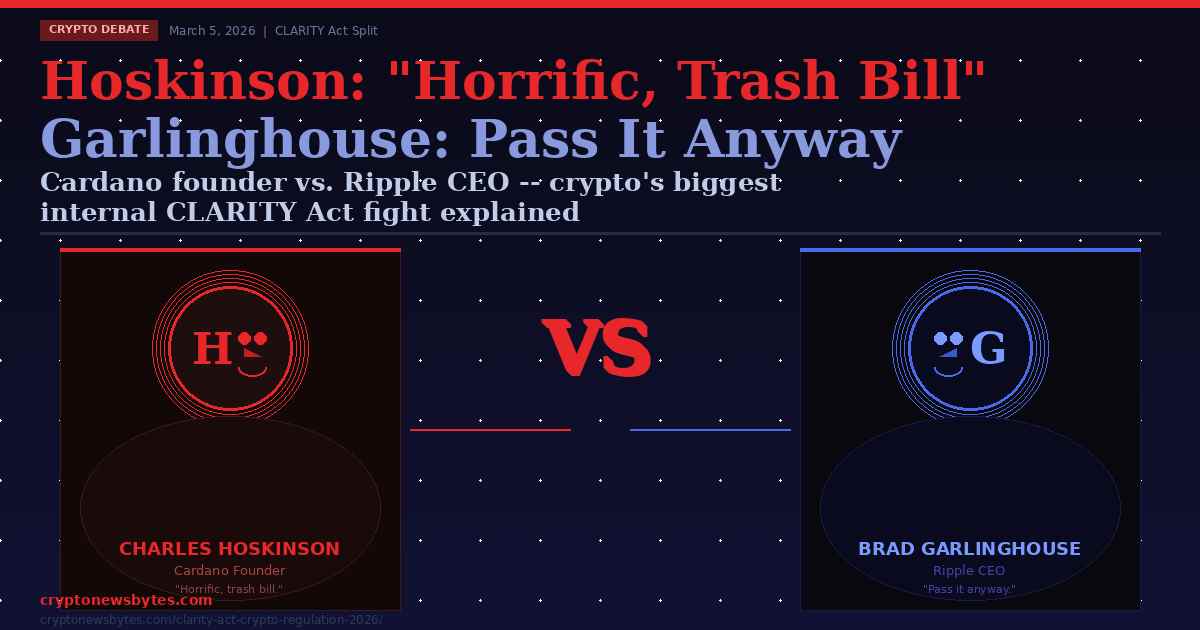
The CLARITY Act has divided Washington. It has divided banks and crypto companies. And now — in the most revealing fault line of all — it is dividing the crypto industry against itself. On one side: Charles Hoskinson, founder of Cardano, who called the bill a “horrific, trash bill” in a March 3 YouTube broadcast and warned it could destroy all future American crypto innovation. On the other: Brad Garlinghouse, CEO of Ripple, who has staked out the opposite position — predicting 90% odds of passage by April and arguing that any clarity is better than the decade of regulatory chaos the industry has endured.
Between them sits a question that goes to the heart of what crypto regulation should actually achieve: is a flawed bill that passes better than no bill at all — or does locking in the wrong framework do more damage than the uncertainty it replaces? The answer depends entirely on who you are in the industry and whether the bill protects your existing position or threatens your future growth.
Hoskinson’s Case: A “Security by Default” Trap
Hoskinson’s objection to the CLARITY Act is not primarily about the stablecoin yield dispute that has dominated headlines. His critique goes deeper — to the bill’s fundamental architecture for classifying new digital assets. And it is a technical argument worth taking seriously.
“This is not a good bill. Through rulemaking, it can become horrific and weaponized and it doesn’t cover the core of what’s going on in the industry right now.”
— Charles Hoskinson, Cardano Founder, YouTube Broadcast, March 3, 2026 · Source: CryptoPotato · CoinCentralUnder the CLARITY Act as currently drafted, every new token launches as an investment contract asset — a security — under SEC oversight. To escape that classification and achieve digital commodity status under the CFTC, the project must demonstrate that its blockchain has reached a “maturity” standard — sufficient decentralization and adoption — and the SEC must agree with that determination. Hoskinson’s argument: the SEC does not have to agree. It can say no. And under the bill’s rulemaking framework, it can construct procedural barriers that keep projects classified as securities indefinitely.
“Everything starts as a security. Then you have to go to the SEC and tell them, I don’t think I’m a security anymore… The SEC has to agree with you. And, they can make an argument and say no.”
— Charles Hoskinson, March 3, 2026 · Source: The Coin Republic · StocktwitsThis is what Hoskinson calls a “regulatory Catch-22” — a framework that is ostensibly designed to provide a pathway to commodity classification but in practice gives the SEC veto power over that pathway. He describes it as a “wet dream” for an adversarial SEC under a future administration.
The Developer Protection Problem
Hoskinson’s second major objection is that the bill strips out developer protections that were present in earlier drafts. He claims to have participated in the bill’s development for years before key protections for software developers and open-source contributors were removed — leaving the final version with no meaningful shield for builders who deploy protocols but do not control user funds. The recently introduced Promoting Innovation in Blockchain Development Act of 2026 (introduced by Representatives Fitzgerald, Cline, and Lofgren) attempts to fill this gap separately — but Hoskinson argues it should be in the CLARITY Act itself.
The Democratic Risk Scenario
Perhaps Hoskinson’s most politically significant warning is his long-game argument about what happens if the regulatory environment shifts. The Trump administration is pro-crypto today. But if Democrats win the next election running on an anti-crypto platform — framing crypto as corruption — they will inherit HR 3633. And in its current form, Hoskinson argues, the bill gives a hostile SEC more tools, not fewer.
“Instead of having scary Gary rolling the dice with no law and ambiguity in a court that’s favorable to us, they will now have HR 3633 with no developer protections.”
— Charles Hoskinson, March 3, 2026 · Source: Stocktwits · The Crypto BasicGarlinghouse’s Case: Clarity Beats Chaos
Brad Garlinghouse’s response to Hoskinson is not a point-by-point rebuttal — it is a fundamentally different philosophy about how regulation works and what the industry needs right now.
“A bad bill is better than no bill. Clarity beats chaos. We have spent a decade with no framework, regulation by enforcement, and SEC lawsuits. Any statutory clarity — even imperfect clarity — is better than what we have now.”
— Brad Garlinghouse, Ripple CEO, January–March 2026 · Source: The Crypto Basic · CoinCentralGarlinghouse’s core argument is pragmatic: the CLARITY Act can be amended after passage. No legislation is perfect on day one. The alternative — continued regulatory ambiguity, SEC enforcement actions, and no statutory framework — has cost the industry far more than a flawed bill would. He has predicted 90% odds of passage by April, citing the White House’s strong support, bipartisan House vote, and Treasury Secretary Bessent’s spring signing target.
As recently as Saturday March 1 — the day the White House deadline lapsed — Garlinghouse told the industry:
“The door to a deal is wide open. The banks just need to act in good faith and walk through it.”
— Brad Garlinghouse, Ripple CEO, March 1, 2026 · Source: StocktwitsGarlinghouse has also specifically noted that Ripple will not support any legislation that undermines XRP’s hard-won legal clarity — and that the CLARITY Act, in his view, does not. After years of costly SEC litigation that ended with a federal court finding XRP sales on secondary markets are not securities, Ripple’s position is that the bill codifies and protects that outcome rather than reversing it.
The “Ladder” Accusation — and Why It Stings
The sharpest moment in the Hoskinson-Garlinghouse exchange was not a policy argument. It was a personal one.
“You climbed up the ladder and then pulled it up so no one else could climb up with you.”
— Charles Hoskinson on Brad Garlinghouse, March 2026 · Source: CoinCentral · The Crypto BasicThe accusation is that Ripple — and by extension Garlinghouse — is supporting the CLARITY Act specifically because XRP and other legacy tokens like ADA and ETH are likely to be grandfathered in as digital commodities under the bill’s maturity standard. Their legal battles are over. Their classifications are secure. But by supporting a bill that locks in a “security by default” framework for all future tokens, Hoskinson argues, they are effectively raising the drawbridge on the next generation of American crypto projects that do not yet have their regulatory status resolved.
It is a charge Garlinghouse has not directly answered — because the underlying factual premise is hard to dispute. XRP almost certainly does get grandfathered treatment. The question is whether that makes supporting the bill self-interested, or simply pragmatic.
Where They Actually Agree: The Banks
For all the noise of the Hoskinson-Garlinghouse fight, there is one area where the two sides — and President Trump — are all in agreement: the banks have gone too far.
On March 4, the day after his “horrific, trash bill” broadcast, Hoskinson posted on X in response to Trump’s Truth Social attack on the banking lobby:
“I agree with the President. The banks amended the bill 137 times. They have to stop messing with it and trying to shut down the industry.”
— Charles Hoskinson, X post, March 4, 2026 · Source: DeFiRateThis is a significant convergence. Hoskinson thinks the bill itself is flawed. Garlinghouse thinks it should pass now. Trump wants it passed immediately. But all three agree that the banking industry’s 137 amendments — most designed to restrict stablecoin yield and weaken crypto’s competitive position — represent overreach that must be reversed before the Senate can advance. For the full story on Trump’s direct intervention and the banks’ position, see our Trump vs. Banks news update. For the Dimon “level playing field” argument in detail, see our Dimon analysis piece.
Hoskinson vs. Garlinghouse: The Positions Side by Side
✗ Charles Hoskinson — Fix It First
- Bill creates “security by default” — every new token starts under SEC
- SEC can veto commodity reclassification indefinitely
- Developer protections stripped from final draft
- Democrats can weaponize HR 3633 after next election
- No rush — bill can be amended at any time, so fix it now
- Banks amended it 137 times — both sides agree on this
- Legacy tokens (ADA, XRP) grandfathered; future projects destroyed
✓ Brad Garlinghouse — Pass It Now
- Any statutory clarity beats decade of regulatory chaos
- Bill can be amended after passage — perfection is not the standard
- 90% passage odds by April; window is closing fast
- XRP’s legal status protected and codified by the bill
- CFTC jurisdiction over major tokens is a massive win
- Continued uncertainty costs industry more than a flawed bill
- White House support + bipartisan House vote = rare opportunity
What This Means for the CLARITY Act’s Senate Prospects
The Hoskinson-Garlinghouse split is not just a personality conflict — it has real legislative implications. The crypto industry’s lobbying power in Washington depends heavily on presenting a unified front. Fairshake PAC and its affiliated committees have raised $193 million in total, with Coinbase ($25M), Ripple ($25M), and a16z ($24M) as the top donors. That political capital is most effective when the industry speaks with one voice.
When the founder of Cardano is publicly calling the industry’s flagship regulatory bill “horrific” and “trash,” it gives Senate Democrats who are skeptical of the bill — and already pushing ethics provisions targeting the Trump family’s crypto conflicts of interest — additional ammunition to slow-walk the process. It also gives wavering Republicans cover to demand more amendments before scheduling a markup.
For a complete breakdown of what the CLARITY Act actually does, how every asset class is classified, and what crypto companies need to do to prepare — see our CLARITY Act 2026 Complete Guide.