3 Key Takeaways
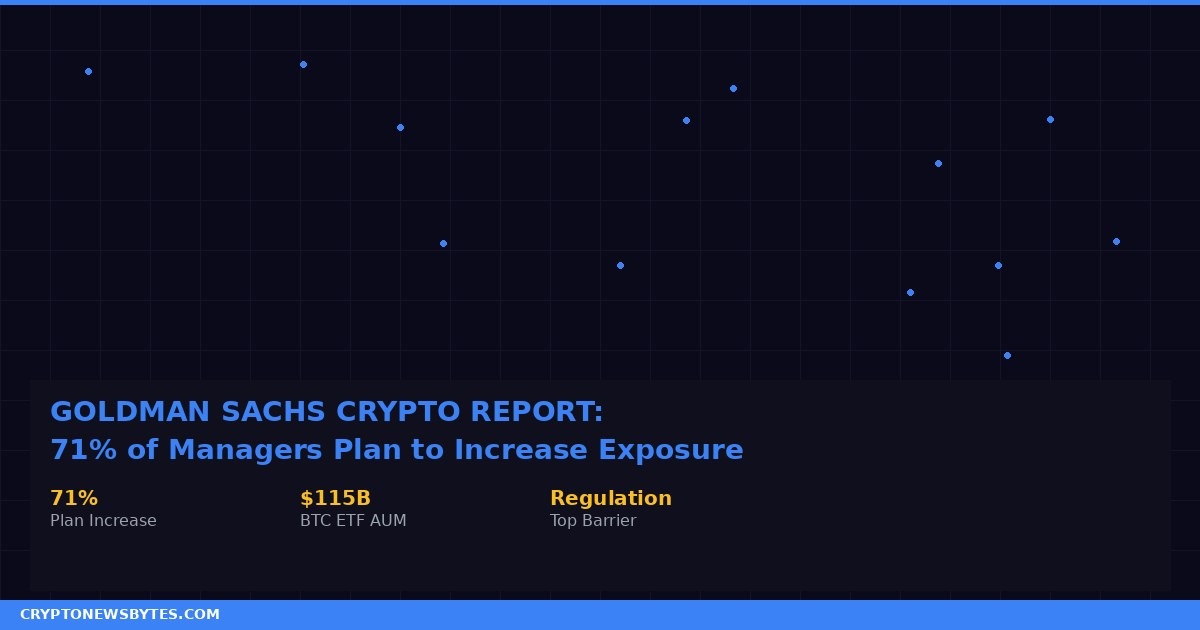
- 71% of institutional asset managers plan to increase their crypto exposure over the next 12 months, according to Goldman Sachs, yet current allocations average just 7% of AUM, leaving massive room for growth
- Regulatory clarity is the top catalyst: 32% of institutions say clear rules would unlock their crypto investment, while 35% cite regulatory uncertainty as the biggest barrier. The Clarity Act is the key they are waiting for
- Bitcoin ETFs have reached $115 billion in AUM and Ether ETFs surpassed $20 billion, but Goldman says crypto infrastructure firms, not tokens, may be the biggest institutional winners of 2026
Goldman Sachs Crypto Report: Institutional Adoption Is About to Accelerate
The Goldman Sachs crypto adoption report, published in January 2026, delivers the clearest signal yet that Wall Street’s largest institutions are preparing to dramatically increase their digital asset exposure. The report identifies regulatory reform as the single most important catalyst, positions crypto infrastructure companies as the primary beneficiaries, and forecasts that bipartisan market structure legislation (the Clarity Act) becoming law in 2026 would trigger the next wave of institutional capital flows.
This is not a speculative crypto fund talking its own book. Goldman Sachs manages over $2.8 trillion in assets. When its analysts tell institutional clients that regulation is the key unlock and 71% of managers plan to increase crypto allocations, it carries weight that reshapes capital allocation decisions across the entire financial industry.
Goldman Sachs Crypto Survey: The Numbers That Matter
The Goldman Sachs crypto report contains several data points that quantify the institutional opportunity:
71% plan to increase exposure. Nearly three-quarters of institutional asset managers surveyed indicated they intend to increase their crypto allocations over the next 12 months. This represents a significant shift from 2024, when institutional interest was growing but commitment was tentative.
7% current allocation. Despite growing interest, institutional managers have invested only about 7% of assets under management in crypto on average. With total institutional AUM measured in tens of trillions, even a modest increase to 10-15% would represent hundreds of billions in new capital entering the market.
35% cite uncertainty as the barrier. Regulatory uncertainty remains the single largest hurdle. More than one-third of institutions say unclear rules prevent them from allocating more. This is not about institutions being anti-crypto. It is about fiduciary duty: fund managers cannot justify allocating client capital to an asset class without a clear legal framework.
32% say clarity is the catalyst. The flip side of the barrier is the opportunity. Nearly one-third of institutions explicitly identify regulatory clarity as the top factor that would unlock additional investment. The Clarity Act’s progress through the Senate is directly relevant to whether this capital arrives in 2026 or gets pushed to 2027.
Bitcoin and Ether ETFs: The Gateway That Opened
The Goldman Sachs crypto report highlights exchange-traded funds as the primary vehicle through which institutional adoption has accelerated. Since their approval in 2024, Bitcoin ETFs have grown to approximately $115 billion in assets under management by end of 2025. Ether ETFs surpassed $20 billion. These numbers exceeded even the most optimistic launch projections.
ETFs matter because they solve the custody, compliance, and reporting problems that previously prevented institutional participation. A pension fund or endowment that cannot hold Bitcoin directly can hold a Bitcoin ETF within its existing brokerage infrastructure, with familiar tax reporting, auditing, and custody arrangements.
However, the report notes that February 2026 saw record outflows of $3.8 billion from Bitcoin ETFs, coinciding with the broader market correction. This underscores that institutional investors are not unconditional buyers. They respond to the same macro signals (the Fed rate decision, tariff uncertainty, geopolitical risk) as the rest of the market. The difference is that their return will be driven by regulatory milestones, not price action alone.
Infrastructure Over Tokens: Goldman’s Investment Thesis
A notable element of the Goldman Sachs crypto report is its emphasis on infrastructure companies rather than tokens as the primary institutional opportunity. Goldman argues that crypto infrastructure firms (exchanges, custody providers, blockchain analytics companies, stablecoin issuers) are less exposed to trading cycles while benefiting from overall ecosystem growth.
This thesis aligns with what is happening on the ground. Kraken’s Federal Reserve master account makes it a more valuable infrastructure company regardless of where Bitcoin’s price goes. Coinbase’s $255 million crime insurance and NASDAQ listing position it as regulated infrastructure. Circle (USDC issuer) went public. These are infrastructure plays that benefit from volume and adoption, not directional price movement.
For investors, the implication is that the “institutional crypto trade” of 2026 may not be buying Bitcoin. It may be investing in the companies building the rails that institutions will use to access crypto, the same rails being formalized by the GENIUS Act and Clarity Act.
Tokenization, DeFi, and Stablecoins: The Three Growth Vectors
Beyond ETFs, the Goldman Sachs crypto report identifies three areas poised for institutional expansion in 2026:
Tokenization. BlackRock CEO Larry Fink has stated plans to trade all stocks and bonds using tokens. Goldman sees tokenization of traditional financial assets as a multi-hundred-trillion-dollar opportunity that bridges public blockchains with traditional finance. The Clarity Act’s framework for digital asset tokens is the regulatory prerequisite.
DeFi. The report notes growing institutional focus on decentralized finance, with regulated financial institutions beginning to participate in DeFi protocols. This creates complex regulatory questions but also represents a massive expansion of crypto’s addressable market beyond trading and speculation into lending, borrowing, and yield generation.
Stablecoins. With market capitalization near $315 billion and the GENIUS Act providing regulatory clarity, stablecoins are positioned as the primary on-ramp for institutional capital. The $6 trillion deposit migration that Bank of America warns about is precisely the capital flow that Goldman sees as an institutional opportunity from the other side of the trade.
What This Means for Crypto Markets in 2026
The Goldman Sachs crypto thesis has a clear timeline dependency. If the Clarity Act passes in the first half of 2026, Goldman expects it to “unlock tokenization, DeFi, and broader institutional flows.” If it is delayed past midterm elections later in 2026, the institutional capital timeline pushes to 2027, potentially extending the current bear market.
The Grayscale Digital Asset Outlook for 2026 reinforces this view, calling this the “Dawn of the Institutional Era” and predicting bipartisan market structure legislation becomes law this year. Combined with Goldman’s data showing 71% of managers planning to increase exposure, the setup is clear: the regulatory unlock is the catalyst, and the capital is ready to deploy when it arrives.
For individual investors, the Goldman report offers a useful framework. If you believe the Clarity Act passes in 2026, positioning in crypto infrastructure and blue-chip tokens ahead of institutional flows is the trade. If you believe legislative delays will push institutional adoption to 2027, patience and accumulation during Extreme Fear (the current environment at Fear Index 14) may be the better strategy. Either way, the institutional demand is not in question. Only the timing is.
Related Reading
Sources: CoinDesk (Goldman Report) | Grayscale 2026 Outlook
Disclaimer: This article is for informational and educational purposes only and does not constitute financial or investment advice. Institutional survey data reflects stated intentions, not commitments. Past ETF inflows do not guarantee future flows. Always do your own research (DYOR) and consult qualified advisors.