
⚡ Key Takeaways
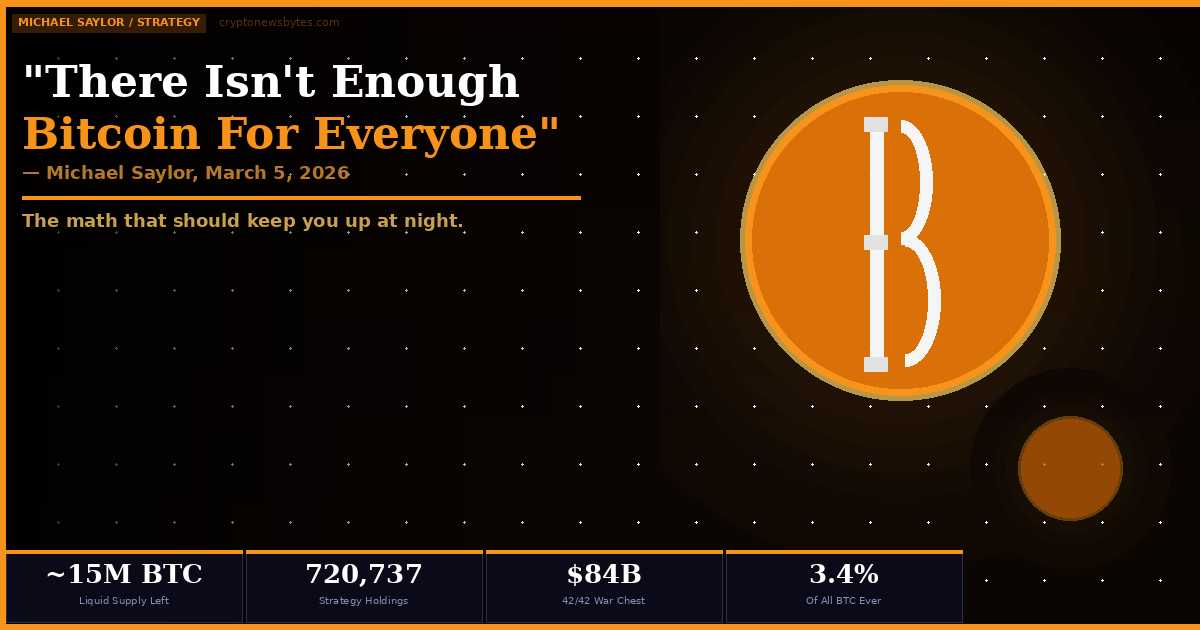
- On March 5, Michael Saylor posted “There isn’t enough Bitcoin for everyone” — four words that sum up the most powerful supply argument in crypto.
- Bitcoin’s total supply is fixed at 21 million coins. But the real number available to buy today is far lower, closer to 15 million once lost, frozen, and permanently held coins are removed.
- Strategy alone holds 720,737 BTC, representing 3.4% of all Bitcoin that will ever exist, more than the combined holdings of the U.S. and Chinese governments.
- Under its 42/42 Plan, Strategy is targeting $84 billion in additional Bitcoin purchases by 2027, potentially pushing its holdings above 1.4 million BTC, or 6.7% of total supply.
- There are 60 million millionaires in the world. If every one of them wanted just one whole Bitcoin, there still wouldn’t be enough to go around.
- The CLARITY Act, currently in Senate negotiations, would unlock institutional demand for Bitcoin at a scale that makes Saylor’s scarcity math even more pressing.
Four words. That is all Michael Saylor posted on X on March 5, 2026: “There isn’t enough Bitcoin for everyone.” No chart. No explanation. No price prediction. Just a statement about Bitcoin scarcity in 2026 that cuts to the heart of why long-term holders think the way they do about value. It got 64,000 views, hundreds of shares, and set off a chain of commentary across the crypto space. But the most important response came from analyst Lark Davis, who did the actual math, and the numbers are more striking than Saylor’s four words suggest.
Here is the full breakdown: where the 21 million coins actually are, what is truly available to buy, what Strategy’s $84 billion war chest means for supply, and how Washington’s regulatory battle connects to Bitcoin scarcity in 2026.
Bitcoin Scarcity in 2026: Where Are the 21 Million Coins?
Bitcoin scarcity in 2026 is more acute than most people realise. Bitcoin’s 21 million coin supply cap is well known. What is less discussed is how much of that supply is already permanently out of circulation, making the real, purchasable float significantly smaller than the headline number suggests.
₿ Bitcoin Supply Breakdown: March 2026
And that 15 million figure is, as Lark Davis noted, generous. It does not account for the millions of Bitcoin held by long-term holders who have not moved their coins in years, exchange reserves at decade lows, or the growing cohort of corporate treasury buyers following Strategy’s model. There are roughly 60 million millionaires in the world. If every single one of them wanted just one whole Bitcoin, there still wouldn’t be enough to go around. And that’s before the other 8 billion people show up.
Saylor’s Three Posts This Week: What He Actually Said
“There isn’t enough Bitcoin for everyone.”
— Michael Saylor (@saylor), March 5, 2026 · Source: X“I’m buying Bitcoin right now. Are you?”
— Michael Saylor (@saylor), March 3, 2026, as Bitcoin bounced from below $66,500“We can buy more Bitcoin than they can sell.”
— Michael Saylor (@saylor), March 5, 2026, referring to Strategy’s purchasing power vs. market sellersRead together, the three posts tell a coherent story: Saylor was calling the dip in real time, asserting Strategy’s firepower to absorb selling pressure, and then making the supply argument that underpins the entire thesis. It is a coordinated narrative, but it is also backed by documented facts about Strategy’s holdings and its capital raising plan.
Strategy’s Accumulation Chart: 2020 to March 2026
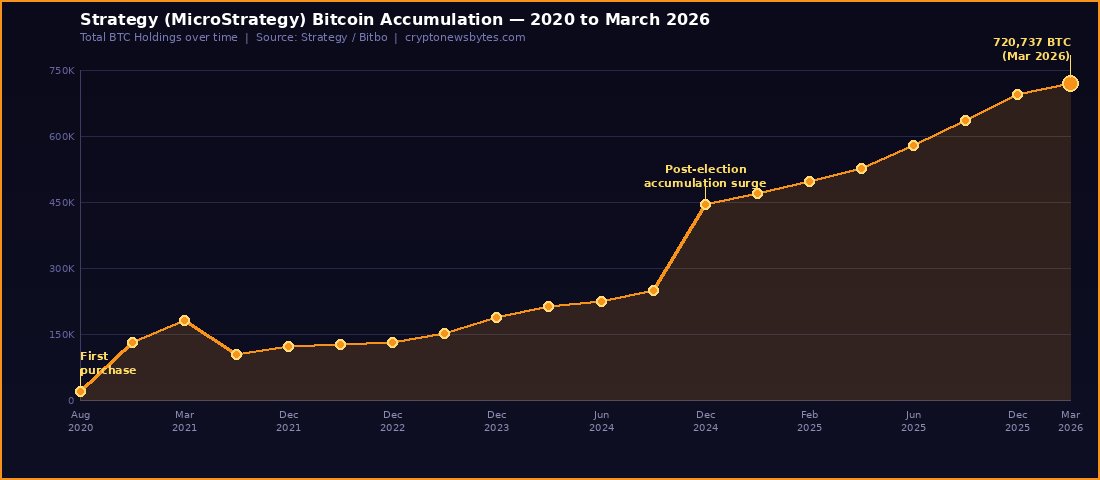
The chart tells the story better than any number can. From Strategy’s first purchase of 21,454 BTC in August 2020 through to 720,737 BTC in March 2026, the accumulation has been relentless, with one dramatic inflection point standing out above all others: the post-election surge in late 2024, when holdings jumped from roughly 252,000 BTC to over 446,000 BTC in a single quarter. That acceleration has not stopped.
Strategy’s 42/42 Plan: The $84 Billion Machine
Under the 42/42 Plan, Strategy could deploy up to $84 billion into Bitcoin by 2027, potentially pushing holdings above 1.4 million coins, over 6.7% of total supply. The plan splits fundraising equally: $42 billion from equity sales and $42 billion from debt issuance. It is a self-reinforcing system: issue stock, buy Bitcoin, use larger holdings to justify higher valuation, issue more stock, buy more Bitcoin.
Strategy’s 101st Bitcoin purchase — executed between February 23 and March 1, adding another 3,015 BTC at an average price of $67,700, marking ten consecutive weeks of back-to-back accumulation. Strategy currently holds 720,737 BTC, acquired at an average cost of $66,384 per coin for a total outlay of $33.1 billion.
The CLARITY Act: The Institutional Catalyst That Makes Scarcity Matter More
Saylor’s scarcity argument exists in a regulatory vacuum without the CLARITY Act. Here is why the two are connected: right now, the institutional investors who would most aggressively compete for scarce Bitcoin, including pension funds, endowments, registered investment advisors — are constrained by regulatory uncertainty about what Bitcoin is, how it can be held, and what fiduciary standards apply. The CLARITY Act resolves all of that by explicitly classifying Bitcoin as a digital commodity under CFTC jurisdiction and creating the market structure framework for regulated Bitcoin products.
In other words: the scarcity is fixed. The demand is not. The CLARITY Act is a demand multiplier that makes the supply constraint Saylor is pointing to materially more significant. If the Senate Banking Committee markup, currently targeted for mid-to-late March — advances the bill, expect the institutional demand side of Saylor’s equation to accelerate sharply. For the full Senate timeline, see our Senate Banking Markup explainer.
Is Saylor Right About Bitcoin Scarcity in 2026?
The Bitcoin scarcity argument in 2026 is real and verifiable. Lost coins, Satoshi’s wallet, the Strategic Reserve, and Strategy’s never-sell commitment do meaningfully reduce the purchasable float. The 60-million-millionaires calculation is not hyperbole. It is straightforward division. On the supply side, Saylor’s case is sound.
Where it gets more complicated is on the demand side. The implicit assumption in the scarcity argument is that every millionaire, institution, and government will want a full Bitcoin. That is not guaranteed. Price, regulatory environment, competing assets, and macro conditions all shape demand. The scarcity is the ceiling. Demand is what determines whether that ceiling is reached.
What makes 2026 different from previous years is that the demand-side catalysts are more concrete than they have ever been: a crypto-friendly White House, the CLARITY Act advancing through Congress, the SEC’s token taxonomy removing securities uncertainty, and Strategy’s $84 billion war chest actively buying every dip. The supply math has always been true. The demand environment to test it is only now fully forming.
❓ Frequently Asked Questions
Michael Saylor (@saylor) — X posts March 3 to 5, 2026 | U.Today: Saylor scarcity analysis | 24/7 Wall St.: Strategy 3.4% supply ownership | Bitbo: Strategy holdings tracker | Coin Gabbar: 101st purchase details