📋 In This Guide
⚡ Key Takeaways — UAE Crypto Regulation 2026
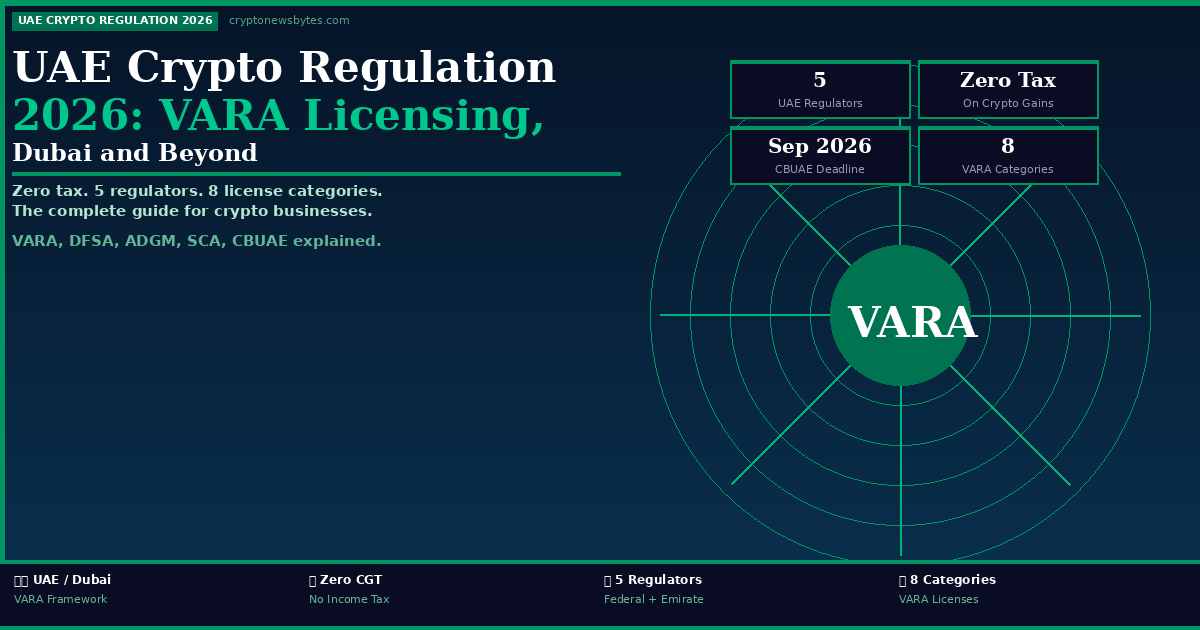
- The UAE operates five separate crypto regulatory authorities across federal and emirate levels, including VARA, DFSA, ADGM/FSRA, SCA, and CBUAE.
- Zero capital gains tax and zero personal income tax on crypto in the UAE. Corporate tax at 9% applies only when annual profits exceed AED 375,000.
- All crypto transactions have been VAT-exempt retroactively since January 1, 2018, confirmed by the Federal Tax Authority in 2024.
- VARA governs Dubai mainland and most free zones. A VARA license automatically registers the VASP with the federal SCA, enabling UAE-wide operation.
- VARA Rulebook Version 2.0, published May 2025, introduces a Sponsored VASPs regime, overhauled issuance rules, and increased Qualified Investor thresholds.
- The CBUAE deadline for DeFi and crypto payment platforms is September 2026, with penalties up to AED 1 billion for non-compliance.
- 100% foreign ownership is permitted across most UAE business activities, with no requirement for a local partner.
No other jurisdiction in the world has positioned itself for the crypto industry the way the UAE has. Zero personal income tax. Zero capital gains tax. Zero VAT on crypto transactions. One hundred percent foreign ownership. A dedicated standalone crypto regulator, including VARA, which exists nowhere else on earth. And a government that has explicitly made the digital economy a national strategic priority. Understanding UAE crypto regulation 2026 is essential for any business or investor considering the UAE, because while the tax advantages are straightforward, the regulatory landscape is genuinely complex: five separate authorities, multiple licensing routes, and deadlines that carry penalties of up to one billion dirhams.
Why the UAE Is the World’s Top Crypto Business Hub
The UAE’s appeal to crypto businesses is not just about taxes, though the tax picture is exceptional. It is the combination of a clear legal framework, a digitally sophisticated government, a strategic geographic location serving over 3 billion consumers across Africa, Asia, and the Middle East, and an aggressive posture toward attracting global crypto firms that other jurisdictions are slowly pushing out through regulatory uncertainty.
Major crypto firms that have established UAE presence include Binance, Bybit, OKX, Kraken, and Animoca Brands, which received its broker-dealer and digital asset license from Dubai in early 2026. The UAE’s fast company formation processes, English-language contracts, and common law legal systems in the financial free zones make it operationally familiar for international firms, particularly those coming from the UK or common law jurisdictions.
The 5 UAE Crypto Regulators Explained
The most important thing to understand about UAE crypto regulation is that there is no single regulator. The UAE operates a multi-authority framework where jurisdiction depends on the geographic zone and the type of activity. Getting this wrong. Setting up under the wrong regulator for your business model, which is one of the most common and costly mistakes crypto firms make when entering the UAE.
VARA in Depth: Dubai’s Dedicated Crypto Authority
VARA is the regulatory centerpiece of Dubai’s crypto ambitions and the authority most crypto businesses will interact with when setting up in the UAE. It was established in March 2022 under Law No. 4 of 2022 and published its founding Virtual Assets and Related Activities Regulations in February 2023. DLA Piper served as VARA’s exclusive global advisor in developing Dubai’s first VA-specific regulatory framework.
VARA’s Version 2.0 Rulebook, published in May 2025, introduced significant updates. A new Sponsored VASPs regime allows entities to operate under a licensed Regulated Sponsor, reducing the capital and compliance burden for smaller or early-stage firms. The Virtual Asset Issuance Rulebook was overhauled, with Category 1 issuances (stablecoins and Asset-Referenced Virtual Assets) now requiring prior VARA approval and Category 2 tokens (utility tokens) required to be distributed through licensed distributors. Margin trading rules were codified, and the Qualified Investor threshold was raised to align with broader UAE financial standards.
Critically, a September 2024 cooperation agreement between VARA and the SCA established that a single VARA license covers UAE-wide operation, meaning firms no longer need to navigate separate federal and emirate licensing once VARA approval is obtained.
The 8 VARA License Categories
| Category | Activity | Key Requirement |
|---|---|---|
| 1. Advisory Services | Crypto investment advice to clients | Qualified staff, disclosure standards |
| 2. Broker-Dealer Services | Buy/sell crypto on behalf of clients | Capital requirements, AML/KYC |
| 3. Custody Services | Safekeeping client crypto assets | Segregated reserves, insurance |
| 4. Exchange Services | Operating a crypto trading platform | Highest capital requirement, reserve reporting |
| 5. Lending and Borrowing | Crypto lending products to clients | Risk disclosure, capital buffers |
| 6. Payments and Remittance | Crypto payment processing | CBUAE coordination required |
| 7. VA Management and Investment | Managing crypto funds/portfolios | Fund governance, investor protections |
| 8. VA Issuance | Issuing new tokens or stablecoins | VARA pre-approval for Cat 1 assets |
How to Get a VARA License: Step by Step
Submit a comprehensive overview of your business model, ownership structure, proposed activities, and compliance approach. VARA uses this to assess regulatory fit before accepting a full application.
If the IDQ is accepted, VARA issues an ATI, which is permission to legally incorporate your entity in Dubai and build out your operational setup. You cannot conduct virtual asset activities yet at this stage.
Register the legal entity, secure office premises, obtain a trade license, and appoint required personnel including a Money Laundering Reporting Officer (MLRO) and compliance function.
Submit comprehensive documentation covering AML/KYC policies, cybersecurity framework, governance structure, capital adequacy evidence, and activity-specific rulebook compliance. VARA conducts detailed review at this stage. Full rulebook available at rulebooks.vara.ae.
On approval, VARA issues the VASP license. Automatic registration with the SCA follows, enabling UAE-wide operation. Ongoing compliance obligations include monthly, quarterly, and annual reporting to VARA.
UAE Crypto Tax: What You Pay (and Don’t)
The UAE’s tax position on crypto is among the most favorable in the world, and has been clarified significantly in recent years. Personal income tax does not exist in the UAE. There is no tax on individual crypto gains regardless of size. Corporate income tax at 9% applies only to businesses with annual profits exceeding AED 375,000, making it irrelevant for most individual investors and early-stage businesses.
The Federal Tax Authority confirmed in 2024 that all cryptocurrency transactions are exempt from VAT, retroactively effective from January 1, 2018. This means no VAT on crypto purchases, sales, exchanges, or transfers. The UAE signed the Multilateral Competent Authority Agreement (MCAA) under CARF in September 2025, meaning automatic exchange of crypto tax information with partner countries begins from January 2027, with first actual data exchanges in 2028. If you operate a licensed UAE crypto business serving foreign customers, prepare your KYC and transaction records for CARF compliance now.
Key 2026 Deadlines and Changes
Two significant changes took effect or are approaching in 2026. From January 12, 2026, DIFC-regulated firms must independently assess whether tokens meet suitability standards. The DFSA no longer maintains a Recognised Crypto Tokens list, shifting compliance responsibility directly to individual firms. This requires firms to establish internal token assessment frameworks and governance processes.
The more critical deadline is September 2026, the CBUAE hard cutoff for crypto payment platforms and DeFi protocols serving UAE users. The “decentralised” label provides no legal shield. The CBUAE evaluates functional reality: if a protocol facilitates financial transactions involving UAE users, licensing is required. Platforms without CBUAE authorization after September 2026 face fines up to AED 1 billion, license suspension, and potential criminal charges for serious violations.
For the broader global regulatory context, including how the UAE compares to the EU’s MiCA, Japan’s FIEA reform, and the U.S. CLARITY Act. See our Global Crypto Regulation Map 2026.
❓ Frequently Asked Questions — UAE Crypto Regulation 2026