- Thailand crypto platforms have frozen over 10,000 suspected mule accounts after stricter screening and KYC checks were introduced
- The SEC, TDO, banks and law enforcement are coordinating on data sharing, Travel Rule enforcement and anti–gray money measures
Thailand crypto platforms have intensified efforts to curb money laundering and fraud, freezing tens of thousands of accounts suspected of being used as “mule accounts.” The latest freezes come as authorities and industry groups roll out stricter checks on digital asset transfers, tighten Know Your Customer (KYC) requirements and expand data sharing between regulators, banks and exchanges.
Thailand crypto platforms step up freezes on mule accounts
Thai cryptocurrency platform operators have recently blocked more than 10,000 accounts believed to be involved in laundering illicit funds, according to local reporting from the Bangkok Post on Tuesday. These accounts were identified after new screening procedures were introduced to slow down suspicious transfers and trigger additional KYC checks before higher-risk transactions are allowed to proceed.
Att Thongyai Asavanund, chief executive of KuCoin Thailand and chairman of the Thai Digital Asset Operators Trade Association (TDO), told the Bangkok Post that the revised procedures enabled operators to single out and freeze the suspected mule accounts. The move marks a continuation of Thailand’s broader campaign against mule accounts, which are often used to obscure the origin of criminal proceeds.
The latest round of freezes follows earlier measures involving the Securities and Exchange Commission of Thailand, the TDO and several other agencies. In February 2025, the SEC said it had coordinated with the TDO, the Bank of Thailand, the Cyber Crime Investigation Bureau, the Central Investigation Bureau, the Anti-Money Laundering Office and the Thai Bankers’ Association to introduce additional safeguards aimed at detecting and shutting down mule accounts tied to digital assets.
Those earlier efforts led Thai digital asset operators to reportedly freeze 47,692 mule accounts in 2025. The TDO, which represents licensed digital asset operators in the country, including exchanges and brokers, has been a central participant in designing and implementing these measures. Requests for comment to the TDO about the total value of frozen funds had not been answered at the time of publication.
Regulatory push: SEC and TDO coordination with Thailand crypto platforms
Regulators and industry representatives formalized many of these initiatives during a workshop held in February 2025. At that meeting, the SEC and TDO worked with police and banking groups to refine methods for flagging and restricting suspicious crypto accounts.
SEC Deputy Secretary-General Jomkwan Kongsakul said the SEC and TDO had created joint guidelines for monitoring and investigating accounts that may be linked to illicit activity. She added that the meeting not only sought to raise industry standards for addressing digital asset mule accounts but also established measures to deal with different types of mule accounts within an expedited timeframe.
Participants in the workshop also agreed on expanding data-sharing protocols among Thailand crypto platforms, banks and law enforcement agencies. By broadening the exchange of information, the agencies aim to identify suspicious wallets more quickly and block transfers to accounts suspected of being used as mules.
This structured cooperation reflects an attempt to align oversight across multiple parts of the financial system. Crypto exchanges, traditional banks and investigative bodies are expected to use common frameworks when assessing transaction risks and responding to potential money laundering patterns.
Gray money crackdown and tighter rules for Thailand crypto platforms
The latest account freezes coincide with a broader campaign by Thai authorities against so-called “gray money.” This push, reported by Cointelegraph on Jan. 13, involves tightening supervision in both physical gold markets and digital assets in order to close loopholes that might allow money laundering to persist.
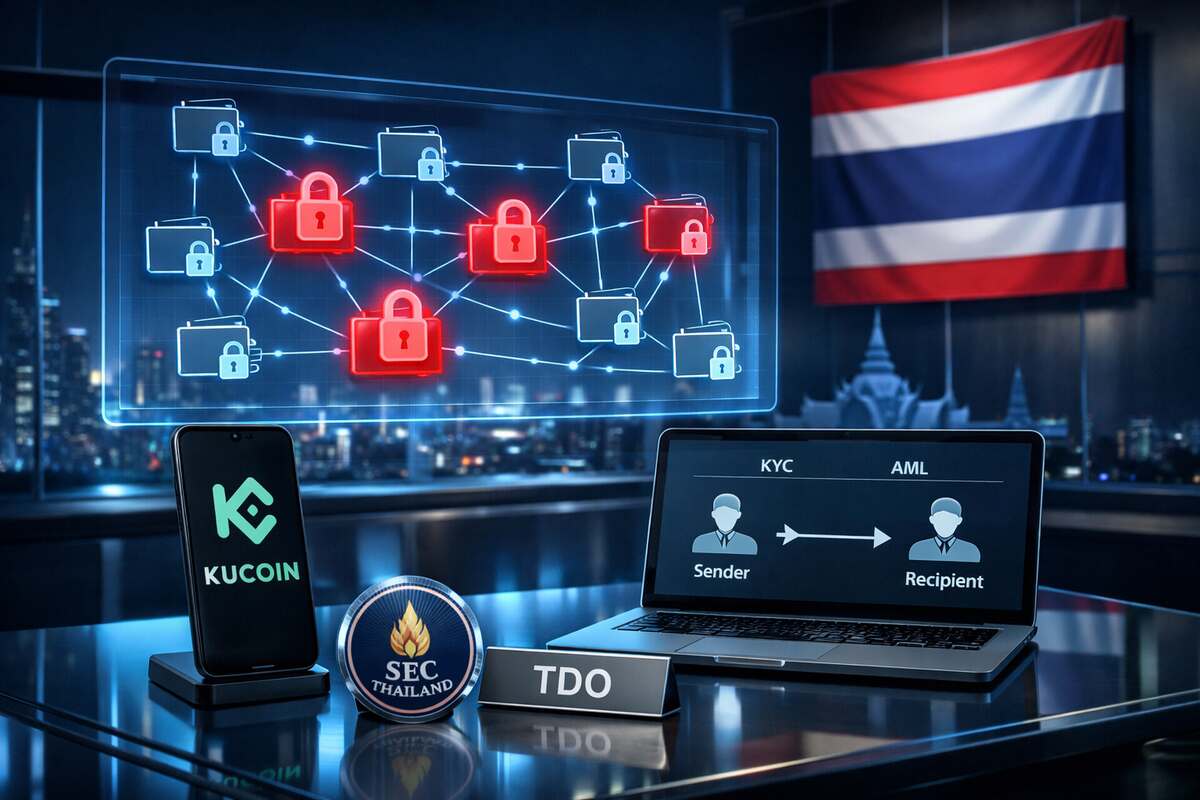
In the crypto sector specifically, the government has instructed the SEC to strictly enforce the Travel Rule. Under this rule, licensed crypto asset service providers must collect and transmit identifying details about both the sender and the recipient of certain digital asset transfers. The requirement is particularly focused on wallet-to-wallet transactions that are routed through exchanges, where anonymity can make it harder to trace funds.
For Thailand crypto platforms, stricter Travel Rule enforcement and enhanced KYC procedures add extra layers of compliance to daily operations. Before higher-risk transactions are finalized, operators are expected to verify customer identities more rigorously and scrutinize the purpose and pattern of transfers. Combined with shared data frameworks, these steps are designed to reduce the number of accounts that can be used to move illicit funds through the digital asset system.
The focus on mule accounts also ties into the government’s efforts to respond quickly when suspicious activity is detected. Speeding up the process for freezing accounts and coordinating with other financial institutions is seen as important to prevent funds from being quickly shifted across multiple wallets or converted into other assets.
Conclusion
Thailand’s recent actions show a continued tightening of controls around digital assets, with Thailand crypto platforms playing a central role in identifying and freezing mule accounts. New screening measures, expanded KYC checks and strict enforcement of the Travel Rule are being deployed alongside deeper cooperation between the SEC, TDO, banks and law enforcement agencies. Together, these steps form a coordinated response to money laundering and fraud risks in the country’s growing digital asset market.
Disclaimer
The information provided in this article is for informational purposes only and should not be considered financial advice. The article does not offer sufficient information to make investment decisions, nor does it constitute an offer, recommendation, or solicitation to buy or sell any financial instrument. The content is opinion of the author and does not reflect any view or suggestion or any kind of advise from CryptoNewsBytes.com. The author declares he does not hold any of the above mentioned tokens or received any incentive from any company.
Featured image created by AI