
Key Takeaways
- On March 9, 2026, Bitcoin crossed the 20 millionth coin mined at block 939,999 — a monetary milestone that took 17 years to reach. The remaining 4.8% of supply will take over 114 years to emerge due to the halving schedule.
- With an estimated 2.8 to 3.8 million BTC permanently lost (Satoshi’s coins, lost keys, burn addresses), the real actively circulating supply is closer to 17 million BTC — not 20 million.
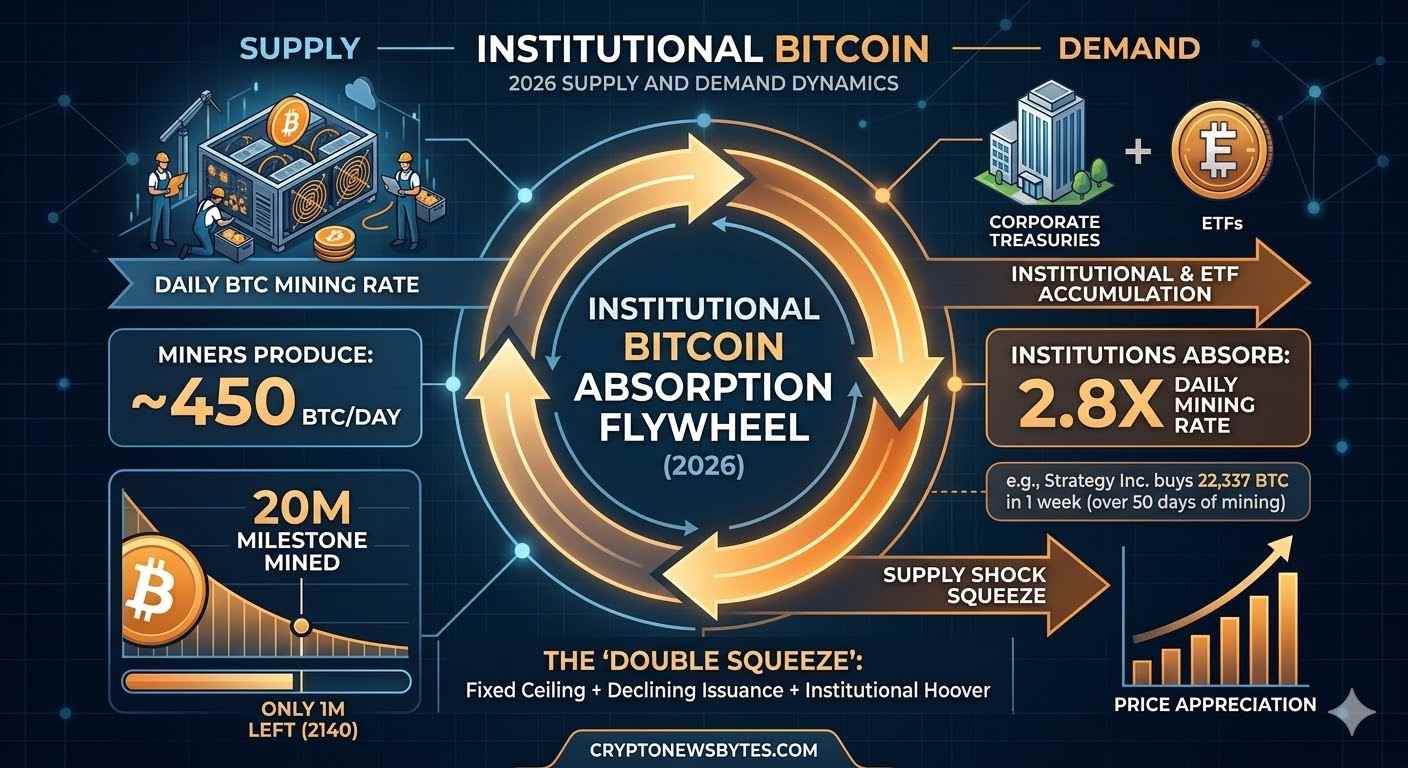
- Corporate treasuries and ETFs are now absorbing Bitcoin at 2.8 times the daily mining rate. Miners produce approximately 450 BTC per day. Strategy Inc. alone bought 22,337 BTC in one week — roughly 50 days of global mining output in 168 hours.
- Bitcoin’s security model is undergoing a structural shift from inflation-subsidized (block rewards) to fee-based (transaction fees). At 3.125 BTC per block, the network is entering the era where miner revenue depends on blockspace demand, not new coin issuance.
📋 In This Article
📊 Live Data Snapshot — March 16, 2026
On March 9, 2026, at block 939,999, Bitcoin crossed a threshold that no monetary system in history has ever approached: 20 million of its 21 million total coins had been mined. The remaining 996,875 Bitcoin — less than one million — will take approximately 114 years to emerge, locked behind a cryptographic schedule that no government, central bank, or corporation can alter.
This is not just a round number. It is a structural event in the history of money. We have officially entered what analysts are calling the Bitcoin Final Million Supply era — a period defined not by new supply coming to market, but by existing supply being competed over by an expanding universe of institutional, retail, and sovereign buyers. Understanding what happens next requires understanding three simultaneous forces: the mathematics of the halving schedule, the reality of lost coins, the intensification of HODLing behaviour, and the acceleration of institutional absorption.
The 20M Milestone: A Monetary Event Horizon
The term “event horizon” is borrowed from physics — the point beyond which the gravitational pull of a black hole becomes inescapable. The 20 million milestone is Bitcoin’s monetary equivalent. Beyond this point, the supply dynamics are effectively locked. The curve is set. The schedule is known. What changes is demand — and demand has never been less predictable.
Consider the asymmetry of the timeline. It took Bitcoin just 17 years to mine the first 20 million coins, from the genesis block in January 2009 to block 939,999 in March 2026. The remaining 4.8% — just 996,875 BTC — will take 114 years to fully emerge, with the final satoshi not mined until approximately the year 2140. This is not a quirk of the design. It is the design. Satoshi Nakamoto’s halving schedule deliberately compresses new supply over time, creating a monetary system that becomes increasingly scarce with every passing year.

For comparison: the US Federal Reserve increased M2 money supply by approximately $6 trillion between 2020 and 2022 alone — a 40% expansion in two years. Bitcoin’s total remaining issuance for the next 114 years is less than one million coins. These two monetary systems are not operating on the same planet.
The Final Million: 114 Years of Anti-Dilution
To understand why the Final Million will take so long, you need to understand the halving schedule. Bitcoin’s protocol halves the block reward approximately every four years — every 210,000 blocks. This creates an exponential decay in new supply that is now in its most compressed phase.
📊 Bitcoin Halving Schedule — Current and Future
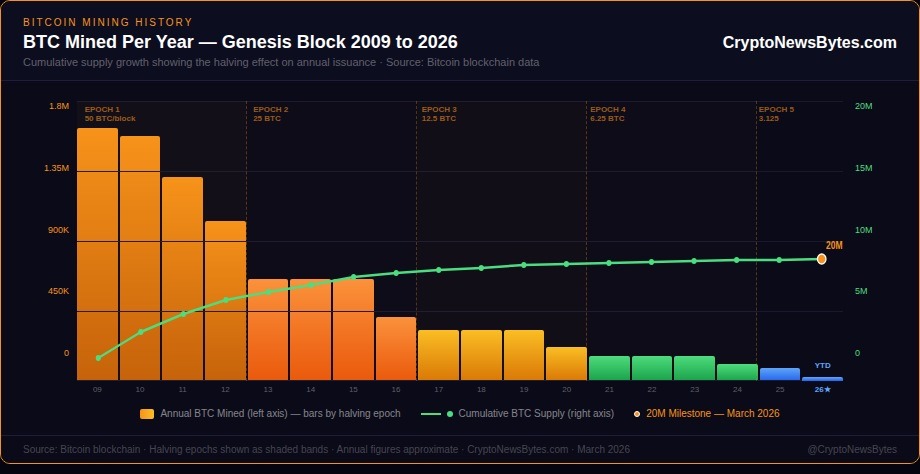
The reward curve is deliberately aggressive. Each halving cuts daily issuance in half. By 2032, daily issuance will be below 113 BTC. By 2036, below 57 BTC. The contrast with fiat monetary systems is stark: while central banks can expand their money supply at the stroke of a pen — and frequently do — the Final Million Bitcoin is locked behind 114 years of cryptographic proof-of-work. No authority can accelerate it, delay it, or change it.
Bitcoin Supply Velocity Crisis: 17 Million in Play, Not 20 Million
The 20 million figure is the theoretical mined supply. The real actively circulating supply is significantly lower — and this gap is the most underappreciated fact in all of Bitcoin analysis.
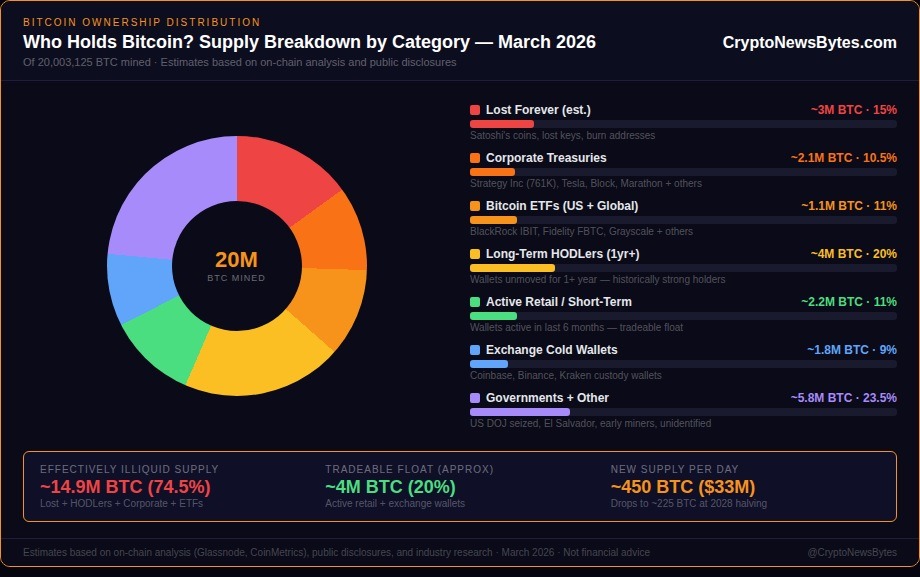
Between 2.8 and 3.8 million Bitcoin are estimated to be permanently inaccessible. Satoshi Nakamoto’s known wallets alone hold approximately 1.1 million BTC that have never moved in 17 years and are widely considered unrecoverable. Early miners who lost hard drives, forgotten wallet passwords, and coins sent to burn addresses add millions more to the tally.
This means the real supply available for purchase, transfer, and institutional accumulation is approximately 17 million BTC — not 20 million. And of that 17 million, a significant portion is held by long-term HODLers who have demonstrated through years of price volatility that they have no intention of selling at current prices.
Bitcoin Fee-Based Security Pivot: From Subsidy to Service
The 20 million milestone marks not just a supply threshold but a structural turning point in how Bitcoin’s network security is funded. For the first 17 years, miners were subsidised by block rewards — new Bitcoin issued with every block as an incentive to secure the network. As those rewards continue to halve, the security model is shifting from inflation-funded to fee-funded.
The economics of the shift
At the current reward of 3.125 BTC per block, and with Bitcoin trading at approximately $74,784, each block generates roughly $231,000 in block reward revenue for miners. Transaction fees add a variable amount on top — typically between $5,000 and $50,000 per block depending on network congestion. Block rewards still dominate miner revenue today, but the trend is clear.
The hashrate signal
Bitcoin’s hashrate — the total computational power securing the network — has continued to reach all-time highs in 2026 despite the reward halving in 2024. This tells an important story: miners are not abandoning the network as rewards shrink. They are becoming more efficient, consolidating, and betting that fee revenue will compensate for declining block rewards. The network is not weakening. It is transitioning.
From a cybersecurity perspective, a fee-based security model is arguably more robust than a subsidy-based one. It means network security is tied to actual economic utility rather than an inflation subsidy that will eventually run to zero. The more Bitcoin is used for settlement, the more fees are generated, and the more economically rational it becomes for miners to continue securing the network.
Institutional Supply Shock: The 2.8x Absorption Rate
The supply mathematics become even more striking when set against current institutional demand. As of March 2026, corporate treasuries and Bitcoin ETFs are absorbing Bitcoin at approximately 2.8 times the daily mining rate.
Strategy Inc alone bought 22,337 BTC in a single week in March 2026. Global miners produce approximately 450 BTC per day. That means Strategy absorbed nearly 50 days of global mining production in 168 hours — while the price was falling. And Strategy is one buyer among many.
Bitcoin ETFs approved in the US in January 2024 have collectively accumulated hundreds of thousands of BTC. Sovereign wealth funds in the Middle East have made public Bitcoin allocations. Corporate treasury adoption is accelerating following Strategy’s playbook. Every one of these buyers is drawing from the same 17 million active supply pool.
| Buyer Type | Estimated Daily Absorption | Notable Holdings (Mar 2026) |
|---|---|---|
| Strategy Inc (MSTR) | Variable — weekly tranches | 761,068 BTC ($57.6B) |
| US Bitcoin ETFs | ~500–800 BTC/day average | ~1.1M BTC collectively |
| Other corporate treasuries | ~200–400 BTC/day | Tesla, Block, Marathon, etc. |
| Sovereign and institutional | Growing, untracked | El Salvador, UAE funds |
| Total estimated daily demand | ~1,200–1,500 BTC/day | vs 450 BTC/day mined |
The Double Squeeze: Price Implications
The term “double squeeze” captures the two simultaneous forces compressing Bitcoin’s available supply from opposite directions.
Squeeze one — from above: The hard cap of 21 million coins is absolute. No new supply can be created. The remaining 996,875 BTC will emerge on a fixed mathematical schedule that cannot be accelerated. This ceiling is immovable.
Squeeze two — from below: Institutional demand is absorbing existing supply faster than new coins are being mined. Each halving cuts new supply further. Each new institutional entrant — ETF, corporate treasury, sovereign fund — increases the competition for the same pool of 17 million active coins.
Bitcoin’s price history has been defined by speculative cycles — retail manias, corrections, rebuilding. The 20 million milestone marks a potential phase transition. When the available supply is this constrained and the buyer base is this institutional, the asset stops behaving like a speculative growth asset and begins behaving like a reserve settlement asset. The price volatility does not disappear — but its character changes. Corrections become buying opportunities for institutions with multi-year time horizons rather than panic events for retail holders with short ones.
The CLARITY Act moving through the US Senate in 2026 adds a regulatory dimension to this story. Clearer legal frameworks for institutional Bitcoin holding remove a significant barrier for pension funds, insurance companies, and sovereign wealth managers who have been waiting on the sidelines. Each new institutional entrant that regulatory clarity unlocks is a new permanent buyer entering a market where supply is mathematically contracting.
The final picture is this: a fixed supply ceiling, an exponentially decaying issuance schedule, 3 million coins permanently inaccessible, institutions buying at 2.8 times the mining rate, and regulatory frameworks opening new pools of institutional capital. Whether you are a Bitcoin maximalist or a sceptic, the supply mathematics are not a matter of opinion. They are arithmetic. And the arithmetic of the Final Million era points in one direction.
❓ Frequently Asked Questions