
Key Numbers
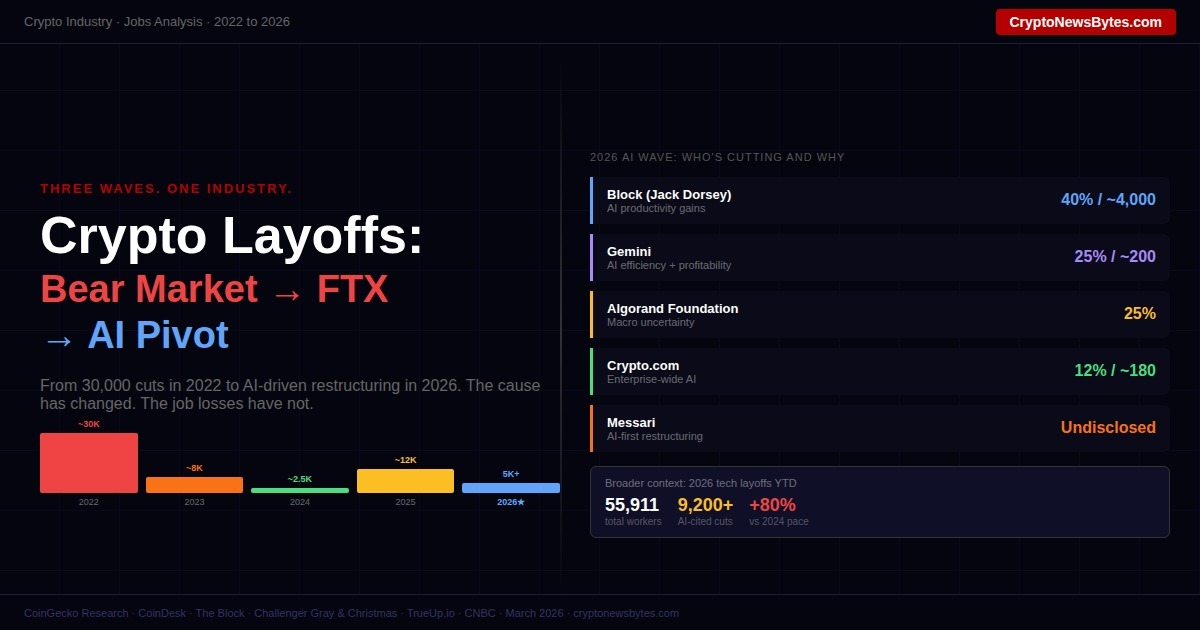
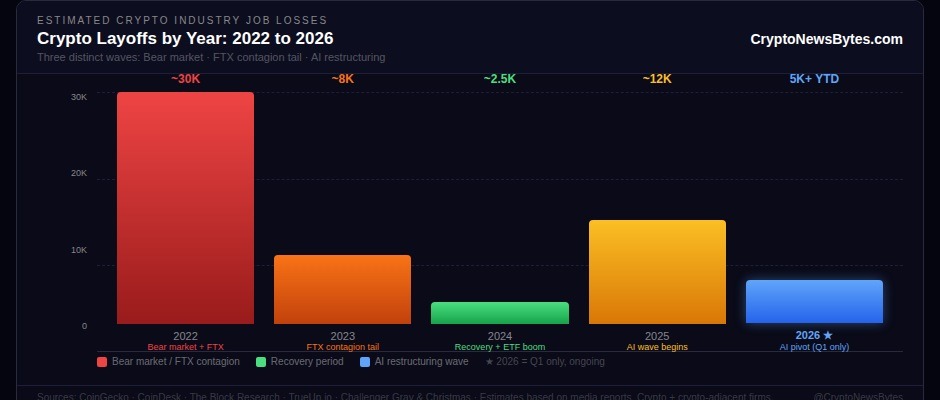
- Crypto firms cut approximately 9,500 jobs in 2022, with the largest spike following the FTX collapse in November. CoinDesk tracked nearly 30,000 crypto job losses through March 2023, spanning both the 2022 bear market and the FTX contagion wave
- 2024 marked a recovery: tech layoffs fell more than 80% from March 2023 to March 2024 as Bitcoin hit new all-time highs and spot ETFs were approved. Crypto firms rehired aggressively through mid-2024
- 2025 and 2026 have brought a new wave, with a different driver: AI. Over 9,200 tech jobs have been explicitly linked to AI implementation in 2026 alone, with crypto firms leading the narrative
- March 2026 has been particularly active: Crypto.com cut 12%, Block cut 40%, Gemini cut 25%, Algorand Foundation cut 25%, and Messari reorganised around an AI-first model, all within weeks of each other
Crypto layoffs 2026 are different from everything that came before. Between 2022 and 2023, the crypto industry shed tens of thousands of jobs because the market collapsed, lenders went bankrupt, and FTX wiped out confidence across the sector. In 2025 and 2026, jobs are being cut while prices are recovering, regulatory clarity is improving, and companies are expanding their product lines. The reason cited now is not survival. It is AI. The cause has changed. The job losses have not.
This article tracks the full arc of crypto layoffs from 2022 to 2026, using the CoinGecko layoffs-by-month framework as a starting point and building out with current data through March 2026. The pattern is striking: every major industry shock has been followed by a layoff spike 8 to 13 times above the monthly average, and the current AI restructuring wave is shaping up to be the third such event in four years.
Crypto Layoffs by Year: The Full Picture
Wave 1: The Bear Market (2022)
The first wave of crypto layoffs began in April 2022 as cryptocurrency prices entered a prolonged bear market. Bitcoin fell from approximately $47,000 in April to under $16,000 by year-end. The collapse of Terra/Luna in May 2022 was the first major catalyst, followed by the insolvency of Celsius Network and Three Arrows Capital in June. FTX’s collapse in November 2022 triggered the final and largest spike.
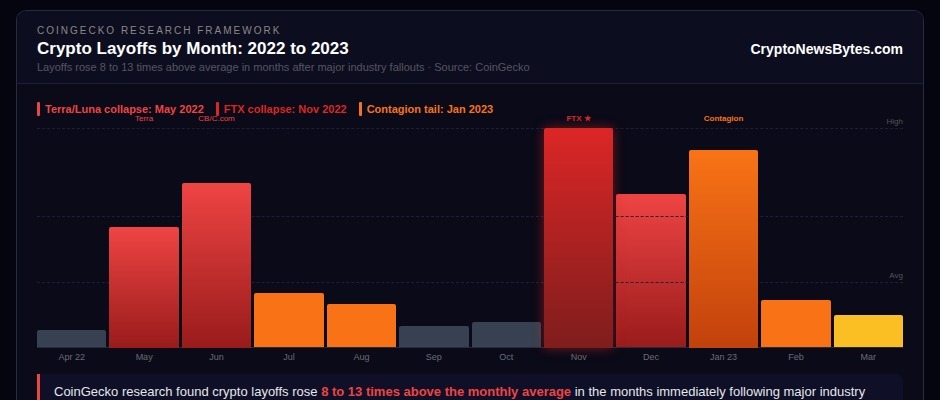
Crypto firms cut approximately 9,500 jobs through 2022, according to The Block Research. The largest cuts came from the biggest names.
| Company | Year | Jobs Cut | % of Workforce | Reason |
|---|---|---|---|---|
| Coinbase | Jun 2022 | ~1,100 | 18% | Bear market, overhiring |
| Crypto.com | Jun 2022 | ~260 | 5% | Market downturn |
| Gemini | Jun 2022 | ~100 | 10% | Market downturn |
| BlockFi | Jun 2022 | ~250 | 20% | Celsius contagion |
| Robinhood | Apr + Aug 2022 | ~1,060 | 9% then 23% | Revenue collapse |
| OpenSea | Jul 2022 | ~50 | 20% | NFT market crash |
| Blockchain.com | Jul 2022 | ~150 | 25% | Bear market |
| Galaxy Digital | Nov 2022 | ~170 | ~20% | FTX contagion |
| Amber Group | Dec 2022 | ~300 | 40% | FTX contagion |
| Kraken | Nov 2022 | ~1,100 | 30% | Market conditions |
| Silvergate Capital | Q4 2022 | ~200 | 40% | FTX exposure |
Wave 2: FTX Contagion Tail (Early 2023)
The effects of FTX’s collapse continued to ripple through the industry well into 2023. January 2023 became the single worst month for crypto job losses as company after company announced cuts that had been delayed from late 2022.
| Company | Month | Jobs Cut | % of Workforce |
|---|---|---|---|
| Coinbase | Jan 2023 | ~950 | 20% |
| Crypto.com | Jan 2023 | ~700–900 | 20% |
| Genesis Global Trading | Jan 2023 | ~60+ | 30% |
| Gemini | Jan 2023 | ~100 | 10% |
| ConsenSys | Jan 2023 | ~96 | 11% |
| Silvergate Capital | Jan 2023 | ~200 | 40% |
| Blockchain.com | Jan 2023 | ~110 | 28% |
| Protocol Labs | Feb 2023 | ~89 | 21% |
CoinDesk’s running count tracked nearly 30,000 crypto job losses through March 2023. The broader tech industry saw approximately 151,600 job cuts through 2022, with crypto contributing roughly 6.2% of the total despite being a fraction of tech employment. The concentration of cuts in crypto relative to industry size made it one of the hardest-hit sectors per capita.
The 2024 Recovery: Rehiring and Relief
The recovery was as fast as the collapse. Bitcoin spot ETFs were approved in January 2024. Bitcoin hit new all-time highs. And the hiring began almost immediately.
By April 2024, Crypto.com, Binance, Coinbase, Gemini, and Kraken were all actively hiring. Crypto.com had already onboarded 700 new staff since November 2023 and was planning another 700. Coinbase listed 215 open positions, Binance listed 347, and Kraken listed 81. Tech layoffs overall fell more than 80% from March 2023 to March 2024, according to Layoffs.fyi data.
Wave 3: The AI Pivot (2025 to 2026)
The third wave is fundamentally different from the first two. Companies cutting in 2026 are not doing so because they are losing money or because the market has collapsed. They are cutting because they believe AI can replace entire categories of human work, and they want to be the companies that make that transition before their competitors do.
The language from CEOs has shifted completely. In 2022, cuts were described as “difficult decisions” driven by “macroeconomic conditions.” In 2026, they are described as strategic positioning for “a new world” where companies that “do not adapt immediately will fail.”
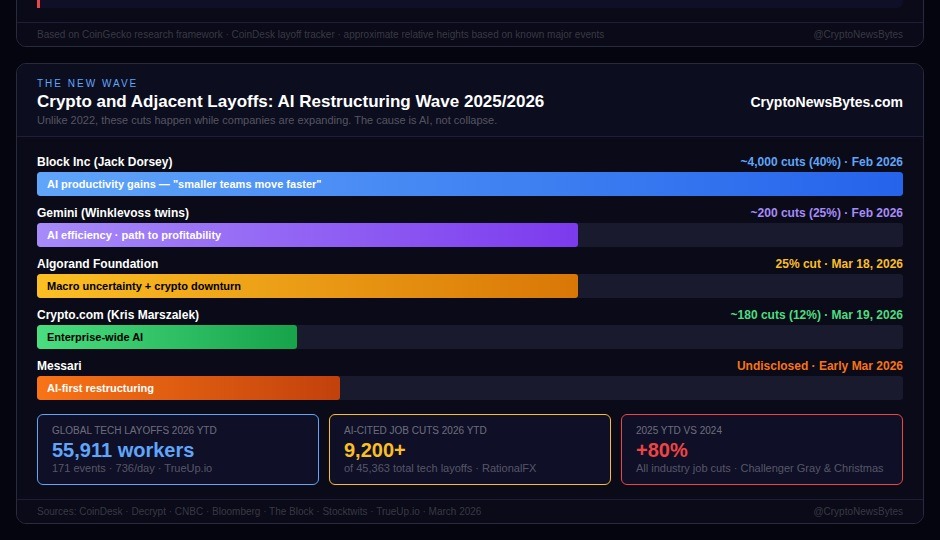
March 2026: The AI Layoff Wave in Real Time
| Company | Date | Jobs Cut | % of Workforce | Reason Cited |
|---|---|---|---|---|
| Block Inc (Jack Dorsey) | Feb 2026 | ~4,000 | ~40% | AI productivity gains, smaller teams move faster |
| Gemini | Feb 2026 | ~200 | ~25% | AI efficiency, path to profitability |
| Messari | Early Mar 2026 | Undisclosed | Significant | AI-first restructuring, CEO change |
| Algorand Foundation | Mar 18, 2026 | Undisclosed | 25% | Macro uncertainty, crypto market downturn |
| Crypto.com | Mar 19, 2026 | ~180 | ~12% | Enterprise-wide AI integration |
| OKX | Jan 2026 | ~8–10+ (institutional) | Restructuring | Global business reorganisation |
Crypto.com CEO Kris Marszalek was the most direct. “We are joining the list of companies integrating enterprise-wide AI. Companies that do not make this pivot immediately will fail.” Jack Dorsey at Block cited AI-enabled productivity gains and said smaller teams can now move faster. Gemini’s founders Tyler and Cameron Winklevoss tied the cuts to accelerating their “path to profitability” through AI efficiency.
The Broader Tech Context
Crypto layoffs do not exist in a vacuum. In 2026, the entire tech sector is restructuring around AI. Amazon cut 16,000 jobs. Meta is planning cuts of up to 20%. Atlassian cut 10% (about 1,600 people). Salesforce cut 4,000. All cited AI efficiency as the driver.
According to TrueUp.io, there have been 171 layoff events at tech companies in 2026 so far, affecting 55,911 workers at a pace of 736 people per day. In all of 2025, there were 783 layoff events affecting 245,953 workers (674 per day). The 2026 pace is running ahead of 2025.
Separately, year-to-date job cuts across all industries in 2025 were running 80% above 2024 levels by May, according to Challenger, Gray and Christmas. The crypto industry is not leading this trend but it is fully participating in it.
The Pattern: Three Waves, One Industry
Looking across the full 2022 to 2026 period, three distinct waves of crypto layoffs emerge, each with a different cause but the same outcome for workers.
| Wave | Period | Primary Cause | Estimated Jobs Lost | Recovery |
|---|---|---|---|---|
| Wave 1 | Apr 2022 to Jan 2023 | Bear market, Terra collapse, FTX bankruptcy | ~30,000 (crypto + adjacent) | Hiring resumed mid-2023 |
| Wave 2 | Jan to Jun 2023 | FTX contagion tail, regulatory pressure | Included in Wave 1 count | Full recovery by mid-2024 |
| Wave 3 | Late 2025 to present | AI restructuring, efficiency drives | Ongoing, thousands in Q1 2026 | Unknown |
The structural difference between Wave 3 and its predecessors is important. Waves 1 and 2 were reactive: companies cut because revenue had collapsed and survival was at stake. Wave 3 is proactive: companies are cutting while revenue is stable or growing, betting that smaller AI-augmented teams will outperform larger traditional ones. The risk is different but the human cost is the same.