
- US lawmakers advance multiple bills targeting prediction markets, focusing on insider use by officials and contracts tied to politics and sports.
- Platforms like Kalshi and Polymarket respond to rising federal and state scrutiny by tightening rules on who can place event-based bets.
Prediction markets are facing rising pressure in the United States as lawmakers introduce multiple bills targeting how government officials and retail users can wager on event-based contracts tied to politics, policy and sports.
New PREDICT Act targets insider use of prediction markets
A new bipartisan bill in the US House of Representatives would bar senior federal officials from placing bets on prediction markets. Introduced on Tuesday by Representatives Adrian Smith and Nikki Budzinski, the Preventing Real-time Exploitation and Deceptive Insider Congressional Trading Act (PREDICT Act) is aimed at limiting how people with access to nonpublic information interact with these platforms.
The proposal would prohibit members of Congress, the president, vice president and political appointees from wagering on contracts linked to political events, policy decisions and other government actions. The restriction would also apply to their spouses and dependents, closing off indirect routes to trade on such markets. Lawmakers backing the bill point to recent examples of traders earning large profits on contracts tied to issues such as a potential war with Iran or the duration of a US government shutdown, and say this has raised concerns about the possible use of insider information.
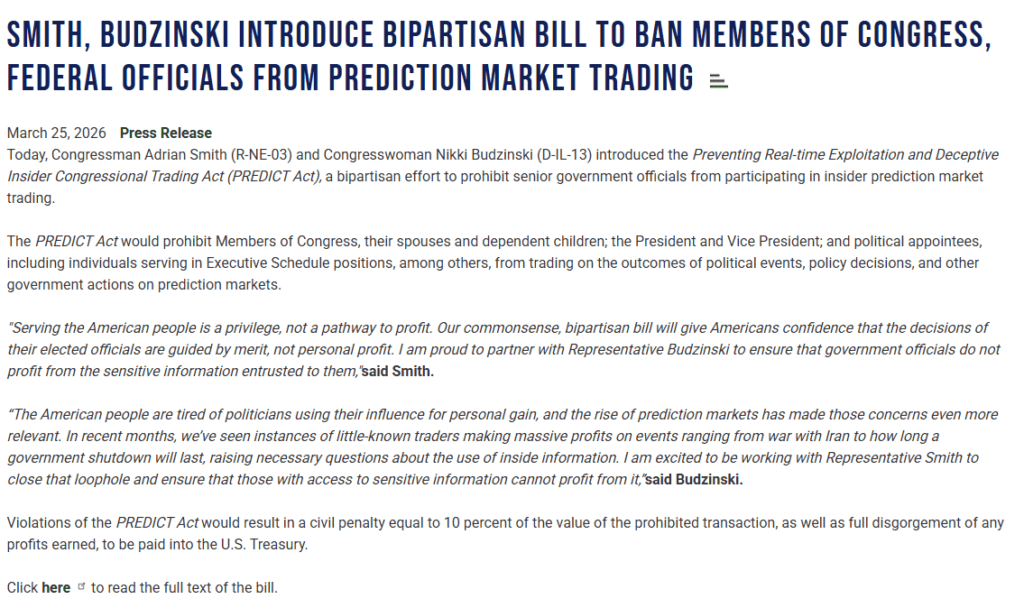
Under the PREDICT Act, violations could trigger a fine of 10% of the total contract value, along with the full forfeiture of profits to the US Treasury. Supporters frame the measure as an effort to remove incentives for officials to use confidential knowledge in prediction markets, which often run on crypto rails or operate as blockchain-based platforms.
Additional bills widen the crackdown on prediction markets
The push against prediction markets in Washington is not limited to the PREDICT Act. Earlier this month, two Democratic lawmakers introduced another proposal, the Banning Event Trading on Sensitive Operations and Federal Functions (BETS OFF) Act. Senator Chris Murphy, speaking about that bill, claimed it was likely that some market participants had used inside information to bet on former US President Donald Trump’s military actions involving Iran.
Beyond insider concerns, lawmakers are also focusing on contracts that resemble gambling products. At the federal level, Senators John Curtis and Adam Schiff put forward a bill on Monday that would prohibit any Commodity Futures Trading Commission (CFTC) registered entity from listing prediction market contracts that look like sports bets or casino-style games. They argue that some companies are listing large volumes of contracts that are “indistinguishable from gambling,” and criticize what they see as a shift in the CFTC’s enforcement stance.
The senators note that for about fifteen years the CFTC enforced a ban on contracts that involve or reference “gaming,” but say the agency and its chair have recently moved to loosen that approach. They point to CFTC rulemaking and litigation moves as evidence that the regulator is relaxing restrictions just as lawmakers are seeking tighter boundaries around event-based trading.
State and platform responses to mounting pressure on prediction markets
Pressure on prediction markets is also building at the state level. According to recent reporting, 11 US states have already taken legal action against such platforms, with another two states having additional actions pending. While the specific state measures are not detailed, the overall trend signals a broader regulatory sweep that spans both federal and state authorities.
Amid this environment, major platforms in the sector are adjusting their policies. Kalshi and Polymarket, two of the largest prediction market venues, have recently moved to tighten their internal rules in response to the scrutiny. Both platforms have taken steps to prevent professional athletes and political candidates from betting on prediction markets, aiming to reduce conflicts of interest and address concerns over the integrity of their markets.
These changes come as lawmakers increasingly link prediction markets to questions of insider trading, political ethics and gambling regulation. Crypto-native and hybrid platforms that offer event contracts are now navigating a landscape in which access for certain user groups is being restricted by both law and platform policy.
Conclusion
US regulators and lawmakers are escalating their focus on prediction markets, with the PREDICT Act and BETS OFF Act addressing insider use by officials and a separate Senate proposal targeting sports-style contracts at CFTC-registered entities. State-level actions and policy shifts at platforms such as Kalshi and Polymarket show that the pressure extends across jurisdictions and market participants, leaving the sector to operate under tightening rules around who can trade and which events can be listed.
Disclaimer
The information provided in this article is for informational purposes only and should not be considered financial advice. The article does not offer sufficient information to make investment decisions, nor does it constitute an offer, recommendation, or solicitation to buy or sell any financial instrument. The content is opinion of the author and does not reflect any view or suggestion or any kind of advise from CryptoNewsBytes.com. The author declares he does not hold any of the above mentioned tokens or received any incentive from any company.
Featured image created by AI