3 Key Facts
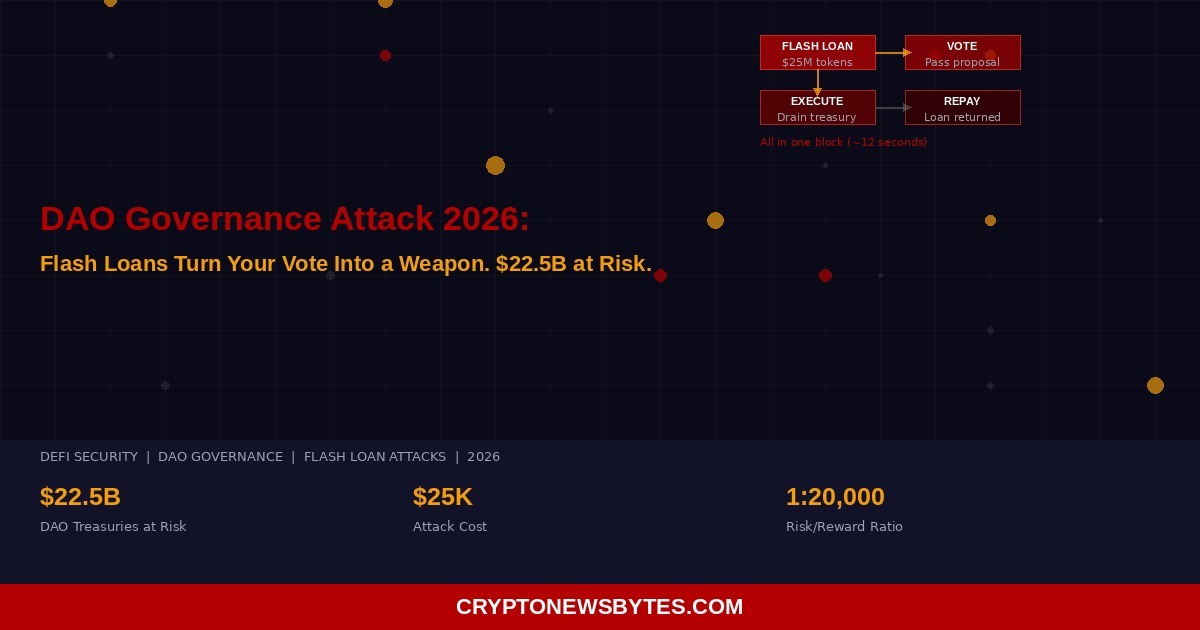
$22.5 billion sits in DAO treasuries governed by token-based voting systems, per 2025 data. Voter turnout across major DAOs averages below 10%. The Compound GoldenBoyz governance capture attempt in 2024 demonstrated that attackers needed only slightly more than 4-5% of total supply to near-feasibly redirect $25 million in COMP tokens. At those participation levels, governance attacks do not require a majority. They require only slightly more than apathy.
The definitive proof of concept is Beanstalk Farms in April 2022: an attacker borrowed $1 billion in flash loans from Aave, accumulated 67% of governance voting power, passed two malicious proposals in a single block using the protocol’s emergencyCommit() function, drained $182 million in collateral, and repaid the loans before the block settled. Per CertiK and CoinDesk, the smart contracts and governance procedures functioned exactly as designed. It was not a hack. It was a legitimate governance action carried out with borrowed authority.
In 2026, the same vulnerability class has gone multi-chain. Uniswap governance now spans Ethereum, Arbitrum, Base, Optimism, and Unichain. Aave V4 is deploying cross-chain functionality. Lido has explicitly stated it paid security researchers to try to break its Dual Governance design with flash loans, per Blockworks. The cross-chain version of this attack is harder to detect, potentially cheaper to execute, and has not yet happened at scale.
The biggest DeFi risk in 2026 is not a bridge hack. It is a governance proposal that passes.
The security industry spent 2022 to 2024 hardening bridge infrastructure after Wormhole ($320M), Ronin ($625M), and Nomad ($190M). Signature validation was tightened. Multisig thresholds were raised. Monitoring was improved. But while teams were reinforcing the pipes, a different attack surface was quietly expanding: the authority to control protocols was being distributed across chains through the same messaging layers that were built to move tokens, not make decisions.
Modern DAOs do not just bridge assets. They bridge governance. Voting power, delegations, and proposal execution rights flow across chains through infrastructure that was designed for asset transfers, not democratic security. The resulting desynchronisation between chains creates windows that an attacker can exploit without touching a bridge at all. The attack does not look like a hack. It looks like a proposal that passed.
This article breaks down how cross-chain governance attacks work, the real incidents that prove the economics, why the multi-chain expansion of major DAOs has dramatically increased the surface area, and what defensive patterns are actually being deployed. For context on flash loan mechanics, see our analysis of the $50M AAVE swap loss and how flash loans work in the MEV context. For the regulatory environment that governs DAO protocols, see the CLARITY Act 2026 guide.
| $22.5B In DAO Treasuries | <10% Average Voter Turnout | $182M Beanstalk (2022) | <$25K Est. Attack Cost vs $500M |
1. The Ghost Vote Problem: Plain English
To understand cross-chain governance attacks, start with a basic fact about blockchains: they do not talk to each other in real time. When you cast a vote on Chain B that references voting power held on Chain A, there is a lag between when the vote is cast and when it is verifiable. Attackers live in that lag.
Here is how a single-chain flash loan governance attack works, because it is the foundation everything else builds on. Flash loans allow a user to borrow any amount of tokens from a lending protocol, execute arbitrary transactions, and repay the loan, all within a single Ethereum block (approximately 12 seconds). No collateral required. The loan is atomically guaranteed by the block’s execution logic: if repayment fails, the entire transaction reverts.
On a single chain, this creates a window where an attacker momentarily holds enormous voting power. If the governance contract checks balances at the moment of the vote, and there is no snapshot requirement or time lock, the attacker can: borrow 10 million governance tokens, vote on a malicious proposal, repay the loan, and the vote is recorded as legitimate. The Beanstalk exploit used exactly this mechanic in April 2022 to drain $182 million.
Cross-chain governance adds a second exploit layer. When voting power is bridged from Chain A to Chain B through a messaging protocol, the destination chain receives a message saying “address X has Y voting power.” The destination chain trusts this message. It does not independently verify the current state of Chain A. And it especially does not verify what happened to those tokens in the time between the message being sent and the vote being recorded.
The cross-chain governance attack: step by step
How borrowed voting power persists after repayment across chains.
2. The Proof of Concept: Beanstalk, $182 Million, One Block
On April 17, 2022, an attacker demonstrated that governance attacks at scale are not theoretical. On a single chain, without any cross-chain complexity, the attack executed from start to finish in a single Ethereum block.
The mechanics, per CertiK’s post-mortem and Merkle Science analysis: the attacker first planted a malicious governance proposal 24 hours earlier, disguising it as a donation to Ukraine relief. Beanstalk’s emergencyCommit() function required a supermajority of governance power to execute a proposal immediately, bypassing the standard voting delay. The attacker waited for the 24-hour window to pass, then acted.
In the same block: borrowed $1 billion in DAI, USDC, and USDT from Aave, converted the borrowed funds into Beanstalk’s Stalk governance tokens accumulating 67% of all voting power, called emergencyCommit() to execute the malicious proposal immediately, drained all $182 million in protocol collateral to their wallet, removed all positions, repaid the flash loans. Net profit: approximately $76-80 million. Beanstalk lost everything. The Stalk token collapsed 83%.
The critical point, stated explicitly by the Beanstalk team afterward: the smart contracts and governance procedures functioned exactly as designed. There was no bug. There was a design. The design allowed governance tokens to be borrowed and voted in the same block. The rest followed logically.
3. The 2026 Vulnerability Map: Four Root Causes
Cross-chain governance attacks are not a single vulnerability but a cluster of four distinct failure modes that interact. Understanding each one separately clarifies why they are difficult to fix without deliberately accepting trade-offs in usability or decentralisation.
| Root Cause | What Goes Wrong | Real Example |
|---|---|---|
| Balance consistency assumptions | Chain B’s governance contract trusts a message from Chain A about a user’s voting power. It assumes that balance is still accurate at the time of the vote. But Chain A state may have changed since the message was sent. The message is a snapshot, not a live feed. | Cross-chain token bridges that pass balance proofs via LayerZero or Wormhole without requiring vote-time verification on the source chain. |
| Temporal desynchronisation | Different chains have different finality times. Ethereum mainnet finalises in ~12 minutes. Arbitrum in ~7 days (optimistic challenge period). Base in seconds. A vote cast on Base during the finality window of an Arbitrum transaction creates an arbitrage window where the same capital can effectively vote twice. | Any DAO that counts votes from multiple chains without normalising to a single finality checkpoint. |
| Wrapped token double-counting | When a governance token is bridged from Ethereum to Arbitrum, a wrapped version is minted on Arbitrum. If both the original token on Ethereum AND the wrapped token on Arbitrum carry voting rights in the same governance system, a holder can vote twice with the same underlying capital. | Lido explicitly addressed this: wrapped versions of stETH used in restaking are not eligible to vote directly, per Blockworks reporting on Lido’s Dual Governance design review. |
| Low participation amplifier | With voter turnout below 10% across major DAOs, an attacker does not need a majority. They need slightly more than apathy. The Compound GoldenBoyz attack series (proposals 247, 279, 289 in 2024) attempted to redirect 499,000 COMP worth $25 million with only 4-5% of total supply participating. | Jupiter DAO suspended all voting through 2026 for governance reform, per SpottedCrypto, citing the structural risks of low-participation governance. |
Single-chain vs cross-chain attack: what changes
Cross-chain breaks the constraint that made single-chain attacks hard to execute.
4. Why 2026 Is the Critical Window: The Multi-Chain Expansion
The attack surface for cross-chain governance has grown significantly in 2025 and into 2026, driven by the major DeFi protocols deploying their governance token authority across multiple chains simultaneously.
Uniswap governance now spans Ethereum mainnet, Arbitrum, Base, Optimism, Polygon, and Unichain (Uniswap’s own Layer 2, launched February 2025). The protocol is actively voting on fee activation across all these chains, with the UNIfication proposal moving through governance in late 2025. Each chain where UNI tokens exist and carry governance weight is a potential attack surface. Unichain, with 1-second block times and 200ms Flashblocks via a Flashbots partnership, creates particularly tight finality windows that interact with the longer settlement times of other chains in the governance network.
Aave V4, currently under development, includes cross-chain functionality as a core feature. Aave already operates on Ethereum, Avalanche, Polygon, and Base. The AAVE governance token carries authority across these deployments. Each additional chain is a new vector where voting power bridging could be exploited.
Lido, the largest liquid staking protocol with $33 billion in TVL, has officially adopted Chainlink’s CCIP as its cross-chain infrastructure for wstETH. Lido has also implemented Dual Governance, a design explicitly hardened against flash loan attacks. Hasu and Victor from Lido’s DAO operations team told Blockworks: “We have paid people to try to break the design with flash loans.” Wrapped versions of stETH used in EigenLayer restaking or Pendle yield strategies are explicitly excluded from voting. That Lido specifically built and tested against this attack vector confirms the threat is real and known.
Compound faces the reality documented in the GoldenBoyz attack series: with voter turnout of 4-5%, governance capture of a $25M COMP allocation was near-feasible for well-funded attackers. Compound’s cross-chain deployments extend that surface area.
5. The Economics Are Brutal: The Attack Math
The numbers come from the DEV Community analysis of cross-chain governance attack economics, which models the cost structure clearly. The inputs are voter turnout, treasury size, and flash loan fee rates.
| Input | Value | Notes |
|---|---|---|
| Treasury size | $500M | Conservative for major DAOs. Total DAO treasury assets exceed $22.5B. |
| Voter turnout | 10% | Industry average. Lido’s Dual Governance on-chain vote had 4% at time of reporting, per Blockworks. |
| Voting power required | ~$25M in gov tokens | Slightly more than 10% of total supply at 10% turnout. Varies by quorum rules. |
| Flash loan fee | 0.09% | Aave standard rate. 0.09% on $25M = $22,500. |
| Bridge + gas fees | $50-500 | Per cross-chain message, depending on bridge and chains used. |
| Total attack cost | < $25,000 | Against a $500M treasury. Risk/reward ratio: 1:20,000. |
Note: This is a theoretical model based on publicly available attack economics. Actual attack feasibility depends on liquidity depth, governance token market caps, specific quorum rules, and whether defensive patterns described below are in place. Presented as a risk framework, not a playbook.
It is worth noting that in practice, executing a cross-chain governance attack requires more than just the economics: the attacker needs to design a malicious proposal that passes community scrutiny before voting, have a vehicle for extracting the treasury, and manage the governance process across chains. But the Beanstalk case proved that social engineering can bypass scrutiny (BIP-18 was disguised as a Ukraine donation), and the economic incentives at these ratios make sophisticated attacks financially rational.
6. Defensive Patterns That Actually Work
The good news is that defences exist, are being implemented, and some have been specifically battle-tested against flash loan vectors. The bad news is that adoption is uneven, and each defence involves a genuine trade-off against convenience or decentralisation.
| Defence | How It Works | Trade-off | Who Uses It |
|---|---|---|---|
| Vote finality delays | Only count votes after the source chain has reached finality. Cross-chain votes are held in escrow until the originating chain confirms the balance with finality guarantees, not just probabilistic confirmation. | Slows voting cycles. Cross-chain proposals take longer to settle. | Emerging standard. Not yet universal. |
| Pre-proposal snapshots | Voting power is calculated from a snapshot taken 24+ hours before the proposal was created, not at vote time. Tokens acquired after the snapshot carry no voting weight on that proposal. Flash loans cannot borrow retroactively. | Requires precise snapshot oracle infrastructure across all chains. | Compound, Aave, Uniswap on mainnet. Cross-chain snapshot oracles still maturing. |
| Time-weighted voting power | Voting weight accumulates over time based on how long tokens have been held. A flash loan gives no holding period credit. Tokens held for 7 days might get 1x weight; held for 6 months gets 2x. Curve Finance’s veCRV model is the best-known example. | Favours long-term holders over new participants. Reduces liquidity. | Curve (veCRV), Frax, newer governance designs. |
| Optimistic delays with veto | A 48-72 hour delay between vote passing and execution, during which any stakeholder can flag suspicious activity for review. Also called a “challenge period.” Lido’s Dual Governance is the most sophisticated version, where stETH holders can effectively veto actions that threaten their interests. | Slows execution. Requires active community watchdogs. | Lido Dual Governance (flash-loan tested). Compound timelock. Most major DAOs. |
| Wrapped token exclusion | Bridged or wrapped versions of governance tokens are explicitly excluded from voting rights. Only the canonical token on the primary chain votes. Eliminates double-counting entirely but reduces participation from L2 holders. | Centralises governance on the primary chain. L2 users cannot vote. | Lido explicitly excludes wrapped stETH from voting, per Blockworks. |
7. The Technical Fix: Why veTokens Make This Attack Mathematically Impossible
Of all the defences available, time-weighted voting via vote-escrowed tokens (veTokens) is the only one that does not just slow the attack or raise its cost, it eliminates the economic premise entirely. Here is why, with the math.
The core of every flash loan governance attack is a simple arbitrage: borrow tokens, extract value from governance, repay tokens, keep profit. The attacker’s holding period is measured in seconds. Time-weighted voting destroys this by making voting power a function of both quantity and duration. A flash loan provides zero duration. Zero duration means zero voting power. There is nothing to arbitrage.
The veToken Formula
The canonical implementation is Curve Finance’s veCRV model. The formula for voting power is:
veToken voting power formula
| ve_power = tokens_locked × (t_remaining / t_max) | where t_max is the maximum lock period (e.g. 4 years in Curve) |
| 100 tokens locked 4 years | = 100 vePower (full weight) |
| 100 tokens locked 1 year | = 25 vePower (0.25x) |
| 100 tokens locked 1 week | = 0.48 vePower (0.0048x) |
| 100 tokens flash-loaned (~12 seconds) | = 0.0000001 vePower (~0) |
A flash loan held for 12 seconds against a 4-year maximum lock period produces voting power of approximately 0.0000001x the face value of the borrowed tokens. To match the voting power of someone who has locked 1,000 tokens for 4 years, the attacker would need to flash-borrow roughly 10 billion tokens, a sum that does not exist in any governance token’s total supply and would be impossible to source as a flash loan even if it did.
Why the Attack Economics Collapse
Recall the attack model from Section 5: borrow $25M in governance tokens, pay $22,500 in flash loan fees, acquire enough voting power to redirect a $500M treasury. That math only works if $25M in borrowed tokens produces $25M worth of voting power.
Under veToken mechanics, $25M in flash-borrowed tokens produces approximately $120 in effective voting power (using the 12-second / 4-year ratio). The attacker would need to borrow the entire governance token market cap, multiplied many times over, to accumulate meaningful voting weight. Flash loan pools do not have that liquidity. Even if they did, the fee on a $5 trillion flash loan would be $4.5 billion, far exceeding any treasury value.
Attack cost under veToken governance: the math
| Scenario | Tokens Needed | Flash Loan Cost | Feasible? |
|---|---|---|---|
| Standard token voting (no time-weight) | $25M | $22,500 | Yes (proven) |
| veToken, 4-year max lock, flash loan (12s) | ~$5 trillion equivalent | ~$4.5 billion | No (pool doesn’t exist) |
| veToken, attacker locks tokens for 1 week | $5.2B at market | $520M capital at risk | No (can’t repay via flash loan) |
Figures illustrative based on Curve veCRV model (4-year max lock). Ratios vary by protocol implementation. Flash loan scenario uses 12-second block time against 4-year maximum = 0.0000095x multiplier.
The third row is important. An attacker who decides to lock tokens for a week rather than flash-loan them does acquire real voting power (0.0048x per token). But now they cannot use a flash loan. They must own $5 billion in governance tokens outright, lock them for a week (during which the market can see the large position and react), and accept that the tokens are illiquid until the lock expires. The capital requirement, market impact, and lock-up period transform the attack from a cheap flash loan arbitrage into an extremely expensive, visible, and slow market manipulation operation.
The Cross-Chain Implementation: Where It Gets Complex
The veToken model works elegantly on a single chain. The complexity in 2026 is implementing it across multiple chains without reintroducing the balance consistency and temporal desynchronisation problems that create the attack surface in the first place.
The key design requirement for a cross-chain veToken system is that the lock record, not just the token balance, must be verified cross-chain. A message from Chain A to Chain B cannot simply say “address X has Y tokens.” It must say “address X has Y tokens locked until timestamp Z, producing V vepower at the current block.” The destination chain must be able to verify that lock record is current and has not been modified since the message was sent.
This requires one of three architectural approaches, each with trade-offs:
| Approach | How It Works | Trade-off |
|---|---|---|
| Single canonical chain | All veToken locking and voting power calculation happens on one chain (typically Ethereum mainnet). Other chains query this chain for voting power but cannot independently modify it. Lido’s current approach: wrapped tokens are excluded, base token on mainnet is the only valid governance instrument. | L2 token holders cannot participate unless they bridge back to mainnet. Reduces multi-chain participation. |
| Cross-chain lock oracles | A trusted oracle (such as Chainlink CCIP) bridges not just token balances but lock records. The oracle attests to the lock timestamp, expiry, and resulting vepower at a specific block. The destination chain accepts votes only from oracle-attested lock proofs, not raw balance messages. | Introduces oracle trust assumption. Oracle compromise becomes a governance attack vector. |
| ZK lock proofs | A zero-knowledge proof attests to a user’s lock state on Chain A without requiring a trusted intermediary. The proof is verifiable on Chain B with mathematical certainty. No oracle needed. Currently experimental; proof generation cost and latency are production barriers. | Computationally expensive today. Likely the production standard in 3-5 years as ZK infrastructure matures. |
What This Means for Investors and DAO Participants
For token holders in multi-chain DAOs, the implications are practical. The governance token you hold is not just an investment in a protocol. It is a component of a security system. Low voter turnout is not just a governance health metric. It is a direct amplifier of attack feasibility.
Before participating in or investing in any multi-chain DAO, the questions worth asking: Does the governance system use pre-proposal snapshots that cover all chains? Is there a timelock or optimistic delay between vote passage and execution? Are wrapped or bridged versions of the governance token excluded from voting or counted separately? Has the governance design been formally reviewed for cross-chain flash loan vectors? Is there a community watchdog process that monitors for suspicious proposal activity?
The protocols that will survive the first major cross-chain governance exploit, whenever it comes, are the ones treating multi-chain voting power as a first-class security concern right now. The infrastructure layer is maturing fast. Governance security, as the Reddit community discussion that surfaced this topic noted, is lagging behind. That gap is where the next nine-figure DeFi loss will likely originate.
For a broader view of where DeFi security is heading in 2026, see our analysis of cyber insurance for crypto firms and the structural lessons from the $50M AAVE swap loss. The regulatory context that could create DAO liability disclosure obligations is covered in the CLARITY Act 2026 guide and the SEC token taxonomy framework.
Frequently Asked Questions
📰 Related Coverage on CryptoNewsBytes
Sources and References
CoinDesk, Beanstalk $182M Exploit · CertiK, Beanstalk Post-Mortem · Merkle Science, Beanstalk Attack Analysis · Blockworks, Lido Dual Governance and Flash Loan Testing · DEV Community, Cross-Chain Governance Attack Economics · Cyfrin, Governance Attack Reference · Medium, DAO Governance Failures 2025 Analysis · Uniswap, UNIfication Governance Proposal
Why veTokens Make Flash Loan Governance Attacks Mathematically Impossible
Time-weighted voting, commonly implemented through vote-escrowed tokens (veTokens), is the single most effective structural defence against flash loan governance attacks. The reason is mathematical rather than procedural: flash loans exist within a single block, lasting approximately 12 seconds on Ethereum. veToken systems require governance power to be locked for weeks, months, or years. There is no mechanism by which a 12-second loan can satisfy a multi-week lockup requirement.
The veToken model, pioneered by Curve Finance with veCRV, works as follows. A holder locks their governance token for a defined period, receiving vote-escrowed tokens in proportion to both the amount locked and the lock duration. Locking 1,000 CRV for four years yields four times the voting power of locking the same 1,000 CRV for one year. Crucially, the veTokens are non-transferable and non-borrowable. They cannot be bought on a secondary market, cannot be lent through a flash loan protocol, and decay over time as the lock period expires.
An attacker who wanted to acquire meaningful veToken voting power would need to lock capital for months in advance, losing the use of that capital for the entire lock period. The attack cost, previously $22,500 in flash loan fees for a $25M governance position, becomes the opportunity cost of locking $25M for a year or more. That is not a flash loan attack. That is a hostile takeover requiring sustained capital commitment and public on-chain visibility.
veToken Defence: Why the Math Works
| Attack Type | Attack Window | veToken Lock Required | Feasible? |
|---|---|---|---|
| Flash loan single-block | ~12 seconds | Minimum 1 week | No |
| Cross-chain ghost vote | 1-2 blocks | Minimum 1 week | No |
| Slow accumulation | Weeks to months | Equal or longer lock | Possible but on-chain visible |
| Whale coalition vote | Proposal period | Existing locked position | Possible, costs real capital |
The limitation of veTokens is that they reduce liquidity and participation. Locking tokens for four years is a commitment that discourages casual governance participants. Protocols that have adopted veToken models, including Curve, Balancer (veBAL), and Frax, have found that governance concentrates among the most committed long-term holders, which is good for security but raises questions about whether governance truly represents the broader token holder base.
For cross-chain DAOs specifically, the veToken model solves the flash loan attack vector but does not solve the oracle problem: the cross-chain messaging layer that reports locked voting power to subsidiary chains must itself be tamper-resistant. A veToken system with a compromised bridge oracle is no safer than a standard token system. The security stack requires both the lockup mechanism and a reliable cross-chain state verification layer to be genuinely attack-resistant.
Disclaimer: This article is for informational and educational purposes only and does not constitute financial, legal, or security advice. The attack economics presented are theoretical models based on published research and historical incidents. Actual attack feasibility depends on protocol-specific governance rules, token liquidity, and defensive measures in place. Always conduct independent security audits and consult qualified professionals before deploying governance systems. Information is current as of March 2026.