
Michael Saylor walked onto the Blockworks Digital Asset Summit stage and opened with a number that sets the frame for everything that follows: $400 trillion. That is the size of the global capital market currently sitting in traditional credit and equity instruments. His argument, laid out over 24 minutes, is that even 10 percent of that capital migrating into digital alternatives represents $40 trillion in flows. And he believes Strategy, through its Bitcoin holdings and STRC preferred stock, is building the infrastructure that captures a meaningful share of it.
This is not a prediction about Bitcoin’s price. It is a structural argument about capital markets, and the numbers Saylor cited at Blockworks are specific enough to be worth examining closely.
| 11.52% STRC Effective Yield ($99.81 / share) | $5B+ STRC Outstanding (March 2026) | $40T Saylor’s Digital Capital Opportunity |
Digital Capital: What Saylor Means When He Says Bitcoin Is Different
Saylor frames Bitcoin as one of several forms of capital competing for the world’s savings. He listed the others explicitly: metallic capital (gold), property capital (New York real estate), cultural capital (a Monet painting), and fiat capital (sovereign debt). Bitcoin, in his framing, is digital capital, the same function as gold or real estate but without physical instantiation.
The adoption evidence he cited at Blockworks is worth noting because it has moved significantly since he began making this argument years ago. The U.S. Treasury, the Fed, the SEC, and the CFTC all now have leadership that accepts Bitcoin as a legitimate capital asset. Morgan Stanley is rolling out Bitcoin ETF access, building derivatives, and offering credit against Bitcoin holdings. There are now 125 Bitcoin ETFs globally holding 1.4 million BTC. And 194 public companies are holding a combined 1.1 million Bitcoin on their balance sheets. Bitcoin represents 66 percent of all non-stablecoin crypto market capitalisation.
His characterisation is straightforward: Bitcoin is the most stable, well-supported, and politically powerful crypto network that exists. Everything else in the digital capital conversation flows from that premise.
Digital Credit: How Strategy Converts Bitcoin Into Cash Flow
The core business argument Saylor made at Blockworks is that the world runs on credit, not capital. He used real estate as the illustration: owning $1 million of Manhattan property for 30 years with no cash flows is not useful if you need income today. The property only becomes useful when you develop it, lease it, and convert the underlying capital into monthly cash flows. Strategy does the same thing with Bitcoin. It takes digital capital and converts it into digital credit.
STRC, the Variable Rate Series A Perpetual Stretch Preferred Stock, is that conversion mechanism. Saylor explained the mechanics at Blockworks in plain terms: Bitcoin carries roughly 30 percent annualised return expectations over the next two decades, but also 30 to 40 percent volatility. STRC strips out the first 11.5 percent of that expected return and packages it into a preferred stock with near-zero volatility. The equity investors in MSTR keep everything above that threshold, which is why MSTR has outperformed Bitcoin itself over a five-year period, averaging around 55 percent annual returns against Bitcoin’s 30 percent. The credit investors in STRC take the lower, stable number with principal protection.
“The world is built on capital, runs on credit,” Saylor said. “Some people want the 71 volatility. Some people want the 1. Depends on what kind of investor you are.”
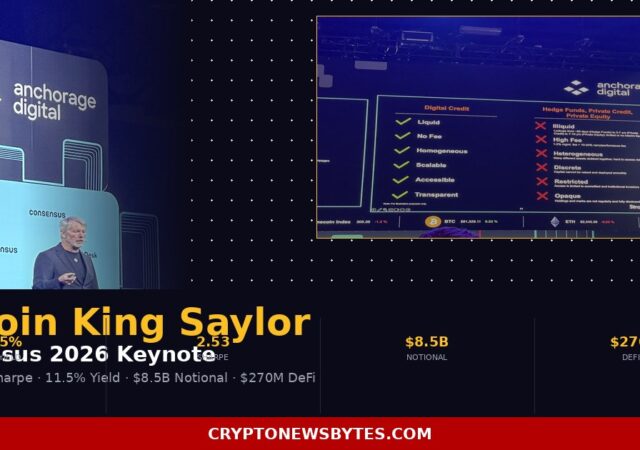
Digital Credit vs Private Credit: What Saylor Claims STRC Has Solved
Source: Michael Saylor keynote, Blockworks Digital Asset Summit 2026. STRC data: strategy.com
| Feature | Private Credit | STRC (Digital Credit) |
|---|---|---|
| Yield | 8.4% avg | 11.5% (variable) |
| Liquidity | Illiquid (5-year lockups) | $224M avg / $400M+ peak (Nasdaq) |
| Transparency | Opaque, heterogeneous | Publicly listed, on-chain backing |
| Fees | High management fees | No management fees |
| Volatility | Low but hidden credit risk | ~2% (vs Bitcoin’s 52%) |
| Sharpe Ratio | ~0.5-0.8 | 3-5 (vs S&P 500’s 0.6) |
| Tax treatment | Ordinary income taxed yearly | Return of capital (deferred) |
How STRC Compares: Yield Across Credit Instruments
Nominal yield vs tax-equivalent yield for a New York City taxpayer (combined ~50% marginal rate). Source: Saylor keynote, Blockworks Digital Asset Summit 2026 | March 2026.
| STRC (Digital Credit) | 11.52% nominal +23% tax-equiv (NYC) | 11.52% |
| Private Credit | 8.4% avg, illiquid, locked 5 years, high fees | 8.4% |
| Investment Grade Corp | SOFR + 80bps spread (return-free risk) | ~5.5% |
| U.S. T-Bills | 3.7%, risk-free rate in dollars | 3.7% |
Tax-equivalent yield for STRC calculated assuming return-of-capital treatment and ~50% combined marginal rate (federal + NY state + NYC). ROC treatment confirmed by Strategy Inc for all 2025 distributions. Consult a tax adviser for your specific situation.
The STRC Tax Advantage: What Return of Capital Actually Means
This was the section of the Blockworks keynote that generated the most interest, and it warrants careful explanation because the mechanics are genuinely unusual. Saylor claimed that STRC dividends function as return of capital rather than ordinary income, meaning holders do not pay federal, state, or city tax on the dividend payments until their original cost basis is fully recovered.
This is confirmed by official filings. On February 2, 2026, Strategy published a press release confirming that 100 percent of distributions paid on all preferred stock instruments in 2025 were treated as non-taxable return of capital for U.S. federal income tax purposes, as reported on IRS Form 8937. The company stated it expects this treatment to continue for ten years or more because it does not have accumulated earnings and profits and does not expect to generate them in the foreseeable future. The SEC filings confirm the March 2026 preferred dividends carry the same expected treatment.
How it works mechanically: when STRC pays an 11.5 percent annual dividend classified as return of capital, you receive the cash but the IRS treats it as a partial return of your original investment rather than income. Your cost basis in the shares decreases accordingly. No tax is owed until either your basis reaches zero or you sell. If you hold until death, your heirs receive a stepped-up basis that can eliminate the deferred tax entirely.
Saylor illustrated the tax equivalent yield at Blockworks: for a taxpayer in Miami Beach, 11.5 percent tax-deferred translates to a tax equivalent yield of approximately 18 percent. For a New York City taxpayer facing combined federal, state, and city income tax, the tax equivalent yield reaches approximately 23 percent. His line from the stage: “It’s like a bank account that pays you 23 percent.”
The important caveat, which Saylor did not dwell on but which independent analysts have flagged: return of capital is tax-deferred, not tax-free. Each dividend payment reduces your cost basis, and when you eventually sell, the lower basis creates a larger capital gain. The tax comes due eventually, either at capital gains rates on sale or potentially never if the stepped-up basis applies at death. Investors should consult a tax adviser regarding their specific situation. (Note: CryptoNewsBytes is not a financial adviser, see our standard investment disclaimer.)
The Sharpe Ratio Claim: Leaving the S&P in the Dust
Saylor made a specific performance claim at Blockworks that is worth examining.
30-Day Volatility: STRC vs Everything Else
Lower is more stable. STRC engineers near-zero volatility by stripping it from Bitcoin and transferring excess returns to MSTR equity. Source: strcincome.com, Saylor keynote | March 2026.
| MSTR Equity | 71% | |
| Bitcoin | 52% | |
| Gold | 33% | |
| S&P 500 | 12% | |
| Typical Bond | ~5% | |
| STRC | ~2% |
Saylor at Blockworks: “We have stripped all of that volatility off of STRC to make it a 2, sometimes 1.” MSTR absorbs the residual volatility, delivering STRC holders a near-bond-like experience on a Bitcoin-backed instrument.
He said STRC’s Sharpe ratio, the measure of risk-adjusted return, sits in the range of three to five. By comparison, the S&P 500 index runs at approximately 0.6, the Nasdaq at 0.7, Nvidia at roughly 1.0, and Google at approximately 2.0. He described STRC as the “lightsaber of money” and suggested it may be the highest Sharpe ratio of any publicly traded liquid instrument ever created.
Independent data from March 2026 confirms the 30-day volatility of STRC is approximately 2.2 percent, against Bitcoin at 52 to 53 percent, MSTR common stock at approximately 71 percent, gold at around 33 percent, and the S&P 500 at approximately 12 percent. The combination of 11.5 percent yield and roughly 2 percent volatility does mathematically produce an unusually high Sharpe ratio, though this metric is calculated over a relatively short track record, STRC launched in mid-2025 and has fewer than 12 months of performance data at the time of the keynote.
Since Bitcoin peaked at around $110,000 in mid-October 2025 and has since declined to approximately $68,000 to $70,000, STRC holders were up approximately 1 percent in price while collecting 5.5 percent in cumulative dividends. Bitcoin holders over the same period were down approximately 43 percent. That performance comparison is the clearest practical illustration of what the instrument does: it trades most of the upside for protection against the downside.
Sharpe Ratio: Risk-Adjusted Return Comparison
Higher is better. Measures return per unit of risk. Saylor: “STRC has got a Sharpe ratio in the three, four, even five range… leaving them all in the dust.” Source: Saylor keynote, Blockworks Digital Asset Summit 2026.
| STRC | 3 to 5 | |
| Google (GOOGL) | ~2.0 | |
| Nvidia (NVDA) | ~1.0 | |
| Nasdaq | 0.7 | |
| S&P 500 | 0.6 |
Sharpe ratio = (return minus risk-free rate) divided by standard deviation of return. STRC figures based on less than 12 months of live performance data since launch in mid-2025. Past performance does not guarantee future results.
Buying 5.3 Bitcoins for Every One Mined: The Synthetic Miner Argument
One of the most striking data points Saylor shared at Blockworks was how STRC issuance translates into Bitcoin acquisition relative to global mining output. In the week of March 2 to 8, 2026, miners produced approximately $221 million worth of Bitcoin. Strategy purchased 1.7 times that amount the same week. The following week, Strategy was buying 5.3 Bitcoin for every single Bitcoin created by a miner anywhere in the world.
“We’ve created synthetic miners,” Saylor said. “We’re mining all of the Bitcoin, and we’re doing it with a credit instrument.”
The practical result: the $1.18 billion STRC issuance in a single week, the first time preferred stock rather than common equity was the primary funding vehicle for Bitcoin purchases, allowed Strategy to acquire Bitcoin at a scale that no single mining company comes close to. The company’s total Bitcoin holdings stood at 762,099 BTC as of March 22, 2026, acquired at a total cost of approximately $57.69 billion at an average price of $75,694 per coin. Strategy now holds approximately 76 percent of all Bitcoin held by treasury companies, per CryptoQuant data, though that concentration is itself a risk factor that independent analysts have flagged. (CoinDesk, March 26, 2026)
Digital Money and Digital Yield: What Saylor Is Building Next
The final section of the Blockworks keynote moved beyond STRC itself into what Saylor sees as the next layer of financial products that STRC makes possible. He described STRC as an intermediate layer, the infrastructure on top of which a generation of new financial products can be built.
He outlined three directions. First, a Bitcoin-backed savings coin: an instrument that looks and feels like a stablecoin, carries 8 to 10 percent yield, and is backed by STRC rather than fiat reserves. Second, leveraged yield products: taking STRC and applying 20 to 80 percent leverage to create instruments paying 15 to 25 percent annually with modest volatility. Third, currency-denominated yield: taking the same structure and redenominating it in yen, euros, pounds, or Australian dollars, targeting investors in low-yield environments, he noted that an 8 percent yen-denominated yield, against the Bank of Japan’s current rate of roughly 70 basis points, represents an extraordinary arbitrage.
The Builder Opportunity: 100-300 Basis Points on $400 Trillion
His call to action at Blockworks was direct: if he were starting a company today and wanted to build a billion-dollar business, he would build a product on top of digital credit. Step it up, step it down, add leverage, change the currency, change the container. The underlying addressable market, in his framing, is $300 trillion in credit investors currently earning SOFR plus a thin spread on instruments he characterises as “return-free risk.” His arithmetic: capturing 1 to 3 percent of a $400 trillion market, keeping 100 to 300 basis points in fees while passing the rest to investors, produces billion-dollar businesses at scale. “The customers and investors would feel like they’ve got the best thing in the world,” he said.
For context on Strategy’s broader Bitcoin accumulation model and how it compares to other institutional buyers, see our earlier analysis of the Strategy World 2026 keynote and the Bitcoin scarcity analysis.
What Saylor Did Not Address at Blockworks
A complete read of the Blockworks keynote requires noting what was left out. Saylor did not address Strategy’s current unrealised loss on its Bitcoin holdings, approximately $5 billion at the time of the keynote, representing a drawdown of roughly 9 percent from the average cost basis of $75,694 against a Bitcoin price near $68,000 to $70,000. He did not address the rising annual dividend obligation, which now exceeds $1 billion across all preferred series, or what happens to that obligation if Bitcoin remains below the average cost basis for an extended period.
He also did not directly address the counterargument made by analysts including those at Protos: that return of capital dividends are not tax-free, only tax-deferred, and that the basis reduction they create means the eventual tax liability grows at an accelerating rate as cost basis is depleted. These are legitimate risks that the Blockworks framing, focused on opportunity, did not engage with.
Strategy has publicly disclosed a $1.44 billion cash reserve designed to cover 24 months of dividend and interest obligations. The $21 billion STRC shelf registration announced in March 2026 provides significant additional capital-raising capacity. Whether that is sufficient insulation against a prolonged Bitcoin downturn is the central question the market is currently pricing.
FAQs: Saylor, STRC, and Digital Credit
Further Reading on CryptoNewsBytes
The Las Vegas keynote where Saylor first outlined the digital capital, credit, money hierarchy and the STRC dual-engine capital model.
The full breakdown of Strategy’s Bitcoin accumulation model, STRC mechanics, and the dual-engine capital approach explained for a general audience.
With Strategy buying 5.3 BTC for every one mined, the supply-side analysis behind why institutional demand is structurally outpacing production.
How the institutional accumulation model that Saylor pioneered is reshaping who holds Bitcoin and what that means for price dynamics.
The competitive pressure on traditional banking that Saylor’s digital credit model sits inside, and why the CLARITY Act matters for yield products.
The regulatory backdrop that makes Saylor’s digital capital hierarchy possible, Bitcoin classified as a commodity removes the biggest legal uncertainty.
The DeFi security context Saylor’s preferred stock model is designed to avoid, centralised, regulated instruments with predictable cash flows instead of on-chain exposure.
Coinbase and Fannie Mae opening mortgage underwriting to Bitcoin assets. If Saylor is right about digital capital, this is what mainstream adoption looks like in the real economy.
Watch the full keynote: Michael Saylor, “Digital Capital, Credit, Money, and Yield,” Blockworks Digital Asset Summit 2026 | Runtime: ~24 minutes.
Primary sources: Blockworks Digital Asset Summit 2026 keynote transcript | Strategy.com ROC press release, February 2, 2026 | Strategy SEC 8-K filings | CoinDesk, March 26, 2026 | strcincome.com tax analysis. This article is for informational purposes only and does not constitute financial or tax advice. Consult a qualified adviser before making investment decisions.