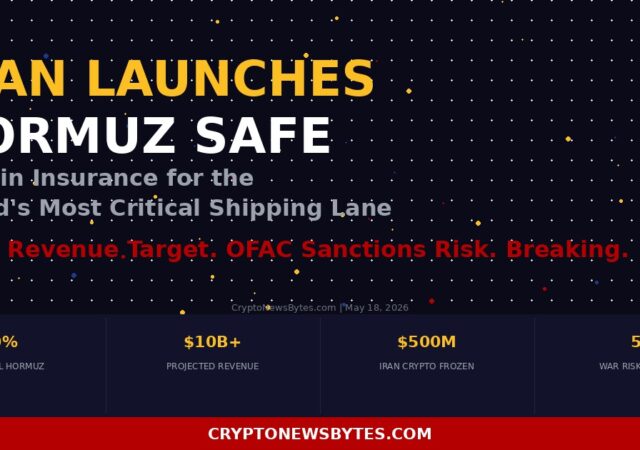
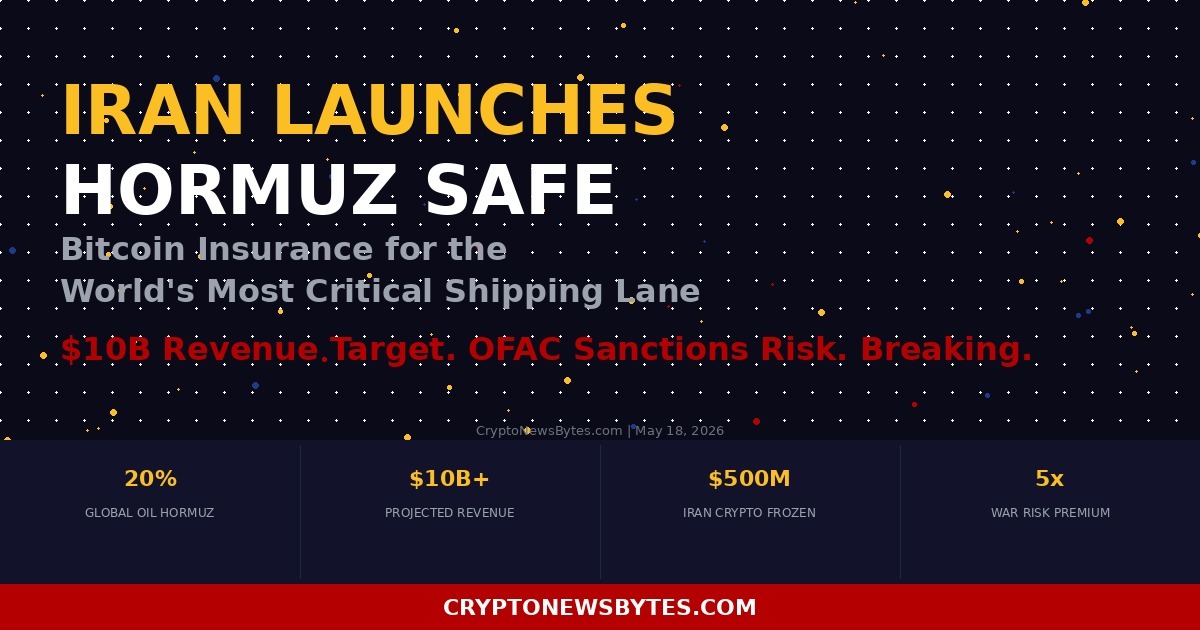
Iran’s Ministry of Economy launched a Bitcoin-settled maritime insurance platform on May 16, 2026. It is called Hormuz Safe. It covers cargo transiting the Strait of Hormuz, the Persian Gulf, and surrounding waterways. Premiums are paid in Bitcoin. Coverage activates the moment the blockchain transaction confirms. A cryptographically signed digital receipt is issued to the cargo owner. And it is structured so that no dollar, no SWIFT message, and no Western financial institution needs to be involved at any point in the transaction.
The Strait of Hormuz handles roughly 20% of the world’s daily oil supply. Iran has effectively controlled it since U.S. and Israeli airstrikes began on February 28, 2026. The platform reportedly projects more than $10 billion in annual revenue. Whether it becomes a functioning insurance market or remains a state-media announcement is not yet clear. What is clear is the strategic logic behind it: Iran is attempting to convert geographic control over the world’s most important energy chokepoint into a crypto-denominated revenue stream that no foreign government can touch.
How Hormuz Safe Actually Works
The Fars News Agency report, authored by Fatemeh Sadeghi and citing documents obtained from Iran’s Ministry of Economic Affairs and Finance, describes a three-step operational sequence. A vessel operator selects a risk tier and transmits the designated premium in Bitcoin to a state-controlled wallet. The moment the transaction receives blockchain confirmation, the cargo is considered insured. The owner receives a cryptographically signed digital receipt usable as proof of coverage.
The policy framework primarily covers inspection, detention, and physical confiscation of vessels by regional actors. War damage is explicitly excluded. The website hormuzsafe.ir, which is not accessible outside Iran, showed a landing page as of the time of reporting. Full policy terms, underwriters, exclusions beyond war damage, and claims procedures have not been publicly released. CoinDesk could not independently verify whether the platform is operational or has processed any actual policies.
The platform is described by Fars as targeting “Iranian shipping companies and cargo owners” specifically. The framing matters: this is not positioned as a neutral international insurance market. It is a state-linked financial product designed to generate revenue for the Iranian government from cargo passing through waters Tehran claims to control, settled in a currency that cannot be frozen, blocked, or intercepted through Western financial channels.
The Geopolitical Context: Why This Is Happening Now
U.S. and Israeli airstrikes on Iran began on February 28, 2026, following the killing of Iran’s Supreme Leader Ayatollah Ali Khamenei. Iran responded by closing the Strait of Hormuz to shipping from countries it designated as enemies. Since then, the IRGC has been operating an informal toll system for commercial vessels seeking passage. Reports from early April confirmed that ships were being charged in cryptocurrency, including Bitcoin, USDT, and Chinese yuan, with some tanker operators paying up to $2 million per transit at the height of regional conflict, approximately $1 per barrel of oil cargo.
Iran’s parliament passed the Strait of Hormuz Management Plan in March 2026, a law that formally codified the transit fee system the IRGC had already been operating. On May 18, the same day Hormuz Safe’s wider media coverage broke, Iran’s Supreme National Security Council announced the formation of the Persian Gulf Strait Authority, a new body to manage the waterway and provide real-time operational updates. Hormuz Safe fits into that institutional architecture as the financial layer: rather than imposing an explicit toll that every government and international body would immediately condemn, Iran has structured passage fees as insurance premiums, giving the transaction a veneer of commercial legitimacy.
Babak Zanjani, an Iranian businessman with a documented history of helping Iran evade sanctions and who was released from prison last year after having his death sentence commuted, first promoted the Hormuz Safe concept on May 8, sharing details with his followers within minutes of the Fars publication. His involvement in the scheme’s public promotion is not a peripheral detail.
Hormuz Crisis and Bitcoin Monetization: Timeline
From US-Israeli strikes to Hormuz Safe launch | @cryptonewsbytes
Feb 28, 2026: US-Israeli airstrikes begin
Iran’s Supreme Leader Khamenei killed. Iran closes the Strait of Hormuz to enemy-linked vessels. Global war risk insurance premiums spike up to 5x within days.
March 2026: IRGC toll system begins
Iran’s parliament passes the Strait of Hormuz Management Plan. IRGC begins charging crypto-based transit fees. Vessels required to submit ownership, cargo, destination, and crew details.
Early April 2026: Crypto fees confirmed
Shipping operators confirm fees of roughly $1/barrel in BTC, USDT, or yuan. Some tankers pay up to $2M per transit. US naval blockade of Iranian ports begins April 13.
Late April 2026: OFAC freeze
US freezes nearly $500M in Iranian crypto assets. Tether freezes $344M in USDT across two Tron addresses at OFAC’s request. Iran accelerates Bitcoin-native infrastructure.
May 8, 2026: Zanjani promotes Hormuz Safe
Babak Zanjani, former sanctions evader released from death row in 2025, shares Hormuz Safe concept publicly. Fars News publishes originating report on May 16.
May 16-18, 2026: Hormuz Safe launches
Ministry of Economy formally announces platform. PGSA announced same day. Bloomberg, CoinDesk, Al Jazeera, and Bitcoin Magazine cover within hours. Operational status unconfirmed.
Sources: Fars News, Al Jazeera, Bloomberg, crypto.news, Insurance Journal, Bitcoin Magazine | @cryptonewsbytes
Why Bitcoin Specifically, and Why It Creates Immediate Sanctions Exposure
Iran’s choice of Bitcoin as the settlement layer is not incidental. The OFAC freeze of $344 million in USDT from two Tron addresses in late April demonstrated that stablecoins can be frozen at the issuer level. Tether controls the USDT contract and can blacklist addresses on request from regulators. Bitcoin has no equivalent central control point. No issuer can freeze a Bitcoin transaction. No government can instruct a protocol to reverse a payment. For a sanctions-constrained state attempting to collect fees from international shipping, Bitcoin’s properties are not ideological, they are operational.
The problem for any shipping company or cargo owner considering the platform is that U.S. secondary sanctions do not distinguish between payment methods. OFAC’s Iran sanctions prohibit U.S. persons and, under secondary sanctions, non-U.S. companies from engaging in transactions with designated Iranian entities. Whether a premium is paid in dollars, USDT, or Bitcoin is legally irrelevant. The transaction itself is the violation. Greek maritime risk firm MARISKS has already warned shipping companies that scammers are impersonating Iranian authorities and demanding fake crypto payments for safe passage clearances, adding a fraud layer on top of the legal exposure.
“No one can freeze it,” said Sam Lyman, Research Director at the Bitcoin Policy Institute, summarizing the core utility of Bitcoin for sanctioned states in the current geopolitical environment. That framing cuts to the operational logic precisely: Hormuz Safe is not a bet on Bitcoin’s price. It is a bet on its censorship resistance. Bitcoin’s volatility introduces a separate commercial problem. Unlike stablecoins pegged to a fiat currency, Bitcoin’s value can move 10% or more in the time between when a premium is priced and when it is paid. A shipping company taking out a policy priced at a specific dollar equivalent in BTC faces basis risk on every transaction. Iran’s own state media acknowledged this indirectly by noting that other cryptocurrencies may also be accepted, which suggests the platform may offer flexibility on settlement currency despite the Bitcoin framing.
Hormuz Safe: What Works, What Does Not, and What Is Unknown
Operational reality check as of May 18, 2026 | @cryptonewsbytes
What is established
Fars News published originating report May 16. Ministry of Economy cited as source. hormuzsafe.ir domain exists. BTC settlement confirmed by Fars. IRGC toll system already operational since March.
What creates legal exposure
OFAC secondary sanctions apply regardless of currency. Payments to Iranian state-linked entities trigger violations. No country or shipping firm has publicly confirmed using it. US warned against transit fee payments.
What is not yet known
Whether platform is live and processing policies. Full underwriting terms and claims process. Whether IRGC controls the wallet infrastructure. How $10B revenue figure was calculated. Site inaccessible outside Iran.
Active fraud risk
MARISKS (Greek maritime risk firm) has warned shipping companies of scammers already impersonating Iranian authorities and demanding fake crypto safe-passage payments.
Sources: CoinDesk, Bloomberg, Al Jazeera, Insurance Journal, MARISKS | @cryptonewsbytes
The Bigger Signal: Bitcoin as State-Level Geopolitical Infrastructure
What Hormuz Safe represents, regardless of whether it processes a single policy in its first year of operation, is a qualitative shift in how nation-states are deploying Bitcoin. For the first decade of its existence, Bitcoin’s state-level use cases were primarily passive: mining it, holding it as a reserve, or tolerating it as an unofficial parallel financial system. El Salvador’s legal tender adoption in 2021 represented the first mainstream attempt to integrate it into formal state financial infrastructure. What Iran is attempting with Hormuz Safe is categorically different.
Iran is not mining Bitcoin or holding it. It is using Bitcoin’s settlement properties as the financial layer for asserting administrative control over a critical piece of global physical infrastructure. The Strait of Hormuz is not a metaphor. It is the single most important energy chokepoint in the world. If Hormuz Safe becomes operational at any meaningful scale, Bitcoin will be the currency in which access to 20% of global oil supply is priced and settled. That is not a retail payments use case or a store-of-value argument. It is state-level weaponization of a decentralized monetary network against the dollar-based financial system that underpins Western sanctions enforcement.
The US and China have both publicly stated that no country should be allowed to impose tolls for transit through the Strait. An uneasy ceasefire between the US and Iran has been in place since early April. Treasury Secretary Scott Bessent has said China could play a role in reopening the Strait. Prediction market Polymarket showed traders expecting traffic through the Strait to remain disrupted in the short term, with possible resolution by year-end. Whether Hormuz Safe survives a diplomatic resolution, or whether it is precisely the kind of mechanism that makes a diplomatic resolution harder to reach, is a question that connects the crypto policy world directly to the energy markets and the geopolitics of the ongoing US-Iran conflict.
Frequently Asked Questions
What is Hormuz Safe?
Hormuz Safe is a digital maritime insurance platform launched by Iran’s Ministry of Economy on May 16, 2026, reported by the IRGC-affiliated Fars News Agency. It offers cryptographically verifiable insurance policies for cargo transiting the Strait of Hormuz, the Persian Gulf, and surrounding waterways, with premiums settled in Bitcoin. Coverage activates upon blockchain confirmation, and a digital signed receipt is issued to the cargo owner. The website hormuzsafe.ir is not accessible outside Iran, and whether the platform has processed any live policies has not been independently confirmed.
Is it legal for shipping companies to use Hormuz Safe?
For companies subject to U.S. jurisdiction, using Hormuz Safe would almost certainly violate OFAC’s Iran sanctions. U.S. secondary sanctions also apply to non-U.S. companies in many cases. The payment currency, whether Bitcoin, USDT, or any other, is legally irrelevant under sanctions law. What matters is that the payment goes to a designated Iranian entity. The U.S. government has explicitly warned shipping companies that payments to Iran for safe passage through the Strait could expose them to sanctions violations. Any company considering the platform should obtain legal advice before any interaction.
Why did Iran choose Bitcoin rather than a stablecoin?
The OFAC-directed freeze of $344 million in USDT from Iranian-linked Tron addresses in April 2026 demonstrated that stablecoins can be frozen at the issuer level. Tether can blacklist wallet addresses. Bitcoin has no equivalent central authority. No government can instruct the Bitcoin protocol to reverse or freeze a transaction. For a sanctioned state collecting fees from international shipping, Bitcoin’s censorship resistance is an operational feature, not a philosophical position.
What is the $10 billion revenue projection based on?
Fars News cited the $10 billion figure without providing a time frame, a breakdown of how it was calculated, or the assumptions behind it. No independent source has verified the projection. The Strait of Hormuz handles roughly 20% of global daily oil supply, which represents trillions of dollars in annual cargo value. At $1 to $2 per barrel of oil in transit fees, the arithmetic could theoretically reach that range under certain assumptions, but the figure as stated by Fars News is unverified and unattributed.
Further Reading
Iran is using Bitcoin to route around Western sanctions. Wall Street is using it to build GENIUS Act-compliant reserve infrastructure. Two completely different use cases of the same monetary network, running in parallel.
While Iran deploys Bitcoin as sanctions-evasion infrastructure, the U.S. is building the regulated alternative: nationally chartered stablecoin banks with Fed master account access and 24/7 programmable clearing.
The geopolitical case for accelerating U.S. crypto regulation has never been more concrete. Iran’s Hormuz Safe is exactly the kind of state-level crypto deployment that gives urgency to the CLARITY Act debate in Washington.
This article is for informational purposes only and does not constitute financial or legal advice. Sources: Bloomberg, CoinDesk, Al Jazeera, Insurance Journal, Fars News Agency. Published May 18, 2026.