TL;DR
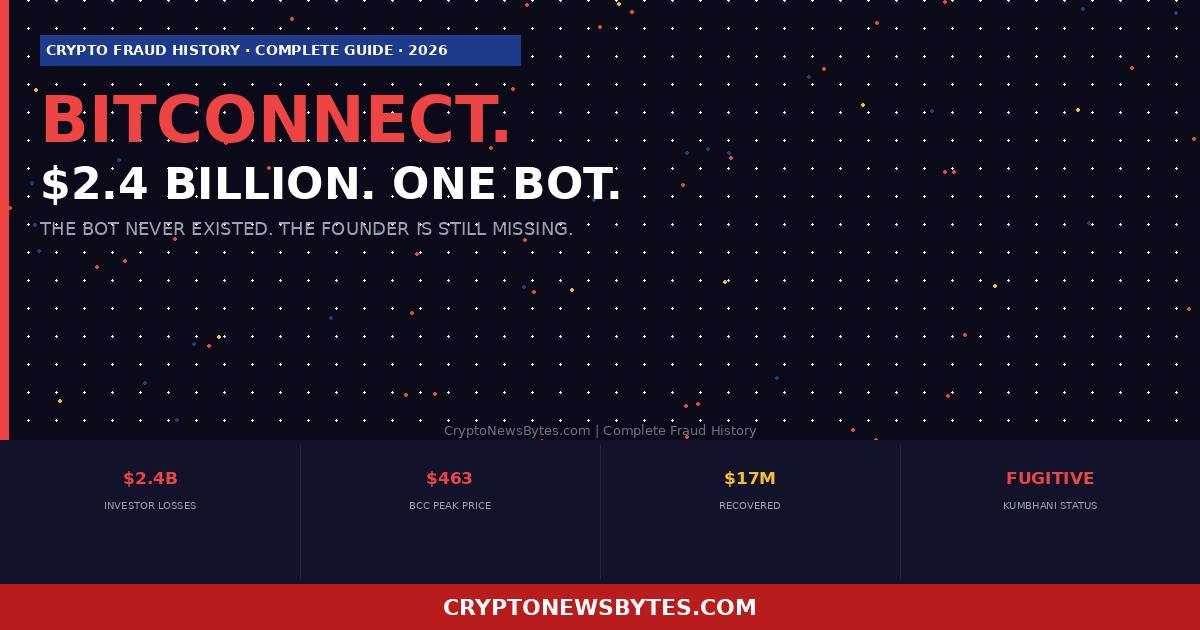
▶ BitConnect raised over $2.4 billion from investors worldwide between 2016 and 2018 promising up to 1% daily returns via a proprietary trading bot.
▶ The trading bot never existed. Returns were paid using new investor deposits. Classic Ponzi mechanics.
▶ At its peak, BitConnect Coin hit $463 with a $3.4 billion market cap, placing it in the top 20 cryptocurrencies.
▶ On January 16, 2018, BitConnect shut down. BCC collapsed over 90% in days. Investors received near-worthless tokens.
▶ Founder Satish Kumbhani was indicted February 2022 and remains a fugitive. Top US promoter Glenn Arcaro pleaded guilty and was ordered to repay $24 million.
▶ Total restitution recovered: over $17 million. Total losses: $2.4 billion. Less than 1% returned.
In December 2017, at the height of the cryptocurrency bull market, a platform called BitConnect had a market capitalisation of $3.4 billion. Its native token BCC had risen from $0.17 to $463 in under a year. Hundreds of thousands of investors from more than a dozen countries had locked their Bitcoin into its lending programme in exchange for daily interest payments. YouTube channels dedicated to BitConnect had millions of subscribers. Its promoters held stadium-scale events. One investor named Carlos Matos became so famous for his enthusiastic conference speech that the video became one of the most recognisable moments in crypto history.
Six weeks later it was gone. On January 16, 2018, BitConnect shut down its lending platform and exchange. Investors were repaid in BCC tokens at a fixed rate of $363 per coin. Within days of trading resuming on open markets, BCC collapsed more than 90%. People who had invested their life savings, remortgaged their homes, or borrowed money to participate received tokens worth almost nothing. Total investor losses were approximately $2.4 billion.
This is the complete story: how BitConnect worked, how it fooled investors, who ran it, how regulators caught them, what happened in court, and what the picture looks like in 2026. It also covers the warning signs that were visible from the beginning, the people who sounded the alarm, and why the vast majority of investors ignored them.
What Is BitConnect?
BitConnect was a cryptocurrency lending platform and Ponzi scheme that operated from 2016 to January 2018. Founded by Satish Kumbhani, it promised investors returns of up to 1% per day, approximately 3,678% annually, through a proprietary Bitcoin trading bot and volatility software. The trading bot never existed. Investor returns were paid using deposits from newer investors, the textbook definition of a Ponzi scheme. BitConnect collected more than 325,000 Bitcoin from investors worldwide before collapsing in January 2018, with total losses estimated at $2.4 billion.
BitConnect is widely considered the largest cryptocurrency fraud in history by total funds raised. Its native token BitConnect Coin (BCC) rose from $0.17 at launch to $463 at its peak in December 2017, then collapsed more than 90% within days of the platform shutting down. The US Securities and Exchange Commission and Department of Justice subsequently charged BitConnect’s founder, top promoters, and regional distributors. Founder Satish Kumbhani remains a fugitive as of 2026.
How BitConnect Actually Worked: The Ponzi Mechanics Explained
What is a Ponzi scheme?
A Ponzi scheme is a fraud where returns paid to existing investors come from new investor deposits rather than from any legitimate business activity. The scheme requires a continuous inflow of new money to pay earlier participants. When new money stops, or when too many investors try to withdraw simultaneously, the scheme collapses. Ponzi schemes are named after Charles Ponzi, who ran a large-scale version in 1920. BitConnect used a cryptocurrency trading bot as its cover story. The bot never generated the returns investors were paid. New deposits did.
BitConnect was founded by Satish Kumbhani, an Indian national, in 2016 and launched its initial coin offering in November of that year. The pitch was built to appeal to the specific psychology of the 2017 crypto market: BitConnect claimed to have a proprietary Trading Bot and Volatility Software that exploited Bitcoin price movements to generate consistent daily returns. Investors could participate by lending BCC tokens to the platform and receiving daily interest payments, compounded into their principal.
The structure had four layers. First, the lending programme: investors locked Bitcoin on the platform and received BCC tokens in exchange. Second, the promise of returns: up to 1% per day compounded, approximately 3,700% annually at maximum. Third, a tiered system where larger deposits unlocked higher returns, incentivising investors to put in more. Fourth, a referral programme where existing investors earned commissions for recruiting new ones, creating a multi-level marketing structure that did the growth work for the platform.
No evidence of the trading bot was ever produced. Not during the platform’s operation, not during regulatory investigations, not during criminal proceedings. The SEC complaint filed September 1, 2021 found no proof of any legitimate trading operation. The DOJ indictment of Kumbhani in February 2022 found no evidence of an operational trading system. The daily interest credited to accounts came from the deposits of new investors, not from trading profits.
Why 1% per day sounds plausible until you do the annual math
One percent per day compounded daily equals approximately 3,678% per year. Warren Buffett has averaged approximately 20% per year over his career. The best hedge funds in history average 30-40% annually in their peak decades. BitConnect was claiming 3,678%. No legitimate financial product anywhere in the world has ever delivered returns at that level sustainably. Any product promising guaranteed returns above 10-15% per year deserves serious scrutiny. Guaranteed returns above 100% annually are not achievable from any legitimate investment activity.
The Lending Tiers: How BitConnect Incentivised Larger Deposits
BitConnect Lending Programme: The Tier Structure
Source: BitConnect platform terms, SEC complaint September 1 2021, BDO Canada case study | @cryptonewsbytes
| Investment Amount | Lock-Up Period | Promised Daily Return | Implied Annual Return |
|---|---|---|---|
| $1,010 to $4,999 | 299 days | 0.10% + volatility bonus | ~43% base |
| $5,000 to $9,999 | 239 days | 0.20% + volatility bonus | ~94% base |
| $10,000 to $49,999 | 179 days | 0.25% + volatility bonus | ~140% base |
| $50,000 to $99,999 | 120 days | 0.20% + 0.10% volatility | ~110% base |
| $100,000 and above | 120 days | Up to 1% per day total | Up to 3,678% annually compounded |
Volatility bonuses were added on top of base rates. No evidence of any trading activity generating these returns was ever found by SEC or DOJ investigators. | @cryptonewsbytes
The Promoter Network: How $2.4 Billion Was Recruited
BitConnect built a global commission-driven promoter network that did the recruitment work. The referral programme paid existing investors a percentage of every new investor they brought to the platform. Promoters who recruited other promoters received commissions on those sub-promoters’ recruits too, creating the layered referral structure the DOJ described as a pyramid scheme within a Ponzi scheme.
Glenn Arcaro, based in Los Angeles, served as BitConnect’s lead US national promoter from August 2017 to January 2018. He oversaw a network of regional promoters across North America, coordinating recruitment and passing instructions from BitConnect’s core team. Arcaro produced promotional videos across YouTube and social media, hosting events and testimonials designed to project legitimacy. The DOJ found he personally earned no less than $24 million from the conspiracy through commissions, bonuses, and payments from a concealed slush fund. He earned as much as 15% of certain investments.
Other prominent US promoters included Trevon James, Ryan Hildreth, Craig Grant, Ryan Maasen, Michael Noble, Joshua Jeppesen, and Carlos Matos. Each built audiences of tens of thousands on YouTube and social media who were systematically converted into BitConnect investors. Carlos Matos promoted at live events, and his enthusiastic conference speech became one of the most-shared videos in crypto history. These promoters had financial incentives perfectly aligned with recruiting more investors regardless of whether the product was legitimate.
Key Individuals: Who Ran BitConnect and What Happened to Them
Sources: SEC complaints, DOJ indictment Feb 25 2022, court records | Primary: sec.gov, justice.gov | @cryptonewsbytes
| Person | Role | Charges | Outcome |
|---|---|---|---|
| Satish Kumbhani | Founder | DOJ indictment Feb 25 2022: wire fraud, conspiracy, money laundering, unlicensed MSB, commodity manipulation. SEC civil action Sep 1 2021. | Fugitive. Believed fled India. Location unknown 2026. |
| Glenn Arcaro | Lead US Promoter, Future Money Ltd. | Pleaded guilty Sep 16 2021: conspiracy to commit wire fraud. SEC judgment Dec 3 2021. | Ordered to repay $24M+. Sentenced. Cooperated with investigators. |
| Michael Noble | US Regional Promoter | SEC civil action May 28 2021. | Judgment Aug 2021: $3.5M+ and 190 BTC disgorgement with Jeppesen. |
| Joshua Jeppesen | US Regional Promoter | SEC civil action May 28 2021. | Final judgment Aug 2021. Collective disgorgement with Noble. |
| Carlos Matos | Conference Promoter | Pleaded guilty 2022. | Sentenced to prison. |
| Trevon James | YouTube Promoter | SEC civil action May 28 2021. | Case resolved. Settlement terms varied. |
Sources: SEC LR-25177, LR-25286, DOJ press releases Feb 25 2022, court records SDNY and SDCA | @cryptonewsbytes
The Warning Signs That Were Visible From the Start
The tragedy of BitConnect is not that the warning signs were hidden. They were public, repeated, and came from credible sources. They were simply ignored by investors who wanted the returns to be real.
By mid-2017, multiple independent analysts had publicly called BitConnect a Ponzi scheme based purely on the arithmetic of its promised returns. The argument was simple: no trading strategy in history has reliably returned 1% per day compounded. These analyses appeared on Reddit, Medium, and crypto forums where BitConnect investors were active. The promoter community dismissed every critic as FUD, fear, uncertainty, and doubt designed to suppress BCC’s price.
In December 2017, Vitalik Buterin, Ethereum’s co-founder, tweeted directly that BitConnect was a Ponzi scheme. His was not a fringe voice. The response from BitConnect’s community was to accuse him of suppressing a competitor. Texas and North Carolina state regulators issued cease-and-desist orders in early January 2018 identifying the lending programme as an unregistered securities offering. These were matters of public record. They did not trigger mass withdrawals. Seventeen days later, BitConnect shut down.
The Collapse: January 16, 2018
When BitConnect announced its shutdown it cited “bad press” and regulatory pressure. Investors were credited BCC tokens at $363 per coin, BitConnect’s own fixed valuation. When investors tried to sell those tokens on open markets, the price had no relationship to what BitConnect had told them. BCC collapsed more than 90% within days as the market absorbed what had happened.
Investors who had deposited Bitcoin received worthless BCC. Those who had been receiving daily interest payments found those payments were credits in the platform’s internal accounting system, not withdrawable assets. The Bitcoin that hundreds of thousands of investors had sent to BitConnect-controlled wallets was gone. Kumbhani and his co-conspirators had obtained more than 325,000 Bitcoin from investors worldwide, worth approximately $2 billion at the time of collection.
BitConnect Coin Price: From $0.17 to $463 to Zero
Source: Historical market data, SEC complaint Sep 2021, DOJ indictment Feb 2022 | @cryptonewsbytes
Source: Historical price data, SEC complaint 2021-172, sweettntmagazine.com March 2026 | @cryptonewsbytes. Not financial advice.
How Regulators Found It: The Investigation Trail
The legal unravelling began with the basic observation that BitConnect’s operations were inconsistent with its claims. Texas and North Carolina state regulators identified in late 2017 that BitConnect was offering securities without registration. The platform shut down before those orders could be fully enforced.
The SEC’s investigation built on state-level findings. On May 28, 2021, three years after the collapse, the SEC filed its first complaint against five US promoters. On September 1, 2021, the SEC filed its main action against BitConnect, Kumbhani, and Arcaro, alleging a fraudulent and unregistered offering raising approximately $2 billion from retail investors worldwide. The agency examined BitConnect’s marketing materials, promotional videos, and investor communications and found the core claims about the trading bot were unsubstantiated.
Arcaro’s cooperation was pivotal. He pleaded guilty on September 16, 2021 to conspiracy to commit wire fraud, admitting that he and others had conspired to mislead investors about the platform’s capabilities. His cooperation built the February 2022 indictment of Kumbhani on six counts: wire fraud conspiracy, wire fraud, conspiracy to commit commodity price manipulation, operating an unlicensed money transmitting business, conspiracy to commit international money laundering, and engaging in unlawful monetary transactions. The DOJ alleged Kumbhani concealed fraud proceeds using mixers, tumblers, and privacy coins across multiple jurisdictions with weak AML controls.
Kumbhani has not been apprehended. He is believed to have fled India. His whereabouts are unknown in 2026.
What Was Recovered: The Settlement and Restitution Picture
The gap between what was lost and what has been recovered is the most sobering figure in the BitConnect story. Approximately $2.4 billion was lost. Over $17 million has been distributed to victims in restitution per the most recent DOJ announcement. That is less than 1% of total losses.
By defendant: Arcaro was ordered to repay at least $24 million representing his personal earnings from the conspiracy. Michael Noble and Joshua Jeppesen were jointly ordered to pay more than $3.5 million and 190 Bitcoin in disgorgement. The SEC reached settlements with additional promoters at various amounts. The bulk of the $2.4 billion has not been recovered and is unlikely to be recovered in full while Kumbhani remains a fugitive.
Where did the Bitcoin go?
The DOJ indictment alleges Kumbhani and co-conspirators concealed fraud proceeds by cycling funds through BitConnect’s cluster of cryptocurrency wallets across internationally-based exchanges in jurisdictions with weak AML controls, and potentially using cryptocurrency mixers, tumblers, and privacy coins to obscure the trail. The $2.4 billion was received primarily in Bitcoin. Some was used to pay investor returns in the scheme’s early months. The rest was converted, moved, and obscured across multiple jurisdictions. Blockchain forensics firms have traced portions of the funds but the full disposition remains unknown.
The Red Flags: What Every Crypto Investor Should Watch For Now
BitConnect is not ancient history. The mechanics it used appear in new forms across the crypto space repeatedly. Understanding precisely what made BitConnect detectable in advance is the most practical takeaway from this story.
The BitConnect Red Flag Checklist: Warning Signs Visible in Real Time
Guaranteed high daily returns with no volatility
No legitimate investment product pays fixed daily interest regardless of market conditions. Fixed daily returns that never miss are funded by new investor deposits, not trading profits.
A proprietary technology that cannot be independently audited
BitConnect’s trading bot was described but never demonstrated. If the technology generating your returns cannot be independently verified, audited, or observed in action, treat it as non-existent.
Multi-level referral bonuses that reward recruitment over returns
Legitimate investments do not pay you a percentage of your friend’s investment. When a platform’s most enthusiastic advocates are also its recruiters, their incentive is to recruit, not to evaluate legitimacy.
Platform-controlled tokens that only trade on the platform’s own exchange
BCC primarily traded on BitConnect’s own exchange where the platform controlled pricing. Legitimate token markets operate on independent exchanges where price reflects genuine supply and demand.
Returns that imply impossibly high annual performance when you do the math
1% per day compounded is 3,678% per year. If a return sounds extraordinary when you calculate the annual figure, it almost certainly is.
Anonymous or unverifiable founding team
Kumbhani’s identity was not publicly verifiable during BitConnect’s operation. Legitimate financial services companies have publicly identified, verifiable leadership who can be held accountable.
Aggressive dismissal of critics as FUD
When a platform responds to analytical criticism by accusing critics of manipulation rather than addressing the substance, the criticism is almost certainly valid.
Not financial advice. Report fraud to the SEC at sec.gov/tcr | @cryptonewsbytes
What BitConnect Changed: The Regulatory Legacy
BitConnect produced several significant legal outcomes that shaped how crypto fraud is prosecuted. It established clearly that cryptocurrency promoters can be held criminally liable for their role in fraudulent schemes even when they are not the architects. Arcaro’s prosecution and Matos’s imprisonment demonstrated that distributing fraudulent marketing materials for a Ponzi scheme constitutes conspiracy to commit wire fraud. This expanded liability exposure for influencers and promoters across the crypto space.
It also demonstrated that the SEC has jurisdiction over cryptocurrency securities offerings regardless of how they are structured. BitConnect’s lending programme constituted an investment contract under the Howey test: an investment of money in a common enterprise with a reasonable expectation of profits derived from the efforts of others. The SEC’s position has since been applied consistently across dozens of cryptocurrency enforcement actions. And the SEC/CFTC five-category framework CNB covered that now governs crypto classification is a direct descendant of the regulatory clarity forged in cases like BitConnect.
BitConnect became the defining example in every discussion of crypto fraud red flags. Guaranteed daily returns. A proprietary technology no one can audit. Multi-level referral structures that reward recruitment. Platform-controlled tokens with manipulated prices. All four elements are now standard items on any fraud awareness checklist. And all four were present in BitConnect from day one. The crypto bankruptcy guide CNB published addresses the legal recovery framework that applies when platforms like this collapse.
Frequently Asked Questions
How much money did investors lose in BitConnect?
Total investor losses are estimated at approximately $2.4 billion, representing the value of Bitcoin deposited into BitConnect’s lending programme between 2016 and January 2018. The platform collected more than 325,000 Bitcoin from investors worldwide, worth approximately $2 billion at the time of collection.
What happened to BitConnect’s founder Satish Kumbhani?
Kumbhani was indicted by a US federal grand jury on February 25, 2022, on six counts including wire fraud, conspiracy, commodity price manipulation, operating an unlicensed money transmitting business, and money laundering. He is currently a fugitive. US authorities believe he fled India and his whereabouts are unknown as of 2026.
What happened to Glenn Arcaro?
Arcaro, BitConnect’s lead US promoter, pleaded guilty to conspiracy to commit wire fraud on September 16, 2021. He was ordered to repay at least $24 million representing his earnings from the conspiracy. He cooperated with investigators, which contributed to Kumbhani’s indictment.
Did BitConnect investors get their money back?
The DOJ distributed over $17 million in restitution to BitConnect victims, less than 1% of total losses. The SEC obtained additional civil judgments including $3.5 million and 190 Bitcoin from two promoters. The vast majority of the $2.4 billion has not been recovered.
Was the BitConnect trading bot real?
No. SEC and DOJ investigations found no evidence that any legitimate trading bot or volatility software existed. No trade records, exchange order histories, or algorithmic documentation were ever produced. Daily interest payments were funded entirely by new investor deposits, not trading profits.
How did regulators catch BitConnect?
Texas and North Carolina state regulators issued cease-and-desist orders in January 2018 identifying BitConnect’s lending programme as an unregistered securities offering. The SEC filed civil actions in May and September 2021. The DOJ secured Arcaro’s guilty plea in September 2021 and indicted Kumbhani in February 2022. State-level enforcement triggered the collapse; federal enforcement followed with criminal accountability.
Further Reading
When a crypto platform collapses through fraud or insolvency, the bankruptcy and legal recovery framework determines what victims can recover. Customer property vs estate property, the clawback rule, and what the CLARITY Act changes.
The Hacken Q2 2026 security report covers the ongoing fraud and theft landscape. The mechanisms have changed since BitConnect but the scale has not.
The regulatory framework that now governs whether crypto products like BitConnect’s lending programme constitute securities requiring registration.
Sources: SEC press release 2021-172 September 1 2021 (primary: sec.gov/news/press-release/2021-172), SEC LR-25177 August 19 2021 (Noble and Jeppesen), SEC LR-25286 December 9 2021 (Arcaro judgment), DOJ press release February 25 2022 (justice.gov: Kumbhani indictment), DOJ restitution press release (justice.gov/archives/opa/pr/crypto-fraud-victims-receive-over-17-million-restitution-bitconnect-scheme), BDO Canada case study October 2022, sweettntmagazine.com March 2 2026, LAB Blockchain Summit December 2025 | Published August 4, 2026 | CryptoNewsBytes.com | Not financial or legal advice.