Key Points
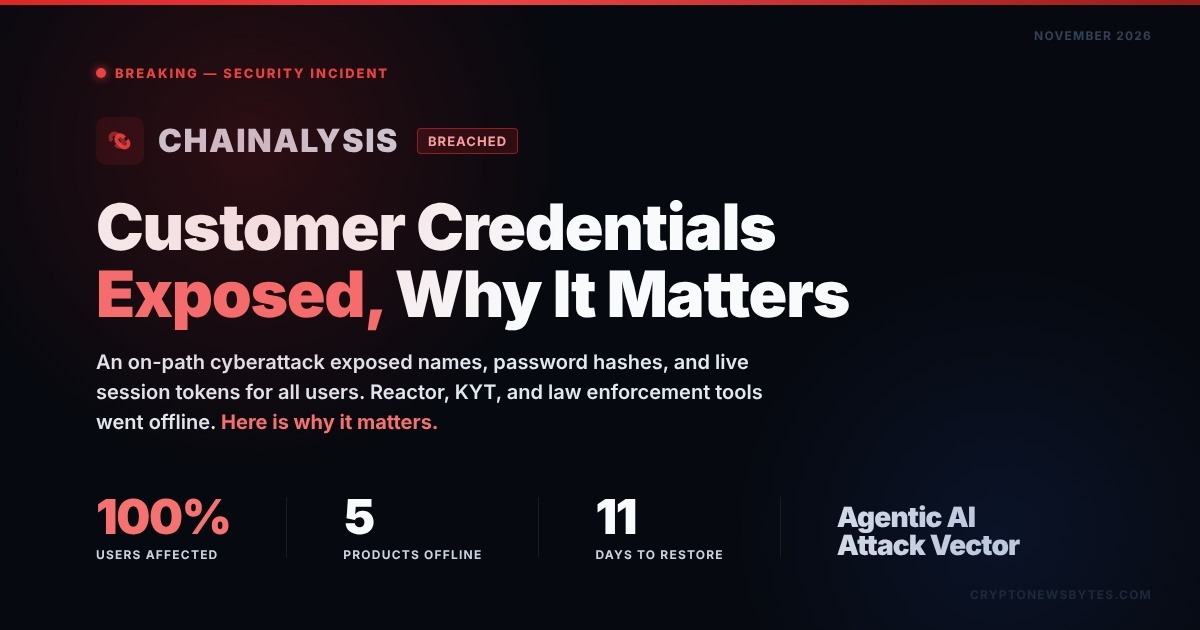
- Chainalysis publicly disclosed a cyberattack on October 30, 2026. The company says detection occurred earlier that month. By November 4 it confirmed an on-path attack had exposed a subset of plaintext passwords and that all users’ names, usernames, password hashes, and live tokens had been accessed.
- The company attributed the intrusion to an external actor using “offensive agentic techniques.” It has not named the attacker.
- Reactor, KYT, Address Screening, and Data Solutions were taken offline. Reactor, KYT, and Address Screening were restored November 7. Data Solutions was restored November 10.
- Chainalysis said the breach was unrelated to the Binance theft and that it has no evidence investigation data was accessed or attribution data was manipulated.
- Chain (Beta) status has not been confirmed restored as of this writing.
What Happened in the Chainalysis Breach?
Chainalysis, the blockchain analytics firm whose tools underpin cryptocurrency investigations at law enforcement agencies around the world, publicly disclosed a cyberattack on October 30, 2026, though the company says it detected the intrusion earlier that month. What started as an incident the company described as limited in scope escalated over eleven days into one of the most consequential data security events in the crypto intelligence industry.
By November 4, the company had confirmed that an on-path attack had exposed a subset of customer passwords in plaintext, that all users’ names, usernames, password hashes, and live authentication tokens had been accessed, and that KYT, its core anti-money laundering screening tool, had shown signs of unauthorized access. By November 6, it was restoring services. By November 10, most affected products were back online.
The attacker used what Chainalysis called “offensive agentic techniques,” a term the company has not defined publicly. It has not attributed the attack to any individual, group, or nation-state. No ransomware claim has been made.
Chainalysis Breach Timeline: October 30 to November 10
Chainalysis issued seven public updates over eleven days. The sequence matters because the company’s initial characterization of the incident as limited was subsequently revised in material ways.
Oct 30
First public disclosure. Chainalysis says an external actor using “offensive agentic techniques” accessed internal systems and tools. Initial email to customers says non-sensitive data was accessed: user IDs, names, emails, and role labels. Company says investigation content, session tokens, and plaintext passwords were not accessed.
Nov 2
Reactor and Data Solutions taken offline as a precaution. KYT and other transaction monitoring products remain online at this point. Chainalysis says the incident is unrelated to the Binance theft.
Nov 4, 9:50 AM
Chainalysis discloses an “on-path attack” exposed a subset of customer passwords in plaintext. Affected accounts are locked. Password resets required. The company notes it found this exposure on November 2 but waited two days to disclose it publicly.
Nov 4, 10:30 AM
KYT user interface, API, other address screening products, and the login page taken offline after abnormal activity is detected on KYT accounts. KYT customers with signs of unauthorized access are notified directly.
Nov 4, 11 PM
Full scope disclosed. All users’ names, usernames, password hashes, and live tokens confirmed exposed. Contradicts the October 30 claim that tokens had not been accessed. Chainalysis says it has no evidence investigation data was accessed or attribution data manipulated.
Nov 6, 3:30 AM
Phased restoration of KYT and Address Screening begins, gated by IP allowlisting. All users must reset passwords and rotate API keys before resuming.
Nov 7
Reactor, KYT (UI and API), and Address Screening fully restored with enhanced security controls.
Nov 10
Data Solutions restored. Customers receiving reconnection emails. Chain (Beta) status has not been publicly confirmed.
What Customer Data Was Exposed?
The October 30 initial disclosure described only “non-sensitive” data: user IDs, full names, email addresses, and organizational role labels. The company said at that time that investigation content, session tokens, and plaintext passwords had not been accessed.
That assessment did not hold. By November 4, Chainalysis had confirmed two additional categories of exposure. First, an on-path attack had captured plaintext passwords for a subset of users during authentication. Second, names, usernames, password hashes, and live authentication tokens had been exposed for all users. Chainalysis has not disclosed the total number of affected accounts.
The company has not said which password hashing algorithm it uses, which matters for assessing whether exposed hashes can be cracked offline. It also has not said how many KYT accounts showed signs of unauthorized access, beyond confirming that affected customers were notified directly.
Why Stolen Session Tokens Matter
Password hashes draw attention in breach reports, but the exposure of live authentication tokens is typically more urgent. A password hash must be cracked before it is actionable. A session token requires no cracking at all.
Depending on how sessions are implemented, an attacker with a valid bearer token may be able to impersonate an authenticated user without supplying a password or completing another MFA challenge. That is not guaranteed: usability depends on token expiration periods, revocation mechanisms, token binding, session restrictions, and server-side validation. Chainalysis has not publicly disclosed the token types, expiration periods, or whether any stolen tokens were successfully replayed before they were revoked.
“Exposed live authentication tokens can pose an immediate account-takeover risk. Depending on how sessions are implemented, an attacker possessing a valid bearer token may be able to impersonate an authenticated user without supplying the password or completing another MFA challenge.”
CryptoNewsBytes Technical Analysis
Chainalysis confirmed that abnormal activity was detected in KYT and that customers whose accounts appeared to have been accessed without authorization were being notified. However, the company has not publicly established whether stolen session tokens, compromised passwords, or another mechanism enabled that access.
How the Attack Was Described: On-Path Interception and Agentic Techniques
Chainalysis described two distinct technical elements in its disclosures. It has not publicly provided a full attack chain or root cause for either.
The on-path attack, sometimes described in security literature as a man-in-the-middle attack, means the attacker positioned themselves between Chainalysis’s systems and authenticating users, intercepting traffic in transit. This is consistent with how plaintext passwords could be captured: they briefly exist in readable form at authentication chokepoints. Chainalysis has not disclosed where the interception occurred, which infrastructure component was involved, or how the on-path position was established.
The “offensive agentic techniques” phrase is the company’s own description. It refers to a class of attack that uses AI agent frameworks, software systems capable of planning, executing, and self-correcting actions autonomously, to move through compromised infrastructure at speed. The company has said this vector was part of the intrusion into its “systems and internal tools,” but has not explained the specific sequence of actions taken by the attacker inside its network.
Chainalysis has not attributed the attack to any named individual, group, or nation-state, and has not confirmed the specific tools or agent framework the attacker used.
Reactor, KYT, and Data Solutions: Disruption and Recovery
The practical impact of the breach extended beyond credential exposure because Chainalysis’s products are operational infrastructure for institutions that cannot simply switch tools.
Reactor, the company’s flagship blockchain investigation platform, was taken offline November 2. It is used by law enforcement agencies, financial intelligence units, and prosecutors across dozens of countries, including agencies that worked on the LockBit ransomware takedown and other high-profile operations. Reactor was restored November 7.
KYT (Know Your Transaction), the company’s real-time anti-money laundering screening product, was taken offline November 4 after abnormal activity was detected on customer accounts. Its user interface, API, and login page were all shut down. Institutions relying on KYT for automated transaction screening may have needed to use alternative monitoring tools, manual reviews, or contingency procedures while the service was unavailable. The extent of any transaction-screening gaps, alert backlogs, or subsequent reviews has not been publicly established. KYT was restored in phases from November 6, with full restoration confirmed November 7.
Address Screening, used to check wallet addresses against sanctions lists and risk scores, was also taken offline and restored November 7.
Data Solutions, a threat intelligence platform, went offline November 2 and was restored November 10.
Chain (Beta) was taken offline November 4. As of November 10, Chainalysis has not publicly confirmed its restoration.
Chainalysis said explicitly that the breach was unrelated to the Binance theft investigation. It has maintained that no evidence exists of investigation data being accessed or attribution data being manipulated, while qualifying that statement with “at this time.”
Impact on Crypto Compliance and Law Enforcement
The disruption matters most when considered against what these tools actually do in practice. Reactor is not a reporting interface. It is the working environment where analysts trace stolen funds, map criminal networks, and build the evidence chains that support prosecutions. Losing access to it, even for days, means active investigations pause or slow to manual alternatives. No evidence of investigation file theft has been reported, but the exposure of analyst names, organizational roles, and session tokens creates a secondary risk: targeted follow-on attacks against individual investigators or the agencies employing them.
KYT outages create a different category of problem. Exchanges and financial institutions rely on automated transaction screening to flag suspicious activity in real time. During the period when KYT was unavailable, those institutions either lost automated alerts entirely or were operating on cached risk data. That does not necessarily mean compliance obligations were violated, but it does mean that any suspicious transactions processed during that window would need to be reviewed retrospectively.
The broader issue is concentration risk. When multiple exchanges, banks, and government agencies depend on a single blockchain intelligence provider, a breach of that provider is not just a vendor incident. It is a systemic disruption across the entire compliance and investigations ecosystem that relies on it.
What Chainalysis Customers Should Verify
Recovery Steps per Chainalysis
1
Submit trusted IP addresses to Chainalysis support for allowlisting before access is restored
2
Reset all account passwords and rotate every API key across all Chainalysis products
3
Change passwords on any other service where the same credentials were reused
Beyond the official steps, security practitioners have noted that password resets alone may be insufficient. Because live tokens were exposed, server-side session invalidation across all active and recently active sessions is the more complete control. Access logs covering the full suspected compromise window, including earlier October activity before the public disclosure, should be reviewed for logins or API calls from unexpected IP addresses. Any dormant accounts with Chainalysis access should be treated as potentially compromised even if the account received no direct notification. Chainalysis said it would provide organization-specific details about which records were accessed; customers who have not received that information should follow up directly.
Why This Breach Is a Bigger Deal Than Most
Most corporate data breaches affect the company’s customers. The Chainalysis breach affects the people investigating everyone else’s customers.
Chainalysis is not a consumer app or a retail crypto platform. It is the infrastructure layer beneath a large share of the world’s cryptocurrency compliance and law enforcement operations. Its Reactor platform is used by the FBI, Europol, the IRS Criminal Investigation division, and dozens of other agencies to trace stolen funds and build prosecutions. Its KYT product sits inside the AML compliance stacks of major exchanges, banks, and payment processors. When Chainalysis goes down or gets compromised, the effects propagate outward across an ecosystem that depends on it.
Three things make this breach unusually consequential compared to a typical SaaS company incident.
The customer list itself is sensitive. Most breaches expose customer data to outsiders. Here, the customer data is the sensitive information. Knowing which government agencies, financial intelligence units, and private investigators have Chainalysis accounts, what roles those individuals hold, and which products they use is operationally valuable to anyone trying to map how blockchain investigations work. Analyst names and organizational affiliations are now in the hands of an unknown attacker.
The timing of a tool outage matters in ways it does not for other software. KYT and Reactor are not productivity tools with a manual fallback that is merely inconvenient. They are live monitoring and investigation systems where timing is part of the value. Stolen funds move fast. Sanctions screening happens in real time. During the period when KYT was offline, any institution that relied solely on it for transaction monitoring had a gap, and that gap coincided with active on-chain activity related to the Binance theft, which Chainalysis separately confirmed it was monitoring. The company said the two events were unrelated. But the outage was real regardless of cause.
Concentration risk in blockchain intelligence is now impossible to ignore. Chainalysis commands a dominant share of the institutional blockchain analytics market. When one provider serves the majority of exchanges, regulators, and law enforcement agencies simultaneously, a breach of that provider is not a contained incident. It is a systemic event. Competitors such as Elliptic and TRM Labs exist, but switching blockchain intelligence providers is not a quick process: data, workflows, and trained analysts are built around a specific platform. The institutions most affected by the Chainalysis outage had no fast alternative.
None of this means that investigations were compromised, that stolen funds went untraced, or that bad actors benefited directly. The company has found no evidence of that. But the structural vulnerability that this breach revealed, a single point of failure at the center of global crypto compliance infrastructure, is the story that will outlast the incident itself.
What the Breach Does Not Establish
Several claims circulating in coverage of this incident are not supported by what Chainalysis has actually confirmed. This distinction matters for institutions, regulators, and investigators trying to assess their own exposure.
The credential exposure and service disruptions are confirmed. What is not confirmed: that any investigation data was stolen, that blockchain attribution data was manipulated, that any active law enforcement case was compromised, or that the attacker had any specific objective related to Chainalysis’s law enforcement customers. Chainalysis explicitly said it has found no evidence of investigation data being accessed. That is not a guarantee, but it is the company’s current stated finding, and reporting should not go beyond it.
The on-path attack and “offensive agentic techniques” are confirmed as Chainalysis’s descriptions of the intrusion. What is not confirmed: the specific infrastructure component compromised, the exact agent framework used, or the attacker’s identity. Presenting any of these as established facts would go beyond the available evidence.
The outage of KYT, Reactor, and Data Solutions is confirmed. What is not confirmed: that specific institutions failed to meet AML obligations, that any transaction went unscreened, or that any investigation was delayed as a direct result. The operational risks are real and worth analyzing, but specific harms to named institutions have not been reported.
What Remains Unknown
Eleven days after the initial disclosure, several consequential facts are still not public. Chainalysis has not identified the attacker. It has not said which hashing algorithm protects the exposed password hashes. It has not confirmed the total number of accounts affected. It has not explained the two-day gap between finding the full credential exposure on November 2 and disclosing it on November 4. It has not confirmed whether all stolen session tokens were revoked before any were replayed. It has not said whether an independent forensic report will be published. And it has not provided a return date or confirmed restoration of Chain (Beta).
CNB will update this article as further information becomes available.
Primary source: Chainalysis official incident page (updated November 10, 2026). Additional reporting: The Hacker News, The Register, Unchained Crypto, Tech Insider. Technical context: Helix.ml (third-party analysis, not forensic evidence).