Key Points
- Chainlink held Link:NYC on October 29, 2026, drawing executives from DTCC, BlackRock, Swift, Bank of America, ICE, Cboe, Morgan Stanley, Fidelity, and State Street.
- Chainlink launched CustodySync, connecting qualified custodians to DeFi lending markets, with Anchorage Digital Bank as the official launch partner.
- Chainlink 24/7 launched as a round-the-clock data feed for equities, commodities, and real-world assets including weekends and holidays. Aave is the first adopter.
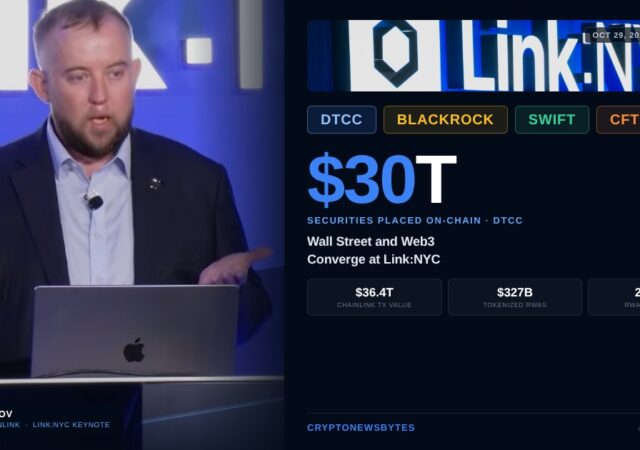
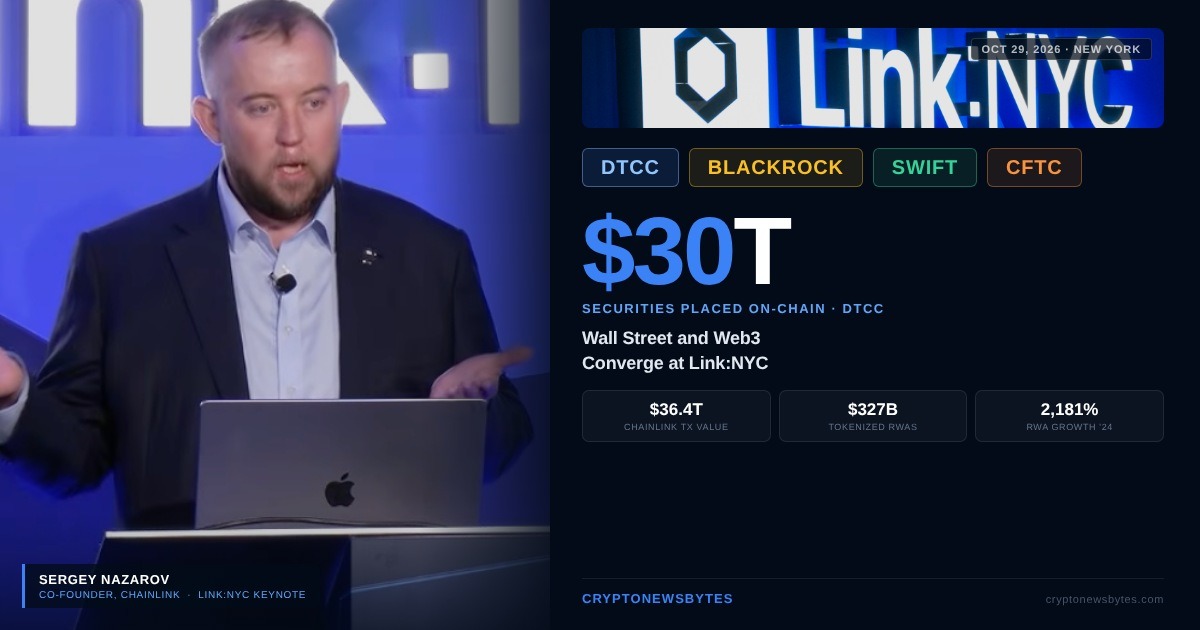
- DTCC CEO Frank La Salla announced the firm had placed $30 trillion worth of securities on-chain and said tokenized repo could save member firms 20 to 30 percent on balance sheet costs.
- Nazarov’s keynote cited $36.4 trillion in cumulative transaction value enabled by Chainlink and $327 billion in tokenized real-world asset value, up 2,181 percent since January 2024.
- Polymarket named Chainlink its official oracle. S&P Global Ratings made its Vault Risk Assessment data available on-chain on Base, the first time a major ratings agency has done this.
On October 29, 2026, Chainlink held Link:NYC, a one-day institutional event that brought the clearest signal yet that the boundary between traditional finance and on-chain infrastructure is collapsing. The room included sitting executives from DTCC, BlackRock, Swift, Bank of America, ICE, Cboe, Morgan Stanley, Fidelity, Broadridge, State Street, and DBS. The CFTC chairman was on stage. What was announced went well beyond concept discussions.
Who Was in the Room
Also on stage: Morgan Stanley, Fidelity, Broadridge, DBS, PwC, FTSE Russell, Deutsche Börse
Nazarov’s Keynote: One System, Not Two
Sergey Nazarov opened the event with a thesis he has been building toward for years: the distinction between DeFi and TradFi will not survive. What replaces both is a unified on-chain financial system, and Chainlink’s job is to be the connective layer that makes it run.
The keynote framed the case in historical terms first. Ownership records, double-entry bookkeeping, and digital recordkeeping were each presented as foundational shifts that unlocked new economic growth. The argument is that on-chain infrastructure represents the same kind of shift, not a product but a new operating layer for how financial agreements are recorded and enforced.
The practical entry point, Nazarov argued, is not tokenized stocks or crypto trading but something far more structural: collateral management. The current system forces enormous amounts of capital to sit idle as collateral inside siloed, manually operated systems that cannot communicate across institutions or run outside business hours. That problem is solvable with on-chain infrastructure, and solving it creates the foundation for everything else.
“Collateral management is the killer app that traditional finance has been waiting for from our industry.”
SERGEY NAZAROV, CO-FOUNDER, CHAINLINK, LINK:NYC KEYNOTE
The keynote also pointed to scale. Nazarov cited $36.4 trillion in cumulative transaction value enabled by Chainlink infrastructure, a 64.5 percent global market share in DeFi oracle services, and $327 billion in tokenized real-world assets currently on-chain, up 2,181 percent since January 2024. Citi’s base case for tokenized assets in 2030 is $5.5 trillion.
The technical roadmap Nazarov outlined covered five layers of the Chainlink stack: data, interoperability, compliance, orchestration, and privacy. He pointed specifically to private smart contracts, what he called the last major missing piece for institutional adoption. The ability to run on-chain logic with confidentiality is a hard requirement for most compliance frameworks, and the current generation of public smart contracts cannot deliver it.
The GENIUS Act, which created a regulatory pathway for tokenized real-world assets, was cited as a legislative tailwind that is now enabling institutional programs that were previously in a legal grey zone.
Product Launch: CustodySync
The first major product launch of the event, CustodySync connects qualified custodians’ collateral systems directly to DeFi lending markets across a loan’s full lifecycle. Anchorage Digital Bank is the official launch partner.
The core problem CustodySync addresses is custody fragmentation. In current DeFi lending, collateral held at a qualified custodian and collateral on a DeFi protocol are two separate things, requiring manual reconciliation. CustodySync makes the custodian the single source of truth for collateral balances, with Chainlink serving as the bridge between the custodian’s systems and the lending protocol.
The practical effect for institutions is that they can participate in DeFi lending markets without moving assets away from a regulated custodian, which has been a primary compliance blocker for bank participation in on-chain lending. Nazarov’s keynote showed a walkthrough: a pension fund and hedge fund use Microsoft shares as collateral, with CCIP bridging cross-chain and the Chainlink Runtime Environment orchestrating the loan creation and fund release across an 11-step automated flow.
How CustodySync Works: Collateral Flow
Source: Chainlink Link:NYC 2026 keynote walkthrough
Product Launch: Chainlink 24/7
The second product launch was Chainlink 24/7, a data feed that delivers market data for equities, commodities, and other real-world assets continuously, including weekends and holidays. Aave is the first adopter, using the feed to manage collateral positions on assets that currently have no price source outside traditional market hours.
“Aave can reliably value RWA collateral through weekends and holidays.”
STANI KULECHOV, FOUNDER, AAVE
Data partners for Chainlink 24/7 include FTSE Russell, ICE, S&P Global Ratings, Tradeweb, Deutsche Börse, SIX, and SGX FX. The absence of 24/7 price data has been a consistent limitation for on-chain protocols trying to hold real-world assets as collateral. Without a live price, protocols cannot accurately value positions or trigger liquidations when needed.
The Weekend Gap That Chainlink 24/7 Closes
DTCC and Chainlink: $30 Trillion On-Chain
The most institutionally significant session of the day was the fireside between Frank La Salla, CEO of DTCC, and Nazarov. La Salla did not come to signal interest. He came to announce a production milestone and a roadmap with specific economic numbers attached.
The headline figure: DTCC has placed approximately $30 trillion worth of securities on-chain. That figure represents the market value of securities eligible for DTCC’s tokenization service, not assets already actively traded on-chain, but the scope of eligible coverage is itself significant. DTCC sits at the center of U.S. securities settlement, clearing and settling the vast majority of equity and fixed-income transactions in the country daily.
“We just got $30 trillion on-chain.”
FRANK LA SALLA, CEO, DTCC
La Salla was specific about the economic case for tokenized repo. Member firms have estimated that operationalizing on-chain repo could reduce balance sheet costs by 20 to 30 percent. The mechanism is straightforward: on-chain collateral can move continuously, freeing up capital that currently sits locked in overnight positions waiting for the next business day. La Salla described demand for dollar liquidity in Asian markets on weekends, when U.S. markets are closed, as one immediate use case that on-chain collateral infrastructure could solve before New York opens on Monday.
DTCC spent 18 to 24 months working with the SEC to obtain a no-action letter, specifically to ensure that tokenized securities carry the same legal rights as their traditional counterparts. That work was a prerequisite for institutional adoption, and La Salla’s framing of it underscored how seriously DTCC has approached regulatory compatibility rather than treating it as an afterthought.
La Salla also called interoperability between blockchains, specifically between Ethereum and Solana, a critical requirement. That position aligns directly with Chainlink’s CCIP infrastructure, which is designed precisely to handle cross-chain communication at institutional standards.
“We are going to free up billions and billions of dollars of trapped liquidity that, in the current structure, is stuck.”
FRANK LA SALLA, CEO, DTCC
The DTCC Collateral AppChain, built on the Chainlink Runtime Environment, automates 24/7 collateral management workflows. Nazarov’s keynote showed collateral mobility, cross-chain liquidity, and financing request orchestration, all tied to the $114 trillion in assets currently custodied by DTCC. The production launch target is Q4 2026.
Adoption Announcements
Beyond the product launches and the DTCC session, Link:NYC included a full slate of adoption announcements from institutions across different verticals.
Polymarket named Chainlink its official oracle for high-speed up/down prediction markets, covering commodities, equities, and forex. Gold and silver markets are already live. S&P Global Ratings made its Vault Risk Assessment data available on-chain for the first time, starting on Base, bringing one of the most recognized credit risk frameworks in traditional finance into the on-chain ecosystem. S&P Global has separately agreed to acquire OpenZeppelin, which at the same event embedded Chainlink’s CRE, CCIP, and Automated Compliance Engine into its developer tools, meaning the most widely used smart contract security library now ships with Chainlink infrastructure integrated.
Archax, the FCA-regulated digital asset exchange, adopted Chainlink Data Streams for its GOVY tokenized UK Treasury product. Hanwha Investment and Securities adopted Chainlink’s data standard and CCIP for its global tokenization platform. LG CNS entered a strategic partnership focused on Korea’s digital asset market. Further Asset Management began using ACE in its Anubis platform for compliance within Abu Dhabi Global Market. The Hong Kong Gold Exchange is bringing its gold-backed token GoldZip (XGZ) to CCIP.
The Chainlink Reserve was also announced: a strategic on-chain LINK reserve designed to tie off-chain and on-chain network revenue to long-term infrastructure sustainability, using revenue to buy LINK on the open market.
The Institutional Panels: What Wall Street Actually Said
The institutional panels at Link:NYC were notable not for caution but for specificity. Executives from ICE, Cboe, Morgan Stanley, BlackRock, Broadridge, State Street, Fidelity, and DBS did not speak in hypotheticals. The conversation was about production timelines, collateral optimization, and cross-chain interoperability for assets being tokenized now.
Michael Blaugrund from ICE and JJ Kinahan from Cboe brought exchange-side perspectives on 24/7 market infrastructure. Maxwell Stein from BlackRock and Sonali Theisen from Bank of America addressed asset management and custody. Jonathan Ehrenfeld Solé from Swift spoke to cross-border messaging and how CCIP connects to the existing correspondent banking infrastructure rather than replacing it. State Street’s Sam ten Cate noted that on-chain custody currently costs up to 15 basis points versus under 10 for traditional assets, naming cost parity as a remaining friction point for wider adoption.
CFTC Chairman Michael S. Selig took the stage to discuss on-chain finance and Chainlink’s role bridging decentralized infrastructure with traditional finance regulatory frameworks, a signal of the degree to which the event was treated as a policy-relevant venue, not just an industry conference.
What It Adds Up To
Link:NYC was not a keynote with a few panels attached. It was a coordinated series of production announcements from institutions that have made implementation decisions. The pattern is consistent across all of it: institutions are not waiting for regulatory clarity to run pilots. They are building production systems, announcing timelines, and naming the infrastructure provider.
The two product launches target the precise problems that have kept institutional capital at the edge of on-chain markets: custody separation and 24/7 data coverage. The DTCC announcement, if it delivers on its Q4 2026 timeline, would put the largest post-trade infrastructure provider in the United States on a Chainlink-based production system before the end of the year. The $30 trillion figure La Salla cited is the addressable pool. The 20 to 30 percent balance sheet savings estimate is the economic incentive for member firms to actually use it.
What Nazarov is describing as the collapse of the DeFi/TradFi distinction is now being described in similar terms by the people who run DTCC, Cboe, ICE, and BlackRock. That is a different conversation than the one that was happening two years ago.
Further Reading
- FinCEN Cuts MEXC Off U.S. Financial System Over $16B in Alleged Sanctions Evasion
- The $1.5B Bybit Hack and EIP-7702: Two Threats Every Security Team Needs to Understand
- Trump Media Moves 4,259 BTC to Crypto.com, Arkham Labels as Convertible Note Collateral