
⚡ Key Highlights
- The global cyber insurance market reached $16 to $20 billion in 2025 and is projected to hit $30 to $50 billion by 2030, yet most crypto companies either have no coverage or have the wrong type of coverage
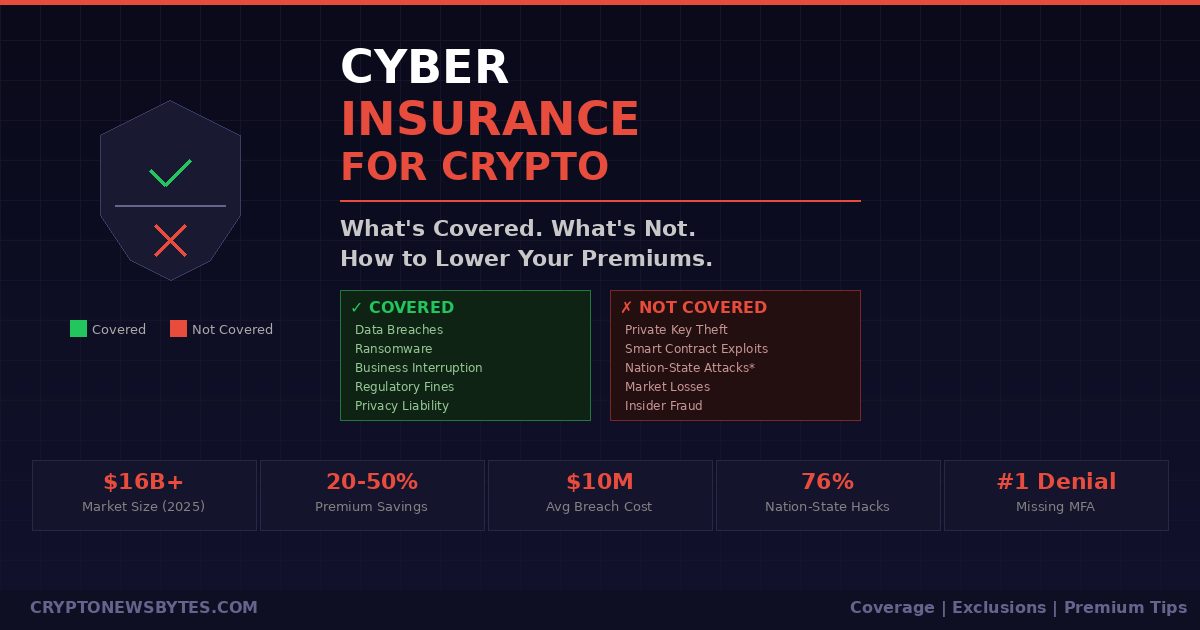
- Cyber insurance for crypto firms covers data breaches, ransomware, business interruption, and regulatory fines, but it does NOT cover private key theft, smart contract exploits, or digital asset losses. That requires separate crime/specie insurance
- Premiums dropped approximately 11% in 2025 as the market matured, but crypto companies still pay 2x to 5x more than equivalent traditional finance firms due to perceived elevated risk
- Organizations that implement strong security controls are lowering premiums by 20% to 50%. The eight controls insurers now treat as non-negotiable include MFA, EDR, tested incident response plans, and network segmentation
- War exclusions are the biggest hidden risk for crypto firms: policies may deny coverage for attacks by nation-state actors, and North Korea’s Lazarus Group was responsible for 76% of service compromise value in 2025
- Insurers are shifting from annual questionnaires to continuous monitoring and real-time telemetry, meaning your security posture is being evaluated year-round, not just at renewal
- The Figure Technology breach (data stolen via social engineering) is exactly what cyber insurance covers. The Bybit hack ($1.5B in digital assets stolen) is exactly what it does not
Cyber Insurance for Crypto Companies: The Coverage Gap That Could Kill Your Business
Cyber insurance for crypto companies is simultaneously the most misunderstood and most urgently needed protection in the digital asset industry. Most crypto founders either assume they do not need it (because they invest in smart contract audits), assume their general business insurance covers it (it almost certainly does not), or assume it covers digital asset theft (it does not). Each of these assumptions can be fatal.
The average cost of a data breach in the United States reached $10 million in 2025, according to the US House Committee on Homeland Security. Average ransom payments increased 104% between Q1 and Q2 of 2025, according to Coveware. Publicly disclosed ransomware attacks hit new highs in Q2 2025, with 276 incidents representing a 63% increase over the same period in 2024. And these are just the incidents that companies reported publicly.[WTW]
This guide breaks down exactly what cyber insurance for crypto firms covers, what it explicitly excludes, where the hidden traps are, and how to reduce your premiums by 20% to 50% through security improvements that insurers actually reward.
What Cyber Insurance for Crypto Actually Covers
Cyber insurance, sometimes called cyber liability insurance, protects against financial losses arising from cyber incidents that compromise your data, systems, or operations. For crypto companies, here is what a standard cyber policy typically includes.
First-Party Coverage (Your Own Losses)
| Coverage Area | What It Pays For | Crypto-Specific Example |
|---|---|---|
| Data Breach Response | Forensic investigation, customer notification, credit monitoring, PR crisis management | Figure Technology’s ShinyHunters breach: forensic analysis of the Okta SSO compromise, notifying affected customers, providing credit monitoring services |
| Ransomware and Extortion | Ransom payments (where legal), negotiation costs, data recovery, system restoration | A crypto exchange hit with ransomware that encrypts trading systems and customer data, demanding payment to restore access |
| Business Interruption | Lost revenue and extra expenses during system downtime caused by a cyber event | A DeFi front-end taken offline by a DDoS attack, costing the protocol trading fees during the outage |
| System Failure | Losses from unintentional system failures, cloud provider outages, or configuration errors | An AWS outage that takes your exchange offline (the October 2025 AWS outage generated 17 million user reports) |
| Data Recovery | Costs to restore, recreate, or recover data lost or damaged in a cyber incident | Rebuilding corrupted databases after a breach compromises transaction records |
Third-Party Coverage (Claims Against You)
| Coverage Area | What It Pays For | Crypto-Specific Example |
|---|---|---|
| Regulatory Defense | Legal costs and fines from data protection violations (GDPR, CCPA, state privacy laws) | A crypto lender facing CCPA enforcement action after customer financial data is exposed |
| Privacy Liability | Lawsuits from individuals whose personal data was compromised | Class action after a KYC database breach exposes passport scans and identity documents |
| Network Security Liability | Claims from third parties who suffer loss because of a security failure at your company | A wallet provider whose compromised API exposes connected dApps to exploitation |
| Media Liability | Claims arising from content published on your platforms | An NFT marketplace facing defamation claims over user-generated content |
What Cyber Insurance for Crypto Does NOT Cover
This is where most crypto companies get it wrong. Understanding what is excluded from a standard cyber insurance policy is more important than understanding what is included, because the excluded risks are often the ones that actually destroy crypto companies.
🚫 Critical Exclusions: What Cyber Insurance Will NOT Pay For
1. Theft of digital assets via private key compromise. This is the single most important exclusion for crypto companies. If an attacker steals your private keys and drains your wallets, standard cyber insurance will not cover the loss. The Bybit hack ($1.5 billion) and Step Finance hack ($40 million) both involved asset theft through operational compromise, not data breaches. Neither would be covered by cyber insurance. You need separate crime or specie insurance for this risk.
2. Smart contract exploits and DeFi protocol failures. If a vulnerability in your smart contract code is exploited, causing loss of user funds, cyber insurance will not cover it. This requires specialized smart contract cover from providers like Nexus Mutual, InsurAce, or Munich Re’s new Digital Asset Protection suite.
3. Nation-state and cyberwarfare attacks. Many cyber policies include a “war exclusion” clause that denies coverage for attacks attributed to nation-state actors. Lloyd’s of London mandated updated war exclusion language across its market in March 2023. Given that North Korea’s Lazarus Group accounted for 76% of crypto service compromise value in 2025, this exclusion could void coverage for the most common and most damaging type of attack facing the crypto industry.[Insurance Thought Leadership]
4. Market losses and token price declines. No insurance product covers losses from market volatility. If your token crashes 97% after a hack (as STEP did), the market cap loss is not insurable.
5. Losses from unpatched or outdated systems. Increasingly, insurers are denying claims where the breach resulted from failure to patch known vulnerabilities, missing MFA, or running unsupported legacy systems. If your security posture does not meet minimum standards at the time of the incident, your claim may be denied entirely.
6. Regulatory fines for non-compliance. While some cyber policies cover regulatory defense costs, many exclude the actual fines and penalties themselves. This distinction matters as crypto-specific regulations (MiCA in the EU, GENIUS Act in the US, VARA in Dubai) create new compliance obligations with financial penalties for violations.
7. Insider fraud without external cyber component. A rogue employee who transfers company funds to their personal wallet may not trigger cyber insurance. This typically falls under crime insurance or fidelity coverage.
🔍 The Real-World Test: Recent Incidents and What Cyber Insurance Would (and Would Not) Cover
| Incident | Covered by Cyber Insurance? | What You Actually Need |
|---|---|---|
| Figure Technology (2.5GB customer data stolen) | Yes: data breach response, notification, credit monitoring, regulatory defense | Cyber liability |
| Step Finance ($40M digital assets stolen) | No: digital asset theft via device compromise is excluded | Crime/specie insurance |
| Bybit ($1.5B ETH stolen via wallet UI compromise) | No: digital asset theft + likely war exclusion (Lazarus Group/DPRK) | Crime/specie + war exclusion carve-out |
| Exchange hit with ransomware (systems encrypted) | Yes: ransom, recovery, business interruption | Cyber liability |
| KYC database breached (passports and IDs leaked) | Yes: breach response, privacy liability, regulatory defense | Cyber liability |
Cyber Insurance for Crypto in 2026: The Exclusions Landscape
Cyber insurance for crypto companies is getting harder to buy correctly, not easier. Insurers are introducing new exclusions and enforcing existing ones more aggressively. Understanding these shifts in cyber insurance for crypto is critical before your next renewal.[Insurance Thought Leadership]
How to Lower Your Cyber Insurance for Crypto Premiums: 8 Controls Insurers Reward
Here is the good news for crypto companies: the same security investments that protect your business also directly reduce your cyber insurance for crypto costs. Organizations that implement the right cybersecurity controls are consistently lowering premiums by 20% to 50%. Some are seeing even larger reductions.[Intelligent Technologies]
Here are the eight controls that insurers in 2026 treat as non-negotiable for favorable terms:
🛡️ The 8 Non-Negotiable Controls for Lower Premiums
1. Phishing-Resistant Multi-Factor Authentication (MFA)
Enforce MFA on all accounts, especially remote access, VPN, privileged/admin accounts, and email. SMS-based MFA is no longer sufficient. Insurers want hardware security keys or authenticator apps. Missing MFA is the top reason claims are denied.
2. Endpoint Detection and Response (EDR)
Traditional antivirus is not enough. Deploy EDR on all endpoints with real-time monitoring. More than 80% of insurers now offer premium reductions for companies using AI-powered threat detection. This is especially critical for crypto firms where executive devices have treasury access (as the Step Finance hack demonstrated).
3. Tested Incident Response Plan
Having an incident response plan on paper is not enough. Insurers want evidence of regular tabletop exercises and red-team simulations. Companies that can demonstrate tested response capabilities get meaningfully better terms.
4. Immutable Backups and Disaster Recovery
Maintain offline, immutable backups that cannot be encrypted by ransomware. Test recovery procedures regularly. Insurers know that effective backup practices dramatically reduce the financial impact of ransomware.
5. Network Segmentation
75% of insurers now assess segmentation posture during underwriting. Automated microsegmentation (not just VLANs) isolates critical systems and limits lateral movement after a breach.[Zero Networks]
6. Privileged Access Management (PAM)
Control and monitor all privileged accounts. Insurers use PAM maturity as a primary indicator when assessing organizational security. Implement least-privilege access, session recording, and just-in-time access for sensitive operations.
7. Regular Vulnerability Management and Patching
Maintain a documented patching cadence. Unpatched systems are increasingly grounds for claim denial. For crypto companies, this includes both traditional IT infrastructure and any web3-specific tooling.
8. Security Awareness Training
Regular training for all employees, with extra focus on high-risk individuals (executives, finance teams, anyone with treasury access). Include simulated phishing drills. This is especially important in crypto where social engineering is now the dominant attack vector.
Cyber Insurance for Crypto Premiums in 2026: What Companies Should Expect
The broader cyber insurance market has been softening after years of sharp increases. Premiums dropped approximately 11% in 2025, and direct written premiums actually declined 2.3% in 2024, the first-ever decrease since data collection began in 2015, according to AM Best. But when it comes to cyber insurance for crypto firms specifically, the picture is different. Competitive pressure among insurers, combined with improved security practices among policyholders, has driven this stabilization.[WTW]
However, crypto companies face a different reality:
- Premiums 2x to 5x higher than equivalent traditional financial services coverage due to perceived elevated risk and limited underwriter competition
- Primary layers typically capped at $5 million with targeted limits and exclusions. Larger coverage requires layered programs across multiple carriers
- Approximately 90% of crypto policies are underwritten through Lloyd’s syndicates, meaning limited competition and pricing power
- Healthcare is the only sector facing higher increases than crypto in 2026, with both experiencing single-digit rate increases while most other industries see flat or declining rates
- Continuous monitoring is replacing annual assessments, meaning poor security hygiene mid-term can affect not just claims but also your renewal terms
How to Actually Buy Cyber Insurance for Your Crypto Company
The process of securing cyber insurance for crypto businesses is different from traditional companies. Here is a practical roadmap.
Step 1: Understand which risks require which policies. Map your risk exposure across four categories: cyber liability (data and systems), crime/specie (digital asset theft), D&O (executive liability), and professional indemnity (technology errors). Most crypto companies need at least two and often all four. See our complete crypto insurance guide for a full breakdown of coverage types.
Step 2: Engage a specialist broker. Do not use a generalist insurance broker. The crypto insurance market is small and specialized. Brokers like Superscript, Embroker, Woodruff Sawyer, and Marsh’s digital asset practice understand how to translate crypto business models into language underwriters accept.
Step 3: Prepare your security documentation. Before approaching underwriters, assemble evidence of your security controls: MFA deployment, EDR coverage, incident response plan, backup procedures, penetration test results, and any smart contract audit reports.
Step 4: Start early. Allow six to eight weeks before you need coverage to begin. The limited underwriter pool means longer placement timelines than traditional insurance.
Step 5: Review exclusions carefully. Pay specific attention to war exclusions (critical given DPRK threat), digital asset exclusions, third-party vendor exclusions, and minimum security control requirements. Negotiate where possible.
Step 6: Layer your coverage. Do not rely on a single policy. Build a program that combines cyber liability, crime/specie insurance, and D&O coverage to eliminate gaps between policies.
Cyber Insurance for Crypto: Frequently Asked Questions
📰 More on CryptoNewsBytes
- Crypto Insurance in 2026: Why the Industry’s Biggest Problem Is Not Hackers, It Is Having No Safety Net
- Crypto in 2026: $16B Market Coming, But 90%+ Still Uninsured. The True Barrier Is Not Hacks
- Top 10 Cybersecurity Trends in Crypto & Blockchain 2025
- Figure Technology Data Breach: Hackers Dump 2.5GB Stolen Records
- Step Finance Hack: $40M Stolen, Platform Shuts Down Permanently
- Jane Street Terra Insider Trading Allegations: $40 Billion Collapse
Sources: WTW | Founder Shield | Insurance Thought Leadership | Delinea | Intelligent Technologies | Zero Networks | American Bar Association | UpGuard
Disclaimer: This article is for informational purposes only and does not constitute insurance, financial, or legal advice. Coverage terms, exclusions, and premiums vary by insurer, jurisdiction, and individual risk profile. Consult a licensed insurance broker with crypto-specific expertise for advice tailored to your business.