
TL;DR
▶ Hunter Biden launched $LAPTOP on Coinbase’s Base network on September 9, 2026. One billion tokens. Founders including Biden hold 30% locked for six months.
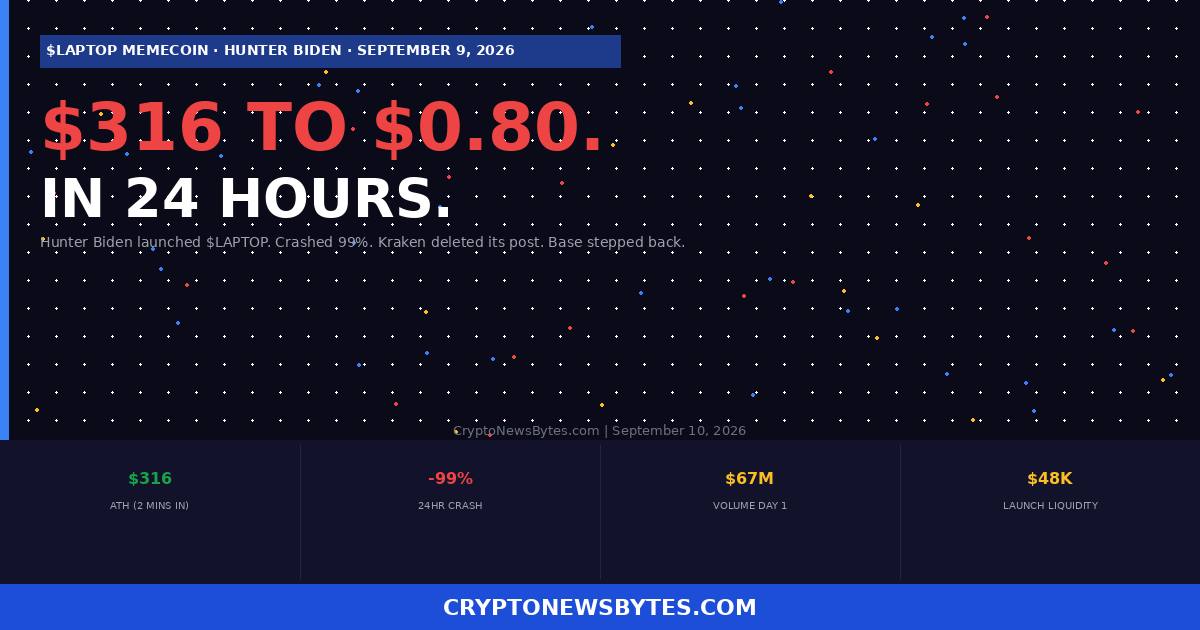
▶ The token hit $316 in the first two minutes of trading then crashed to $0.80 within 24 hours, a decline of more than 99%.
▶ Launch liquidity was approximately $48,000 against a peak implied market cap of $1.6 billion. The gap between paper value and actual liquidity is the story.
▶ Kraken deleted a promotional post after backlash. Base founder Jesse Pollak said Base made a conscious decision not to assist the launch.
▶ The airdrop giving tokens to $TRUMP losers is the most politically pointed element. Hunter Biden explicitly targeted wallets that lost money on his father’s political opponent’s memecoin.
▶ A novel event-based burn mechanism ties up to 30% of supply to real-world triggers including a Democrat winning in 2028 and Bitcoin hitting a new all-time high.
Hunter Biden’s $LAPTOP memecoin launched on Coinbase’s Base blockchain on September 9, 2026, and inside the first 24 hours told the complete story of the political memecoin market in 2026: a $316 opening spike, a 99% collapse to $0.80, $67 million in trading volume, a major exchange deleting its promotional post, the blockchain it deployed on publicly stepping back, and a founder who insisted the whole point was never about the money.
The token’s name references the laptop Hunter Biden left at a Delaware repair shop in 2019, which became one of the most contested political controversies of the 2020 election cycle. Biden’s framing: “The symbol they used to try to end me is now a symbol of resilience, redemption, and recovery.” The crypto community’s response was swift and predictable. The same criticism levelled at $TRUMP, $MELANIA, and every political token before it arrived before $LAPTOP even started trading: another celebrity cashing out on community hype with no underlying value and a 30% founder allocation that creates obvious sell pressure the moment the lockup expires.
What makes $LAPTOP more interesting than most political memecoins, and worth analysing rather than dismissing, is the structural novelty of its token distribution. The airdrop targeting $TRUMP losers is a political statement with verifiable on-chain mechanics. The event-based burn mechanism tying supply to real-world outcomes turns a memecoin into a partial prediction market. Whether those mechanics matter in a market that watched the token lose 99% of its value in 24 hours is the honest question this article answers.
What Is the LAPTOP Memecoin and Who Created It?
$LAPTOP is an ERC-20 token launched on Base, the Ethereum Layer 2 network built by Coinbase, with a total supply of one billion tokens. The project is issued through Phoenix Veritas Foundation and Phoenix Veritas Ventures Ltd, with Hunter Biden identified as the founder. The token’s official materials describe it as a digital collectible connected to internet culture and community participation, which is the standard legal framing for a product the SEC has generally declined to classify as a security.
Biden confirmed the launch on X on September 7, two days before trading began, with a video montage of news anchors discussing his laptop. The Wall Street Journal first reported the full structure on September 7. The explicit political framing distinguishes $LAPTOP from the average celebrity memecoin: Biden described it as the symbol his political opponents used against him repurposed as an asset he controls. That framing attracted both supporters who wanted to participate in the statement and critics who read it as hypocrisy from someone who spent years criticising $TRUMP.
What is a political memecoin?
A political memecoin is a cryptocurrency branded around a political figure, event, or controversy rather than any technological utility. The value proposition is entirely social: the token represents association with a cultural moment. Examples include $TRUMP (Donald Trump), $MELANIA (Melania Trump), and now $LAPTOP (Hunter Biden). Political memecoins share a structural feature: they typically spike on launch as speculators buy the narrative, then crash as early holders sell into the hype. The SEC has generally indicated that memecoins do not constitute securities, which means buyers have no legal protections if the price collapses.
LAPTOP Token Distribution: Who Gets What and Why It Matters
$LAPTOP Token Allocation: 1 Billion Total Supply
Sources: Phoenix Veritas Foundation official documentation, CoinMarketCap, Bitget Academy | @cryptonewsbytes
| Allocation | % of Supply | Tokens | Terms |
|---|---|---|---|
| Founders (including Biden) | 30% | 300,000,000 | 6-month cliff, then vesting over 36 months total |
| Airdrop: $TRUMP losers | ~10% | ~100,000,000 | Wallets that lost money on $TRUMP token. On-chain verifiable. |
| Airdrop: Substack + Callaghan list | ~10% | ~100,000,000 | Biden Substack subscribers and Andrew Callaghan mailing list |
| Event-based burn reserve | Up to 30% | Up to 300,000,000 | Burned permanently if trigger events occur within set timeframes |
| Charitable and operational | ~20% | ~200,000,000 | Foundation operations, partnerships, community programmes |
35% of supply was circulating at TGE (token generation event). Remaining subject to cliffs and vesting. | Sources: Phoenix Veritas Foundation, CoinMarketCap, Bitget Academy Sep 2026 | @cryptonewsbytes
The $TRUMP airdrop: political statement or marketing tactic?
The most unusual element of $LAPTOP’s distribution is the targeted airdrop to wallets that lost money on $TRUMP, Donald Trump’s own memecoin. On-chain records can verify which wallets held $TRUMP at a loss, making this a provable, transparent distribution rather than a vague community airdrop. The political message is explicit: Hunter Biden is airdropping his token to people who were financially hurt by his father’s political opponent’s memecoin. Whether that reads as solidarity or opportunism depends on your politics. The practical effect is that $TRUMP losers received free tokens that were worth approximately $0.80 each as of September 10 after the launch crash.
The Launch: $316 to $0.80 in 24 Hours
$LAPTOP began trading on Base at approximately 12:00 EDT on September 9, 2026. Within two minutes the price had spiked to $316 per token, implying a market capitalisation of hundreds of billions on paper. That implied valuation was meaningless. The liquidity pool backing the market contained approximately $48,000 according to AirdropAlert’s post-launch analysis. When price discovery happens on $48,000 of actual liquidity, a single large buy order produces enormous price spikes that vanish the moment sell pressure arrives.
The collapse was equally rapid. Within the first hour, the price had fallen to $3.70. By the time The Hill published its coverage at approximately 3 PM EDT the same day, the token was trading at $1.36. By September 10, CoinMarketCap listed the price at $0.80 with a 99.44% 24-hour decline. Total 24-hour trading volume hit $67 million, meaning the token generated significant activity despite the collapse, the hallmark of a memecoin where speculators trade the volatility regardless of direction.
The gap between the $1.6 billion implied market cap at one hour post-launch and the $2.5 million in actual liquidity at that same moment, cited by QZ, is the number that defines $LAPTOP’s launch. Paper market caps built on thin liquidity are standard in the memecoin market. They look spectacular in screenshots and generate media coverage. They bear no relationship to what any participant could actually extract from the market by selling at the implied price.
$LAPTOP Price: Launch to 24 Hours
Source: CoinMarketCap, QZ, The Hill, AirdropAlert | @cryptonewsbytes
Sources: CoinMarketCap Sep 10 2026, QZ Sep 9 2026, The Hill Sep 9 2026, AirdropAlert Sep 10 2026 | @cryptonewsbytes. Not financial advice.
Why Kraken Deleted Its Post and Base Stepped Back
Before $LAPTOP launched, two major crypto institutions distanced themselves in public. Kraken posted promotional content about the token and then deleted it after users flooded the replies questioning why one of the largest crypto exchanges was marketing another political memecoin. Kraken never publicly confirmed or denied a listing plan. As of September 10, no major centralised exchange had confirmed a spot listing. Polymarket bettors gave Kraken an 83% probability of listing within 30 days, OKX at 61%, and Binance at 39%.
Base founder Jesse Pollak confirmed that the $LAPTOP team had reached out to his organisation and that Base made a conscious decision not to assist the launch. This is notable because Base is an open, permissionless network: anyone can deploy a token on Base regardless of what Coinbase or Jesse Pollak want. Pollak’s statement was not that Base prevented the launch. It was that Base chose not to help. The distinction matters but the signal is still clear: the leadership of the chain $LAPTOP deployed on did not want to be associated with it.
Jordan Fish, known as Cobie, who heads Coinbase’s Base app team, separately pushed back against traders who blamed Base for the launch. “Anyone can deploy on Base,” he noted. The combination of Kraken deleting a promotional post and Base’s leadership publicly stepping back before the token even launched created a reputational environment that the project carried into its first day of trading.
The Event-Based Burn Mechanic: The Genuinely Novel Part
Most of $LAPTOP’s structure is standard celebrity memecoin. The event-based burn mechanism is not. Up to 30% of the total token supply is tied to real-world triggers. If specified conditions occur within their assigned time limits, those tokens are permanently burned, reducing total supply. The mechanic turns $LAPTOP into a partial prediction market: some of the token’s speculative value comes from bet on whether the burn conditions will be met.
The burn triggers cited in project materials include a Democrat winning the 2028 US presidential election and Bitcoin reaching a new all-time high. The specific thresholds and timelines for each trigger have not been fully disclosed in public materials reviewed for this article. If either condition is met, the corresponding allocation burns. Fewer tokens in circulation, all else equal, supports price. The mechanic gives long-term holders a reason to care about external events beyond just community sentiment, which is the one structural differentiation $LAPTOP has from a generic political token.
Whether that mechanic generates lasting interest depends on whether any holders are still holding by the time the triggers could reasonably fire. At $0.80 with a 99% collapse on day one, the speculative crowd that drove $67 million in volume on launch day has largely moved on. The burn mechanic is most interesting to people who believe the $0.80 floor holds and that one of the trigger conditions will eventually be met. That is a small subset of the market as of September 10.
What $LAPTOP Tells Us About Political Memecoins in 2026
$LAPTOP is the third major US political memecoin of the Trump 2.0 era, following $TRUMP and $MELANIA. All three share the same structural arc: announce, generate outrage and interest simultaneously, spike on launch, collapse within days or hours. $TRUMP peaked near $75 and now trades at fractions of that. $MELANIA followed a similar pattern. $LAPTOP completed its version of the cycle in under 24 hours.
The pattern raises a question that the crypto industry has mostly avoided engaging with directly: at what point does the political memecoin format constitute a reputational problem for the industry it runs on? The SEC and CFTC five-category framework CNB covered explicitly does not classify memecoins as securities, which leaves them outside traditional investor protection frameworks. The CLARITY Act advancing in the Senate includes provisions around conflicts of interest for government officials launching crypto products. It does not specifically address political memecoins launched by private citizens.
Hunter Biden’s own statement on launch day is the most honest framing of what $LAPTOP is: “You should not expect me or anyone else to make this token more valuable for you. $LAPTOP isn’t just about owning something, it’s about saying something.” That is a disclaimer and a political manifesto simultaneously. It is also the clearest possible statement that the token has no investment merit and should not be evaluated as one. The $67 million in trading volume on day one suggests a significant number of people ignored it.
The honest risk assessment
Memecoins have no intrinsic value. $LAPTOP’s price is driven entirely by community sentiment, media attention, and speculative demand. The 30% founder allocation creates structural sell pressure when lockups expire. The launch crash from $316 to $0.80 demonstrates the liquidity risk inherent in thin-market memecoins: paper market caps and actual extractable value are entirely different numbers. If you are considering buying $LAPTOP for any reason other than the cultural statement it represents, the launch data tells you the speculative trade has already run. Nothing in this article constitutes investment advice.
Frequently Asked Questions
What is the LAPTOP memecoin?
LAPTOP ($LAPTOP) is a memecoin launched by Hunter Biden on Coinbase’s Base blockchain on September 9, 2026. It has a total supply of one billion tokens. The name references the laptop Hunter Biden left at a Delaware repair shop in 2019, which became a political controversy during the 2020 US presidential election. Biden described it as turning the symbol used against him into one of resilience. The token has no utility and is classified as a digital collectible.
What happened to the LAPTOP memecoin price?
LAPTOP hit $316 within two minutes of trading beginning on September 9, 2026, on thin launch liquidity of approximately $48,000. The price then collapsed 98% to $3.70 within the first hour and continued falling to $0.80 by September 10, a 24-hour decline of 99.44%. Total 24-hour trading volume was approximately $67 million.
Who gets the LAPTOP airdrop?
Three groups receive airdropped $LAPTOP tokens: wallets that lost money on Donald Trump’s $TRUMP memecoin (verifiable on-chain), Hunter Biden’s Substack subscribers, and the mailing list of video journalist Andrew Callaghan. Approximately 20% of the one-billion-token supply was allocated to airdrops. Callaghan subsequently distanced himself from the project.
Why did Kraken delete its LAPTOP promotional post?
Kraken posted promotional content about $LAPTOP before the launch and deleted it after users flooded the replies criticising why a major exchange was marketing another political memecoin. Kraken did not confirm or deny a listing plan. As of September 10, no major centralised exchange has confirmed a spot listing for $LAPTOP.
What is the LAPTOP token burn mechanic?
Up to 30% of $LAPTOP’s total supply is tied to event-based burns. If specified real-world conditions are met within set timeframes, those tokens are permanently destroyed. Triggers cited in project materials include a Democrat winning the 2028 US presidential election and Bitcoin reaching a new all-time high. This mechanic partially turns $LAPTOP into a prediction market, giving holders exposure to those outcomes through token supply dynamics.
Is LAPTOP on Coinbase or Base?
LAPTOP is deployed on Base, the Ethereum Layer 2 network built by Coinbase. Base is an open, permissionless network where anyone can deploy a token. Coinbase the company did not sponsor or support the launch. Base founder Jesse Pollak confirmed that Base made a conscious decision not to assist the LAPTOP launch. The token can be traded on Base-compatible decentralised exchanges.
Further Reading
The legislative framework advancing in the Senate that includes conflict-of-interest provisions for government officials in crypto. $LAPTOP raises adjacent questions about political figures and token launches outside the government context.
The regulatory classification that puts memecoins outside securities law. The five-category framework is why $LAPTOP buyers have no investor protections under existing federal securities laws.
Sources: CoinDesk Sep 8-9 2026 (pre-launch backlash and launch coverage, primary), QZ Sep 9 2026 (launch price data, Coinbase Base context), The Hill Sep 9 2026 (launch day pricing), CoinMarketCap Sep 10 2026 (live price data, primary), AirdropAlert Sep 10 2026 (liquidity analysis, event burn mechanic), Fortune Sep 8 2026 (Hunter Biden quotes), Bitget Academy Sep 2026 (token structure and allocation details), Phoenix Veritas Foundation official documentation | Published September 10, 2026 | CryptoNewsBytes.com | Not financial advice.