
TL;DR
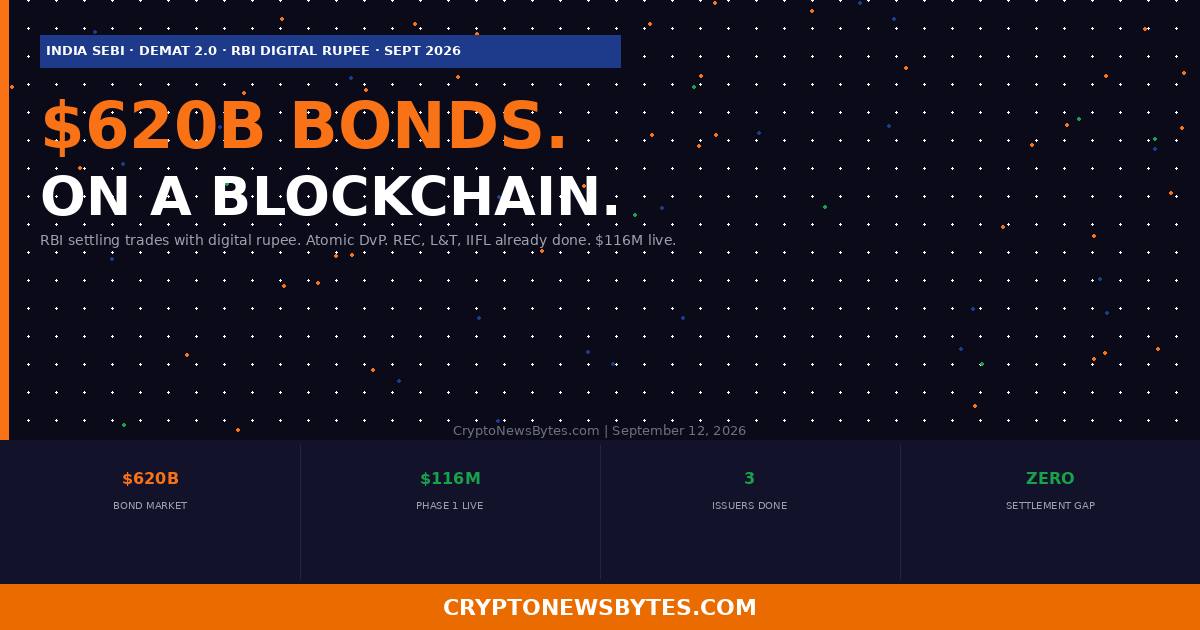
▶ India’s SEBI launched Demat 2.0 on September 10, 2026: a pilot that issues corporate bonds as native digital tokens on a permissioned distributed ledger and settles them against the RBI’s wholesale digital rupee.
▶ Three companies have already raised funds: REC ₹500 crore, Larsen and Toubro ₹500 crore, IIFL Finance ₹25 crore. Total: ₹1,025 crore, approximately $116 million.
▶ The bonds are identical to conventional corporate bonds in legal terms. Same ISIN, same credit rating, same investor rights. What changed is the settlement infrastructure.
▶ Settlement is atomic via the RBI’s Unified Market Interface: the bond and the payment change hands simultaneously in a single operation. No settlement gap. No counterparty risk window.
▶ India’s corporate bond market is approximately $620 billion. Secondary trading and retail access are planned for later phases.
▶ This is the clearest G20 example of a sovereign central bank digital currency being used to settle tokenized securities in a live regulatory environment. Not a proof of concept. Live transactions.
On September 10, 2026, India’s securities regulator SEBI announced that Demat 2.0 had completed its first live transactions. Three corporate bond issuers, REC Limited, Larsen and Toubro, and IIFL Finance, raised a combined ₹1,025 crore (approximately $116 million) through a system that issues bonds as native digital tokens on a distributed ledger and settles payment atomically against the Reserve Bank of India’s wholesale digital rupee. India had just put its corporate bond market on a blockchain in a live regulatory environment, with real money and real investors.
The detail that matters most is not the technology. It is the settlement mechanic. Under conventional bond settlement, the security changes hands at one moment and the cash changes hands at another. That gap, typically two business days in most markets, is called settlement risk. During those two days, either party can default, creating counterparty exposure. Atomic settlement through the RBI’s Unified Market Interface eliminates that gap: the bond token and the digital rupee payment change hands in the same operation, simultaneously and irreversibly. If one leg fails, neither goes through. The counterparty risk window collapses to zero.
To understand why this is significant, it helps to understand what India is actually doing differently from every other tokenized bond pilot announced in 2026. Most tokenized bond pilots use a stablecoin or a commercial bank token as the cash leg. India is using central bank money: the digital rupee issued directly by the RBI, the monetary authority of the world’s fifth-largest economy. When the cash leg is central bank money, the settlement is as final as the monetary system itself. That is a fundamentally different risk profile from any stablecoin-settled RWA system.
What Is a Demat Account? The Foundation Behind Demat 2.0
A demat account, short for dematerialised account, is the Indian equivalent of a brokerage custody account. Before the 1990s, Indian investors held physical share certificates, paper documents that proved ownership of stocks and bonds. Transferring them required physical delivery, signatures, and postal transit, a process that took weeks and generated enormous fraud through forged certificates.
In 1996, India dematerialised its equity markets. NSDL (National Securities Depository Limited) and later CDSL (Central Depository Services Limited) became the two regulated national depositories that maintain electronic records of every share and bond held by every investor in India. When you buy a share of Infosys or a bond from REC, ownership is not a piece of paper. It is an entry in the depository’s database, credited to your demat account. Today, India has over 150 million demat accounts, one of the highest penetration rates in the world for electronic securities holding.
Demat 2.0 does not replace this system. It upgrades the underlying record-keeping layer beneath it. Instead of the depository maintaining a conventional database entry for your bond holding, Demat 2.0 issues the bond as a native digital token on a distributed ledger that NSDL and CDSL operate. Your demat account still shows your holding. The difference is that the record now lives on a shared cryptographic ledger rather than a centralised database, enabling atomic settlement with the RBI’s digital rupee. From the investor’s perspective, the interface is the same. The infrastructure underneath is fundamentally different.
What Is Demat 2.0 and How Is It Different From a Regular Bond?
What is a demat account?
A demat account (dematerialised account) is the Indian equivalent of a brokerage account for holding securities electronically rather than as physical certificates. India dematerialised its stock market in the 1990s, creating a system where NSDL and CDSL, the two national depositories, maintain digital ownership records for all listed securities. Demat accounts are the standard access mechanism for Indian retail and institutional investors. Demat 2.0 builds on this existing infrastructure: instead of moving investors to a new system, it upgrades the underlying record-keeping and settlement layer that their existing demat accounts connect to.
A conventional corporate bond in India is issued, recorded, and transferred through a system that has not fundamentally changed since dematerialisation in the 1990s. The bond exists as an electronic record at a depository. When it changes hands, the depository updates its records. Payment happens separately through the banking system. These two legs, the security transfer and the cash payment, are linked by convention and process but not by any technical mechanism that forces them to happen simultaneously.
Under Demat 2.0, the bond is issued as a native digital token on a permissioned distributed ledger operated by India’s regulated depositories, specifically NSDL and CDSL. The token represents the same bond with the same ISIN, the same credit rating, the same interest rate, the same maturity date, and the same legal rights. The issuer’s repayment obligations are unchanged. What changed is how the ownership record is maintained and how settlement happens.
The key technical link is the Unified Market Interface (UMI), which connects the token ledger to the RBI’s wholesale digital rupee infrastructure. When a bond changes hands, the token transfer and the digital rupee payment are executed together as a single atomic operation. Either both succeed or neither does. This is called atomic Delivery-versus-Payment (atomic DvP), and it is the precise mechanism that eliminates settlement risk.
The Three First Movers: REC, L&T, and IIFL Finance
Demat 2.0 Phase 1: First Three Tokenized Bond Issuances
Sources: CoinDesk September 11 2026, crypto.news September 11 2026, CryptoIndia X post | @cryptonewsbytes
| Issuer | Amount Raised | USD Equivalent | Detail |
|---|---|---|---|
| REC Limited | ₹500 crore | ~$57M | India’s first native distributed-ledger corporate bond issuance. 18 investors participated. REC is a government-owned infrastructure finance company. |
| Larsen and Toubro | ₹500 crore | ~$57M | India’s largest engineering and construction conglomerate. First private-sector tokenized bond issuance under Demat 2.0. |
| IIFL Finance | ₹25 crore | ~$2.9M | Non-banking financial company. Smaller tranche completing the three-issuer first phase. |
| Total Phase 1 | ₹1,025 crore | ~$116M | Settled atomically against RBI wholesale digital rupee via Unified Market Interface. |
Note: All three issuances retain conventional bond terms: fixed interest rate, maturity date, legal rights unchanged. Tokenization affects settlement infrastructure only. | @cryptonewsbytes
What Is Atomic DvP and Why Does It Eliminate Settlement Risk?
The T+2 problem: why settlement gaps matter
In most bond markets, when you buy a bond the trade is agreed on day zero (T) but the security and cash actually change hands two business days later (T+2). During those two days, both parties carry risk: the seller might not deliver the bond, or the buyer might not deliver the cash. This is called settlement risk or Herstatt risk, named after a 1974 German bank failure that left counterparties exposed across time zones. For institutional participants trading billions of rupees of bonds daily, even a small probability of settlement failure represents significant credit exposure. Atomic DvP eliminates T+2 entirely: settlement happens in the same moment the trade is agreed.
The mechanism works as follows. When two parties agree to trade a Demat 2.0 bond, both the token transfer instruction and the digital rupee payment instruction are submitted to the Unified Market Interface simultaneously. The UMI executes both instructions as a single atomic operation. The word atomic in this context means indivisible: either both the bond token and the payment change hands, or neither does. There is no state where one party has the bond but not the payment, or the payment but not the bond.
The cash leg being central bank digital currency is what makes the atomicity meaningful at a systemic level. In a system where the cash leg is a commercial bank stablecoin or a tokenized bank deposit, the finalness of the payment still depends on the commercial bank honoring it. Settlement risk is reduced but not eliminated. When the cash leg is wholesale e-rupee issued directly by the RBI, the finalness of the payment is equivalent to the finality of central bank settlement. There is no counterparty between the payer and the monetary authority.
India has been running a wholesale digital rupee pilot since October 2022 with participating banks using e-rupee to settle government securities trades. Demat 2.0 extends that infrastructure to corporate bonds and opens the settlement mechanism to a broader set of institutional participants. The Unified Market Interface, which links the token ledger to the e-rupee system, was built specifically for this purpose.
How Demat 2.0 Compares to Other G20 Tokenized Bond Initiatives
The scale of India’s ambition is best understood in comparison. The Bank for International Settlements has coordinated multiple tokenized bond experiments through its Innovation Hub, including Project Evergreen (Hong Kong) and Project Genesis. The European Investment Bank issued a tokenized bond on a public blockchain in 2021. JPMorgan’s Onyx and Goldman Sachs’ GS DAP have settled tokenized bonds in private deployments. France, Singapore, and Switzerland have each run pilots of varying scope.
What distinguishes Demat 2.0 is the combination of three elements that no prior initiative has achieved simultaneously. First, it uses native central bank money (RBI wholesale digital rupee) as the cash settlement leg, not a stablecoin or tokenized commercial bank deposit. Second, it operates within the existing regulated depository infrastructure (NSDL and CDSL), meaning investors do not need new accounts or new identity verification. Third, it targets a $620 billion market for eventual rollout, not a proof-of-concept issuance. Most tokenized bond pilots have been single-issuer experiments with synthetic cash settlement. Demat 2.0 is a multi-issuer, multi-investor live market using real central bank money.
The JPMorgan JLTXX tokenized treasury fund CNB covered in July 2026 represents the US institutional approach: a regulated fund vehicle on a public blockchain with commercial bank settlement. India’s approach is different in kind: a government-controlled permissioned ledger with central bank settlement. Neither is objectively superior. They reflect different regulatory philosophies about where the trust boundary should sit. India chose to keep trust entirely within its existing institutional framework. The US and European models accept some trust at the commercial layer.
Global Tokenized Bond Market Milestones: Scale and Settlement Comparison
Sources: BIS, CoinDesk, businesstoday.in, spendnode.io | @cryptonewsbytes
Note: India Demat 2.0 is the first live multi-issuer tokenized bond system using native central bank digital currency as settlement. Sources: BIS Annual Economic Report 2024, CoinDesk Sep 11 2026 | @cryptonewsbytes. Not financial advice.
What Comes Next: Secondary Markets, Smart Contracts, and Retail Access
SEBI has outlined a phased roadmap for Demat 2.0. Phase 1, now complete, covers primary issuance to institutional investors. Phase 2 is intended to enable secondary market trading of tokenized bonds between institutional participants, which would allow the bonds to change hands after issuance without reverting to conventional settlement infrastructure. Phase 3 contemplates retail investor access, subject to additional regulatory work.
The most commercially significant feature in the roadmap is automated corporate actions through smart contracts. Under the current system, coupon payments, redemptions, and other corporate actions require manual processing through multiple intermediaries. If the bonds are held as tokens on a distributed ledger and the payment leg is the digital rupee, coupon payments could execute programmatically: on the payment date, the smart contract automatically transfers the correct digital rupee amount to each token holder’s wallet without any manual processing. That automation eliminates an entire layer of operational cost and introduces programmability that conventional bonds cannot match.
BusinessToday’s coverage of the pilot quoted Nath, a senior market infrastructure participant, noting the pilot remains at an early stage and the path to full-scale deployment involves significant additional regulatory and technical work. The honest assessment: Phase 1 proves the settlement mechanism works with real money and real participants. It does not prove the system can handle the volume and complexity of India’s full secondary bond market, which trades billions of rupees daily. That scale test is the work of Phases 2 and 3.
What this means for the global RWA tokenization narrative
The real-world asset tokenization market has been dominated by announcements and proofs of concept. Demat 2.0 is different: three live transactions, eighteen real investors in the REC bond alone, real money, real settlement, and a sovereign regulator with a statutory mandate behind it. The JPMorgan JLTXX launch and the Stellar-XRP RWA race CNB covered represent the private-sector side of the same trend. India represents what happens when the state decides to build the infrastructure itself rather than waiting for private markets to deliver it. Both approaches will coexist. Neither is going away.
Frequently Asked Questions
What is SEBI’s Demat 2.0?
Demat 2.0 is a pilot programme launched by India’s Securities and Exchange Board of India on September 10, 2026. It issues corporate bonds as native digital tokens on a permissioned distributed ledger operated by India’s regulated depositories (NSDL and CDSL) and settles payment atomically against the Reserve Bank of India’s wholesale digital rupee through the Unified Market Interface. The underlying bonds retain all conventional legal characteristics including ISIN, credit rating, investor rights, and issuer obligations.
What is atomic DvP and why does it matter?
Atomic Delivery-versus-Payment (DvP) means the bond token and the cash payment change hands in a single indivisible operation. Either both succeed or neither does. This eliminates settlement risk, the two-day exposure window (T+2) in conventional bond markets where one party might default after the trade is agreed but before settlement completes. Atomic DvP using central bank digital currency means the settlement is as final as central bank money itself.
Which companies have issued bonds under Demat 2.0?
Three companies completed issuances in Phase 1: REC Limited (₹500 crore, approximately $57 million) through India’s first native DLT corporate bond issuance with 18 investors; Larsen and Toubro (₹500 crore) as the first private-sector issuer; and IIFL Finance (₹25 crore). Total Phase 1 issuance: ₹1,025 crore, approximately $116 million.
How is the RBI’s wholesale digital rupee different from a stablecoin?
The RBI’s wholesale digital rupee (e₹-W) is a central bank digital currency issued directly by the Reserve Bank of India. It is central bank money, not a claim on a commercial bank or a private issuer. When a bond is settled against e₹-W, the payment finality is equivalent to central bank settlement and carries no commercial counterparty risk. A stablecoin or tokenized bank deposit, even if well-regulated, still carries the credit risk of the issuing commercial bank.
What is India’s corporate bond market and how big is it?
India’s corporate bond market is approximately $620 billion in outstanding issuance, making it one of the larger debt markets among emerging economies. It has been growing rapidly as companies shift from bank financing to bond markets, encouraged by SEBI’s market development initiatives. Demat 2.0 targets this entire market for eventual tokenization, though the current Phase 1 pilot covers only institutional primary issuance.
When will retail investors be able to access tokenized bonds in India?
Retail access is planned for a later phase of Demat 2.0 and has not been given a specific timeline. Phase 2 focuses on secondary market trading between institutional participants. Phase 3 contemplates retail access. SEBI has noted that additional regulatory and technical work is required before retail participation is enabled. Existing retail demat account holders do not have access under Phase 1.
Further Reading
The US institutional approach to tokenized securities: a regulated fund vehicle on a public blockchain with commercial bank settlement. Compare and contrast with India’s government-controlled permissioned ledger and central bank settlement.
The private-sector blockchain competition for RWA tokenization market share. India’s Demat 2.0 shows what happens when the state builds the infrastructure instead of waiting for private markets to deliver it.
The US regulatory framework advancing alongside India’s Demat 2.0. Two of the world’s largest economies moving simultaneously toward regulated tokenized securities markets, with fundamentally different approaches.
Sources: CoinDesk September 11 2026 (primary: India starts tokenizing $620B corporate bond market), BusinessToday September 12 2026 (primary: SEBI Demat 2.0 lays groundwork), crypto.news September 11 2026 (live transaction details), spendnode.io September 2026 (settlement mechanism analysis), SEBI official FAQ on Demat 2.0 (sebi.gov.in), RBI wholesale digital rupee programme documentation (rbi.org.in) | Published September 10, 2026 | CryptoNewsBytes.com | Not financial advice.