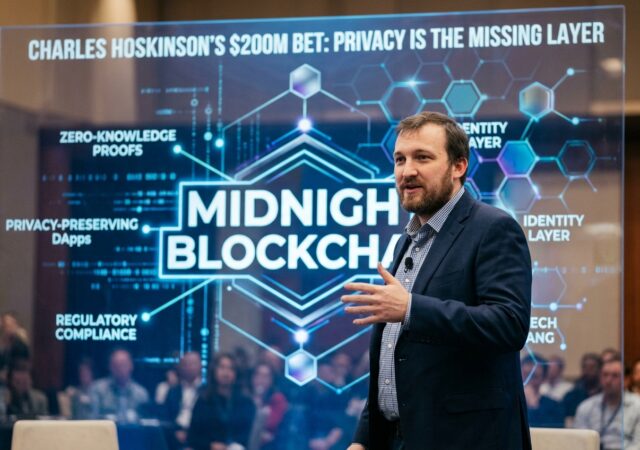
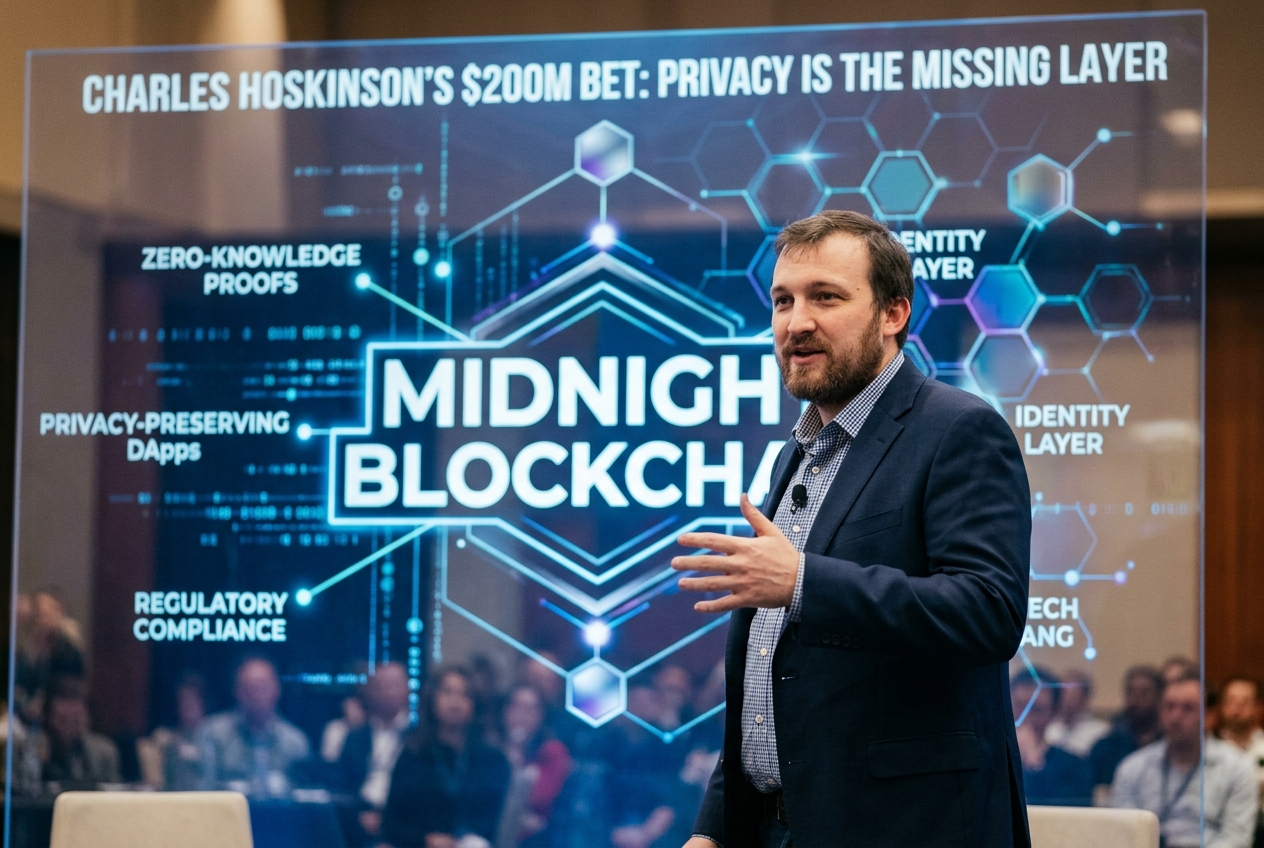
Charles Hoskinson launched Midnight on March 30, 2026, and described it as the answer to an eight-year-old question: why did the crypto revolution not happen? His answer is that public blockchains, from Bitcoin to Ethereum to Cardano, exposed too much. Every transaction is permanently visible. Every address is traceable. Every balance is public. That transparency was sold as a feature. Hoskinson argues it became the lock that kept the real world outside. Midnight is the key he spent $200 million of his own money building.
The mainnet launch came three days after Hoskinson spoke about it at Consensus Hong Kong 2026. Monument Bank, regulated by the Bank of England, announced plans to tokenize up to 250 million pounds in retail deposits on Midnight the same week. Google Cloud, MoneyGram, Worldpay, Pairpoint by Vodafone, eToro, and Blockdaemon committed as launch node operators. A blockchain that launched for the first time three months ago already has a major UK bank, a payment network processing millions of transactions daily, and a Google infrastructure partnership. That is the fastest institutional onboarding of any privacy-focused blockchain on record.
The Problem Hoskinson Is Solving
Hoskinson’s diagnosis is specific and verifiable. Today’s blockchains require users to manage private keys with no recovery mechanism, accept permanent and total transparency over every transaction, operate under irreversible-loss conditions that deter ordinary users, and engage with systems that require technical fluency most people do not have. The result: more than a decade of blockchain infrastructure that the real economy, the trillions in real estate, private equity, healthcare data, payroll systems, and regulated financial products, has entirely declined to touch. Not because of regulation. Because of the transparency problem and the usability problem.
At Consensus Hong Kong 2026, Hoskinson laid out the generational framework: Satoshi gave us sound money. Ethereum gave us programmability. Cardano gave us interoperability, scale, and governance. Midnight gives us identity and privacy back. In his telling, each generation solved one missing piece. The fourth generation solves the piece that was missing from all three: the ability to be on-chain without broadcasting everything about yourself to everyone, permanently. The question he has been asking for eight years is why the revolution did not happen. Midnight is his structural answer.
The practical expression of that argument is what Hoskinson calls selective disclosure. Rather than making everything public or making everything private, Midnight lets users choose exactly what to reveal and to whom, enforced by zero-knowledge cryptography rather than trust in an intermediary. A business running payroll on Midnight can prove it made payments without revealing salaries. A borrower can prove their collateral ratio is sufficient without revealing their portfolio. A patient can prove a health credential to an insurer without handing over medical records. The blockchain verifies the proof. The underlying data stays private. That is the trade-off Hoskinson describes as the missing piece.
How Midnight Actually Works: Architecture and Technology
Midnight is a Layer 1 blockchain and a partner chain to Cardano, not built on Cardano. It uses a Substrate-based architecture, the same modular framework Polkadot’s ecosystem uses, allowing interoperability and future cross-chain connectivity. The core cryptographic primitive is zero-knowledge proofs, specifically zk-SNARKs, implemented through a protocol called Kachina that manages the transition between Midnight’s two ledger states: a public settlement layer where consensus and auditable proof data live, visible to all participants, and a private execution layer where confidential computation and sensitive data are processed without exposure.
To make ZK development accessible without requiring deep cryptographic expertise, IOG built Compact, a domain-specific programming language based on TypeScript syntax. This is architecturally significant. ZK circuit development has historically required specialists in arcane mathematical frameworks. Compact lets a mainstream TypeScript developer build privacy-preserving applications using familiar syntax. They write contracts that simultaneously manage public and private state within a single function. Midnight handles the ZK proof generation underneath. The developer does not need to understand zk-SNARKs to use them. OpenZeppelin, the most-used smart contract auditing firm in Ethereum, has explicitly listed Midnight integration as a target area for DeFi, NFTs, identity, and real-world assets.
For consensus, Midnight uses a protocol called Minotaur, which combines Proof-of-Work and Proof-of-Stake mechanisms to leverage security resources from multiple blockchains simultaneously. The token economics are designed around a dual-asset model: NIGHT is the public, unshielded governance and security token. Holding NIGHT continuously generates DUST, a shielded, non-transferable, renewable resource used to pay transaction fees and execute smart contracts. DUST decays when spent and regenerates over time based on NIGHT holdings, functioning like a battery. Because DUST is renewable and its generation rate is predictable from NIGHT holdings, enterprises and frequent users gain cost predictability that single-token models do not provide. Transaction fees are no longer subject to the price volatility of the governance token.
Midnight’s Architecture: How Privacy and Compliance Coexist
The two-layer model separating public settlement from private execution | @cryptonewsbytes
| Component | What it does | Visibility |
|---|---|---|
| Public NIGHT ledger | Settlement, consensus, governance, staking | Public to all |
| Private execution layer | Confidential computation, contract state, sensitive data | Private by default |
| ZK proofs (zk-SNARKs) | Verify correctness without revealing data | Proof public, data private |
| Selective disclosure | User chooses what to reveal, to whom, when | User-controlled |
| Compact (TypeScript DSL) | Developer language for ZK smart contracts | Lowers barrier to ZK dev |
| NIGHT token | Governance, staking, generates DUST | Public, unshielded |
| DUST resource | Pay for transactions, renewable, non-transferable | Shielded, generated by holding NIGHT |
Sources: midnight.network, CoinStats AI, Bitget Academy, BingX, NBX | @cryptonewsbytes
The Token Distribution: 37 Million Wallets, No Venture Capital
Midnight’s distribution strategy is deliberately different from every high-profile token launch of the past three years. Hoskinson funded the project personally and distributed NIGHT tokens through what became the largest airdrop by number of wallets in the industry’s history. The Glacier Drop reached 37 million wallets across eight blockchains. A second phase called the Scavenger Mine added participation rewards for completing cryptographic tasks. By the time the airdrop sequence completed, 4.5 billion NIGHT tokens had been distributed to over 8 million wallets. Total supply is 24 billion NIGHT.
The no-venture-capital structure matters for one specific reason that is distinct from ideology: no institutional lockups with known unlock dates creating predictable sell pressure. The 2021 to 2023 cycle made clear that the biggest sources of long-term selling pressure in token markets were not retail, they were venture funds whose lockups expired 12 to 18 months after a token launch at prices far above where they bought. Midnight’s distribution into retail and community wallets does not eliminate selling pressure, but it distributes it broadly rather than concentrating it in a handful of institutional schedules. Whether that produces a healthier price history is a live question. NIGHT reached a valuation near $1 billion briefly at launch and currently sits near $776 million at roughly $0.047 per token.
NIGHT Token Distribution: 24 Billion Total Supply
No VC allocation. Community-first from day one. | Sources: midnight.network, CoinStats AI, Phemex | @cryptonewsbytes
24B
NIGHT
Glacier Drop
3.5B NIGHT to 170K addresses. Phase 1 airdrop across 8 chains.
Scavenger Mine
1B NIGHT to 8M addresses. Earned by completing cryptographic tasks.
Ecosystem and Foundation
Remainder held for network development, governance, and future phases. No VC lockup schedules.
Why this matters
Every major token crash of 2022 to 2023 had one thing in common: VC unlock schedules. Midnight skipped that. 8M+ wallets hold NIGHT. No cliff, no lockup, no single entity waiting to exit.
Note: full ecosystem allocation breakdown not publicly itemised. Only confirmed airdrop figures shown. Sources: midnight.network/night, CoinStats AI, Phemex Academy | @cryptonewsbytes
Current Plans: The Four-Phase Hawaiian Roadmap
Midnight’s roadmap follows a four-phase structure named after the Hawaiian lunar cycle. The Hilo phase covered token launch, which happened on Cardano mainnet as a native asset in December 2025 before Midnight mainnet existed, providing immediate liquidity. The Kukolu phase, which launched with mainnet on March 30, 2026, is the current live phase: a federated mainnet secured by institutional node operators including Google Cloud, Worldpay, Blockdaemon, MoneyGram, Pairpoint by Vodafone, eToro, AlphaTON Capital, and Shielded Technologies. Application deployment began in phases during Kukolu, starting with infrastructure, expanding to partner applications like Monument Bank’s deposit tokenization.
The Mohalu phase, expected in Q2 to Q3 2026, opens the network to Cardano Stake Pool Operators, moves toward decentralization, and activates the DUST Capacity Exchange, a marketplace where users can trade excess DUST capacity. By late 2026, the Hua phase completes the decentralization arc through LayerZero integration, allowing Midnight to function as a privacy layer for any blockchain ecosystem, not only Cardano.
The Four Phases: Where Midnight Is Now
Named after the Hawaiian lunar cycle. Currently in Kukolu. | Sources: BingX, CoinStats AI, midnight.network | @cryptonewsbytes
DONE
Dec 2025
Hilo: Token Launch
NIGHT launched as a native asset on Cardano mainnet, providing liquidity before Midnight mainnet existed. Glacier Drop distributed to 170K addresses. Scavenger Mine reached 8M.
LIVE NOW
Mar 2026
Kukolu: Federated Mainnet
Mainnet live March 30, 2026. Secured by Google Cloud, Worldpay, MoneyGram, Blockdaemon, eToro, Vodafone Pairpoint. Monument Bank tokenizing £250M in deposits. Application deployment underway.
NEXT
Q2-Q3 2026
Mohalu: Decentralization
Cardano Stake Pool Operators join the validator set. DUST Capacity Exchange activates: a marketplace where users trade excess DUST capacity. Network opens to community-run infrastructure.
FUTURE
Late 2026
Hua: Universal Privacy Layer
LayerZero integration. Midnight becomes a privacy layer accessible to any blockchain ecosystem, not only Cardano. Bitcoin liquidity via Pogun bridge expected around this phase.
Sources: BingX Academy, CryptoNewsNavigator, midnight.network | @cryptonewsbytes
Future Plans: Pogun, Bitcoin Liquidity, and the Institutional Privacy Market
On May 3, 2026, Hoskinson announced Pogun, a Bitcoin liquidity bridge described as siphoning Bitcoin liquidity into Cardano’s DeFi ecosystem through Midnight’s privacy layer. The mechanism would allow Bitcoin holders to earn DeFi yields without their transaction activity being publicly visible, a combination that, per Crypto News Navigator’s analysis, no other Layer 1 currently provides. A lending module is anticipated for Q2 2026 and a bridge powered by BitVM technology for later in the year. The Pogun bridge also enables collateralized lending where borrowers can prove their collateral ratio without revealing their full portfolio, the specific use case that institutional DeFi players have described as a prerequisite for participation in on-chain credit markets.
The longer-term Midnight vision is what Hoskinson calls invisibility: a future where users interact with blockchain infrastructure without knowing it. Applications built on Compact that abstract away private key management, where authentication happens biometrically and the ZK proof generation happens invisibly, where the user experience is tap, authenticate, done. The Wall Street application of this is concrete: fund managers who cannot expose their position sizes pre-execution could manage funds on-chain without the front-running risk that public mempool visibility creates. Compliance workflows where regulators receive selective disclosure proofs rather than raw data. Payroll systems where the blockchain guarantees payment execution without broadcasting employee compensation to competitors.
Midnight vs the Privacy Landscape: Where It Fits
Not a privacy coin, not a public chain, something different | @cryptonewsbytes
Sources: midnight.network, Bitget Academy, CoinStats AI, CryptoNewsNavigator | @cryptonewsbytes
Frequently Asked Questions
Is Midnight a Cardano sidechain or a separate blockchain?
Midnight is a Layer 1 blockchain and a partner chain to Cardano, not a sidechain built on Cardano. An earlier CoinDesk report described it as built on Cardano; this was corrected on March 31, 2026. It uses Substrate-based infrastructure and interoperates with Cardano rather than inheriting its consensus rules or running under Cardano validators.
How is DUST different from a regular transaction fee token?
DUST is not purchased or held directly. It is generated continuously by holding NIGHT tokens, functioning like a renewable resource or a battery that recharges over time. DUST is shielded and non-transferable; it can only be spent on transaction fees and smart contract execution, not sold. This separates the capital asset (NIGHT, which fluctuates with market sentiment) from the operational cost (DUST, which regenerates at a predictable rate), giving enterprises more predictable fee structures than networks where the same token serves both roles.
What is selective disclosure and how does it work in practice?
Selective disclosure is the ability to prove a specific fact about yourself or your data without revealing the underlying information. Midnight uses zero-knowledge proofs to construct these proofs cryptographically. In practice: a user proves they are over 18 without revealing their date of birth. A borrower proves their loan-to-value ratio is within limits without revealing their full portfolio. A bank proves it processed payroll without revealing individual salaries. The verifier receives a cryptographic proof that the claim is true. The underlying data never leaves the user’s control.
Further Reading
The Cardano ecosystem Midnight is partnered with. Protocol V11 enacted June 18 through on-chain governance, the first such upgrade in Cardano history.
The other major privacy blockchain story of 2026. Midnight and Zcash are solving related but different problems: Zcash hides transactions, Midnight adds programmable privacy to smart contracts.
The identity-on-blockchain story Midnight’s DID integration directly addresses. Hoskinson’s privacy argument is the structural answer to what happened at Humanity Protocol.
This article is for informational purposes only and does not constitute financial advice. Sources: CoinDesk March 30 2026 (Olivier Acuna), midnight.network blog March 30, Midnight Foundation, CryptoNewsNavigator May 2026, CoinStats AI June 2026, BingX Academy, NBX, Bitget Academy, Phemex Academy, midnight.network/night. Published July 2, 2026.