
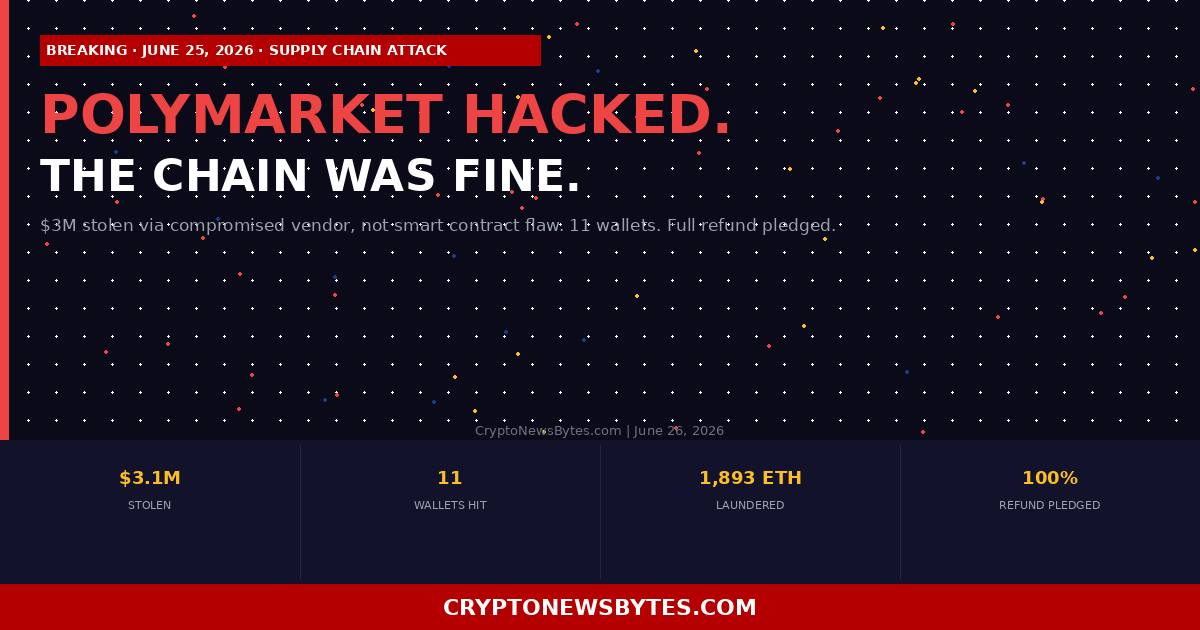
Polymarket lost $3.1 million on June 25, 2026, after attackers compromised a third-party vendor and injected malicious code into the prediction market’s website, tricking 11 users into signing fraudulent transactions. The company disclosed the breach the same day and has pledged full reimbursement to every affected user. Polymarket’s smart contracts were never touched and functioned exactly as designed throughout the incident: the attacker did not break the blockchain, they broke the website that sits in front of it. That script quietly prompted some users to sign or approve transactions they never intended to authorize, and because the blockchain has no way to distinguish a legitimate signature from one obtained through a deceptive prompt, it executed those transactions faithfully. The fraud happened one layer above the chain, in the browser, not on it.
Polymarket confirmed the incident in a post on X from its official trading account: it discovered a third-party vendor had been compromised, contained the breach, removed the affected dependency, and is contacting impacted users with full reimbursement. The company has not named the compromised vendor or disclosed how long the malicious script was active. Blockchain security firms PeckShield and Bubblemaps independently estimated the damage at roughly $3 million, later refined to $3.1 million by intelligence firm AMLBot, drained from fewer than 15 wallets, with 11 confirmed victims. The stolen funds, held in pUSD, Polymarket’s USDC-backed stablecoin, were swapped for ETH and bridged from Polygon to Ethereum, consolidating into a single address holding roughly 1,893 ETH.
How a Supply Chain Attack Actually Works
A supply chain attack does not target the application directly. It targets something the application trusts: a library, a vendor script, an analytics tool, a UI component pulled in from an external source. Nearly every modern website assembles itself from dozens of third-party dependencies, and the developer rarely audits all of them on every update. When an attacker compromises one of those upstream dependencies, the malicious code reaches every site that loads it, often without the site owner doing anything wrong themselves. Polymarket’s own infrastructure, its servers, its smart contracts on Polygon, was never touched. The compromised code arrived through a vendor’s update, and Polymarket’s website served it to users exactly as it would serve any other legitimate script.
Once embedded, the script did not need to steal a seed phrase or break encryption. It needed only to alter what users saw when they were asked to approve a transaction, presenting what looked like a routine signature request while actually authorizing a transfer to an attacker-controlled address. Standard smart contract audits, the security reviews that examine on-chain code for vulnerabilities, have no visibility into this layer. The contract logic was sound. The web interface that mediates between the user and that contract was not. CyberInsider’s framing of this incident put it precisely: trusting a secure decentralized protocol is not enough if the interface used to access it can be quietly tampered with.
Cointribune’s reporting noted the user experience during the attack: visitors loading the compromised page saw apparently legitimate signature requests, the kind any Polymarket user would have seen dozens of times before. There was no obvious red flag. No phishing email, no suspicious link, no unfamiliar domain. The attack arrived through the platform’s own official website, which is precisely what makes supply chain attacks more dangerous than conventional phishing. Users did exactly what they were trained to do: trust the official site. That trust was the vulnerability.
How the Attack Reached User Wallets
Six steps from compromised vendor to laundered ETH | Sources: Polymarket, PeckShield, AMLBot | @cryptonewsbytes
Third-party vendor compromised
Not Polymarket’s own infrastructure
Malicious JavaScript injected
Served live through Polymarket’s own website
Fake signature prompt shown
Indistinguishable from a routine approval request
11 users sign unknowingly
pUSD transferred to attacker-controlled address
pUSD swapped to ETH, bridged
Polygon to Ethereum, classic obscuring move
~1,893 ETH consolidated
Single attacker address, funds not yet recovered
What never broke: Polygon smart contracts
Functioned exactly as designed throughout. The attack never touched on-chain code.
Not financial advice. Sources: Polymarket official statement, PeckShield, AMLBot, BleepingComputer | @cryptonewsbytes
Polymarket Attack: From Compromised Vendor to Stolen Funds
Timeline of the June 25, 2026 disclosure | Sources: Polymarket, PeckShield, AMLBot | @cryptonewsbytes
Sources: Polymarket official statement, BleepingComputer, TechTimes, Cointribune | @cryptonewsbytes. Not financial advice.
Polymarket’s Rough Stretch: Three Incidents in Two Months
This is not Polymarket’s first security event of 2026. In May, blockchain investigator ZachXBT reported that roughly $520,000 had been drained from two Polygon smart contracts associated with the platform. Polymarket attributed that loss to a compromised six-year-old private key tied to an internal operations wallet, not a protocol exploit. The June 25 supply chain attack is structurally different, an external vendor compromise rather than an internal key failure, but it lands on a platform already under scrutiny. TechTimes called it the platform’s second serious security failure in five weeks, and the one that hit users directly rather than internal operations. CNB has covered three other major 2026 incidents that, read alongside Polymarket’s, map the full range of how DeFi platforms actually get attacked. Kelp DAO’s $292 million loss in April came through a single compromised validator node on its LayerZero bridge, an infrastructure failure at the cross-chain messaging layer. Radiant Capital’s $50 million hack in 2024, the one that eventually wound the protocol down to a $2 million husk, came from North Korea’s Lazarus Group using social engineering to compromise a developer’s hardware wallet, a human and key-management failure. Humanity Protocol’s $32 million loss in June combined a private key compromise with proxy admin access that ZachXBT has publicly questioned as possibly staged. Polymarket’s incident is the fourth distinct category: nothing was bridged, no key was stolen, no admin access was seized. The website itself, the layer every other defense assumes is safe, was the point of failure.
The security incidents arrive alongside other reputational pressure. A Wall Street Journal investigation reported days before the hack that Polymarket had paid online creators to post deceptive videos showing fabricated bets and winnings. The CFTC has an active investigation into the platform’s compliance practices, and a separate $345 million dispute over an Iran peace deal contract exposed that just nine anonymous wallets control more than half the voting power used to resolve contested outcomes on Polymarket. None of these issues caused the supply chain attack. But for a platform valued at $9 billion and processing billions in volume, the cumulative effect of security failures and governance and marketing controversies in the same month raises the kind of institutional scrutiny that compounds rather than fades.
The Pattern Nobody Else Is Connecting: Frontend Attacks Are the New Bridge Hacks
Every major DeFi security category gets its moment of dominance, then attackers move to the next undefended layer. 2024 was the year of bridge hacks: Ronin, Wormhole, and dozens of cross-chain bridges lost a combined $2 billion-plus to exploits in validator logic and message verification. By 2025, bridges had hardened, audits caught up, and attackers shifted to private key compromise instead, the Radiant Capital and Kelp DAO playbook of stealing admin access rather than breaking code. Polymarket’s incident marks the next shift. The frontend, the actual website a user loads in their browser, is now a confirmed attack surface that bypasses every defense the industry built for the previous two threat categories. Smart contract audits do not see it. Hardware wallets and multisig key management, the fixes that followed the bridge and key-compromise eras, do not stop it either, since the attacker never needs the private key itself, only a deceptive prompt that gets the user to sign with it. DeFiLlama’s own count of 89 security incidents in Q2 2026, the highest quarterly total on record, suggests the overall attack surface is expanding faster than defenses are closing it, even if frontend-specific incidents are not yet broken out as their own tracked category.
Why This Fits the 2026 Pattern, and Why It Is Different
DeFiLlama recorded this as the 89th security incident of the second quarter of 2026, the highest quarterly count ever logged, with June exploit losses reaching $74.9 million, up from $60.5 million in May. The dominant story of 2026 security failures has been operational: compromised private keys, weak entropy in wallet generation, mismanaged admin access. Polymarket’s incident adds a new category to that list rather than repeating it. It is not a key management failure. It is a frontend trust failure, an attack on the layer where users interact with otherwise-secure protocols. As more DeFi platforms harden their key management in response to 2026’s losses, the interface layer that Polymarket’s incident exposed may become the next frontier attackers move toward.
The practical defense the industry is converging on is unglamorous but effective: read every transaction before signing it. Wallet software increasingly offers transaction simulation, showing in plain language what a signature will actually authorize before it is confirmed. Users who rely on transaction simulation tools would have seen a Polymarket-style fraudulent request flagged before signing, regardless of how legitimate the surrounding website looked. That single habit, treating every signature request as a discrete decision rather than a routine click, is the only defense that works against an attack vector built specifically to look unremarkable.
Frequently Asked Questions
Were Polymarket’s smart contracts or on-chain funds compromised?
No. Polymarket’s core smart contracts on the Polygon network were not breached and continued to operate as designed throughout the incident. The attack targeted the website’s frontend, the interface layer between users and those contracts, not the contracts themselves. Funds in active markets that were not touched by the fraudulent approvals remained secure.
How do I protect myself from a supply chain attack like this?
The most effective defense is reading every transaction request before signing it, ideally using a wallet with built-in transaction simulation that shows in plain language what a signature will authorize. Be suspicious of any unexpected signature prompt, even on a site you trust and have used before, since supply chain attacks specifically exploit that trust. Hardware wallets that display transaction details on a separate screen add a layer of protection against malicious browser-based prompts.
Has Polymarket said which vendor was compromised?
No. As of this writing, Polymarket has not disclosed the identity of the compromised third-party vendor or how long the malicious script remained live on its frontend. Multiple outlets including BleepingComputer and SecurityWeek have requested comment and received no further detail beyond Polymarket’s original X statement.
Further Reading
The other major June 2026 security story. Private key compromise plus a proxy admin takeover, with ZachXBT publicly questioning whether it was an inside job.
DeFi’s largest 2026 bridge hack and the rescue operation that followed. Wall Street’s split verdict on whether DeFi’s security model actually held.
The case study in what happens when a hack is not contained quickly. Radiant never recovered. Polymarket’s fast containment is the opposite outcome in real time.
The other side of the coin: a vulnerability caught before exploitation. A four-year-old bug found by AI and patched in four days, the contrast case to Polymarket’s after-the-fact response.
This article is for informational purposes only and does not constitute financial advice. Sources: Polymarket official statement via X (@PolymarketTrade) June 25 2026, BleepingComputer, TechTimes, Cointribune, CyberInsider, SecurityWeek, Cryip, TheNextWeb, PeckShield, Bubblemaps, AMLBot, DefiLlama Q2 2026 data. Published June 26, 2026.