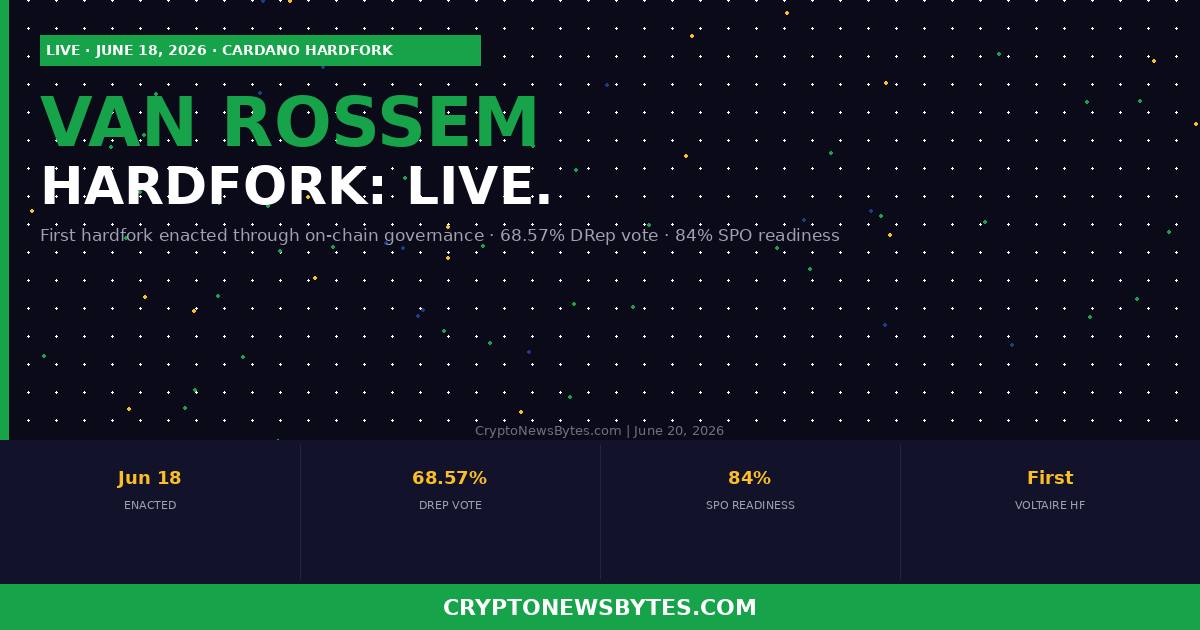
Cardano’s van Rossem hardfork enacted on mainnet on June 18, 2026 at 21:45 UTC. Protocol Version 11 is live. What makes this upgrade different from every prior Cardano hardfork is not the technical specification. It is the mechanism by which it happened. For the first time in Cardano’s eight-year history, a mainnet hardfork was initiated, ratified, and enacted entirely through the Voltaire on-chain governance framework, without Input Output Global scheduling or executing it unilaterally. Three governance bodies had to independently clear their thresholds before the upgrade could proceed: DReps voted 68.57% approval weighted by ADA stake, 5 of 7 Constitutional Committee members signed off, and stake pool operators delivered 84% block production on Protocol Version 11 nodes over the five days before ratification. All three converged. The hardfork went live.
The upgrade takes its name from Max van Rossem, a Cardano governance contributor who died on January 11, 2026, the same day his son Max Louis Hans van Rossem was born. An on-chain DRep naming vote ran in January and February 2026 and received 83.62% support with 4.44 billion ADA backing, one of the most decisive governance votes the network has recorded. Intersect wrote in its June 12 update: the child will grow up in a world where the blockchain his father helped shape carries his family name. The upgrade is named not for a product or a protocol milestone but for a person who showed up, asked hard questions, and built. That context is worth holding alongside the technical facts.
What Van Rossem Actually Changes
Protocol Version 11 is technically classified as an intra-era upgrade, not a full era change on the scale of Shelley or Basho. It does not launch a new ledger era. What it does: it updates the Plutus cost model, the pricing schedule that determines how much computation each smart contract operation costs on-chain, with increases to some existing primitives that took effect at enactment and new primitive settings that allow Cardano developers to use new capabilities immediately after the fork. It also lays the foundations for the Dijkstra era, the next phase in Cardano’s roadmap, which is designed to prepare the network for Leios.
Leios is the upgrade that actually matters for Cardano’s scalability story: a new consensus mechanism using endorser blocks to dramatically increase throughput beyond the current single-block-per-slot model. The Ouroboros Leios Musashi Dojo testnet launched on June 23, giving developers and stake pool operators the first live test environment. Van Rossem itself does not deliver Leios throughput. It delivers the governance precedent and some of the protocol scaffolding that Dijkstra and then Leios will build on. The Cardano roadmap now runs through van Rossem to Dijkstra to Leios, and the first step landed on schedule.
Van Rossem Readiness: Three Layers All Cleared
The three-body governance process that enacted the hardfork | @cryptonewsbytes
Sources: Intersect weekly update #116, 99Bitcoins, icobench, Dealroom | @cryptonewsbytes
Why the Governance Mechanism Is the Real Story
Every prior Cardano hardfork was scheduled and executed by IOG. The community could comment, stake pool operators could signal readiness, but IOG held the keys. Van Rossem changes that permanently. Under the Voltaire framework now active on mainnet, no single entity can schedule or block an upgrade unilaterally. DReps, whose voting power reflects the ADA stake their individual holders have delegated to them, must approve. The Constitutional Committee, whose members are elected on-chain, must ratify. Stake pool operators signal readiness through their block production choices. All three bodies must independently clear their thresholds.
The governance action for the hardfork was submitted to mainnet on June 16. Ratification was confirmed on June 13 via the DRep vote. Enactment followed on June 18, faster than the original July 18 expiry window suggested was possible. That compression from submission to enactment in two days demonstrates that the Voltaire framework can move efficiently when readiness genuinely converges rather than waiting for an arbitrary calendar date. For future upgrades including Dijkstra and Leios, the same process applies. IOG cannot rush a hardfork and cannot block one if the governance bodies approve. That is a structural change in how Cardano evolves.
The discord that preceded van Rossem is worth noting. An 81% active stake majority opposed a 32.9 million ADA proposal to fund IOG’s core research team in May, led primarily by Japanese delegated representatives arguing the proposal lacked auditable milestones. Hoskinson called it an attempt to destroy the core of the ecosystem. The IOG funding dispute resolved, but it showed that Cardano’s governance can and does produce contested outcomes with real consequences for the organizations that have historically run the protocol. Van Rossem’s clean ratification is the flip side of that same system: when technical readiness is strong and the upgrade is unambiguous, the governance process delivers quickly.
Cardano Upgrade Roadmap: Where Van Rossem Sits
Intra-era upgrade to Protocol Version 11, stepping stone to Leios | @cryptonewsbytes
Sources: Intersect, Cardano Foundation, CoinMarketCap AI | @cryptonewsbytes
Frequently Asked Questions
What does Protocol Version 11 actually change for ADA holders?
For most ADA holders, the immediate impact is minimal. The Plutus cost model update changes the computational pricing for smart contracts, which affects DApp developers more directly than token holders. The hardfork also lays groundwork for the Dijkstra era, which will eventually bring Leios scaling to mainnet. The more significant change is structural: future protocol upgrades now require on-chain governance approval from DReps, the Constitutional Committee, and SPOs, meaning no single entity controls Cardano’s upgrade path.
What is Leios and why does it matter?
Ouroboros Leios is Cardano’s next-generation consensus mechanism, designed to dramatically increase transaction throughput by introducing endorser blocks that run in parallel alongside the standard block production process. The current Cardano chain produces one block per slot with limited throughput. Leios aims to increase that significantly without changing the security model. The Musashi Dojo testnet launched June 23 for developer testing. Mainnet is targeted for end of 2026, pending testnet results.
Further Reading
The governance tension that preceded van Rossem: 81% of active stake opposing the IOG research funding proposal. The same system that produced that confrontation just ratified a clean hardfork.
The same June 2026 pattern that hit Cardano’s SecondFi wallet: attack vector is tooling, not the underlying chain.
Key management failures as the dominant 2026 attack vector. SecondFi’s wallet generation flaw fits the same category.
This article is for informational purposes only and does not constitute financial advice. Sources: Intersect weekly update #116 June 19 2026, intersectmbo.org/news/cardano-upgrade-van-rossem-hard-fork, 99bitcoins.com, icobench.com, dealroom.co, crypto.news, livebitcoinnews.com (SecondFi), CoinMarketCap AI Cardano latest. Published June 17, 2026.