
On June 10, we published an article noting that Glassnode data showed XRP holders capitulating, selling at a loss in a pattern that historically marks the late stage of a drawdown rather than the start of one. Three structural signals were stacking simultaneously: the capitulation on-chain data, CME Group’s new Nasdaq CME Crypto Index futures adding XRP at a 5.80% weighting, and SBI Shinsei Bank launching an XRP interest program. The article concluded that the trigger for a recovery would come from macro flows turning, not from the on-chain setup alone. On June 16, 2026, Bitcoin reclaimed $66,340 on the back of the US-Iran deal, and the XRP data that followed confirmed the bottom call.
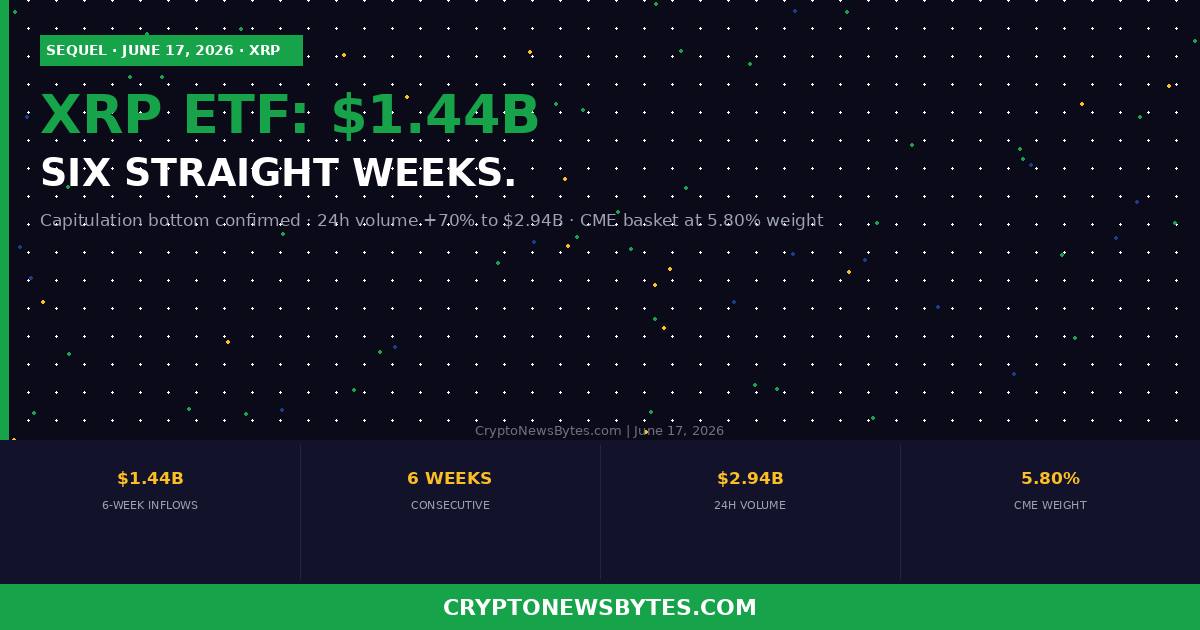
US spot XRP ETFs have now recorded six consecutive weeks of net inflows, totalling $1.44 billion. On June 16 alone, XRP 24-hour trading volume surged approximately 70% to $2.94 billion. XRP is trading near $1.23 with its market structure improving as BTC reclaims the $66,000 zone. The six-week inflow streak represents a structural shift in institutional positioning: not the short-term speculative rotations that accompanied XRP’s 2024 SEC victory, but sustained allocation from funds that have made XRP a line item in their crypto portfolio.
Reading the Reversal: From Capitulation to Inflows
The sequence matters more than any single data point. First, the Glassnode capitulation signal: XRP holders selling at a realized loss, the spent-output profit ratio collapsing, the behavior of late-stage drawdowns not early ones. That was visible on June 9-10. Second, the macro catalyst: the US-Iran deal announced around June 11-12 sent oil lower, equities higher, and removed the dominant geopolitical fear trade from the risk equation. Bitcoin moved from $63,000 to $66,340. Third, the rotation into high-beta: Solana up from near $58 to above $73. Hyperliquid up 9.47% in a single session on June 16. XRP volume surging 70%. The pattern is textbook risk-on rotation into assets that had been most beaten up by the macro headwinds.
The six-week ETF inflow streak predates the Iran deal, which means institutional investors were positioning before the geopolitical catalyst, not in reaction to it. The $1.44 billion accumulated over six weeks represents a deliberate allocation decision by funds that saw XRP’s legal clarity after the SEC case concluded in August 2025 confirming XRP is not a security, its CME basket inclusion, and the Japan institutional backing through SBI Shinsei as reasons to build a position into the weakness, not sell into it. The June 16 volume spike is the retail and momentum layer finally joining what the institutional layer had been building.
XRP Recovery: The Signals That Stacked Before the Move
June 9-16, 2026 | @cryptonewsbytes
Sources: Glassnode via CoinDesk, CoinMarketCap, BlockchainReporter June 16, SBI Shinsei | @cryptonewsbytes. Not financial advice.
What Happens Next: The $1.40 Level and Above
The technical level that matters is $1.40. A daily close above it repairs the structure that broke down during the spring selloff and opens the way toward the $1.60 to $1.80 zone that served as support before the cascade. XRP currently sits at $1.23, meaning it still has work to do before the chart is constructive. But the preconditions for that move are now in place: the capitulation has occurred, institutions are accumulating on weakness, the legal overhang is resolved, the CME provides regulated access, and the macro ceiling that was suffocating all risk assets has shown signs of lifting.
The risk to the thesis is the same as it was on June 10: XRP is a high-beta asset that will not sustain a rally if Bitcoin loses $66,000 decisively. The Fed meeting under new Chair Kevin Warsh concludes June 17, and if the language is more hawkish than markets expect, the risk-on move from the Iran deal could partially reverse. Watching the daily close on BTC is the primary input for XRP’s near-term trajectory. The six-week institutional inflow streak will not disappear overnight. But momentum assets need momentum conditions, and those conditions are currently holding by a thread pending the Fed.
Frequently Asked Questions
Why did XRP spot ETF inflows continue even before the Iran deal?
Institutional investors operate on longer allocation cycles than retail. The $1.44 billion accumulated over six weeks reflects portfolio decisions made based on XRP’s regulatory clarity after the August 2025 SEC conclusion, its legal status as a non-security, the CME basket inclusion normalising it within regulated fund mandates, and the Japan institutional backing. These are multi-month allocation decisions, not reactive trades to short-term news.
What is the difference between XRP spot ETF inflows and XRP price performance?
ETF inflows reflect the net capital entering XRP spot ETF products, measured by share creation. This is separate from XRP’s spot price performance. An ETF can have positive inflows while XRP’s price is flat or declining if the inflows are offset by spot selling elsewhere. The sustained six-week streak indicates consistent institutional demand even during a period when XRP’s spot price was under pressure from macro factors.
Further Reading
The original article from June 10. The signals described there have now resolved: capitulation confirmed, inflows confirmed, macro catalyst arrived.
The Bitcoin macro context that XRP’s recovery depends on. BTC back at $66K is the precondition everything else needs.
When BTC macro stabilises, the rotation into XRP and other high-beta assets is the pattern. June 16 data looks like the early stages of that rotation.
This article is for informational purposes only and does not constitute financial advice. Sources: BlockchainReporter June 16 2026, CoinMarketCap, Glassnode, SBI Shinsei, CoinDesk, CME Group, CNB June 10 XRP coverage. Published June 17, 2026.