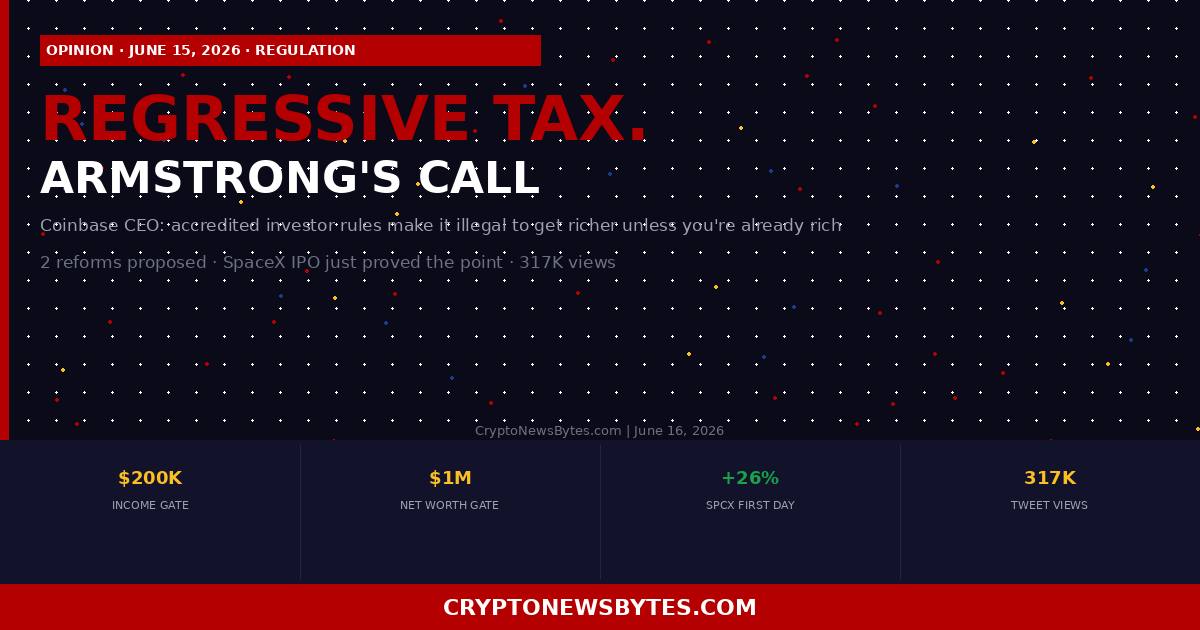
Brian Armstrong, CEO of Coinbase, posted a call to reform accredited investor laws on June 15, attracting 317,000 views in hours. His argument is concise: companies are staying private longer, so the best returns happen before the IPO, and only rich people are allowed into those pre-IPO rounds. By the time retail investors can participate, as SpaceX just demonstrated on June 12, much of the upside has already been captured. Armstrong called the current system a “regressive tax” and proposed two fixes: replace the wealth threshold with a merit-based financial literacy test, or remove the rule entirely while keeping disclosure requirements and fraud enforcement in place.
The tweet lands at an unusually relevant moment. The SpaceX IPO on June 12 saw retail investors limited to a fraction of the offering while institutional books filled at four times oversubscription. The IPO opened around 26% above its $135 offer price. Investors who bought at the open paid the premium that accredited investors who got in earlier at lower private-market valuations did not. That is exactly the dynamic Armstrong is describing, and it just played out in the most-watched public offering of the decade.
Brian Armstrong
“I think it’s time to revisit the accredited investor laws in the US. Companies are staying private longer, where only accredited investors (aka rich people!) can invest. Retail investors can only come in after IPO, when much of the upside has already been captured.”
“These rules were created with the best of intentions, to protect regular people from scams and a noble idea. Unfortunately, in practice they’ve often made it illegal to get richer, unless you’re already rich. A regressive tax!”
Two routes: 1) Replace with a merit-based financial literacy test. 2) Remove the rule entirely. Let consenting adults assess their own risk. Disclosure and fraud enforcement stay.
317K views · View original tweet
What the Accredited Investor Rule Actually Says
The accredited investor rule lives in SEC Regulation D, Rule 501(a). It defines who is permitted to invest in private securities offerings: startups, pre-IPO rounds, venture funds, hedge funds, and private credit. To qualify as an individual, you need individual income above $200,000 in each of the past two years (or $300,000 jointly with a spouse), or a net worth exceeding $1 million excluding your primary residence. Those thresholds have not been adjusted for inflation since they were established in 1982. The $200,000 income line that felt like serious money in the Reagan administration is approximately $640,000 in 2026 dollars. In real terms, the bar has fallen significantly while the nominal number stayed fixed.
The 2020 SEC amendments added a professional license pathway: holders of FINRA Series 7, Series 65, or Series 82 licenses can qualify regardless of income or net worth. The SEC acknowledged at the time that sophistication correlates better with knowledge than with bank balance, but it stopped short of creating a general knowledge-based pathway, the exact thing Armstrong is now proposing. The SEC under Chair Paul Atkins has signalled ongoing interest in broadening the definition, noting its intent to reduce compliance burdens and facilitate capital formation, but as of April 2026 no formal rulemaking has been proposed. Congress is moving in parallel through the INVEST Act, which specifically targets expanding pathways to private capital markets.
Who Qualifies as an Accredited Investor Today
Current rules as of 2026 and thresholds unchanged since 1982 | @cryptonewsbytes
Income test
$200K individual income each of the past 2 years ($300K joint). Reasonable expectation of same in current year. Set in 1982. Equivalent to ~$640K in 2026 dollars.
Net worth test
$1M net worth excluding primary residence, individually or jointly. Set in 2010 by Dodd-Frank (reduced from $1M including home).
Professional license pathway (added 2020)
Holders of FINRA Series 7, Series 65, or Series 82 licenses qualify regardless of income or net worth. The only existing knowledge-based pathway. Armstrong wants to expand this to all investors via a literacy test.
Everyone else
Cannot invest in unregistered private offerings. Can only access opportunities after IPO, when the company is public and disclosure requirements apply.
Sources: SEC Regulation D Rule 501(a), Carta, Accountable Equity | @cryptonewsbytes
The SpaceX Case Study: Armstrong’s Point in Practice
The SpaceX IPO on June 12 illustrated Armstrong’s argument more effectively than any abstract example could. SpaceX raised $75 billion at $135 per share. The book came in four times oversubscribed. Retail investors received up to 30% of the offering, which sounds generous until you note that the demand was so extreme that most retail orders were partially or unfilled entirely. Crypto exchanges Binance, Bybit, and Bitget all had to refund customers after failing to secure shares through tokenized equity platforms. The stock opened around 26% above the offer price on day one.
The investors who captured the majority of that first-day premium were the accredited investors in venture rounds going back to 2008, the institutional allocations at the IPO price, and the pre-IPO secondaries available only to qualified purchasers. A retail investor who learned about SpaceX in 2010, followed the company for 16 years, understood its business better than most Wall Street analysts, and correctly anticipated its dominance in commercial launch and satellite internet could not legally invest until June 12, 2026, at $135. A venture fund analyst who happened to have worked at a firm with a Reg D exemption could have invested at a tiny fraction of that. The difference was not sophistication. It was the credential.
Where the Upside Goes: SpaceX as a Case Study
The accredited investor gap in practice | @cryptonewsbytes
Valuations illustrative and approximate. Not financial advice. | @cryptonewsbytes
Armstrong’s Two Routes: What Each Would Mean
Armstrong’s first option, a financial literacy test, already has a real-world antecedent in the SEC’s 2020 professional license amendment. The Series 7, 65, and 82 pathways let licensed professionals invest in private securities regardless of personal wealth because the SEC acknowledged that knowledge correlates better with investment sophistication than net worth does. A general literacy test would extend that logic to any individual who could demonstrate competency, democratizing access without eliminating the underlying protection logic entirely. Fairmint, an SEC-registered transfer agent, submitted formal recommendations along exactly these lines to the SEC’s Crypto Task Force in February 2026, proposing that product users, contributors, and knowledge-verified individuals qualify as investors through competency rather than capital.
Armstrong’s second option, removing the rule entirely while keeping disclosures and fraud enforcement, is the more radical position and the one with the most resistance. The counterargument is that disclosure requirements without a gate still rely on retail investors reading and correctly weighting the disclosures, and that the historical failure modes of unregistered offerings, the pump-and-dump schemes, the fraudulent startups, the high-pressure sales to unsophisticated investors, did not primarily result from sophisticated investors being defrauded. They resulted from people who did not know what they did not know being sold something they could not evaluate. A literacy test attempts to address that. Full removal does not.
The Crypto Angle: Why Armstrong Is Making This Argument
Armstrong’s interest in accredited investor reform is not abstract. Coinbase’s core business depends on retail access to crypto markets, and crypto’s market structure has historically operated outside the Reg D framework because tokens are not securities under most current interpretations. But tokenized equity, which we covered in depth through the Bybit SpaceX and Securitize stories this week, sits directly in the accredited investor framework. As crypto exchanges move toward offering tokenized pre-IPO equity, tokenized venture funds, and tokenized credit products, the accredited investor rule becomes the regulatory ceiling on their addressable market.
The CLARITY Act, which CNB has covered extensively, deals with stablecoin infrastructure. The accredited investor reform Armstrong is advocating would deal with who can use it. Both are part of the same underlying question: what financial products can ordinary Americans access, and who decides? The SEC under Atkins has signalled openness to expansion. Congress is moving through the INVEST Act. And now the CEO of the largest US crypto exchange is putting 317,000 views worth of attention on the question in a single Sunday night post. The timing after SpaceX week is not a coincidence.
Frequently Asked Questions
Am I an accredited investor?
You qualify if you earned over $200,000 individually (or $300,000 with a spouse) in each of the past two years and expect the same this year, or if your net worth exceeds $1 million excluding your primary home. You also qualify if you hold an active FINRA Series 7, 65, or 82 license. Accreditation is self-certified when investing in Regulation D offerings; you do not register with the SEC. The issuer or fund you invest in is responsible for verifying your qualification, particularly under Rule 506(c) general solicitation offerings.
What is the INVEST Act?
The Improving New Investments for a Stronger Economy and Tomorrow (INVEST) Act is pending Congressional legislation aimed at expanding access to private capital markets. It proposes to broaden the definition of accredited investors to include individuals with demonstrated financial knowledge or experience, moving in the direction Armstrong advocates. The SEC under Chair Paul Atkins has separately signalled intent to expand capital formation pathways, but no formal rulemaking had been proposed as of April 2026.
Further Reading
The IPO that made Armstrong’s argument concrete: retail waited 16 years for SpaceX, got in at $135, and paid a 26% first-day premium for the privilege.
The infrastructure building to deliver what Armstrong is advocating: on-chain access to equities. The accredited investor rule is the regulatory ceiling on how far it can go.
The other major piece of financial access legislation moving in Washington, covering the payment rails accredited investor reform would route through.
This article is for informational purposes only and does not constitute financial advice. Sources: Brian Armstrong on X, June 15, 2026, SEC Regulation D Rule 501(a), Carta, Accountable Equity, The Startup Law Blog, Fairmint SEC submission February 2026, SEC Spring 2025 Unified Agenda statement. Published June 16, 2026.