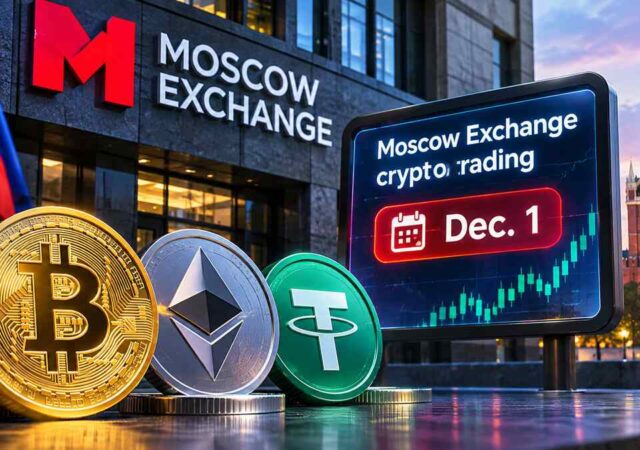
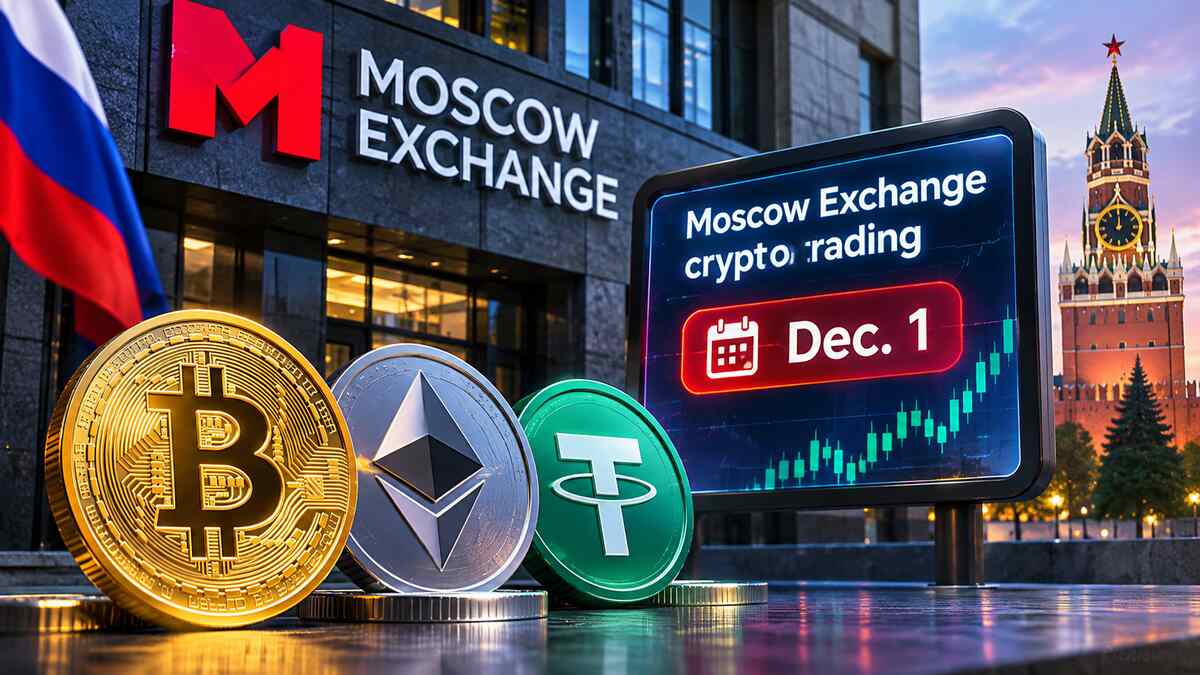
- Moscow Exchange plans to begin Bitcoin Ether and USDT trading on Dec. 1.
- Non-qualified investors must pass a test and face a 300000 ruble annual limit per broker.
- A Russian payments executive questioned demand pricing and competitiveness.
Moscow Exchange crypto trading is scheduled to begin on Dec. 1, marking what the exchange described as Russia’s first organized digital currency market. The venue plans to list Bitcoin, Ether and Tether’s USDT, with pilot trades starting as participants connect to the platform. The launch comes after the main provisions of Russia’s new crypto law took effect on Sept. 1, allowing regulated trading while still prohibiting cryptocurrency payments for goods and services inside the country. Moscow Exchange said the market will run on its existing stock-market infrastructure and will be cleared through the National Clearing Center.
Moscow Exchange crypto launch details
Moscow Exchange said its new market for Bitcoin, Ether and USDT will open on Dec. 1. The exchange added that pilot trades would begin as market participants join the platform, suggesting the rollout may start gradually rather than all at once. The exchange said Moscow Exchange crypto trading will use its existing stock-market systems. Clearing will be handled by the National Clearing Center, known as NCC, and trading hours are set from 6:50 am to 11:50 pm Moscow time.
Moscow Exchange crypto products and settlement
At launch, the market will support same-day settlement, next-day settlement and swap transactions. Those features indicate the exchange is starting with a limited but structured set of trading and settlement options rather than a broader range of products. Moscow Exchange presented the plan as the start of an organized digital currency market in Russia. The initial asset list is limited to Bitcoin, Ether and USDT, which shows the exchange is beginning with major crypto assets rather than a wide selection of tokens.
Investor rules under Moscow Exchange crypto
The launch follows Russia’s new crypto law, whose main provisions took effect on Sept. 1. Under that legal framework, regulated crypto trading is allowed, but the ban on using cryptocurrency to pay for goods and services in Russia remains in place.
For non-qualified investors, access to Moscow Exchange crypto trading will come with restrictions. They must first pass a test before they can buy crypto, and their purchases will be capped at 300,000 rubles per year for each broker, or about $3,700 according to the exchange.
Sanctions and criticism of the new market
Moscow Exchange and the NCC have been under US sanctions since June 2024. The UK also sanctioned the exchange in the same month, and the European Union later added it to its sanctions list in July 2026. Sergey Mendeleev, founder of Russian cross-border payments platform Exved, told Cointelegraph he doubted the market would generate significant demand. He said neither the global nor the local market would notice much and questioned who would choose to trade on a sanctioned exchange.
Pricing concerns and cross-border use
Mendeleev also argued that the proposed trading conditions may be uncompetitive. He compared the idea to precious metals accounts at Russian lender Sberbank, where customers trade account balances without taking possession of the underlying metal. He warned that investors could face very wide spreads between buy and sell prices, making the product unattractive for ordinary non-qualified investors. Still, he said the platform could have some usefulness for cross-border payments if importers and exporters were able to buy and sell crypto directly with one another, although he questioned whether another intermediary could compete in a market where traders bargain over price gaps as small as 0.05%.
Conclusion
Moscow Exchange crypto trading is set to start on Dec. 1 with Bitcoin, Ether and USDT as the first assets on the platform. The exchange said trading will run through its existing infrastructure, with NCC clearing transactions and support at launch for same-day settlement, next-day settlement and swaps. The move follows Russia’s new crypto law, which allows regulated trading but still bars crypto payments for goods and services. Non-qualified investors will face testing requirements and annual purchase caps. At the same time, sanctions on the exchange and criticism over likely demand and pricing show that the launch may face clear practical limits.
Disclaimer
The information provided in this article is for informational purposes only and should not be considered financial advice. The article does not offer sufficient information to make investment decisions, nor does it constitute an offer, recommendation, or solicitation to buy or sell any financial instrument. The content is opinion of the author and does not reflect any view or suggestion or any kind of advise from CryptoNewsBytes.com. The author declares he does not hold any of the above mentioned tokens or received any incentive from any company.
Featured image created by AI