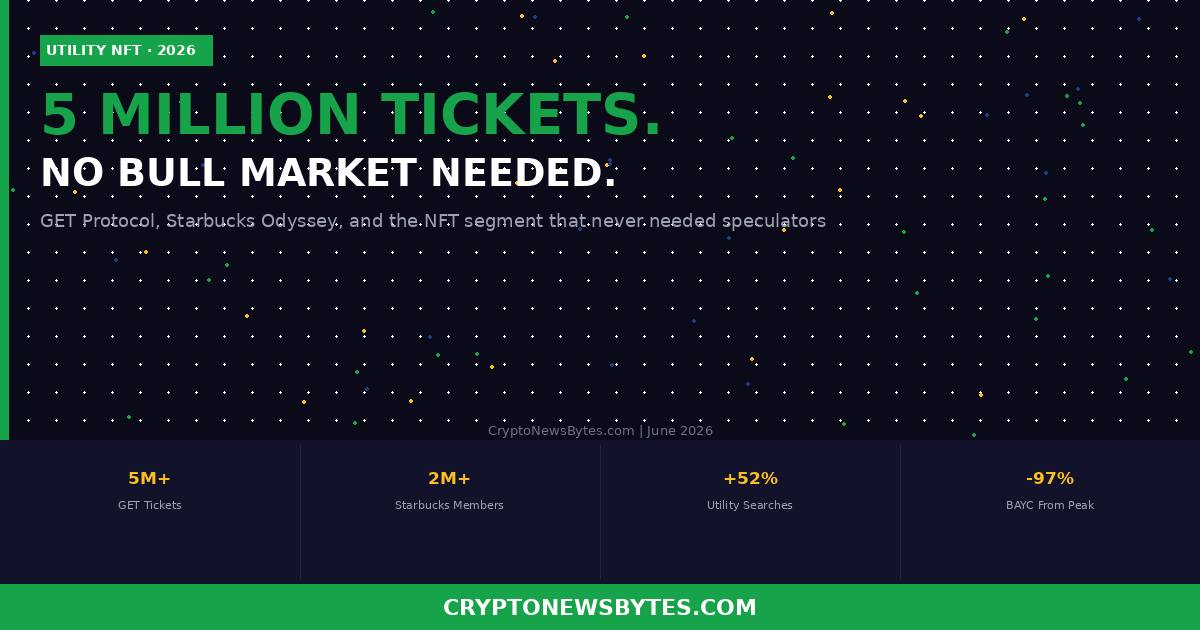
Google searches for ‘are NFTs dead’ peaked in March 2024 and fell 67% by December 2025. Searches for ‘NFT utility’ and ‘gaming NFTs’ rose 52% over the same period. The retail crowd stopped asking whether NFTs were alive and started asking whether they were useful. That question has a clear answer in one corner of the market: ticketing. GET Protocol has sold more than 5 million tickets on-chain. NFT ticketing reduces fraud by up to 90% compared to traditional venues. Event organizers collect royalties on every secondary resale, a revenue stream the old paper-and-barcode system made impossible to enforce. And none of this required a bull market, a celebrity endorsement, or a floor price to go up.
DappRadar described the NFT sector in late 2025 as moving ‘beyond JPEGs,’ with momentum returning through utility, stronger on-chain communities, and real-world use cases rather than pure speculation. The ticketing segment is the cleanest example of that description. It never had the JPEG phase. It went from concept to infrastructure without the speculative overhang that crippled PFP collections when sentiment reversed. That is why it is still growing while everything else is trying to recover.
What GET Protocol Actually Built
GET Protocol is a blockchain-based ticketing infrastructure that event organizers plug into rather than a consumer brand anyone queues for. The product sits behind the scenes: organizers issue tickets as NFTs, fans receive them in a wallet (often without knowing it is on-chain), and the smart contract enforces royalties on every secondary sale automatically. When a ticket sold at face value for $50 gets flipped for $200 on the secondary market, the organizer captures a programmable percentage without any manual intervention or platform negotiation. That royalty enforcement is the feature Ticketmaster cannot offer because its business model depends on controlling the resale market entirely.
The fraud reduction story is equally compelling. A counterfeit NFT ticket is trivially verifiable at the gate: the wallet either holds the token or it does not. No barcode scanning, no paper fraud, no printed fakes that look identical to the real thing. Stubhub estimates 12% of event tickets are counterfeit in traditional markets. GET Protocol venues effectively reduce that to zero for verified NFT holders. The technology is not speculative. It works today, and it has worked through the entire NFT bear market because it does not depend on floor prices to be useful.
NFT Ticketing vs PFP Collections: Two Very Different 2026 Stories
Utility NFTs scale through the bear market | @cryptonewsbytes
Sources: EarnPark, Colexion, CoinGecko, BeInCrypto | @cryptonewsbytes
Starbucks Odyssey: The Loyalty Program That Quietly Scaled to 2 Million Members
Starbucks launched Odyssey in 2022 as an experiment: NFT stamps earned by completing coffee-related challenges, redeemable for rewards and tradeable on secondary markets. By 2026 it has enrolled more than 2 million members. The stamps unlock coffee-making classes, exclusive events, and limited merchandise drops. They can be resold, creating a secondary market where Starbucks captures royalties. It is the loyalty program every brand wanted to build without having to call it an NFT program, because the underlying technology is irrelevant to a customer who just want their free latte and a backstage pass to a coffee harvest tour.
Nike’s .Swoosh platform follows the same structure: digital wearables tied to physical product drops, community governance on which colorways get made, and royalties on peer-to-peer resales. Neither Starbucks nor Nike talks about their programs as NFT products in consumer-facing marketing. Both of them are exactly that. The rebranding is strategic and correct: the technology is a means to utility, and utility is what scales.
The Use Cases That Work vs the Ones That Did Not
The honest accounting of NFT utility in 2026 looks like this. What works: ticketing with fraud prevention and royalty enforcement, loyalty programs where the token unlocks real benefits the user genuinely wants, gaming assets with actual in-game function, and membership passes that gate real communities or services. What did not work: virtual land in metaverses nobody uses (Decentraland and Sandbox parcels have gone from digital gold to ghost towns), profile picture collections with roadmaps promising metaverse integration that never shipped, and celebrity endorsements attached to projects with no underlying utility.
The boundary line between the two categories is simple and consistent: does the NFT do something the user wants regardless of its market price? If holding a GET Protocol ticket grants entry to a concert whether the NFT market is up or down, it has utility. If holding a Bored Ape only felt valuable when the floor was at $430,000, it did not. That distinction is now reflected in survival rates. The utility projects are still operating and growing. The floor-price-dependent projects are in the 96% category.
Frequently Asked Questions
Can someone who has never used crypto buy an NFT ticket?
GET Protocol and similar platforms are specifically designed for this: the ticket holder receives an NFT in a custodial wallet without needing to understand blockchain or manage keys. The on-chain verification happens behind the scenes at the gate. From the fan’s perspective, the experience is identical to receiving a digital ticket in an email, except the backend prevents counterfeiting and enables programmable royalties.
Why don’t traditional venues just adopt NFT ticketing already?
Ticketmaster, the dominant US ticketing venue, has a financial interest in controlling secondary market resales through its own platforms. NFT ticketing with on-chain royalties bypasses that control, routing resale revenue directly to organizers. The incumbency problem is the main barrier to faster adoption, not the technology. GET Protocol has grown fastest in European markets where Ticketmaster’s grip is weaker and where smaller independent venues have more flexibility to choose their infrastructure.
Further Reading
Phygital products and NFT ticketing are the same thesis expressed differently: NFTs that do something regardless of market sentiment.
ERC-8257’s NFT-gated tool access is the infrastructure extension of the NFT ticketing model: tokens as access keys rather than collectibles.
Another utility category scaling in the same direction: blue-chip NFTs as functional financial instruments rather than speculative collectibles.
This article is for informational purposes only and does not constitute financial advice. Sources: EarnPark February 2026, Coincub April 2026, Colexion, NFTEvening, Bitrue NFT Trends 2026, SoluLab, Emjay Writes. Published June 12, 2026.