Key Points
- The Polkadot Community Foundation deployed a full privacy-focused super app at Web3 Summit 2026 in Berlin, running on proofs of concept open-sourced by Parity Technologies.
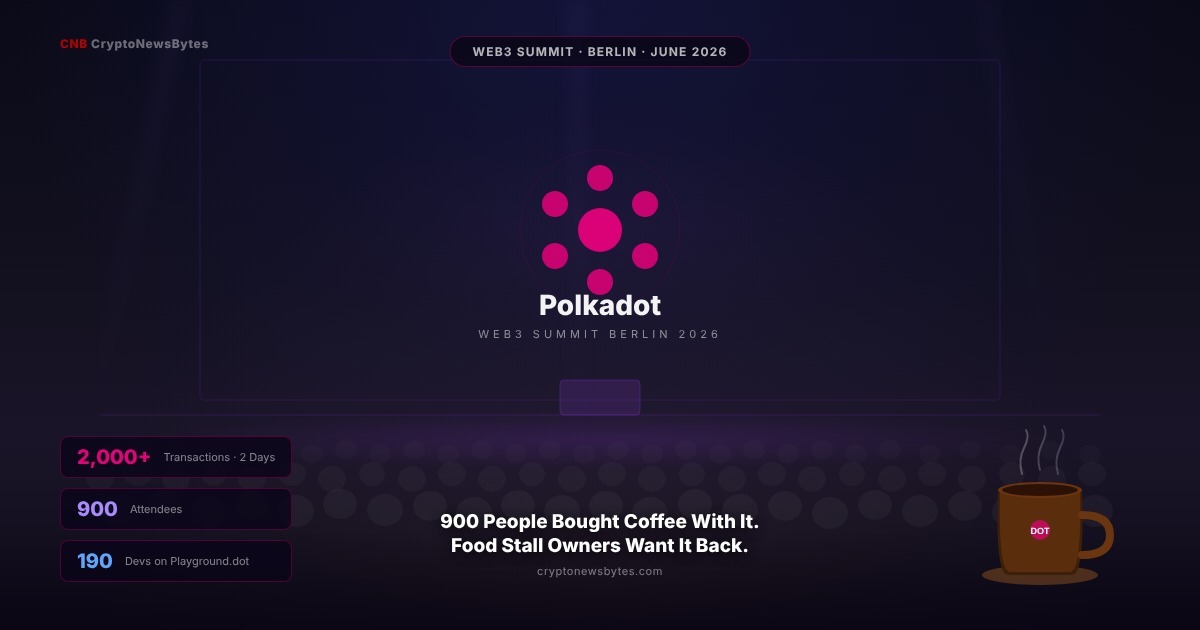
- The app handled over 2,000 peer-to-peer payment transactions across two days, used by food stall owners at the event, who said they wanted to keep using it.
- Playground.dot, a one-click app development tool, was used by around 190 developers on-site to build and deploy to a temporary network.
- The super app includes serverless private chat, a single digital identity layer, the Humanity proof-of-personhood module, private payments, and native dApp browsing, with no login and no install required to start.
- Attendees completed transactions without knowing which chain processed them, a deliberate design choice to test Polkadot’s chain-agnostic user experience.
- DOT is currently trading near the $0.94 support level, with bearish pressure from sellers dominating taker flow heading into November 2026.
Most blockchain conference demos involve someone showing a wallet on a laptop. At Web3 Summit 2026 in Berlin, Polkadot did something different. They ran a live payment network for a food stall. The food stall owners, using a Polkadot-powered private payment app for the first time, said afterward that they wanted to keep using it. That is a real product signal, and it came from the right kind of user.
What the Polkadot Community Foundation Built and Deployed
The Polkadot Community Foundation (PCF) ran every app at the summit on proofs of concept open-sourced by Parity Technologies. The apps were not prototypes in the usual sense: they processed real transactions, handled real peer-to-peer communications, and were used by real attendees who had no prior context on how Polkadot works.
The core product is a super app combining five modules. There is no login and no install required to start. That choice is deliberate: requiring a wallet setup before a first interaction is one of the biggest dropout points in crypto onboarding, and Polkadot is designing around it.
The Polkadot Super App: Five Modules
The Food Stall Test
The private payment module processed over 2,000 transactions at the summit across two days. These were not test transactions between developers checking latency. They were food and drink purchases at event stalls. The people running those stalls had no particular reason to use an experimental blockchain payment system except that it worked.
After the event, the food stall owners said they wanted to use the system again. That response is more informative than any benchmark. A food stall owner at a two-day Berlin conference is not a crypto native, is not invested in Polkadot’s success, and has no patience for friction. If the payment experience was bad, they would not ask for it back.
“Food stall owners said they wanted to use it again.”
Polkadot Community Foundation | Web3 Summit 2026 Rewind
Playground.dot: One-Click App Development
The developer-facing tool at the summit was Playground.dot, a one-click app builder that lets developers modify working prototypes and immediately deploy them to a temporary network without a local setup. Around 190 developers used it on-site.
The chain-agnostic design was central to both the developer and user experience. Attendees completed transactions without knowing which chain handled each task. That is not a bug in the UX: it is the stated goal. Polkadot is building for a world where the underlying chain is infrastructure, not a feature that users need to understand or choose.
Students from TU Munich, TU Berlin, and Bard College Berlin were among the 900 attendees. Thirteen artists presented installations and workshops. The summit crowd was not exclusively crypto-native, which made it a more honest environment for testing whether these tools work for ordinary users.
Where DOT Stands Right Now
The product momentum at Web3 Summit is happening while DOT is under price pressure. The token is trading near the $0.94 support level as of November 2, 2026, with bearish signals across the moving average stack and sellers dominating taker flow. The S1 pivot at $0.9417 is the key level to watch: holding it would be a neutral signal; losing it opens the door to further downside.
The divergence between product development and token price is a familiar pattern in crypto. Polkadot’s JAM upgrade, which replaces the relay chain architecture with a more scalable design, is in active testing. The Web3 Summit deployment is the first sustained public demonstration of what that infrastructure enables at the application layer. Whether market participants connect those dots is a separate question from whether the technology is working.
Frequently Asked Questions
What happened at Polkadot’s Web3 Summit 2026 demo?
The Polkadot Community Foundation deployed a privacy-focused super app built on Parity Technologies’ open-source proofs of concept. Around 900 attendees used it across two days. The app handled peer-to-peer payments for food and drinks, serverless private chat, digital identity, and dApp browsing. Over 2,000 transactions were processed. Food stall owners said they wanted to keep using it after the event.
What is Playground.dot?
Playground.dot is a one-click app development tool that lets developers modify working prototypes and deploy them to a temporary Polkadot network without a local environment setup. Around 190 developers used it at the summit.
What is Humanity in the Polkadot super app?
Humanity is a proof-of-personhood module that verifies someone is a unique person without requiring KYC or personal data disclosure. The goal is one person, one private account, with no link between the verification and the user’s real-world identity.
What is DOT’s price right now?
As of November 2, 2026, DOT is trading near the $0.94 support level. Technical signals are bearish, with the full moving average stack pressing from above and sellers dominating taker flow. The key pivot is $0.9417.
Further Reading
Ethereum’s founder published a parallel vision of a local-first, serverless internet the same week Polkadot demonstrated one in Berlin.
The case for private, peer-to-peer payments grows stronger every time a centralized exchange gets hit.
Sources: Polkadot Community Foundation Web3 Summit 2026 Rewind, polkadot.network forum; KuCoin Insight; TokenPost; Coinfomania; Blockchain.News DOT price report; CryptoNomist | Published November 2, 2026 | CryptoNewsBytes.com | Not financial advice.