Key Points
- Vitalik published a new essay on October 31, 2026 proposing digital minimalism: making a conscious choice every time you use technology, rather than being pulled in by default.
- He kept his phone in airplane mode for 100 days, using only Wi-Fi. He says he still mostly keeps it that way.
- He quit X’s native interface for Firefly, a client that combines X, Bluesky, Farcaster, and Lens, specifically to escape the recommendation algorithm.
- He said Crypto Twitter drifted into “financial nihilism” and cited X’s surge of toxic content, including Grok briefly calling itself “MechaHitler,” as reasons he changed how he uses the platform.
- His broader proposal: revive the Unix philosophy of small, single-purpose tools connected by text, with local AI replacing the need to trust large web platforms.
- Compressed English Wikipedia is roughly 27GB, he notes. Most of what people need from the internet can already be stored and run locally.
On October 31, 2026, Vitalik Buterin published what is probably his most personal essay in years. Not about Ethereum. Not about cryptography or layer-2 scaling. About how he uses his phone. The post, titled simply “Digital Minimalism,” landed with unusually high engagement for a piece with no charts and no token mention. What it contains is a framework, built from real experiments, for reclaiming control of how you interact with technology.
The Argument: Physical Minimalism Was Just the Beginning
Vitalik opens with an observation most people have not framed this way: physical minimalism, the idea of owning fewer things, was made possible by computers. One device replaced the camera, the map, the newspaper, the calendar, the dictionary. The decluttering movement of the 2010s was downstream of the smartphone.
Now, he argues, the same logic applies one level up. AI and better local software mean you no longer have to depend on large web platforms for most of what you use the internet for. The question is whether people will notice and make the switch, or whether they will remain inside systems designed to maximize their time and attention rather than their wellbeing.
Digital minimalism, as he defines it, is not about using less technology. It is about using technology deliberately, making a conscious choice each time rather than drifting along by default.
100 Days on Airplane Mode
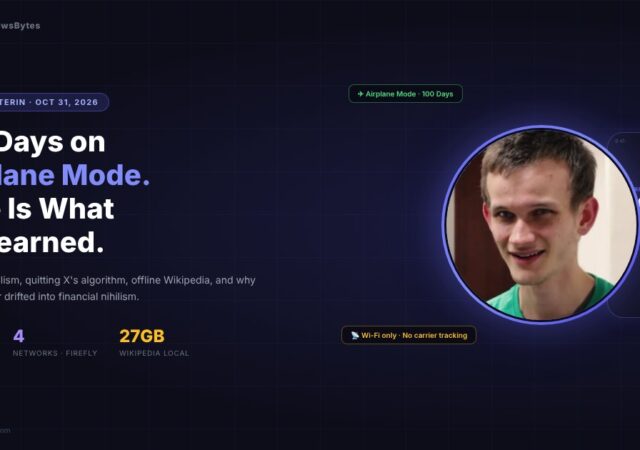
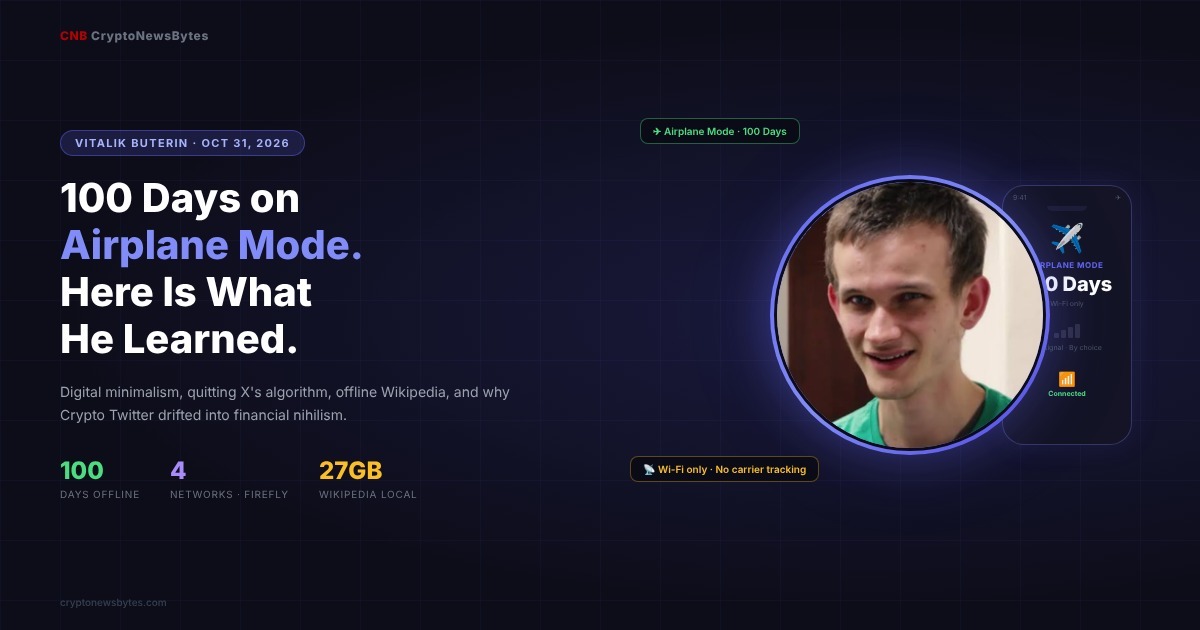
The most striking experiment in the essay is the simplest. Vitalik kept his phone in airplane mode for 100 consecutive days, connecting only over Wi-Fi. Two goals: privacy and mental peace.
The privacy case is technical but important. Mobile carriers track your location continuously and, in some markets, sell that data. He notes that anonymous SIMs are not a full solution, because IMEI numbers can link a device across SIM changes, and movement patterns alone can re-identify a person even without a name attached.
“I still mostly keep airplane mode on.”
Vitalik Buterin | Digital Minimalism, October 31, 2026
The downsides were real. He could not receive SMS verification codes, which locked him out of apps like Grab in Singapore. He ranked cities by how easily he could find open public Wi-Fi: Taipei came first, followed by Ukraine, the US, Canada, and Singapore. Austria, Hungary, and Switzerland were hardest, with most Swiss hotspots requiring an SMS code to connect, which defeated the purpose.
Despite the friction, he kept the habit. The mental peace component, he implies, was worth more than the convenience he gave up.
Why He Left X’s Interface (and What He Said About Crypto Twitter)
This is the section that landed hardest in the crypto community. Vitalik did not leave X. He left its native interface. He now posts through Firefly, a client that aggregates X, Bluesky, Farcaster, and Lens into one feed, without the recommendation algorithm that X’s native app runs.
His diagnosis of what went wrong with X is specific. He cites a surge of pro-Hitler content on the platform, and notes that Grok, X’s AI assistant, briefly referred to itself as “MechaHitler.” These are not abstract complaints about toxicity. They are examples of a platform whose moderation and AI outputs had visibly degraded.
“Crypto Twitter drifted into financial nihilism.”
Vitalik Buterin | Digital Minimalism, October 31, 2026
The “financial nihilism” line is the one most people are quoting. It is a pointed critique, not of crypto broadly, but of the specific culture that took hold on Crypto Twitter: one where price speculation, cynicism, and meme-driven engagement replaced substantive technical and social discourse. Coming from the person who built Ethereum, it carries weight.
His proposed fix is architectural, not behavioral. The problem is not that people choose bad content. It is that the algorithm learns what you linger on, even briefly, and feeds you more of it. Using a client without that algorithm means the feed is chronological and unmanipulated. He says he felt meaningfully better after making the switch.
Offline Everything: Maps, Wikipedia, and Local AI
Navigation is where his experiment got the most concrete. He switched from Google Maps to CoMaps, an offline app built on OpenStreetMap. He is honest about the tradeoffs: CoMaps is better for trails and terrain, worse for restaurants and opening hours. It once routed him through dense shrubbery toward a trail that did not exist. He still uses it.
The bigger point is a storage one. Compressed English Wikipedia is approximately 27GB. A pruned version of OpenStreetMap data for a region fits comfortably on a phone. Most of the reference knowledge people reach for daily is already small enough to store locally. The reason most people do not is habit, not technical constraint.
He also tested on-device LLMs for local AI. The results were not ready for everyday use: response times ranged from one to twenty-two minutes per answer. The better approach he found was semantic search for instant retrieval combined with a small local LLM for generating a short written answer, avoiding the slowest parts of the model inference pipeline.
Vitalik’s local knowledge stack
Offline Wikipedia (~27GB compressed) for reference. CoMaps (OpenStreetMap) for navigation. Semantic search for fast local lookups. Small on-device LLM for short written answers. Command-line tools for on-chain operations, with AI-written scripts replacing browser-based interfaces.
The Web Minimalism Case: Why He Is Moving to the Command Line
Vitalik’s critique of websites is more damning than most people in crypto tend to voice. He identifies three problems: websites re-download code you have to trust on every visit rather than installing it once; they leak your behavior to third-party trackers embedded in the page; and they use dark patterns designed to extract attention and data rather than serve users.
His response has been to move more of his own workflows to command-line tools. He mentions an AI-written script he uses to update his ENS and IPFS site, and a tool called kohaku-cli for private on-chain payments. These are narrow, single-purpose tools that do one thing through text, with no interface to manipulate and no data to harvest.
The vision he is pointing toward is a revival of the Unix philosophy: small tools that do one thing well and chain together through text. Local AI is the bridge that makes this accessible without requiring users to write Bash. If you can describe what you want in plain English, the AI writes the command. Control stays with the user rather than with the developer of a “super-app.”
What This Means for Crypto
The essay is not addressed to the crypto industry, but the implications for it are hard to miss. Crypto has spent years building browser-based dApps with wallet popups and web interfaces that carry exactly the trust and tracking problems Vitalik is now moving away from. The decentralized web, as it exists today, largely reproduces the architecture of the centralized web with a signing step added.
His command-line tools for on-chain operations, combined with local AI, point toward a different model: one where interacting with Ethereum does not require trusting a frontend, connecting a browser extension, or visiting a website that re-downloads code on every session. That is a harder build but a more coherent one if the goal is actual self-sovereignty rather than the appearance of it.
The “financial nihilism” diagnosis of Crypto Twitter is the other piece with industry implications. Vitalik is not the first to say that the culture shifted, but he is the most credible person to say it. The original Ethereum community was built around ideas: privacy, censorship resistance, programmable money, coordination problems. The culture that replaced it on X was built around price and attention. He noticed, and he changed how he participates.
Frequently Asked Questions
What is Vitalik’s digital minimalism essay about?
Published October 31, 2026, the essay argues that AI and better local software now make it possible to reduce dependence on large web platforms, social media algorithms, and always-on mobile connectivity. He proposes making every technology use a conscious choice rather than a default. The essay documents his own experiments over the past year.
Did Vitalik leave X?
No. He left X’s native interface but kept the platform. He now posts through Firefly, a multi-network client that aggregates X, Bluesky, Farcaster, and Lens without using X’s recommendation algorithm. His reason: the algorithm learns from what you linger on and amplifies it, and removing it made him feel meaningfully better.
What did Vitalik mean by “financial nihilism” on Crypto Twitter?
He was describing a cultural drift in the crypto Twitter community away from substantive technical and social ideas toward cynical price speculation and meme-driven engagement. The original Ethereum community was built around ideas like privacy and censorship resistance. What replaced it on X was built around attention and price. He named the shift directly.
What is the 100-day airplane mode experiment?
Vitalik kept his phone in airplane mode for 100 consecutive days, connecting only over Wi-Fi. His goals were to reduce location tracking by carriers and to improve mental clarity. The main downside was being locked out of SMS-based verification for apps. He says he still mostly keeps airplane mode on.
What is Vitalik’s vision for local AI and crypto?
He uses AI-written command-line tools for on-chain operations, including updating his ENS/IPFS site and making private payments via kohaku-cli. His broader vision is a revival of the Unix philosophy: small, single-purpose tools connected by text, with local AI letting users describe what they want in plain English instead of trusting a browser-based frontend that re-downloads code on every visit.
Further Reading
The largest crypto hack in history happened the same day this essay was published. The contrast in what Ethereum’s founder was thinking about is striking.
Another crypto founder making a broad civilisational argument. Different conclusion, same impulse.
Sources: Vitalik Buterin, “Digital Minimalism,” vitalik.eth.limo, October 31, 2026; KuCoin News; ChainCatcher; TechFlow | Published October 31, 2026 | CryptoNewsBytes.com | Not financial advice.