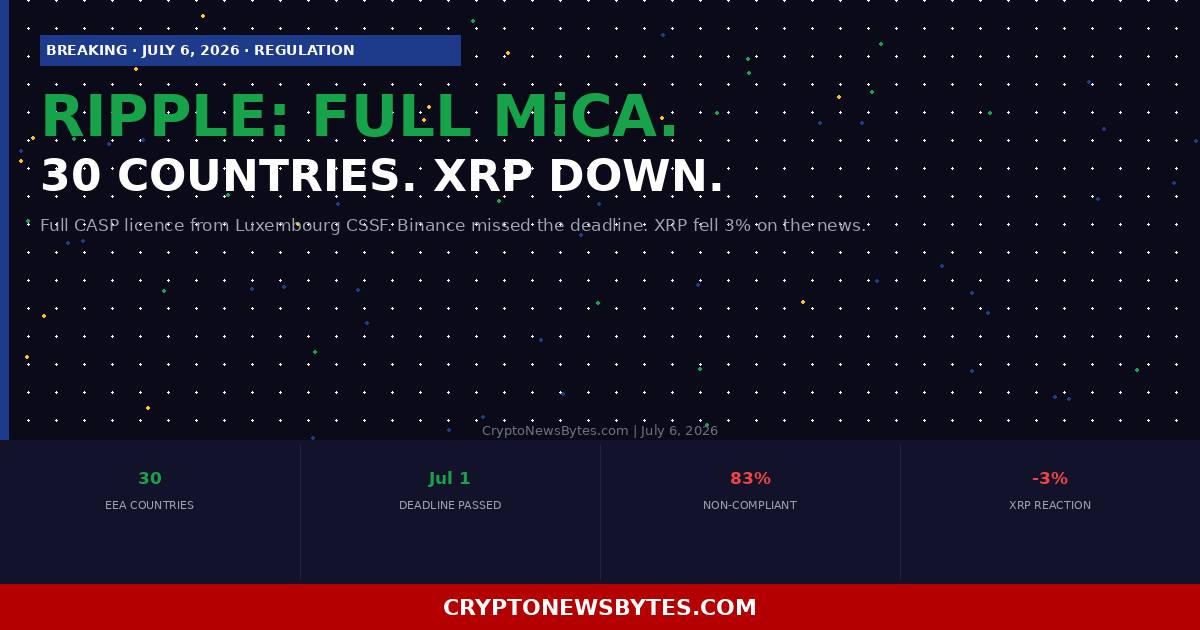
Ripple received full authorisation of its Crypto Asset Service Provider license from Luxembourg’s Commission de Surveillance du Secteur Financier on July 6, 2026. The CSSF upgraded the preliminary Green Light Letter issued on June 23 to a definitive authorisation, making Ripple fully MiCA-compliant and clearing it to offer regulated crypto payments to financial institutions, corporates and businesses across all 30 countries of the European Economic Area. Cassie Craddock, Ripple’s Managing Director for UK and Europe, said: ‘This CASP authorisation means Ripple enters the post-transitional MiCA era fully compliant and ready to scale.’
The timing is pointed. MiCA’s transitional grace period for existing operators expired on July 1. Firms without a licence as of that date cannot legally offer crypto services across the EU. Binance, the world’s largest exchange by volume, is among the thousands of CASPs that failed to qualify in time. Ripple now holds both a full CASP licence and an Electronic Money Institution licence in Luxembourg, the combination that lets European banks, fintechs and corporates access Ripple’s entire payments and crypto infrastructure through a single integration, across 30 countries, with no country-by-country approval needed. That is the passport.
What the CASP and EMI Licences Together Actually Unlock
A CASP licence under MiCA covers custody, transfer, exchange and placement of crypto assets. Ripple’s existing EMI licence covers electronic money, meaning fiat-denominated payment services. Together they create what Ripple calls a full-stack regulatory framework: a European bank can plug into one Ripple integration and move both cash and crypto through a single compliant pipe, collecting funds, exchanging between fiat and crypto, and paying out, without requiring separate regulatory procedures in each of the 30 EEA states. For cross-border payments, which is Ripple’s actual business, that matters. Ripple Payments has already processed over $100 billion in volume across 60-plus countries. The European market was the missing regulated piece.
The passport mechanism is what makes Luxembourg the right jurisdiction. MiCA allows a firm licensed in any one EEA state to offer services across the entire bloc, the same principle that made Luxembourg the EU domicile of choice for investment funds. Ripple is not the first here. Coinbase secured full MiCA authorisation in Luxembourg in 2025. Kraken cleared its own in Ireland around the same time. Ripple is joining a regulated front of the pack rather than pioneering new ground. What makes July 6 significant is the expiry of the transition period three working days earlier. Roughly 83% of European crypto firms lacked a MiCA licence as of mid-2026 per ESMA’s public register. Only approximately 210 entities are compliant. Ripple is now one of them.
MiCA Compliance: Where the Industry Stands at July 6, 2026
Post-deadline landscape | Sources: ESMA public register, CoinDesk, spaziocrypto | @cryptonewsbytes
Sources: ESMA register, CoinDesk July 6, spaziocrypto, Ripple press release | @cryptonewsbytes
The XRP Question: Why a Ripple Win Is Not Automatically an XRP Win
When the preliminary approval landed on June 23, XRP dropped approximately 2.9% to around $1.10 rather than rallying. That was not a contradiction. It was the market correctly separating two things that get conflated constantly: Ripple the company and XRP the token. Ripple’s CASP and EMI licences authorise Ripple Payments to operate in Europe. Most of that volume settles in RLUSD, Ripple’s dollar stablecoin, or in fiat through the EMI structure. XRP is not required for any of that. The fees on XRP Ledger transactions are minimal fractions of a cent. More European payment volume through Ripple does not translate into proportional XRP demand unless that volume routes through XRP specifically, which most of it currently does not.
24/7 Wall St. put it cleanly: ‘Ripple keeps stacking licences, and XRP doesn’t even flinch.’ The scenario where this changes is if European payment volume grows large enough and Ripple routes a material portion through the XRP Ledger as a bridge asset rather than RLUSD or direct fiat rails. That is the original Ripple thesis from 2017. It has not scaled in the way XRP advocates projected. RLUSD now has a $300 million circulating supply and its own MiCA stablecoin approval pending, which is the product line most directly enabled by the licence stack Ripple just completed. The institutional business Ripple is building in Europe is real and growing. Whether XRP benefits from it remains the open question it has been for eight years.
Frequently Asked Questions
What is the difference between Ripple’s CASP and EMI licences?
The EMI licence covers electronic money, meaning fiat-denominated payment services: collecting, holding and sending regular currency on behalf of clients. The CASP licence covers crypto asset services: custody, transfer, exchange and placement of crypto assets including XRP and RLUSD. Together they allow a European bank or fintech to move both cash and crypto through a single Ripple integration without separate regulatory approvals in each country.
What happens to unlicensed crypto firms in Europe after July 1?
Firms that did not secure a MiCA CASP authorisation by July 1, 2026 cannot legally offer crypto asset services to EU customers. They must either stop operating in the EU, apply for a licence and pause services in the interim, or exit the market. Binance is among the large operators that missed the deadline. The enforcement timeline and national regulator appetite for action varies by country, but the legal position is clear: no licence, no service.
Further Reading
The institutional XRP demand story that runs separately from Ripple’s corporate licensing milestones.
MiCA is the European framework. The CLARITY Act is the US equivalent moving through Congress simultaneously.
This article is for informational purposes only and does not constitute financial advice. Sources: Ripple press release July 6 2026 (ripple.com), CoinDesk July 6 (Policy), 24/7 Wall St. July 6, BanklessTimes July 6, spaziocrypto July 2, CryptoBriefing July 6, ESMA CASP register, Ripple preliminary approval press release June 23 2026. Published July 2, 2026.