Key Points
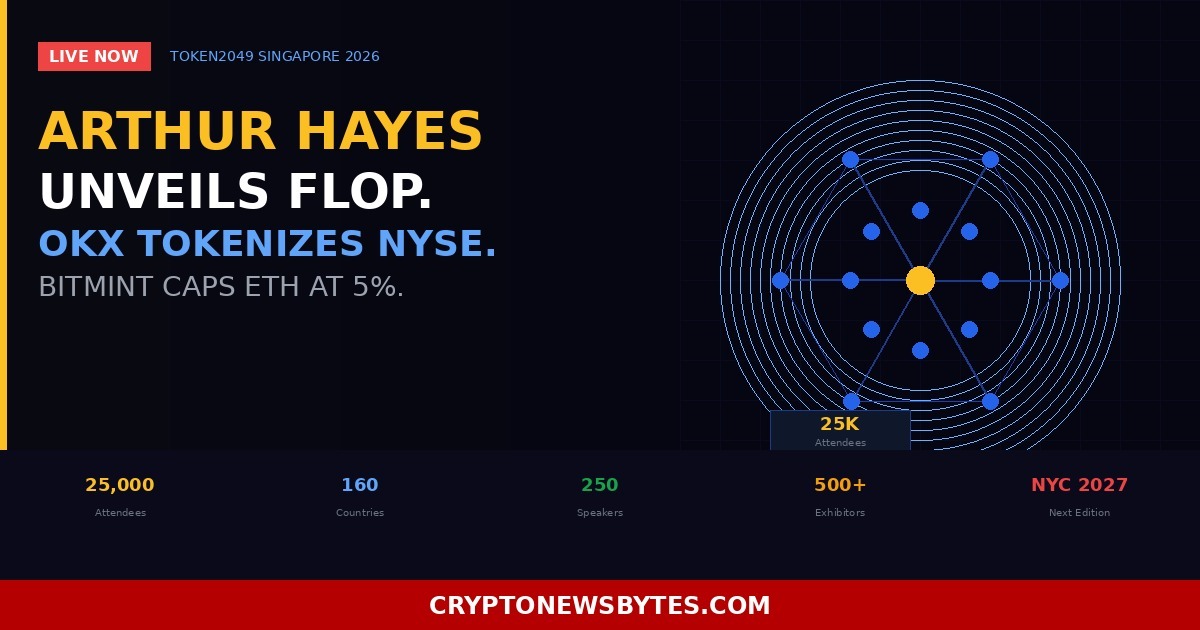
▶ TOKEN2049 Singapore 2026 opened October 7 at Marina Bay Sands, fully sold out with 25,000 attendees from 160 countries, 250 speakers across six stages, and 500+ exhibitors.
▶ Arthur Hayes (Maelstrom CIO) unveiled FLOP, an AI-agent compute network using ‘Proof-of-Useful-Inference’ to connect agents with GPU providers. Testnet targets late October 2026; mainnet Q1 2027. Genesis supply: 2.48 billion tokens.
▶ OKX and NYSE owner ICE filed with the SEC to tokenize trading for 63 U.S.-listed companies using Uniswap v4. OKX confirmed Circle and Ripple as strategic investors at a reported $25 billion valuation.
▶ BitMine CEO Tom Lee set a 5% hard cap on Ethereum holdings. BitMine currently holds ~6.02 million ETH (4.9% of supply), making it the largest institutional ETH holder.
▶ Polymarket CEO Shayne Coplan discussed ‘the possibility of an on-chain asset connected to Polymarket’s platform economy’ but did not confirm a token launch.
▶ TOKEN2049 announced its first U.S. edition: New York, June 16-17, 2027, targeting ~15,000 attendees.
TOKEN2049 Singapore 2026 Opens: Scale and What Is Different This Year
TOKEN2049 Singapore 2026 opened its doors at Marina Bay Sands on October 7 with 25,000 registered attendees from 160 countries. The event sold out in advance, its largest edition to date. Co-founder Alex Fiskum described it as the best programme yet. Six stages run simultaneously throughout October 7 and 8, with 250 speakers and more than 500 exhibitors across the venue.
The structural difference in the 2026 edition is the weight of institutional representation. Nasdaq CEO Adena Friedman and Franklin Templeton CEO Jenny Johnson are on stage alongside native crypto figures. Goldman Sachs, BlackRock, and Morgan Stanley are represented in the TOKEN2049 Institutional programme on Day 2, an invitation-only session for 250 senior finance leaders. The conference has deliberately positioned itself at the intersection of Wall Street and on-chain markets rather than remaining a developer-only event.
TOKEN2049 Singapore 2026 is also the backdrop for several announcements timed to the conference’s reach. The three most significant from Day 1 involve AI-agent infrastructure, institutional equity tokenization, and the largest single institutional Ethereum position in existence. Each is covered in detail below.
Arthur Hayes Unveils FLOP: The TOKEN2049 Singapore 2026 AI Agent Bet
Arthur Hayes, CIO of Maelstrom, used his TOKEN2049 Singapore stage time to formally present FLOP, the AI-agent infrastructure project he launched under Flop Labs in August 2026. The project is built on a specific macro thesis: AI capital expenditure will overshoot, creating massive excess compute capacity, which will dramatically lower the cost of AI inference and make decentralised compute networks economically viable.
FLOP proposes a mechanism called Proof-of-Useful-Inference. GPU providers supply compute capacity to the network. AI agents needing inference purchase that compute using the FLOP token. The token coordinates payment and rewards across the system. Genesis supply is set at approximately 2.48 billion tokens. Testnet targets late October 2026. Mainnet launch is planned for Q1 2027.
“There is an AI bubble. But I 100% believe in the agentic economy.”
Arthur Hayes, Maelstrom CIO, TOKEN2049 Singapore 2026
Hayes is direct about the risk in his own thesis. He acknowledged that agents may simply use existing stablecoins rather than a new token, and that centralised cloud providers may prove more reliable than a decentralised alternative. His argument for why crypto rails matter for agents: open settlement, stablecoin liquidity, machine-readable ownership, and cross-platform interoperability. Traditional payment systems require intermediaries that agents cannot easily navigate autonomously.
Hayes distinguishes between an ‘AI bubble’ in infrastructure financing, which he believes exists, and the ‘agentic economy,’ which he considers a certainty. The concern is not the technology but the debt financing the buildout. Overcapitalised compute infrastructure eventually creates credit stress; the resulting price collapse in compute makes the agentic economy more viable. FLOP is the bet that the agentic economy materialises and runs on crypto rails.
OKX and NYSE Owner ICE File to Tokenize 63 U.S. Stocks Using Uniswap v4
One of the most significant infrastructure announcements timed to TOKEN2049 came from OKX and Intercontinental Exchange (ICE), the company that owns the New York Stock Exchange. The two companies filed with the Securities and Exchange Commission this week to launch tokenized trading for 63 U.S.-listed companies, using Uniswap v4 as the underlying infrastructure layer.
The filing represents a convergence of traditional equity market infrastructure and on-chain settlement. ICE brings regulated exchange licensing and market structure. OKX brings crypto-native distribution and liquidity networks. Uniswap v4 provides the programmable AMM layer. The 63 target companies have not been identified in public releases, but the structure suggests a phased expansion if SEC approval is granted.
On the same day, OKX confirmed that Circle and Ripple have made strategic investments in the exchange at a reported valuation of $25 billion. The combination of NYSE owner participation, two of the most significant USD stablecoin operators as investors, and a Uniswap v4 integration positions OKX as the platform attempting to bridge regulated U.S. equity markets with DeFi liquidity at institutional scale.
BitMine’s 5% ETH Supply Cap: The Largest Institutional Ethereum Position
BitMine CEO Tom Lee announced at TOKEN2049 Singapore 2026 that the company will establish a hard ceiling on its Ethereum holdings at 5% of total ETH circulating supply. BitMine currently holds approximately 6.02 million ETH, representing 4.9% of all circulating Ethereum. By any measure, this makes BitMine the largest institutional holder of Ethereum.
The 5% cap is a market structure signal. At current Ethereum supply levels, 5% represents roughly 6.12 million ETH. BitMine is approximately 100,000 ETH below that ceiling. The announcement makes explicit that BitMine is not pursuing unlimited accumulation and is self-imposing a limit to prevent its position from creating network concentration risk or market impact on any eventual liquidation.
BitMine appears to be running an Ethereum-native version of the corporate treasury model that Strategy (formerly MicroStrategy) pioneered for Bitcoin. The difference is the explicit 5% cap, which has no MicroStrategy equivalent. Lee did not publicly elaborate on the rationale for the ceiling beyond the announcement. The cap implies an awareness that a dominant institutional position in Ethereum carries different reputational and regulatory considerations than a Bitcoin treasury strategy.
Polymarket CEO at TOKEN2049 Singapore 2026: What Was and Was Not Said
Polymarket CEO Shayne Coplan addressed speculation about a Polymarket token at TOKEN2049 Singapore 2026, but did so with deliberate care. Coplan described discussions around the possibility of an on-chain asset connected to Polymarket’s platform economy. He did not confirm a token launch, did not provide a timeline, and did not specify what form such an asset might take.
Polymarket is the leading prediction market platform by volume and has no native token. Speculation about a token has persisted throughout 2025 and 2026 as platform volumes and user base grew, particularly around major events. Coplan’s statement at TOKEN2049 is the most explicit public acknowledgment that the question is being considered at the executive level. It is not a token announcement. Coverage framing it as one would overstate what was said.
TOKEN2049 Goes to New York: June 2027 U.S. Expansion Announced
TOKEN2049 used Day 1 of the Singapore edition to announce its first dedicated U.S. event. TOKEN2049 New York is scheduled for June 16-17, 2027, with an initial target of approximately 15,000 attendees. The venue has not been announced publicly.
TOKEN2049 has previously run Dubai and Singapore as its two flagship events. A New York edition creates a three-city calendar covering Asia, the Middle East, and North America. The June 2027 timing is deliberate: the CLARITY Act is expected to have produced final implementation rules by then, the GENIUS Act stablecoin framework is already in effect, and the SEC’s posture on digital assets will have had another 18 months to develop. The organisers are betting the U.S. market will be at a structural inflection point.
Day 1 Sessions: Hyperliquid, Base, Aave, and the Institutional DeFi Thesis
Beyond the headline announcements, Day 1 featured substantive sessions on institutional DeFi. The morning session DeFi’s Institutional Breakthrough included representatives from Aave Labs, Ethena Labs, and Synthetix, moderated by a16z crypto. The session addressed how yield-bearing on-chain positions are being integrated into institutional treasury operations, credit facilities, and liquidity management strategies.
Hyperliquid Labs CEO Jeff Yan presented Hyperliquid: Rebuilding Finance from First Principles, making the case for purpose-built financial infrastructure that begins from on-chain settlement rather than retrofitting blockchain onto traditional market structure. Hyperliquid’s growth through 2026 has been built primarily on perpetuals trading; Yan addressed the platform’s roadmap as it expands beyond that initial product.
Jesse Pollak, creator of Base and Coinbase’s on-chain lead, presented on Base’s position as infrastructure for the next wave of consumer applications. NEAR co-founder Illia Polosukhin presented on the AI-agent economy, a theme that echoes Hayes’s FLOP announcement and runs as a thread through the conference programme. Adena Friedman of Nasdaq and Jenny Johnson of Franklin Templeton represent the TradFi presence, both here as operational participants rather than observers.
What TOKEN2049 Singapore 2026 Day 1 Signals About the Industry
Three themes run through Day 1. The first is institutional integration at the infrastructure level, not just custody and spot ETFs, but active participation in on-chain market making, tokenized equity trading, and DeFi yield strategies. The OKX-ICE SEC filing and Nasdaq’s CEO on stage are the most visible signals of where the integration is heading.
The second theme is the AI-agent economy. Hayes’s FLOP announcement is the highest-profile single product launch of Day 1, but the conference programme broadly includes sessions on agent infrastructure, machine-to-machine payments, and autonomous on-chain operations. The question the industry is actively working through: do agents need a native token economy, or do they operate on existing stablecoin rails? FLOP is a direct bet on the former.
The third theme is the geographic broadening of crypto markets. The inaugural Dubai Pavilion, the New York 2027 announcement, the 160-country attendee base, and the ICE-OKX filing targeting U.S. equities all point to a market that is no longer waiting for one jurisdiction to lead. Day 2 begins with the TOKEN2049 Institutional programme, which will add a layer of private conversations between senior finance leaders and crypto infrastructure builders that rarely surface publicly.
Frequently Asked Questions
What is Arthur Hayes’s FLOP project announced at TOKEN2049 Singapore 2026?
FLOP is an AI-agent compute network launched by Arthur Hayes under Flop Labs. It uses a Proof-of-Useful-Inference mechanism connecting AI agents needing compute with GPU providers supplying capacity, with the FLOP token coordinating payments. The thesis is that AI infrastructure overcapacity will create cheap compute, making decentralised networks viable. Testnet targets late October 2026; mainnet Q1 2027. Genesis supply: 2.48 billion tokens.
What did OKX and ICE announce at TOKEN2049 Singapore 2026?
OKX and Intercontinental Exchange (ICE, which owns the NYSE) filed with the SEC to launch tokenized trading for 63 U.S.-listed companies using Uniswap v4 infrastructure. On the same day, OKX confirmed strategic investments from Circle and Ripple at a reported $25 billion valuation.
What is BitMine’s Ethereum position and 5% cap?
BitMine is the largest institutional holder of Ethereum, with approximately 6.02 million ETH representing 4.9% of total supply. CEO Tom Lee announced at TOKEN2049 Singapore 2026 that BitMine will not exceed 5% of Ethereum’s circulating supply, establishing this as a self-imposed hard ceiling.
Did Polymarket announce a token at TOKEN2049 Singapore 2026?
No. Polymarket CEO Shayne Coplan described the possibility of an on-chain asset connected to the Polymarket platform economy, but did not confirm a launch, provide a timeline, or specify a structure. It is an acknowledgment the question is under consideration, not a token announcement.
When is TOKEN2049 New York 2027?
TOKEN2049 New York is scheduled for June 16-17, 2027, targeting approximately 15,000 attendees. It will be the first dedicated U.S. edition of TOKEN2049. The venue has not been announced.
How large was TOKEN2049 Singapore 2026?
25,000 attendees from 160 countries, 250 speakers across six stages, 500+ exhibitors at Marina Bay Sands. The event sold out in advance and is the largest TOKEN2049 edition in the conference’s history.
Further Reading
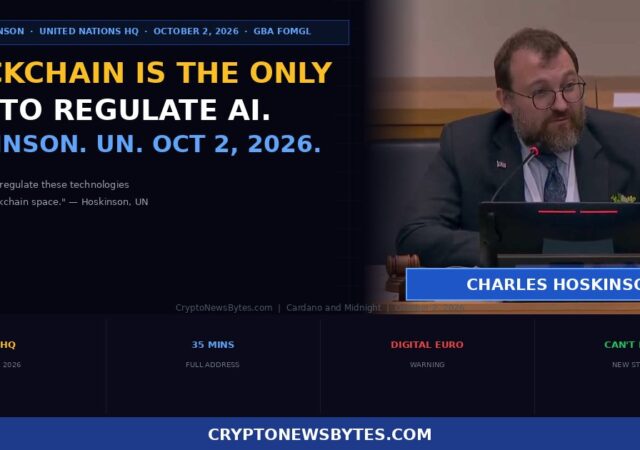
Charles Hoskinson at the UN General Assembly, one week before TOKEN2049 Singapore 2026. The regulatory framework arguments that connect directly to the institutional themes on stage.
NEAR co-founder Illia Polosukhin is presenting at TOKEN2049 Singapore 2026. This piece covers NEAR’s IronClaw security harness for autonomous agents — directly relevant to the AI-agent economy discussions at the conference.
The privacy infrastructure argument that underpins the agent economy theme running through TOKEN2049 Singapore 2026. If agents are going to operate autonomously, their data and IP need protection.
Sources: CryptoTimes (Day 1 announcements, October 7 2026), AsiaBizToday (attendance and scale, October 7 2026), Yahoo Finance/TOKEN2049 (institutional programme and agenda), KuCoin Blog (Arthur Hayes FLOP thesis detail), TheStreet Crypto (agenda overview) | Published October 7, 2026 | CryptoNewsBytes.com | Not financial advice.