Key Takeaways
- Real world asset tokenization is the process of representing ownership of a physical or financial asset, property, bonds, gold, equities, as a digital token on a blockchain. The token is the legal or beneficial ownership record, just held on-chain instead of on paper.
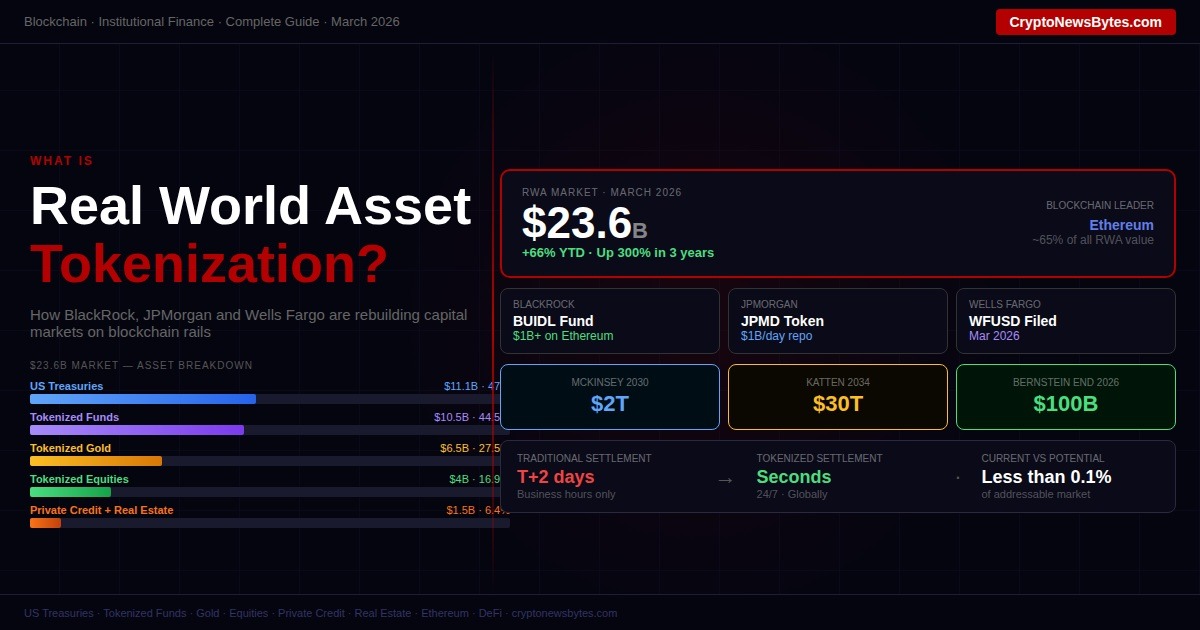
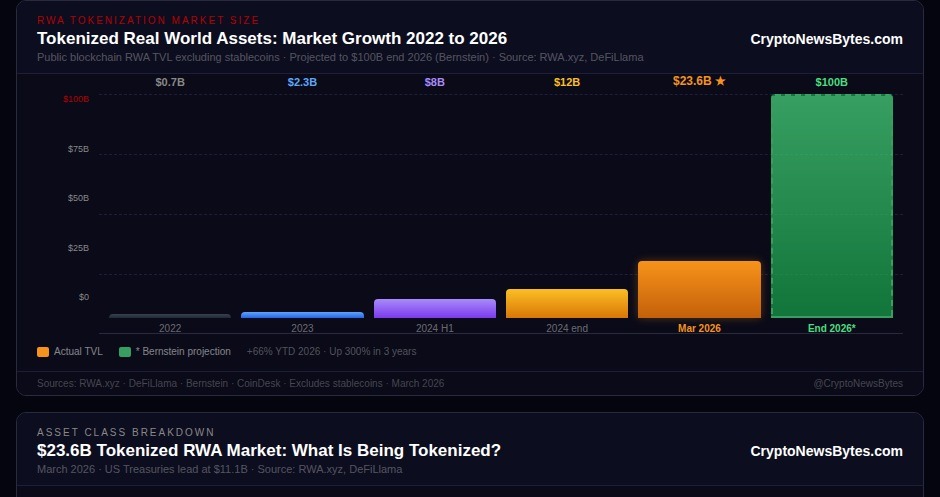
- The tokenized RWA market hit $23.6 billion on public blockchains as of March 2026, up 66% year-to-date. Tokenized US Treasuries lead at $11 billion, followed by tokenized funds at $10.5 billion and tokenized gold at $6.5 billion.
- BlackRock, JPMorgan, Wells Fargo, Franklin Templeton and BNY Mellon have all launched or are actively building tokenized products. 2026 is widely described as the year the market shifts from pilots to standardised institutional products.
- The long-term market size projections are staggering, McKinsey estimates $2 trillion by 2030, while Katten research puts the ceiling at $30 trillion by 2034. The current $23.6 billion represents less than 0.1% of what analysts believe is achievable.
📋 In This Article
Real world asset tokenization is one of the most significant structural shifts in global finance since the introduction of electronic trading. It is not a crypto experiment. It is not a speculative trend. It is BlackRock, JPMorgan, Wells Fargo, and the Bank of New York Mellon rebuilding the plumbing of capital markets on blockchain rails, and in March 2026, the market just crossed $23.6 billion with every major institution accelerating, not slowing down.
This guide explains what real world asset tokenization actually is, how it works mechanically, what is being tokenized right now, who is building it, and why the numbers suggest we are still in the very early innings of a multi-trillion dollar transformation.
What Is Real World Asset Tokenization?
Real world asset (RWA) tokenization is the process of creating a digital token on a blockchain that represents ownership rights in a physical or financial asset. The token is not a reference to the asset, it is the ownership record itself, stored on a distributed ledger that is transparent, immutable, and accessible 24 hours a day from anywhere in the world.
Think of it this way. When you own shares in a company today, your ownership is recorded in a centralised database, a registry maintained by a custodian, a broker, or a clearing house. You cannot trade those shares at 2am on a Sunday. You cannot use them as collateral in a DeFi protocol. You cannot split them into fractions of a cent and sell them to 10,000 small investors simultaneously. A tokenized share can do all three of those things.
There are two main structures. In an on-chain structure, all key legal information about the asset is embedded directly in the token on the blockchain, fully transparent and verifiable. In an off-chain structure, the token is a digital reference to the asset while the underlying ownership rights are maintained by a traditional custodian outside the blockchain. Most institutional products today use hybrid approaches that combine on-chain transparency with off-chain legal frameworks.
How Does RWA Tokenization Work?
What Assets Can Be Tokenized?
In theory, any asset with a defined ownership structure and a legal framework that can be connected to a blockchain can be tokenized. In practice, the 2026 market is concentrated in a handful of asset classes where the benefits are most immediate and the regulatory path is clearest.
| Asset Class | Market Size (Mar 2026) | Key Players | Primary Benefit |
|---|---|---|---|
| US Treasuries | $11.1 billion | BlackRock BUIDL, Ondo Finance, Franklin Templeton | 24/7 yield, instant settlement, DeFi collateral |
| Tokenized Funds | $10.5 billion | BlackRock, KKR, Hamilton Lane | Fractional access, global distribution |
| Tokenized Gold | $6.5 billion | Pax Gold (PAXG), Tether Gold (XAUT) | Physical gold exposure without custody |
| Tokenized Equities | $4 billion | Ondo, xStocks, Securitize | Fractional ownership, 24/7 trading |
| Private Credit | Growing fast | Centrifuge, Maple Finance | Access to private credit for retail investors |
| Real Estate | Early stage | Various platforms | Fractional property ownership, rental yield |

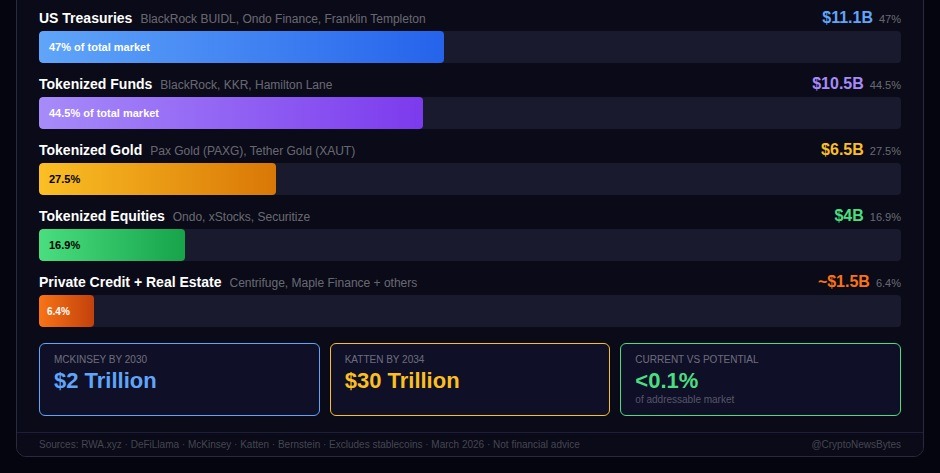
US Treasuries dominate because they are the simplest case, a highly standardised, liquid asset with clear legal rights that translates directly to an on-chain structure. The tokenized Treasury market crossed $10 billion in February 2026 and is widely expected to reach $20 billion before year-end. After Treasuries, tokenized gold is emerging as what analysts describe as the “collateral layer” for on-chain finance, programmable gold that can serve the same function stablecoins serve for cash.
The Market Today: $23.6 Billion and Growing

The tokenized RWA market on public blockchains reached $23.6 billion as of March 11, 2026, up 66% year-to-date and up over 300% from three years ago. This figure excludes stablecoins, which are themselves a form of tokenized fiat currency. If stablecoins are included, the total tokenized value on-chain is well over $200 billion.
Current tokenized RWA market: $23.6 billion
McKinsey projection by 2030: $2 trillion
Katten research ceiling by 2034: $30 trillion
Global bond market: $130 trillion
Global real estate market: $326 trillion
Global equities market: $100 trillion
The current $23.6 billion represents less than 0.004% of the addressable market. The gap between where we are and where analysts believe this is going is the entire investment thesis.
Bernstein called 2026 the start of a tokenization “supercycle” in January, projecting total RWA TVL to exceed $100 billion by year-end. The firm identified Robinhood, Coinbase, Figure, and Circle as the best-positioned equities to benefit. The CLARITY Act moving through the US Senate is the regulatory catalyst most analysts point to as the event that will move the market from billions to trillions.
Who Is Building It: The Institutional Race
The most significant development in RWA tokenization in 2025 and 2026 is not the technology, it is who is deploying it. The world’s largest asset managers and banks are no longer piloting tokenization. They are building native products.
BlackRock, BUIDL Fund
BlackRock’s BUIDL fund (USD Institutional Digital Liquidity Fund) is the largest tokenized Treasury product in the world, holding over $1 billion in assets on the Ethereum blockchain. It pays daily dividends directly to token holders via smart contract. BlackRock CEO Larry Fink has called tokenization the “next generation for markets” and stated that every stock, bond, and real estate asset will eventually be tokenized.
JPMorgan, JPMD Token
JPMorgan’s deposit token JPMD launched successfully on a public blockchain in 2025, becoming the first major US bank to issue a native blockchain-based deposit product. The bank uses its Onyx blockchain platform to process approximately $1 billion in repo transactions daily using tokenized collateral.
Wells Fargo, WFUSD
Wells Fargo filed a trademark for WFUSD in March 2026, covering crypto trading, blockchain payment platforms, and tokenization software. This signals the bank’s intent to enter the stablecoin and tokenized deposit market. We covered the WFUSD filing in detail in our March 17 briefing.
Franklin Templeton and BNY Mellon
Franklin Templeton’s BENJI token offers tokenized money market fund exposure on multiple blockchains. BNY Mellon, the world’s largest custodian with $47 trillion in assets under custody, launched a Digital Asset Custody platform in 2023 and has been expanding tokenization services since. When the world’s largest custodian is building blockchain infrastructure, the direction of travel is clear.
Why It Matters: The Benefits of Tokenization
The case for tokenization is not primarily ideological, it is operational. The benefits are measurable and immediate for institutions that implement it.
Fractional ownership. A $10 million commercial property can be divided into 10 million tokens worth $1 each, opening the asset to investors who could never previously access it. The same applies to private equity funds, which typically require minimum investments of $250,000 or more.
24/7 settlement. Traditional securities markets settle on T+2, two business days after the trade. A tokenized asset settles in seconds, any time of day, any day of the week. For institutions managing collateral across time zones, this is transformative.
Reduced intermediaries. Smart contracts automate the functions currently performed by clearing houses, custodians, transfer agents, and paying agents. Each intermediary removed is a cost removed, and a point of failure eliminated.
Programmable compliance. Regulatory requirements, accredited investor checks, transfer restrictions, reporting obligations, can be encoded directly into the token. The asset cannot be transferred to an ineligible counterparty because the smart contract will not execute the transaction.
Global distribution. A tokenized fund can be distributed to investors in Singapore, London, and New York simultaneously through a single issuance, without separate regulatory filings in each jurisdiction, though cross-border regulatory harmonisation remains a work in progress.
The Risks and Challenges
The tokenization thesis is compelling but the path from $23.6 billion to $30 trillion is not without significant obstacles.
Legal clarity is uneven globally. The US capital parity guidance from the Fed, FDIC, and OCC in March 2026 removed a major barrier for banks, but equivalent clarity does not yet exist in every jurisdiction. Cross-border tokenized asset transfers can trigger complex multi-jurisdictional legal questions that have not been fully resolved.
Interoperability is fragmented. Tokenized assets on Ethereum cannot natively interact with tokenized assets on other blockchains without bridges or intermediary protocols. A fully liquid global tokenized market requires interoperability standards that are still being developed.
Custody and key management. The security of tokenized assets ultimately depends on the security of the private keys controlling the smart contracts. For institutions managing billions, key management risk is not theoretical, it is the primary operational concern.
Liquidity in secondary markets. Many tokenized assets currently lack deep secondary market liquidity. A tokenized private equity position is only as liquid as the secondary market for its token, which may be thin or non-existent in early-stage products.
❓ Frequently Asked Questions