⚡ Key Highlights
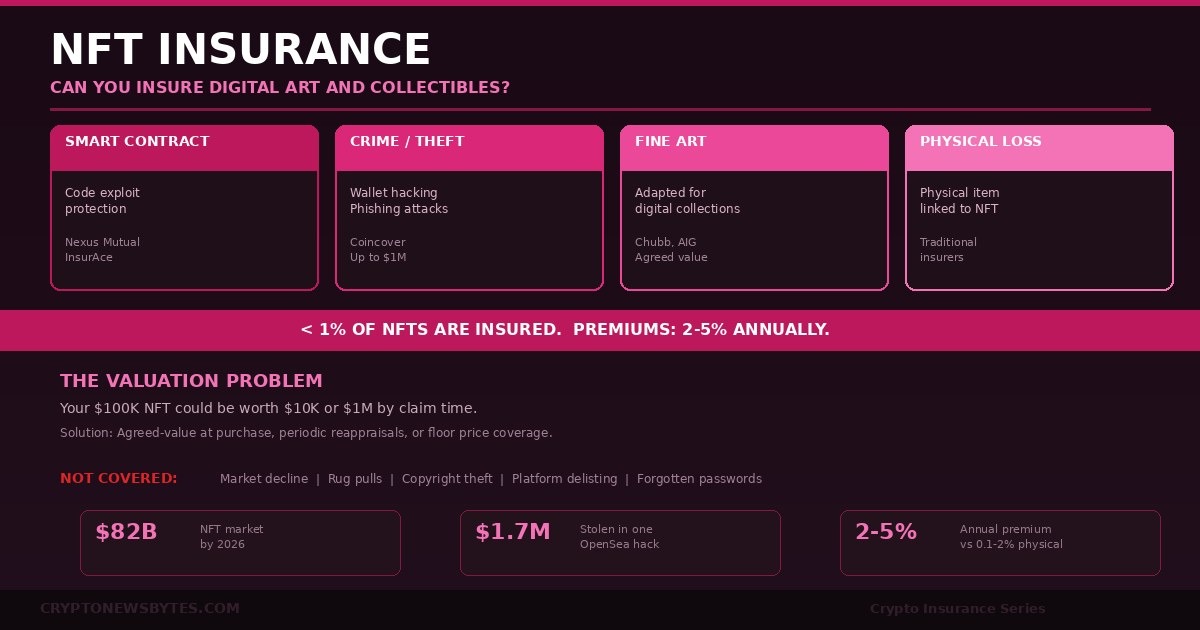
- NFT insurance exists in 2026, but it is not like traditional art insurance. Coverage focuses on theft, hacking, and smart contract exploits, not on market value decline or “damage” to digital files. Most policies are crime/theft policies adapted for digital assets
- The Nifty Gateway shutdown (February 2026) exposed the critical risk of custodial NFT platforms: 650,000+ NFTs were at risk when Gemini closed the marketplace with just one month’s notice. Platform failure is now a recognized insurable risk
- Evertas (Lloyd’s-backed, up to $420M per policy) leads the traditional insurance market with dedicated NFT coverage including theft, loss, hacks, and platform failure. Nexus Mutual and InsurAce offer decentralized alternatives with lower premiums
- Less than 1% of digital assets are currently insured, according to Evertas. The insurance gap for NFTs is even wider, with virtually no retail collectors holding coverage despite billions in cumulative theft losses
- The NFT market has shifted from speculative art trading ($17B peak in 2022, now ~$2.8B) toward gaming, real-world asset (RWA) tokenization, and digital identity. This utility focus is making NFT insurance more viable as assets have clearer, more stable valuations
- Premiums range from 2-5% annually for traditional policies to 1-3% for DeFi coverage. High-value collectors and institutions should combine custody insurance with smart contract coverage for layered protection
NFT Insurance in 2026: Can You Actually Insure Digital Art?
NFT insurance is no longer a theoretical concept. In 2026, you can insure high-value NFTs against theft, hacking, and platform failures through both traditional insurers and decentralized protocols. But the market is young, coverage is limited, and it works very differently from insuring a painting on your wall.
The urgency became real in January 2026 when Nifty Gateway, one of the original NFT marketplaces, abruptly shut down with just one month’s notice. Over 650,000 NFTs sat in custodial wallets, and collectors scrambled to withdraw assets before the February 23 deadline. Digital artists reported being told to “screenshot their NFTs” as a withdrawal method. Meanwhile, the broader crypto market lost .1 billion to hacks in H1 2025 alone, with NFT wallet drains, phishing attacks, and smart contract exploits accounting for hundreds of millions.
The question is no longer whether NFT insurance exists. It does. The question is whether the coverage available actually matches the risks NFT owners face, and whether it is affordable enough for anyone beyond institutions and whales to access. This guide breaks down the risks, available coverage, providers, and practical steps for protecting your digital assets. For the broader insurance landscape, see our comprehensive crypto insurance guide.
What Risks Do NFT Owners Actually Face?
Critical distinction: Most NFT insurance policies cover crime, theft, and loss of digital assets, not market value drops. If your NFT’s floor price falls from 10 ETH to 0.1 ETH, that is market risk, not an insurable loss. NFTs are not tangible, so there is no “physical damage” to cover. The insurable event is someone stealing it or a platform losing it, not the market deciding it is worth less.
How NFT Insurance Works: Coverage Models
There are three distinct models for insuring NFTs in 2026, each with different strengths and trade-offs:
Traditional/specialty insurers like Evertas (the only Lloyd’s of London coverholder dedicated to crypto) offer crime and fidelity policies that extend to NFTs and digital property. These are institutional-grade: A+ rated, up to $420M per policy, with bespoke underwriting that accounts for each asset’s rarity and price history. Lloyd’s syndicates and brokers like Marsh facilitate these policies. Best for institutions, family offices, and high-net-worth collectors with holdings above $100K.
Crypto-native/DeFi protocols like Nexus Mutual and InsurAce offer decentralized coverage with parametric triggers. When a verified on-chain exploit occurs, claims are processed through community voting or automated smart contract logic. Premiums are lower (1-3% vs 2-5% for traditional), but coverage limits are smaller and claims depend on community governance. Best for DeFi-native NFT holders and protocol-level coverage.
Custody/institutional add-ons are bundled with major custodians. Coinbase Custody includes crime policies covering digital assets (including NFTs) with coverage reportedly up to $320M+. BitGo, Anchorage, and Fireblocks offer similar custody insurance packages. These cover theft from the custodian’s infrastructure but not your personal wallet. Best for passive holders who want set-and-forget protection.
Parametric vs Indemnity: Which Is Better for NFTs?
Parametric: Pays out automatically when a verifiable on-chain event occurs (e.g., exploit drains a contract). Fast, transparent, no claims adjuster. But the payout is pre-set and may not match your actual loss.
Indemnity: Assesses actual loss after an incident, then compensates accordingly. More accurate but slower, requires documentation, and involves subjective valuation of NFTs. For a deeper comparison, see our parametric vs traditional guide.
Top NFT Insurance Providers in 2026
| Provider | Type | NFT Coverage | Best For | Capacity | 2026 Status |
|---|---|---|---|---|---|
| Evertas | Traditional (Lloyd’s) | Theft, loss, hacks, platform failure, digital property (NFTs). Bespoke rarity/price underwriting | Institutions, HNW collectors | $420M/policy | A+ rated. Only Lloyd’s coverholder for crypto. On-chain policy payments via Nayms |
| Nexus Mutual | Decentralized mutual | Smart contract exploits, custody failures, protocol hacks (covers NFT-linked DeFi risks) | DeFi/NFT users | $285M TVL | $18M+ paid. Community-voted claims |
| InsurAce | DeFi / multi-chain | Portfolio coverage including NFTs, theft, de-pegs, smart contract failures | Retail / multi-asset | $150M TVL | Dynamic pricing. Low premiums (1-3%) |
| OpenCover | Parametric / on-chain | Fast payouts for verifiable hacks and theft events. Automated smart contract triggers | Quick protection | Emerging | Efficient for digital assets. Growing adoption |
| Coinbase Custody | Institutional custody | Crime policy covering custodied assets including NFTs. SOC 2 compliant | Institutional holders | $320M+ | Regulated. Part of broader exchange insurance framework |
| Coincover | Wallet protection | Key recovery and theft protection for wallets holding NFTs. Integrates with wallets/exchanges | Retail / wallets | Varies | B2B integration. 2-5% premiums |
| FairSide | Theft-focused | Personal crypto/NFT theft protection. Covers wallet hacks and social engineering | Individual collectors | Up to $100K | Retail-accessible. Membership model |
Additional options include Sherlock (bundles audit + coverage for NFT-related smart contracts), Etherisc (parametric models), and traditional fine art insurers exploring digital asset riders for high-value tokenized art.
Step-by-Step: How to Insure Your NFTs
Step 1: Assess your value and risk profile. Calculate the total value of your NFT holdings. If your collection exceeds $50K, dedicated insurance becomes cost-effective. Consider whether your assets are in self-custody (higher personal risk) or with a custodian (covered by their policy). High-value single pieces (CryptoPunks, Art Blocks, 1/1 art) warrant individual coverage.
Step 2: Choose your model. For institutional/HNW holdings above $100K, go traditional (Evertas via your insurance broker). For DeFi-native collections under $100K, DeFi protocols (InsurAce, Nexus Mutual) offer accessible premiums. For passive custody, ensure your custodian (Coinbase, BitGo) includes NFTs in their crime policy. Many collectors layer multiple models for comprehensive protection.
Step 3: Provide documentation. Traditional insurers require wallet addresses, transaction history, acquisition records, and provenance documentation. DeFi protocols typically only need your wallet address and on-chain verification. For high-value art NFTs, appraisals or sales history help establish insured value.
Step 4: Purchase coverage. Traditional policies are purchased through insurance brokers (KYC required). DeFi coverage can be bought directly on-chain through protocol interfaces. Evertas now offers on-chain policy payments via Nayms on Ethereum, accepting USDC or native crypto.
Step 5: Implement security best practices alongside insurance. Insurance is a safety net, not a substitute for security. Use hardware wallets (Ledger, Trezor) for high-value NFTs. Enable multi-signature wallets for collections above $50K. Consider wallet protection services like Harpie (transaction monitoring and automatic blocking of malicious transfers). Separate your “vault” wallet from your “trading” wallet.
What NFT Insurance Will NOT Cover
- Market value decline: Your Bored Ape dropping from 100 ETH to 10 ETH is market risk, not insurable
- User error: Sending NFTs to the wrong address, falling for obvious scams, or approving malicious transactions
- Loss of access: Forgotten seed phrases, corrupted wallets. Almost universally excluded
- Fraud/counterfeits: Buying a fake NFT or stolen art. Title verification is emerging but not standard
- Intentional acts: Self-inflicted losses or insurance fraud (obviously)
- Regulatory seizure: Government confiscation of assets. Not covered by any crypto policy
Benefits, Limitations, and the Regulatory Angle
Benefits: Peace of mind for serious collectors. Attracts institutional capital to the NFT market (funds and family offices require coverage before allocating). Signals maturity of the ecosystem. Enables lending against NFT collateral (lenders require insurance). And for NFT platforms, offering bundled protection boosts user trust and retention.
Limitations: Premiums are high (2-5% annually for traditional policies, meaning a $100K collection costs $2K-$5K/year to insure). Valuation is the hardest problem: NFT prices are volatile, subjective, and illiquid, making it difficult for insurers to assess claims. Coverage capacity is limited relative to the total market. Claim processes for DeFi protocols depend on community voting, which can be slow or contentious. Retail-grade affordable NFT insurance products remain scarce.
Regulatory angle: There are no global mandates requiring NFT insurance, unlike the growing requirements for exchange insurance. However, broader crypto regulations are creating indirect pressure. MiCA in the EU pushes operational resilience for platforms handling digital assets, including NFTs. The GENIUS Act in the US focuses on stablecoin custody but sets precedents for broader digital asset safeguards. As RWA tokenization grows (tokenized real estate, art, securities), the insurance products will follow regulatory frameworks for those underlying assets.
NFT Insurance Case Studies
| Incident | Loss | Insurance? | Lesson |
|---|---|---|---|
| Nifty Gateway Shutdown (2026) | 650K+ NFTs at risk | No coverage | Custodial platforms can shut down at any time. Self-custody or custody insurance is essential. Metadata hosted by the platform may become permanently inaccessible |
| Nifty Gateway Account Hacks (2021) | Multiple accounts drained | No coverage | Platform-level hacks expose all custodial users simultaneously. Crime insurance would have covered the theft |
| OpenSea Phishing Attacks (2022) | $1.7M+ in NFTs | No coverage | Phishing is the most common NFT theft vector. Wallet protection tools (Harpie) and insurance together prevent and mitigate this |
| Nexus Mutual DeFi Payouts (2022-2025) | Various exploits | $18M+ paid | Decentralized insurance works. Community-voted claims successfully compensated NFT-linked DeFi losses across multiple incidents |
| Coinbase Custody (ongoing) | No major breach | $320M+ policy | Institutional custody with bundled insurance builds trust and attracts institutional NFT allocators who require coverage |
The pattern is clear: every major NFT loss event occurred where there was no insurance. The platforms and custodians offering bundled protection have maintained trust and grown. As one collector noted after the Nifty Gateway shutdown: the lesson is not that NFTs are risky, but that uninsured NFTs are risky.
Future of NFT Insurance: 2026-2027 Outlook
RWA tokenization drives demand. As real-world assets (art, real estate, securities) are tokenized as NFTs, the insurance products for those underlying assets will extend to their tokenized forms. A tokenized Picasso will carry fine art insurance; a tokenized property deed will carry title insurance. This bridges TradFi insurance into the NFT ecosystem and dramatically expands available coverage.
Gaming and metaverse integration. With the NFT market shifting from speculative art toward gaming items and digital identity, insurance products are following. In-game assets worth thousands of dollars need protection, and gaming platforms are beginning to bundle coverage as a competitive feature.
AI-driven valuation solves the pricing problem. The biggest barrier to NFT insurance is valuation. Machine learning models trained on sales data, rarity scores, collection trends, and on-chain activity are enabling more accurate and dynamic pricing of NFT policies. This will reduce premiums and expand coverage to mid-tier collections.
Hybrid TradFi-Web3 models emerge. Evertas’s partnership with Nayms (Lloyd’s-backed policies payable on-chain in USDC) is the template. By 2027, expect more traditional insurers offering crypto-native policy issuance and claims processing, making NFT insurance accessible to a much broader market.
Parametric products mature. Automated, on-chain parametric triggers for NFT theft and exploit events will reduce claims processing from weeks to minutes. OpenCover and similar protocols are building this infrastructure now. For more on this trend, see our future of crypto insurance analysis.
Frequently Asked Questions
📰 Crypto Insurance & Security Series
- Crypto Insurance in 2026: Why the Industry’s Biggest Problem Is Not Hackers
- Best Crypto Insurance Providers in 2026 Compared
- $2.72B Stolen in 2025: Crypto Insurance Lessons Every Founder Needs
- Cyber Insurance for Crypto Firms: What’s Covered and What’s Not
- Smart Contract Insurance: How to Protect Your DeFi Protocol
- Crypto Exchange Insurance: Regulatory Requirements by Country
- You are here: NFT Insurance: Can You Insure Digital Art and Collectibles?
- Crypto Insurance Claims: What Gets Paid and What Gets Denied
- The Future of Crypto Insurance: On-Chain, AI, and What’s Next
- Will Parametric Insurance for DeFi Replace Traditional Policies?
🏛 Regulation Series
Sources: Evertas | TheStreet (Nifty Gateway) | CoinDesk (Evertas/Nayms) | Artnet | Nexus Mutual
Disclaimer: This article is for informational purposes only and does not constitute insurance, legal, or financial advice. NFT valuations are volatile and subjective. Consult qualified insurance brokers for coverage specific to your holdings.