3 Key Takeaways
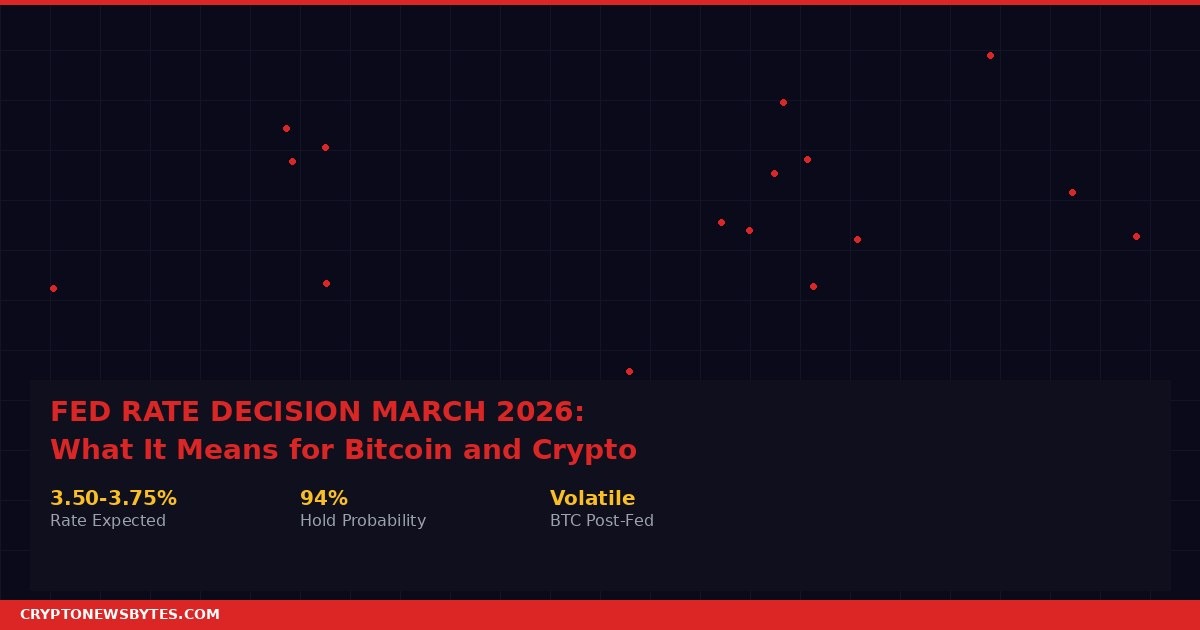
- The Fed rate decision March 2026 on March 18 is expected to hold rates at 3.50-3.75%, with CME FedWatch showing a 94% probability of no change. This would mark the third consecutive pause after 175 basis points of cuts since September 2024
- Bitcoin has dropped after 7 out of 8 FOMC meetings in 2025, even during a cutting cycle, due to “sell the news” dynamics. In January 2026, BTC fell 7.3% in the 48 hours following the hold decision. Traders should prepare for volatility, not direction
- Powell’s tone matters more than the decision itself. Any signal of future cuts (especially for June 2026) could trigger a relief rally. The updated dot plot and economic projections released alongside the decision will set the narrative for Q2
Fed Rate Decision March 2026: What Bitcoin Traders Need to Watch
The Fed rate decision March 2026 arrives at a critical juncture for crypto markets. Bitcoin is trading around $74,000 after a 52% drawdown from its all-time high. The Fear and Greed Index sits at 14 (Extreme Fear). And 43% of Bitcoin’s circulating supply is currently held at a loss, according to Glassnode. The FOMC meets March 17-18, with the announcement at 2:00 PM ET on March 18, followed by Jerome Powell’s press conference at 2:30 PM.
The rate decision itself is largely settled: CME FedWatch shows a 94.1% probability that the Fed holds at 3.50-3.75%, with only a 5.9% chance of a 25-basis-point cut. The real action will come from Powell’s forward guidance, the updated dot plot projections, and any signals about when the next cut might arrive. For crypto, this is not about whether rates change today. It is about whether liquidity conditions are about to improve in the months ahead.
Why the Fed Rate Decision Matters for Crypto in 2026
Bitcoin’s correlation with Federal Reserve policy has strengthened dramatically since institutional capital entered through ETFs. Bitcoin ETFs now hold $115 billion in assets under management. Ether ETFs have surpassed $20 billion. When the Fed signals tighter conditions, institutional allocators reduce risk exposure across all portfolios, including crypto. When the Fed signals easing, capital flows into risk assets, and crypto benefits disproportionately.
The current rate of 3.50-3.75% is still significantly above the pre-pandemic average of 1.7%. Each 25-basis-point cut reduces the opportunity cost of holding non-yielding assets like Bitcoin. More importantly, rate cuts signal expanding liquidity, which historically drives crypto bull markets. The 2020-2021 crypto surge coincided with near-zero rates and massive quantitative easing. The 2022 crash coincided with aggressive tightening.
The Fed has cut 175 basis points since September 2024 (100 bps in autumn 2024, 75 bps in 2025), but paused in January 2026. The March Fed rate decision will clarify whether this pause is temporary or the beginning of a prolonged hold. For crypto, the difference between “pausing before cutting more” and “done cutting” is enormous.
The 2025 Pattern: Bitcoin After Fed Rate Decisions
Here is an uncomfortable truth about the Fed rate decision March 2026 that every crypto trader should internalize: Bitcoin dropped after 7 out of 8 FOMC meetings in 2025, even during a cutting cycle that should theoretically benefit risk assets.
The pattern is consistent. By the time the Fed announces its decision, traders have already positioned based on expectations. When the decision matches those expectations (as it almost always does), early buyers take profits. The result is a “sell the news” drop that typically plays out over 24-48 hours before recovering.
In January 2026, despite the Fed holding as expected, BTC fell from approximately $90,400 on the day of the announcement to $83,383 within 48 hours, a 7.3% decline. This happened even though the hold was fully priced in. The lesson: the Fed rate decision itself rarely moves markets in the direction you expect. The volatility around it creates both risk and opportunity.
What to Watch on March 18 at 2:00 PM ET
The dot plot: If the median FOMC member’s projection still shows one additional cut in 2026 (to 3.25-3.50%), that is dovish and supportive of a crypto recovery. If the dots shift higher, signaling no more cuts, expect downward pressure.
Powell’s language: Key phrases to listen for: “data dependent” (neutral), “patient” (hawkish lean), “prepared to adjust” (dovish lean). Any mention of inflation “moving toward target” is bullish for risk assets.
Balance sheet guidance: The Fed continues quantitative tightening at a slower pace. Any signal of ending QT or pivoting to QE would be massively bullish for crypto.
Powell leadership transition: Jerome Powell’s term expires May 15, 2026. Trump nominated Kevin Warsh as successor in January. Any comments about the transition or Warsh’s policy orientation could introduce additional uncertainty.
Fed Rate Decision and Stablecoin Liquidity
One under-discussed factor connecting the Fed rate decision March 2026 to crypto is the stablecoin market. Total stablecoin market capitalization stands at approximately $315 billion. These stablecoins are backed primarily by U.S. Treasury bills and short-term government securities.
When the Fed holds or cuts rates, Treasury yields decline, which directly impacts stablecoin issuer revenue. Lower yields could push issuers to seek alternative revenue models, potentially accelerating the interest-bearing stablecoin debate that has already fractured industry support for the GENIUS Act.
Conversely, stablecoins serve as a liquidity buffer during volatile periods. During past Fed-driven selloffs, capital often moves from volatile crypto into stablecoins rather than exiting the ecosystem entirely. This “dry powder” effect means that post-decision dips can reverse quickly as stablecoin holders re-enter the market once the uncertainty clears.
Bitcoin ETF flow data will be critical in the days following the decision. February saw record outflows of $3.8 billion from Bitcoin ETFs. A reversal of that trend post-March 18 would signal institutional re-engagement and potentially mark the beginning of a recovery.
Fed Rate Decision Meets Regulatory Momentum
The Fed rate decision March 2026 does not exist in a vacuum. It arrives alongside several regulatory catalysts that could amplify or offset its market impact:
The Clarity Act. The Clarity Act remains in Senate negotiations, with a potential signing target as early as April 3. Passage would provide the regulatory clarity that Goldman Sachs identifies as the top institutional catalyst.
Kraken’s Fed access. Kraken’s historic Federal Reserve master account approval signals deepening integration between crypto and traditional financial infrastructure, regardless of where rates go.
The programmable money question. As Catherine Austin Fitts warned, the stablecoin infrastructure being built through the GENIUS Act’s Treasury compliance pipes has implications that extend beyond monetary policy into financial surveillance and control.
The combination of a dovish Fed signal plus Clarity Act progress could create a powerful double catalyst for crypto markets in Q2 2026. Conversely, a hawkish hold plus continued legislative delays would extend the current bearish environment.
How to Position for the Fed Rate Decision
Based on historical patterns and current market structure, here is a practical framework for the Fed rate decision March 2026:
Before the decision (March 17): Reduce leverage. The 48-hour window around FOMC announcements consistently produces 5-10% moves in Bitcoin. Leveraged positions get liquidated in both directions. Over $327 million was liquidated in a single 24-hour period during the last major FOMC volatility event.
During the announcement (March 18, 2-3 PM ET): Watch, do not trade. The initial reaction is often reversed within hours. Wait for Powell’s full press conference to conclude before making directional bets.
After the dust settles (March 19-20): This is where opportunity lives. If the dot plot signals future cuts and Powell’s tone is neutral to dovish, the post-announcement dip (if it follows the 2025 pattern) could be a buying opportunity. If Powell is unexpectedly hawkish, the dip may deepen and patience is warranted.
The contrarian signal: The Fear and Greed Index at 14 and 43% of supply underwater are historically consistent with cycle bottoms, not cycle peaks. Investors who accumulated during similar Extreme Fear periods in 2018, 2020, and 2022 saw returns exceeding 1,000% within 24 months. The Fed rate decision may provide the volatility event that marks the transition from capitulation to accumulation.
Related Reading
Sources: CoinGecko FOMC Analysis | CME FedWatch | Switch Markets | CoinGape | BYDFi
Disclaimer: This article is for informational and educational purposes only and does not constitute financial or investment advice. Cryptocurrency markets are extremely volatile, especially around FOMC events. Past performance during previous Fed decisions does not guarantee future results. Always do your own research (DYOR) and consult qualified advisors before making investment decisions.