3 Key Facts
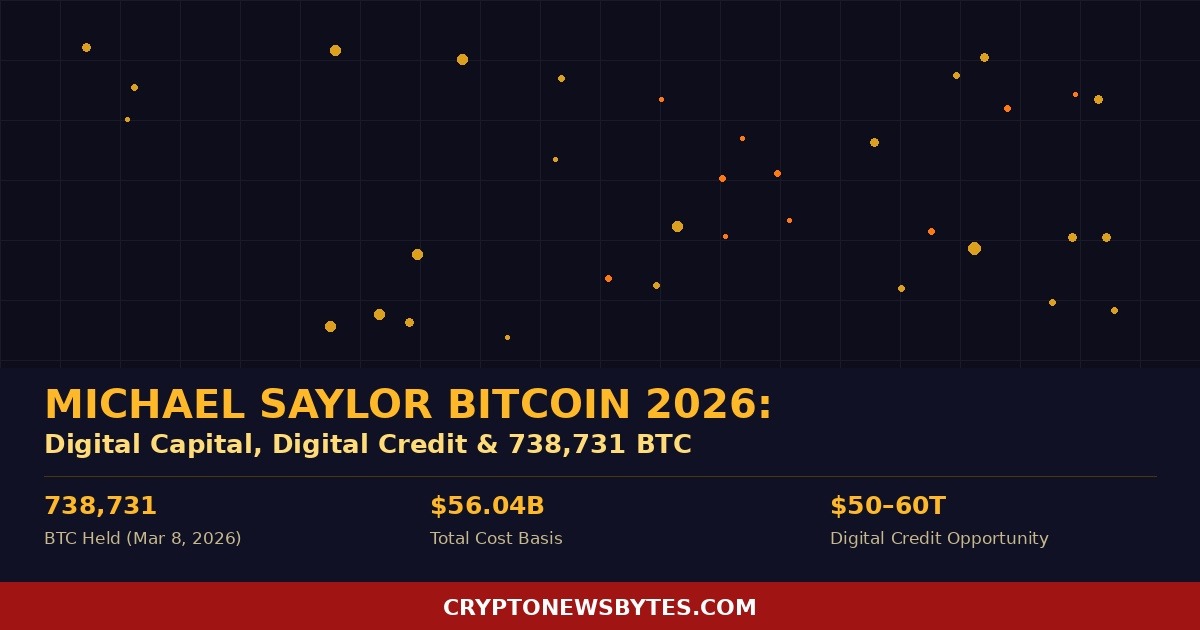
As of March 8, 2026, Strategy holds 738,731 BTC — more than 3.4% of Bitcoin’s fixed 21 million supply — acquired for a total of $56.04 billion at an average price of $75,862 per bitcoin, per the company’s most recent SEC 8-K filing. The purchase was funded through $899.5M in MSTR equity sales and $377.1M in STRC preferred stock issuances — Strategy’s 101st consecutive weekly Bitcoin acquisition.
At Strategy World 2026 in Las Vegas (February 23–26), Saylor unveiled “Digital Credit” — a three-layer financial architecture with Bitcoin as the base layer, Bitcoin-collateralised yield instruments (STRC, STRK, STRF) as the second layer, and programmable digital money as the third. He projected a $50–60 trillion opportunity if digital credit instruments capture just 5–10% of the $300 trillion global credit market.
Saylor told CNBC on February 10, 2026 that forced Bitcoin sales are “an unfounded concern” — Strategy holds two and a half years of preferred dividends in cash, carries net leverage at half the ratio of a typical investment-grade company, and intends to buy Bitcoin “every quarter forever.”
Michael Saylor has spent five years turning a business intelligence software company into the world’s largest corporate Bitcoin holder. In early 2026, he is doing something more ambitious: turning those Bitcoin holdings into the foundation of an entirely new global credit system. The thesis has not changed — Bitcoin is the only viable long-term store of value — but the strategy for monetising that thesis has evolved significantly.
At Strategy World 2026, held at the Wynn in Las Vegas from February 23–26, Saylor delivered a keynote titled “Digital Credit” that laid out his most detailed vision yet for where Strategy, Bitcoin, and the broader financial system are heading. The speech drew executives from enterprise AI, institutional finance, and Bitcoin treasury companies. What emerged was a framework that goes well beyond “buy and hold Bitcoin” — it describes a multi-layered digital financial architecture that Saylor believes could redirect trillions of dollars of global capital.
For context on Bitcoin’s current price environment and what the drawdown means for institutional holders, see our Bitcoin price analysis for March 2026 and the Bitcoin 2026 bottom analysis. For the broader scarcity argument that underpins Saylor’s conviction, see our deep-dive on Bitcoin scarcity in 2026.
| 738,731 BTC Held (Mar 8, 2026) | $56.04B Total Cost Basis | 3.4% of All BTC Ever to Exist | 961% Daily BTC Supply (Single Session) |
Strategy World 2026: “Bitcoin Is Digital Capital”
Saylor opened his Strategy World keynote with a statement he has repeated in various forms since 2020, but with a new weight behind it given Strategy’s current position: “Bitcoin is digital capital.” The framing matters because it is the foundation of everything that follows. If Bitcoin is capital — not a currency, not a speculative asset, not a commodity — then all the financial infrastructure that has historically been built on top of capital (mortgages, bonds, credit, derivatives) can theoretically be rebuilt on top of Bitcoin.
He contrasted Bitcoin with traditional capital stores. Gold is capital, but it is not portable, not divisible, not programmable. Real estate is capital, but it requires lawyers and borders and middlemen. Equities are capital, but they carry counterparty risk and are subject to dilution. Bitcoin, in Saylor’s framework, is capital stripped of all those limitations: 21 million coins, fixed supply, borderless, divisible to eight decimal places, and increasingly custodied by regulated institutions.
“If we have digital gold,” Saylor said, “it’s very logical that the world’s going to run on digital gold-backed credit.” The entire Digital Credit vision flows from this premise.
The Three-Layer Digital Financial Architecture
The most substantive part of Saylor’s Strategy World keynote was his articulation of a three-layer financial system built on Bitcoin. This is not abstract theory — Strategy has already launched the instruments that populate layers one and two, and layer three is being built by partners.
| Layer | Name | What It Is | Example |
|---|---|---|---|
| Layer 1 | Digital Capital | Bitcoin itself. The base layer. Fixed supply, no counterparty risk, perfectly portable. Functions as the reserve asset underpinning everything above it — equivalent to gold in the pre-fiat monetary system. | BTC |
| Layer 2 | Digital Credit | Bitcoin-collateralised, yield-bearing financial instruments. Over-collateralised against BTC holdings. Convert Bitcoin’s long-duration appreciation into short-duration income streams. Reduce BTC volatility exposure for income-focused investors while preserving upside for equity holders. | STRC (11.50% yield), STRK (8%), STRF (10%), STRD |
| Layer 3 | Digital Money | Stablecoins and payment tools derived from Layer 2 instruments. Programmable digital currency backed not by central bank fiat but by Bitcoin-collateralised credit. Integrates into payments, DeFi, and banking rails. | USDat (Saturn — backed by STRC + US Treasuries) |
Saylor explained the economic logic of Layer 2 with a striking formulation: “We convert 120 months or 240 months of duration into one month.” Strategy’s Bitcoin holdings are a 10 to 20-year appreciating asset. STRC turns that long-duration asset into monthly income streams for preferred shareholders — while MSTR common equity absorbs the Bitcoin price volatility and captures the upside. Every seven years, Saylor says, Strategy aims to double its Bitcoin per share for common equity holders through this structure.
At Strategy World, he projected that the global credit market — currently estimated at around $300 trillion — could double over the next decade. Capturing even 5–10% of that with Bitcoin-backed credit instruments represents a $50–60 trillion capital migration opportunity. “If you can get 5% or 10% of it, there’s a 50–60 trillion dollar opportunity,” he told the audience, per FXStreet’s reporting from the conference.
STRC: The “Primary Engine” for Bitcoin Accumulation
The strategic pivot at Strategy World 2026 was notable: Saylor shifted from encouraging corporations to simply add Bitcoin to their balance sheets, toward promoting STRC — Strategy’s Variable Rate Series A Perpetual Stretch Preferred Stock — as the primary vehicle for funding ongoing Bitcoin purchases. This is a meaningful evolution in how the company positions itself.
Benchmark analyst Mark Palmer, who maintained a Buy rating on MSTR with a $705 price target following Strategy World, called STRC the “primary engine” for Strategy’s Bitcoin accumulation in a note to clients, per The Block. The logic: STRC issuances raise capital that flows directly into BTC purchases, growing Bitcoin per share for MSTR common equity holders without diluting equity at current depressed MSTR prices.
The most recent SEC filings confirm this mechanism in action. Between March 2 and March 8, 2026, Strategy sold 3,776,205 STRC shares and 6,327,541 MSTR common shares, generating the capital to purchase 17,994 BTC at an average of $70,946 per coin — per the company’s 8-K filing dated March 10, 2026. Strategy also raised the STRC dividend rate from 11.25% to 11.50% per year effective March 1, 2026, and declared March 31 dividends across all preferred series (STRF, STRC, STRE, STRK, STRD).
Anchorage Digital, the first federally chartered US crypto bank, disclosed holdings in STRC following Strategy World. Corporate participants including Prevalon Energy also announced treasury allocations involving STRC at the conference — early signals that the instrument is gaining institutional traction beyond Strategy’s direct investor base.
Strategy’s Bitcoin Holdings: The Numbers as of March 2026
Strategy’s Bitcoin position is now large enough that it materially influences conversations about institutional supply and scarcity. With 738,731 BTC as of March 8, 2026, the company holds more than 3.4% of the total 21 million Bitcoin that will ever exist. The position is currently sitting on a mark-to-market loss — bought at an average of $75,862 per coin, with Bitcoin trading in the mid-$60,000s to low $70,000s in early March 2026 — but Saylor has consistently framed this as irrelevant to the long-term thesis. For Strategy’s complete Bitcoin purchase history and current holdings data, see the Strategy investor dashboard and the company’s SEC filings page.
| Date | BTC Added | Cost | Avg Price | Total Holdings |
|---|---|---|---|---|
| Mar 2–8, 2026 | +17,994 BTC | $1.28B | $70,946 | 738,731 BTC |
| Feb 23–Mar 1, 2026 | +3,015 BTC | $204.1M | $67,700 | 720,737 BTC |
| Feb 2–8, 2026 | +1,142 BTC | $90M | $78,815 | 714,644 BTC |
| Jan 12–19, 2026 | +22,305 BTC | $2.125B | ~$95,300 | 709,715 BTC |
Source: Strategy 8-K SEC filings. All figures per official filings. Average prices and totals include fees and expenses per SEC disclosure.
At the time of the most recent purchase, Strategy’s holdings were sitting on approximately $6 billion in unrealized mark-to-market losses, per Saylor Tracker data cited by The Block. Saylor directly addressed this on CNBC in February 2026: “Our net leverage ratio is half the typical investment grade company. We’ve got 50 years worth of dividends and bitcoin, we’ve got two and a half years worth of dividends just in cash on our balance sheet. We’re not going to be selling, we’re going to be buying bitcoin.” Strategy’s Q4 2025 results showed a $17.4 billion operating loss and $12.6 billion net loss — largely non-cash mark-to-market accounting adjustments tied to Bitcoin price movement, per SEC filings.
The Dual-Engine Model: How Strategy Raises Over $1 Billion for Bitcoin in a Single Day
Understanding how Strategy funds these purchases is as important as understanding why. Financial analyst Adam Livingston, whose breakdown of Strategy’s capital mechanics went viral in the Bitcoin community, describes the architecture as a “dual-engine capital machine” — one capable of channelling more than $1 billion into Bitcoin in a single trading session.
The two engines operate simultaneously and target entirely different pools of capital:
| Engine | Instrument | Target Investor | What They Get |
|---|---|---|---|
| Engine 1 — Yield | STRC (11.50%) | Fixed-income investors frustrated with 4% government bonds but unwilling to take direct Bitcoin volatility. Pension funds, income-oriented institutions, conservative allocators. | 11.50% annual dividend yield, Bitcoin-adjacent exposure, significantly lower volatility than spot BTC or MSTR equity. A “downside cushion” with Bitcoin upside participation. |
| Engine 2 — Growth | MSTR Equity | Growth investors seeking leveraged Bitcoin exposure. Tech-oriented funds, Bitcoin-focused ETFs, retail and institutional investors who want amplified BTC performance without self-custody. | Leveraged upside on Bitcoin price appreciation. The volatility that STRC strips away flows directly to MSTR common shareholders — amplified Bitcoin performance in both directions. |
The practical result of running both engines simultaneously: on one particularly active Thursday cited by Livingston, STRC issuances alone raised approximately $303.2 million in a single day. Combined with MSTR equity issuances that same session, total capital raised eclipsed $1 billion. At an average Bitcoin price of $70,139, that single-day raise translated into roughly 4,322 BTC acquired — equivalent to approximately 961% of the global daily mined Bitcoin supply.
To put that figure in context: Bitcoin’s network produces roughly 450 new coins per day post-halving. Strategy absorbed nearly ten times that amount in one session. No miner, no ETF, and no other institutional buyer operates at anything close to this velocity.
The $300 Trillion Hose — Livingston’s Analogy
| 1 | The pool: The global fixed-income market is worth approximately $300 trillion — roughly one-third of all global wealth. It is the largest capital market on earth, and the majority of it earns below 5% annually. |
| 2 | The network: The Bitcoin network is currently valued at approximately $1.4 trillion — less than 0.5% of the fixed-income pool sitting next to it. |
| 3 | The hose: STRC, offering 11.50% yield backed by Bitcoin collateral, is the mechanism connecting the two. Every dollar of fixed-income capital that flows into STRC becomes a dollar of Bitcoin demand. Strategy is, in Livingston’s framing, the hose between a $300 trillion pool and a $1.4 trillion network. |
This supply shock dynamic is central to the scarcity thesis covered in depth in our analysis of why there is not enough Bitcoin for everyone. When a single public company engineers a mechanism to acquire nearly ten times the daily mined supply in one session — and intends to repeat it every week — the liquid float of Bitcoin available on exchanges compresses structurally, not temporarily.
Banks Are Now the Story: “Not ETFs, Not Retail — Banks”
One of the most consequential claims Saylor made — both at Strategy World and in his CNBC appearance — is that the central actors in Bitcoin’s next phase are not retail investors, not ETF inflows, and not corporate treasuries. They are banks.
In a CNBC interview in late 2025, Saylor described the shift clearly: “The Bitcoin narrative is now shaped around the direct involvement of the banking system, rather than ETFs or retail investor sentiment. The real transformative development in the Bitcoin market is banks accepting the asset and activating their lending mechanisms.” He noted that in the six months prior, approximately half of the major US banks had begun offering BTC-backed loans through Bitcoin ETFs, and that this trend was accelerating.
At Bitcoin MENA in December 2025, Saylor was more specific: “All of the large banks in the United States have gone from not banking Bitcoin 12 months ago to issuing credit against Bitcoin or Bitcoin derivatives.” He named Bank of America, Wells Fargo, JPMorgan, and Citi as having moved from cautious observers to active participants — offering custody solutions, trading desks, and credit facilities tied to Bitcoin. Charles Schwab and Citi were cited as planning Bitcoin-backed loans and BTC custody services in the first half of 2026.
For Strategy’s purpose, bank involvement is not incidental — it is the mechanism through which the STRC credit stack connects to the broader financial system. Banks that custody Bitcoin and lend against it become natural counterparties for Strategy’s preferred instruments. Saylor described the opportunity: “The opportunity for Treasury companies is to accumulate pools of capital and issue credit that meets regulatory requirements, integrates into the banking system, and absorbs currency risk.”
This bank integration thesis connects directly to the Bitcoin scarcity argument covered in our analysis of why there is not enough Bitcoin for everyone and the institutional accumulation shift in 2025. As banks absorb Bitcoin on behalf of clients through loans, ETFs, and custody, the available liquid supply continues to compress.
Addressing the Critics: Volatility, Leverage, and Forced Sale Risk
Strategy’s critics have sharpened their arguments as Bitcoin has pulled back from its October 2025 all-time high of approximately $126,000. With MSTR stock down roughly 60% year-over-year as of early March 2026, and Strategy sitting on billions in unrealized Bitcoin losses, the questions about sustainability have intensified.
The core concern: Strategy has more than $8 billion in total debt, largely convertible notes used to fund Bitcoin purchases. If Bitcoin continues falling and MSTR stock depresses further, can Strategy continue to service its obligations — covering preferred dividends on STRC, STRK, STRF, STRD — without forced liquidation of Bitcoin? Saylor’s answer is straightforward and he has repeated it consistently. The $2.25 billion USD cash reserve covers more than 2.5 years of preferred dividend obligations. Net leverage is below investment-grade benchmarks. And he explicitly declined to sell when Bitcoin hit its 2026 low of $60,062 in late February — instead buying 3,015 more BTC that same week at $67,700.
He also addressed Bitcoin’s current drawdown directly: “Bitcoin volatility is a feature, not a flaw.” In a Coin Stories interview with Natalie Brunell in early March 2026, Saylor compared Bitcoin’s 45% decline from ATH to MicroStrategy’s own history — the company saw its stock fall 99.7% during the dot-com crash and survived. The long-term projection remains unchanged: Bitcoin doubling or tripling S&P 500 performance over the next four to eight years. The mechanism for reaching those returns now runs through the Digital Credit stack.
The Programmability Expansion: Solana and Beyond
One of the more unexpected moments at Strategy World 2026 came when Saylor discussed where Digital Credit instruments could ultimately live. He emphasised the programmability of Digital Credit — that instruments like STRC can be tokenised and deployed across multiple blockchain networks, not only Bitcoin or Ethereum. He specifically mentioned Solana as a platform where these instruments could operate.
Solana’s official X account amplified the clip immediately. The SOL community noted that Saylor — who as recently as May 2024 had declared that no token other than Bitcoin would ever achieve institutional acceptance — was now describing a multi-chain credit architecture. His framing remained anchored: Bitcoin and STRC are the foundation layer. But the credit instruments built on top of that foundation could be distributed on whatever rails institutions and markets prefer. The programmability of the credit, not the blockchain it runs on, is the product.
Conclusion: From Bitcoin Buyer to Bitcoin Architect
Michael Saylor began 2020 as the CEO of a struggling business intelligence company who had just read “The Bitcoin Standard.” He ends the first quarter of 2026 as the architect of a Bitcoin-backed credit system that has issued five distinct preferred equity instruments, accumulated more than 3.4% of the total Bitcoin supply, drawn major US banks into its orbit, and launched a keynote at Strategy World that had Solana’s official account sharing clips to its audience of millions.
The criticism is legitimate and worth tracking: MSTR is down sharply, the mark-to-market losses are real, and the preferred dividend obligations are a structural liability that requires Bitcoin’s long-term appreciation to justify. But the strategic direction is consistent and increasingly sophisticated. Saylor is not pivoting. He is building.
The next major catalyst for Strategy and for the Bitcoin institutional narrative is the continued expansion of bank involvement — BTC-backed loans from Charles Schwab, Citi custody products, and the integration of STRC into bank balance sheets as a yield instrument. If that plays out through 2026, the Digital Credit thesis moves from keynote to infrastructure. Bitcoin’s role in the global financial system would shift from “speculative asset” to “reserve collateral” — precisely what Saylor has been describing since 2020.
For more context on where Bitcoin sits in the current macro and institutional environment, read our analysis of the Fed rate decision’s impact on Bitcoin in March 2026, and for a full picture of the regulatory environment enabling bank participation, see our guide to the CLARITY Act 2026 and SEC Chairman Atkins’ token taxonomy framework.
Frequently Asked Questions
📰 Related Coverage on CryptoNewsBytes
Sources and References
Strategy SEC 8-K Filings (SEC EDGAR) · Strategy Investor Relations · Strategy Bitcoin Holdings Dashboard · FXStreet — Strategy World 2026 Keynote · The Block — Benchmark on STRC · CNBC — Saylor on Credit Risk (Feb 10, 2026) · Bitcoin Magazine — Saylor at Bitcoin MENA · The Block — 738,731 BTC Purchase (Mar 10, 2026) · Strategy World 2026 Official · Adam Livingston — On Time (YouTube, cited analysis)
Disclaimer: This article is for informational and educational purposes only and does not constitute financial or investment advice. Bitcoin and MSTR are volatile assets. Strategy’s mark-to-market Bitcoin losses and preferred dividend obligations are material financial risks. All figures are sourced from SEC filings, company disclosures, and named financial media as of March 13, 2026. Always conduct your own research before making investment decisions.