
Key Takeaways
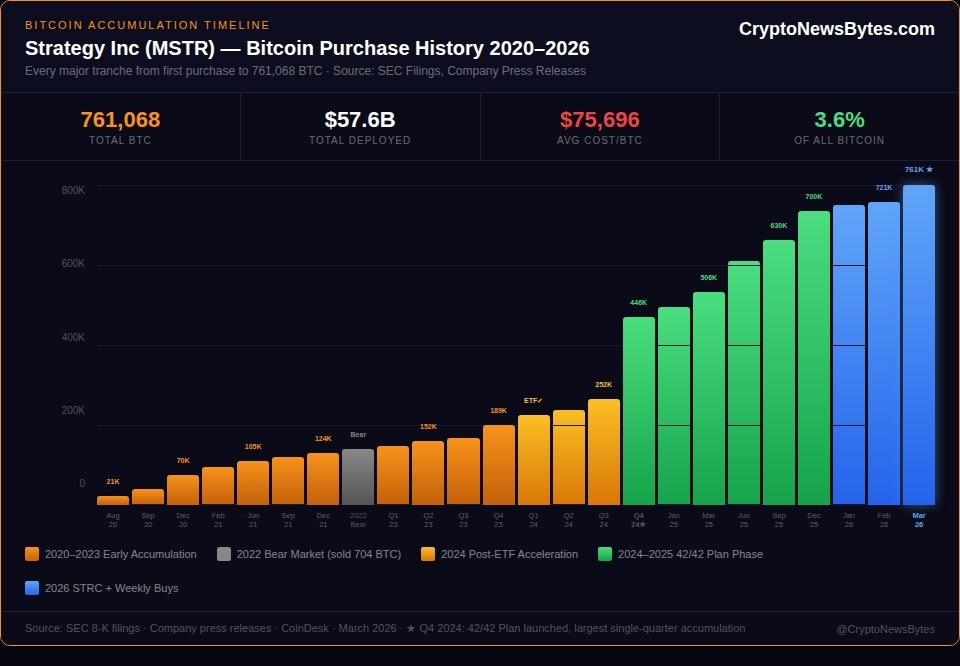
- Michael Saylor has transformed Strategy Inc (formerly MicroStrategy) into the world’s largest corporate Bitcoin treasury, holding 761,068 BTC worth approximately $57.6 billion as of March 2026 — roughly 3.6% of the total 21 million supply that will ever exist.
- The strategy is not simply “buy Bitcoin.” It is a four-step capital markets feedback loop: raise cheap debt, buy BTC, use rising BTC to drive MSTR stock higher, use high stock price to raise more capital, repeat indefinitely.
- The 2026 evolution is STRC preferred stock, offering an 11.5% monthly dividend with no Bitcoin volatility exposure — tapping the $300 trillion global fixed-income market as a new funding source. In one week in March 2026, this raised $1.57 billion.
- The bear case is leverage: Strategy’s average acquisition price is $75,696 per BTC. With Bitcoin trading near $74,000 in March 2026, the company is sitting on a slight unrealized loss. If Bitcoin stalls while debt obligations remain, the same loop that creates wealth can reverse direction.
📋 In This Article
- MicroStrategy Bitcoin Holdings: March 2026 Snapshot
- The Four-Step Feedback Loop Explained
- STRC Yield Magnet: The Dual Engine Model Explained
- The 42/42 Plan: $84 Billion Bitcoin Accumulation Target
- Bitcoin Yield: The Real KPI Most Analysts Miss
- Engineering Not Gambling: The $2.25B Safety Buffer
- MicroStrategy Bitcoin Strategy: The Bull Case
- MicroStrategy Bitcoin Strategy: The Bear Case
- MSTR vs Bitcoin 2026: Performance and Yield Compared
- Michael Saylor Bitcoin Strategy: Final Verdict
- FAQ
This is the Saylor Playbook in full — and the story of the most ambitious MicroStrategy Bitcoin strategy ever executed. No MicroStrategy Bitcoin strategy has attracted more attention, controversy or imitation in corporate finance history. In 1989, Michael Saylor founded MicroStrategy as an enterprise software company. He survived the dot-com crash, rebuilt the business, and by any conventional measure had already won. He had nothing left to prove and every reason to coast.
Instead, in August 2020, he made a decision that financial historians will be studying for decades. He converted his company’s entire treasury into Bitcoin — and then kept going. As of March 2026, Strategy Inc (the company rebranded from MicroStrategy in early 2025) holds more Bitcoin than any other public company on Earth, having deployed $57.6 billion into a single asset using some of the most sophisticated capital markets engineering ever applied to a corporate treasury.
Whether this ends in the history books as the greatest corporate bet ever made or becomes the most expensive cautionary tale in financial history depends on one thing: whether Bitcoin’s long-term appreciation continues to outpace the cost of the debt used to buy it. This article explains exactly how the machine works, what could break it, and where it stands today.
MicroStrategy Bitcoin Holdings: March 2026 Snapshot
📊 Strategy Inc (MSTR) — Live Data: March 2026
The most striking number in that MicroStrategy Bitcoin strategy table is not the $57 billion. It is the fact that Saylor bought another $1.57 billion of Bitcoin in a single week in March 2026 while sitting on an unrealized loss. The pace of accumulation is not slowing with price weakness. It is accelerating. That tells you everything about how Saylor views short-term price fluctuations versus long-term supply scarcity.
The Saylor Playbook: How Does MicroStrategy Buy Bitcoin?
The MicroStrategy Bitcoin strategy is routinely reduced to “he buys Bitcoin with debt.” That framing misses the architecture entirely. What Saylor has built is a self-reinforcing capital markets loop that, under the right conditions, grows larger with every rotation.
“What Saylor has effectively built is a feedback loop. Equity and debt markets fund Bitcoin accumulation, Bitcoin exposure drives investor demand for the stock, and that demand lowers the cost of raising more capital. In a world where liquidity and narrative often move together, the structure can reinforce itself for longer than many expect.”
STRC Yield Magnet: The Dual Engine Behind MicroStrategy Bitcoin Strategy
The most significant evolution of the MicroStrategy Bitcoin strategy in 2025 and 2026 has been the introduction of STRC preferred stock, informally called “Stretch” shares. Understanding STRC is essential to understanding why the pace of Bitcoin accumulation has accelerated sharply this year.
Saylor calls this the Dual Engine Model. Engine one is MSTR equity, targeting investors who want leveraged Bitcoin upside. Engine two is STRC preferred stock, targeting fixed-income investors who want yield without volatility. Together they access two entirely separate pools of global capital simultaneously.
Traditional convertible notes appeal primarily to hedge funds and equity-oriented investors who want Bitcoin upside in a debt wrapper. STRC takes a completely different approach. It offers an 11.5% annual dividend paid monthly with no direct exposure to Bitcoin’s price volatility. The dividend is fixed, predictable, and senior to equity in the capital structure.
This single product unlocks the $300 trillion global fixed-income market as a funding source. Pension funds, insurance companies, family offices, and income-focused institutions that could never justify owning Bitcoin directly or buying volatile equity can now allocate to STRC and receive a competitive yield. In exchange, they are providing Saylor with capital that goes directly into BTC purchases.
In the week of March 9-13, 2026 alone, Strategy raised $1.57 billion primarily through STRC and used it to acquire 22,337 BTC. That is the mechanism working at full speed. An income-seeking institutional investor in Tokyo or London effectively funded a Bitcoin purchase in real time, without ever touching crypto themselves.
The 42/42 Plan: MicroStrategy’s $84 Billion Bitcoin Accumulation Target
In late 2024, as part of the MicroStrategy Bitcoin strategy roadmap, Saylor announced what he calls the “42/42 Plan” — detailed on Strategy’s official Bitcoin treasury page: a commitment to raise $42 billion through equity and $42 billion through fixed-income instruments over a three-year period, totalling $84 billion in fresh capital deployed entirely into Bitcoin. The plan is designed to be executed regardless of short-term Bitcoin price movements.
Progress as of March 2026 suggests the plan is on track and possibly ahead of schedule. The combination of MSTR equity issuances and the rapid uptake of STRC preferred shares has given Strategy access to capital at a pace that would have been inconceivable when the strategy began in 2020.
The 42/42 Plan is what makes this article evergreen. Each major capital raise, each BTC purchase, and each STRC issuance is a milestone against this roadmap. Readers following Strategy’s story in 2026 and 2027 can use this framework to track whether the machine is running on schedule.
Bitcoin Yield: The Real KPI Most Analysts Miss
While most financial media focuses on MSTR’s stock price or the dollar value of Strategy’s Bitcoin holdings, Saylor tracks a completely different metric internally: Bitcoin Yield. Understanding this metric is essential to understanding why the MicroStrategy Bitcoin strategy views share dilution not as a negative but as a feature.
Bitcoin Yield measures the percentage increase in the ratio of total Bitcoin holdings to assumed diluted shares outstanding. In plain terms: how much Bitcoin does each share of MSTR represent, and is that number going up over time?
📈 2025 performance: 22.8% Bitcoin Yield — meaning existing shareholders’ proportional claim on Strategy’s Bitcoin grew by 22.8% in a single year, even as the company was issuing new shares to fund purchases.
🎯 The goal: Ensure that even when Strategy dilutes its stock to raise capital, the Bitcoin-per-share for existing investors continues to rise. It converts a traditional dilution negative into a compounding positive — provided Bitcoin appreciates faster than shares are issued.
This reframes the entire strategy. Critics who say “Saylor is just diluting shareholders to buy Bitcoin” are measuring the wrong thing. The relevant question is not whether more shares exist — it is whether each share represents more Bitcoin than it did before. In 2025, the answer was a 22.8% improvement. That is the number Saylor is managing to.
Engineering, Not Gambling: The $2.25 Billion Safety Buffer
One of the most consistent criticisms of the MicroStrategy Bitcoin strategy is that it is reckless speculation dressed up in financial jargon. The engineering counterargument rests on a specific structural feature that most coverage ignores entirely: the liquidity reserve.
As of January 2026, Strategy held a $2.25 billion USD cash and liquidity reserve specifically designated to cover interest payments on convertible notes and STRC dividends. At current obligations, this reserve is sufficient to service all debt and preferred dividend payments for at least 21 months without selling a single satoshi of Bitcoin.
The second engineering argument is convexity. The MicroStrategy Bitcoin strategy has structured its capital so that gains are amplified on the upside while losses are partially buffered on the downside. If Bitcoin doubles, MSTR equity moves at 1.5x to 3x. If Bitcoin falls, the $2.25B reserve absorbs the carrying costs. The asymmetry is intentional — it is what Saylor means when he describes this as systematic treasury management rather than speculation.
Whether you find that framing convincing depends on whether you believe Bitcoin will recover from any drawdown within 21 months — which it has done in every previous cycle. That is the core assumption the entire safety buffer rests on.
MicroStrategy Bitcoin Strategy: The Bull Case
Why Bulls Believe the MicroStrategy Bitcoin Strategy Loop Holds
Bitcoin’s historical appreciation far exceeds any realistic cost of capital. Over any four-year period since Bitcoin’s launch, the asset has delivered returns that dwarf even the most aggressive debt costs. STRC’s 11.5% yield looks expensive until you compare it to Bitcoin’s compounded annual growth rate over the past decade.
The MSTR premium is structural, not speculative. Strategy trades at a consistent premium to its net asset value (the raw BTC it holds) because investors are paying for Saylor’s ability to keep acquiring more. As long as that premium holds, every new equity issuance is accretive to existing shareholders rather than dilutive.
Bitcoin supply is fixed; institutional demand is growing. The approval of Bitcoin ETFs in 2024 and the progress of the CLARITY Act in 2026 are opening institutional channels that did not previously exist. Strategy’s 761,068 BTC represents 3.6% of the total supply that will ever exist. As Saylor has argued publicly, there is simply not enough Bitcoin for every institution that will eventually want it.
Convertible note structure limits downside. As analyst Joseph Pride noted in the LinkedIn thread, the convertible debt is structured so that on up cycles, lenders convert to equity and take the gains. On down cycles, Strategy services the debt at low interest rates. Either way, the company does not need to sell Bitcoin to meet obligations in most scenarios.
MicroStrategy Bitcoin Strategy: The Bear Case and Risks
MicroStrategy Bitcoin Strategy: Specific Vulnerabilities in 2026
Average cost is above current price. With the MicroStrategy Bitcoin strategy carrying an average acquisition price of $75,696 and Bitcoin trading at approximately $74,029 in mid-March 2026, Strategy is technically underwater on its total portfolio for the first time since the strategy began. This is not a crisis — it is a paper loss on a long-duration position — but it narrows the margin of safety and makes the leverage more visible.
STRC dividends must be serviced regardless of BTC price. Unlike convertible note holders who can wait for conversion, STRC preferred shareholders expect their 11.5% dividend monthly. If Bitcoin drops 40% and stays down, Strategy’s ability to issue new equity at favourable terms is impaired, and it must fund dividends from operating cash flow or asset sales.
The premium can compress quickly. MSTR’s premium over net asset value has historically compressed sharply during Bitcoin bear markets. If the stock trades at or below NAV, the fundraising advantage disappears and the loop stalls. Strategy cannot issue equity at a premium if the premium is gone.
Concentration risk is extreme. Edvard Toth made a pointed observation in the LinkedIn thread: if Strategy had deployed the same capital into gold at the same pace, the holdings would be worth $115 to $140 billion today versus $54 billion. Bitcoin’s performance relative to other store-of-value assets has been weaker in 2025-2026 than its advocates expected. The single-asset concentration that is the strategy’s strength is also its most obvious fragility.
MSTR vs Bitcoin 2026: Performance, Yield and Leverage Compared
| Metric | Bitcoin (BTC) | Strategy Inc (MSTR) |
|---|---|---|
| YTD Performance (Mar 2026) | -22.07% | -9.50% |
| Volatility vs BTC | 1.0x (baseline) | 1.5x to 3.0x (amplified) |
| Downside Absorption (2026) | 1:1 full exposure | ~0.4x (absorbed less downside) |
| Primary Funding Source | Retail and ETF inflows | STRC preferred equity ($20B capacity) |
| Yield Component | None | 11.5% dividend via STRC |
| Institutional Access | Via ETFs only | Equity, debt, and preferred stock |
| Leverage | None (spot asset) | Significant (convertible notes + STRC) |
| Supply Control | 21M cap (fixed) | 761,068 BTC (3.6% of supply) |
The most counter-intuitive number in this MicroStrategy Bitcoin strategy performance table is the YTD performance divergence. Bitcoin is down 22% year-to-date in 2026, yet MSTR is only down 9.5%. This “decoupling” reveals something important: investors are not simply valuing MSTR as a leveraged Bitcoin ETF. They are pricing in Saylor’s ongoing ability to accumulate more Bitcoin at depressed prices. The machine’s buying pace during weakness is itself seen as a value driver.
If Bitcoin doubles from here
Strategy’s holdings would be worth ~$112 billion. At a typical MSTR premium of 1.5x NAV, the equity could trade at values implying Saylor among the wealthiest individuals alive. STRC holders receive their 11.5% dividend throughout. The 42/42 plan accelerates as capital markets compete to fund future purchases.If Bitcoin falls 50% from here
Holdings would be worth approximately $28 billion against $57 billion deployed — a $29 billion paper loss. STRC dividends become the primary stress point. MSTR equity could trade at a significant discount to NAV. The feedback loop stalls as equity issuances at a premium are no longer possible. No bankruptcy trigger, but severe dilution or restructuring becomes possible.Michael Saylor Bitcoin Strategy: History Book or Cautionary Tale?
The original LinkedIn post asked a binary question: does Saylor become the richest man in the world or does this become the greatest cautionary tale ever told? The honest answer is that both outcomes remain live possibilities in March 2026, which is precisely what makes the story compelling.
What is not in question is the structural originality of what Saylor has built. No corporation in history has used the full toolkit of the MicroStrategy Bitcoin strategy of public equity markets — convertible notes, preferred equity, at-the-market stock offerings, and now fixed-income instruments targeting bond investors — to accumulate a single scarce asset at this scale. Whether the MicroStrategy Bitcoin strategy works or not, it has permanently changed the conversation about what a corporate treasury is allowed to do.
The Bitcoin maximalists who populate the LinkedIn comment sections are correct that Bitcoin has worked without interruption for 17 years and that its supply is mathematically fixed. The skeptics who point to leverage and concentration risk are also correct that the mechanism that amplifies gains amplifies losses with equal efficiency. Both things are true simultaneously.
Saylor himself has been clear about his view. He is not speculating. He is making a long-duration bet on a fixed-supply digital asset at a time when every major government on Earth is expanding its money supply. The 42/42 Plan will keep running regardless of short-term price moves. And he has spent 30 years mastering the capital markets tools needed to fund it.
Either this ends with Saylor having built the most successful corporate treasury strategy in history. Or it ends with a business school case study that warns future CEOs about the dangers of single-asset concentration at leverage. The only certainty is that by the time we know which one it is, the position will be too large to quietly unwind.
❓ Frequently Asked Questions