
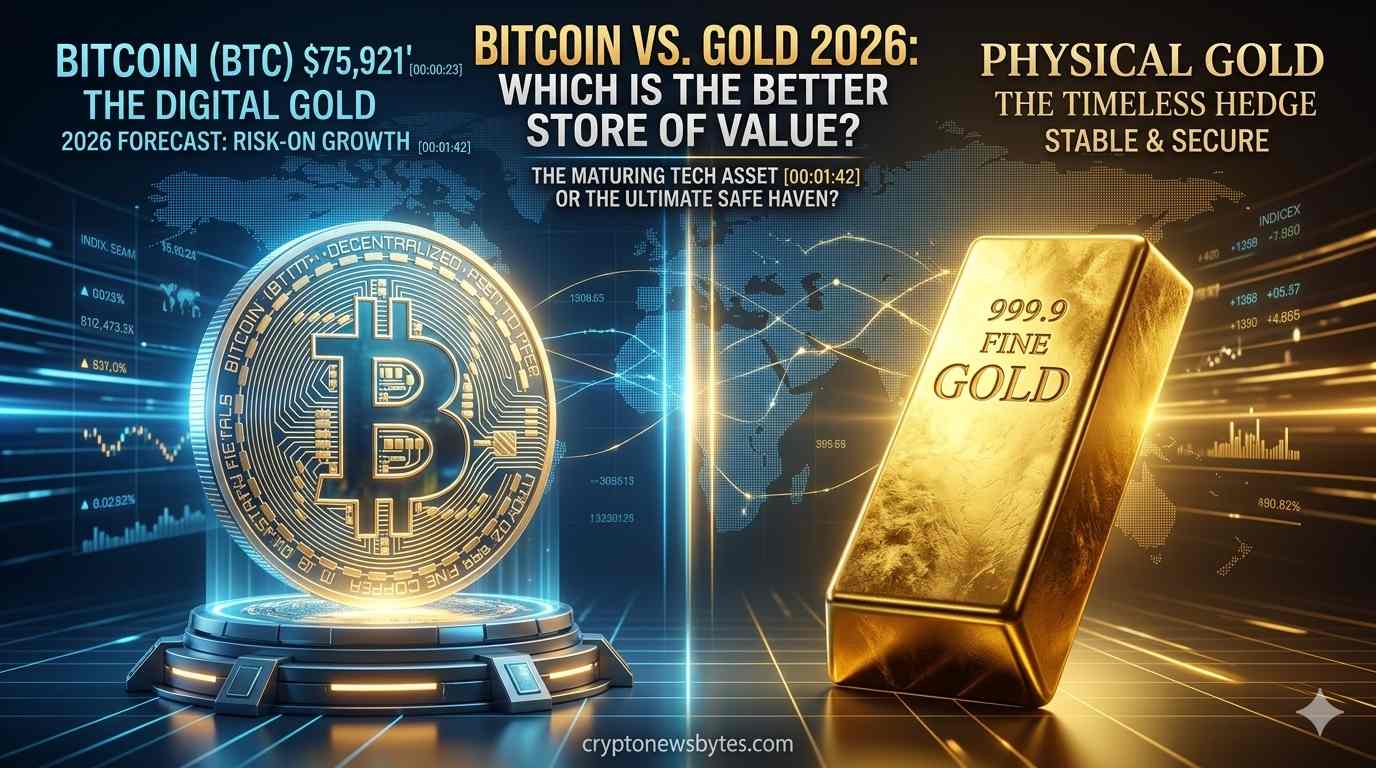
Key Takeaways
- In 2026 year-to-date, Gold is the clear winner, up approximately 20% to $5,025 per ounce while Bitcoin is down 22% to $74,784. For the first time in several years, the traditional store of value is outperforming the digital one.
- Zoom out and Bitcoin dominates. Since 2017, Bitcoin has returned over +2,800% versus Gold’s +160%. Bitcoin has won 7 of the last 10 calendar years on annual returns.
- The core difference is risk profile. Bitcoin’s annualised volatility runs at approximately 52% versus Gold’s 15.5%. Bitcoin offers asymmetric upside with deep drawdown risk. Gold offers capital preservation with modest appreciation.
- Both are scarce. Bitcoin has a hard cap of 21 million coins. Gold’s annual mining output is approximately 3,300 tonnes against 215,000 tonnes already above ground. In 2026, Bitcoin’s annual supply growth rate has fallen below Gold’s for the first time following the 2024 halving.
📋 In This Article
In the Bitcoin vs Gold 2026 debate, the long-term data is unambiguous. A $1,000 investment in Bitcoin in 2010 is worth approximately $249 million today. The same $1,000 in Gold is worth $3,536. Bitcoin has outperformed Gold by over 70,000 times over 15 years, the most dramatic store-of-value outperformance of any asset in financial history. Yes, Gold is having a strong year in 2026 while Bitcoin digests its post-halving cycle. But zoom out and the comparison is not even close.
The debate itself is not new. But the data has become increasingly one-sided over longer timeframes. Bitcoin’s fixed supply of 21 million coins, its four-year halving schedule that systematically reduces new issuance, and its growing institutional adoption have combined to produce returns that Gold, despite its 5,000-year history, cannot match. The relevant question in 2026 is not whether Bitcoin has outperformed Gold. It has, massively. The question is whether that outperformance can continue, and what role each asset plays in a portfolio going forward.
Live Snapshot: March 2026
📊 Bitcoin vs Gold, March 16, 2026
The five-year picture is striking and counterintuitive to Bitcoin maximalists. Gold has returned 199% over the five years from 2021 to 2026 versus Bitcoin’s 45% over the same period. This is not the narrative most crypto media runs with, but it is the data. The reason is straightforward: Bitcoin peaked at its all-time high of around $108,000 in late 2024 and has corrected significantly since. Gold has done the opposite, grinding steadily higher and breaking $5,000 for the first time in 2026.
15-Year Bitcoin vs Gold Returns: The Complete Picture
The 15-year store of value comparison tells a story that goes far beyond annual returns. On a logarithmic scale, the only scale that can even display Bitcoin’s growth meaningfully, Gold’s bar barely registers. A linear chart would make Gold invisible. This is the real Bitcoin vs Gold data that every investor should see before forming an opinion on which is the better store of value.

The pattern is consistent: Bitcoin performs explosively in risk-on environments (2017, 2019, 2020, 2023, 2024) and collapses in risk-off environments (2018, 2022) or during macroeconomic uncertainty (2025, 2026). Gold performs best precisely when Bitcoin struggles, during inflation scares, geopolitical tensions, and flight-to-safety periods. They are not substitutes. They respond to different conditions.
Scarcity Compared: 21 Million vs the Earth’s Crust
Both Bitcoin and Gold derive much of their store-of-value case from scarcity. But the nature of that scarcity is fundamentally different.
₿ Bitcoin Scarcity
- ::before{color:#f7931a;} Hard cap: exactly 21,000,000 BTC ever
- 20,003,125 BTC already mined (95.25%)
- ~450 BTC per day, dropping every halving
- Post-2024 halving: annual supply growth ~0.8%
- Scarcity enforced by code, cannot be overridden
- ~3M BTC permanently lost, real supply lower
🥇 Gold Scarcity
- ~215,000 tonnes above ground globally
- ~3,300 tonnes mined annually (~1.5% supply growth)
- No hard cap, more can always be mined
- Higher prices incentivise more mining
- Post-2024 halving: Bitcoin supply growth now below Gold’s
- Physical scarcity, verified by geology
The 2024 Bitcoin halving crossed a significant threshold: Bitcoin’s annual supply growth rate dropped to approximately 0.8%, falling below Gold’s annual supply growth of around 1.5% for the first time. In theory, Bitcoin is now scarcer than Gold on a supply-growth basis. Whether markets price this in is a different question, but the mathematical case for Bitcoin’s scarcity surpassing Gold’s is now real.
Volatility and Drawdowns: The Risk Reality
The single most important difference between Bitcoin and Gold as stores of value is volatility. A store of value that can drop 75% in 12 months, as Bitcoin did from November 2021 to November 2022, is not functioning as a store of value during that period. It is functioning as a high-risk speculative asset.
| Metric | Bitcoin (BTC) | Gold (XAU) |
|---|---|---|
| Annualised Volatility | ~52% (Q1 2025) | ~15.5% (Q1 2025) |
| Worst single-year return | -72% (2018) | -4% (2021) |
| Largest drawdown ever | -83% (2018 peak to trough) | -45% (1980 peak to trough) |
| Recovery time after 2022 crash | ~18 months | N/A (never crashed comparably) |
| Correlation to equities | High during risk-off events | Low, often negative |
| Inflation hedge track record | Mixed, fell during 2022 inflation spike | Strong, rose during 2022 |
| Safe-haven behaviour | No, sells off in crises | Yes, bought in crises |
Bitcoin’s volatility has been declining over time as the asset matures and institutional capital enters, but it remains more than three times as volatile as Gold. For investors who need capital preservation, that volatility is not a feature. For investors who can tolerate multi-year drawdowns in exchange for asymmetric upside, it is the entire point.
Institutional Adoption: Who Is Buying What?
The institutional landscape for both assets has shifted dramatically in the last two years and the picture is more nuanced than either side admits.
Gold, 5,000 years of institutional trust
Central banks globally hold approximately 36,700 tonnes of gold, representing roughly 17% of all above-ground gold. In 2025, central bank gold purchases were up 28% year-over-year, with gold-backed ETF inflows hitting $26 billion in Q3 2025 alone. When geopolitical stress rises, gold is where sovereign wealth flows. This is not a new trend, it is the oldest institutional behaviour in finance.
Bitcoin, the new institutional entrant
Bitcoin’s institutional story is newer but accelerating. US spot Bitcoin ETFs approved in January 2024 collectively hold over 1.1 million BTC. Strategy Inc alone holds 761,068 BTC worth $57 billion. Corporate treasuries, sovereign wealth funds in the Middle East, and a growing list of public companies have made formal Bitcoin allocations. The CLARITY Act moving through the US Senate in 2026 is expected to open institutional channels further.
Why Gold Is Outperforming Bitcoin in 2026, and Why It Does Not Change the Long-Term Story
Gold’s strong performance in 2026 is real and deserves honest analysis. But it sits within a 15-year context where Bitcoin has outperformed Gold by 70,000x. Here is why Gold is doing well right now, and why it does not change the long-term comparison.
Geopolitical uncertainty drives safe-haven flows. When investors are uncertain about sovereign risk, currency stability, and global conflict, they move toward assets with 5,000 years of trusted value. Bitcoin, despite its growing institutional base, does not yet carry that reflexive safe-haven status. During uncertainty, portfolios rotate to Gold.
Central bank buying is structural. Countries actively diversifying away from US dollar reserves, particularly in Asia and the Middle East, are buying Gold, not Bitcoin. This is a multi-year structural demand driver that does not respond to short-term price signals.
Bitcoin is in a post-halving digestion phase. Every Bitcoin halving has been followed by a period of consolidation before the next major bull run. The 2024 halving created exactly this dynamic. Bitcoin reached a new all-time high of approximately $108,000 in late 2024 and has since corrected. Historically, these corrections last 12 to 18 months before the next cycle begins.
Real interest rates matter differently to each asset. Gold historically performs well when real interest rates are low or falling. With the Federal Reserve navigating a complex rate environment in 2026, Gold’s appeal as a zero-yield but appreciating store of value is elevated.
Bitcoin vs Gold: Which Should You Hold?
The honest answer is that the question itself is the wrong frame. Bitcoin and Gold are not substitutes. They are complements that perform well in different environments. The more useful question is: what is your investment time horizon and risk tolerance?
₿ Bitcoin is better if…
- You have a 4+ year time horizon
- You can tolerate 50-80% drawdowns without selling
- You want asymmetric upside exposure
- You believe in digital asset adoption continuing
- You want an asset that cannot be confiscated or inflated
- You are comfortable with self-custody or regulated ETFs
🥇 Gold is better if…
- You need capital preservation as the primary goal
- You want a geopolitical hedge with 5,000 years of history
- You cannot tolerate large drawdowns
- You want something central banks actually hold
- You are in a risk-off macro environment
- You want physical ownership with no counterparty risk
The most intellectually honest position in 2026 is that both assets have earned a place in a diversified portfolio, in proportions that reflect your time horizon and risk tolerance. Bitcoin offers higher expected returns with higher expected volatility. Gold offers lower expected returns with genuine capital preservation. Over the last decade, a portfolio holding both has outperformed one holding either alone on a risk-adjusted basis.
What is clear is that the “Bitcoin vs Gold” debate has matured past the point of one replacing the other. With 20 million Bitcoin already mined and institutional adoption accelerating on both sides, the question for most investors is no longer which one: it is how much of each.
❓ Frequently Asked Questions