
Key Facts
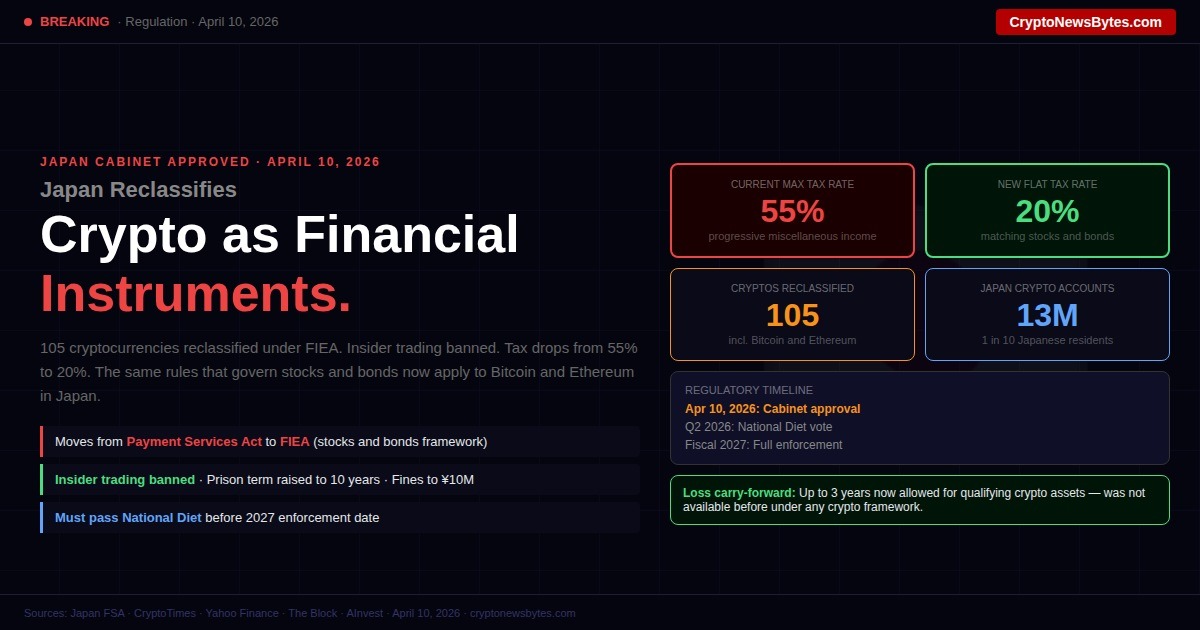
- Japan’s cabinet approved the bill on April 10, 2026, reclassifying 105 cryptocurrencies, including Bitcoin and Ethereum, as financial instruments under the Financial Instruments and Exchange Act (FIEA)
- Oversight shifts from the Payment Services Act (which treated crypto as a payment method) to FIEA, the same framework governing stocks and bonds
- The new flat 20% tax on crypto gains replaces the current progressive rate that peaks at 55%. Investors can also carry losses forward up to three years
- Insider trading is now banned for crypto assets. Unregistered operators face prison terms rising from 3 to 10 years, and fines rising from ¥3 million to ¥10 million
- Japan has 13 million crypto accounts, roughly one in ten residents. The bill now heads to the National Diet for final passage. Enforcement is targeted for fiscal 2027
Japan just made its most significant move in crypto regulation since the Mt. Gox collapse first pushed the country to regulate exchanges in 2017. On April 10, 2026, the Japanese cabinet approved a landmark bill reclassifying 105 cryptocurrencies as financial instruments under the Financial Instruments and Exchange Act. Crypto in Japan will no longer be treated primarily as a payment tool. It will be regulated as an investment product, on equal legal footing with stocks and bonds.
Finance Minister Satsuki Katayama framed the reform as a strategic move to expand the supply of growth capital and align Japan’s framework with global standards. The bill goes next to the National Diet for final passage before the 2027 enforcement date.
What Changes: The Full Breakdown
| Area | Before (Payment Services Act) | After (FIEA) |
|---|---|---|
| Legal classification | Crypto as payment tool | Crypto as financial instrument |
| Tax rate on gains | Progressive, up to 55% | Flat 20% (matching stocks) |
| Loss carry-forward | Not available | Up to 3 years |
| Insider trading | Not prohibited under crypto law | Banned, same rules as equities |
| Issuer disclosures | No mandatory annual reporting | Mandatory annual disclosures required |
| Unregistered operator penalty | Up to 3 years prison, ¥3M fine | Up to 10 years prison, ¥10M fine |
| Exchange oversight | Lighter PSA framework | FIEA-equivalent: segregated assets, cold wallet rules |
| Institutional access | Uncertain compliance requirements | Clear framework enabling banks and asset managers |
Which Cryptos Qualify, and Which Do Not
The 20% flat tax and FIEA protections apply only to the 105 cryptocurrencies on the FSA’s approved “financial product-class crypto tokens” list. Bitcoin and Ethereum are confirmed inclusions, along with the other major assets currently listed on licensed Japanese trading platforms.
Lower-cap tokens, memecoins, and assets that do not meet FSA standards are explicitly excluded from the reclassification. They remain under the older miscellaneous income tax category, meaning the higher progressive tax rates still apply to speculative trading in non-qualifying assets. Exchanges will face pressure to delist tokens that do not qualify, as holding unapproved assets creates regulatory and compliance complexity under the new FIEA framework.
The Two-Phase Story: Near-Term Drag, Long-Term Unlock
The short-term impact on exchange volumes is likely to be a modest headwind. Smaller exchanges face the most pressure: the new FIEA framework imposes requirements comparable to those for Type I Financial Instruments Business Operators, segregated client assets, cold-wallet operations, near real-time reserve reporting, and detailed cybersecurity disclosures. For well-capitalised players like BitFlyer, these are a path to legitimacy. For smaller operators, the compliance cost burden could be existential, accelerating consolidation toward larger firms.
The long-term structural picture is strongly positive. Once the 2027 framework is live, it creates a regulated on-ramp for traditional Japanese banks, asset managers, pension funds, and insurance companies, all of which have been cautious about crypto exposure without clear FIEA-aligned rules. The same institutional hesitation that held back the US market before the SEC approved spot Bitcoin ETFs applies in Japan. The FIEA reclassification resolves it in one legislative move.
Japan in Global Context
Japan’s move lands as the US CLARITY Act moves toward a Senate Banking Committee markup in late April, the EU’s MiCA framework completes its implementation phase, and Hong Kong aggressively courts crypto businesses with its own licensing framework. Japan’s reform aligns it with the emerging global consensus: crypto is an investment asset, not a payment mechanism, and it should be regulated accordingly.
For Japan specifically, the reform completes a regulatory arc that began with the Mt. Gox collapse in 2014. Japan was the first major country to regulate crypto exchanges, in 2017. It introduced the Travel Rule for AML compliance in 2022. It created a stablecoin framework in 2023. The FIEA reclassification is the final piece, bringing the primary asset class, spot crypto, fully under the securities framework that governs all other investment products in one of the world’s third-largest economies.
Frequently Asked Questions