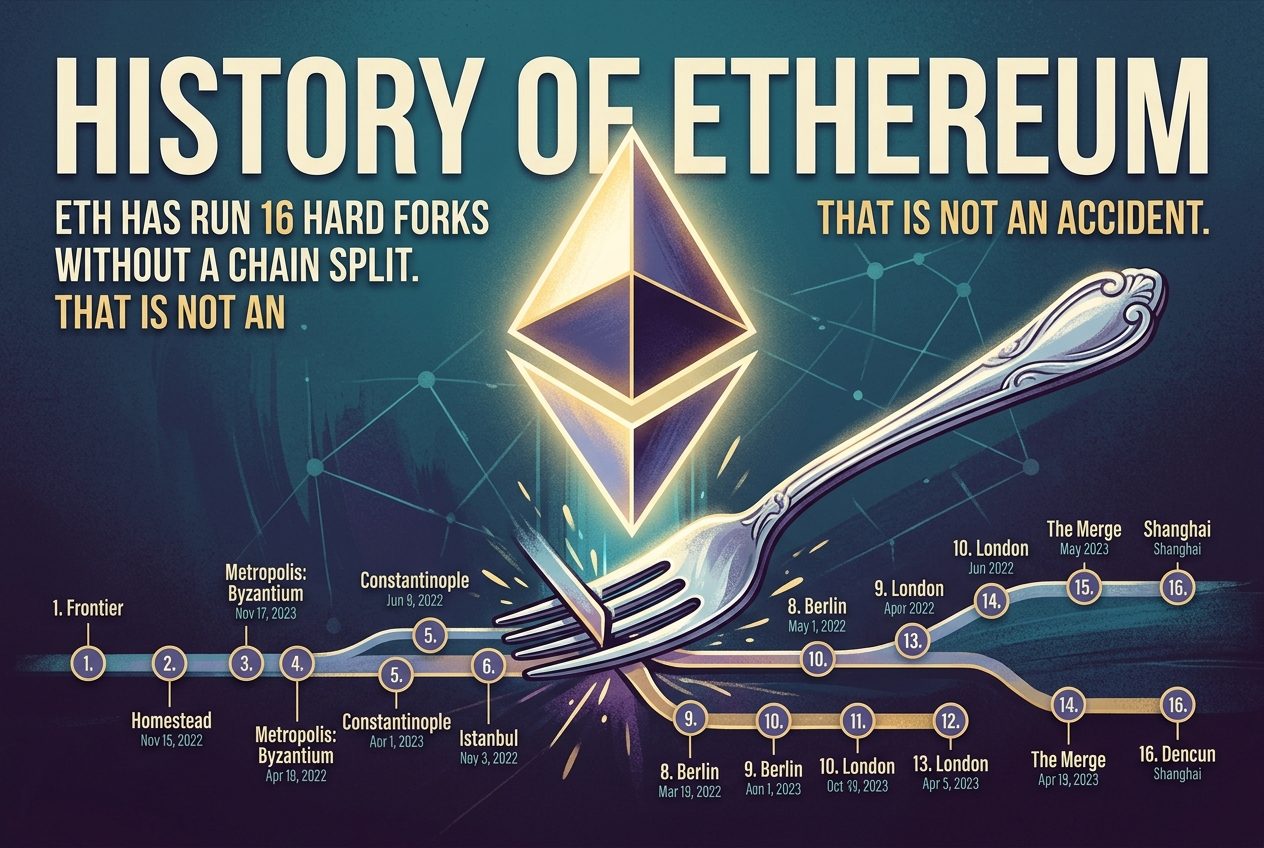
At 10:05 UTC on May 7, 2025, Ethereum executed its 16th hard fork. The Pectra upgrade activated at epoch 364032, finalized 12 minutes later with 88.5% validator participation, and changed 11 fundamental rules of how the network operates, all while processing transactions normally. Not a single user noticed downtime. Not a single block was missed. A network securing more than $200 billion in assets, run by thousands of independent validators across every continent, rewrote its own operating rules without stopping. No CEO authorised it. No company flipped a switch. A decentralised community of researchers, client developers, validators and application builders coordinated a simultaneous global software update on the most widely used smart contract platform in the world.
That sounds unremarkable until you understand what a hard fork actually requires. Every node on the network, running independent software clients built by competing teams in different countries, must upgrade to a new version before a specific block number. If any significant portion does not, the chain splits into two incompatible versions. Bitcoin Cash split from Bitcoin in 2017. Ethereum Classic split from Ethereum in 2016. Both of those splits represented governance failures where the community could not agree. Ethereum has now executed 16 protocol changes since 2015 without a single unintended split. The question worth asking is how, and whether anyone else can replicate it.
What Pectra Actually Changed
Pectra combined the Prague execution layer hard fork with the Electra consensus layer upgrade, 11 Ethereum Improvement Proposals in a single activation. The most impactful for validators: EIP-7251 raised the maximum effective validator balance from 32 ETH to 2,048 ETH. Before Pectra, a staking operator with 6,400 ETH had to run 200 separate validator instances. After Pectra, they can run one. The result one year later: the validator count has decreased 16% from pre-Pectra levels while total staked ETH has grown by 4.7 million, worth roughly $10.5 billion at May 2026 prices. The network is simultaneously smaller in node count and larger in economic security.
For users, EIP-7702 was the headline change. It allows a standard Ethereum wallet address, the kind every MetaMask user has, to temporarily execute smart contract code within a single transaction. In practice this unlocks gas payments in stablecoins, batched transactions, and native account recovery tools without requiring users to migrate to a new wallet address. Trust Wallet launched USDC gas payments within weeks of Pectra going live. Ambire Wallet called it the single greatest UX upgrade to Ethereum so far. Smart contract wallets now represent over 25% of new address activations on Ethereum, up from near zero before Pectra.
For rollups, EIP-7691 doubled the target blob count per block from 3 to 6 and raised the ceiling from 6 to 9, directly reducing the cost for Layer 2 networks to post transaction data to Ethereum. Fusaka, the follow-up hard fork that activated on December 3, 2025, extended this further with PeerDAS, expanding blob capacity roughly 8x and pushing L2 aggregate transactions per second to 1,220 by late 2025. That is approximately 20 times Ethereum’s own base layer throughput. L2 transaction fees now sit consistently below $0.02. The rollup thesis is not theoretical anymore.
Ethereum Upgrade Impact: Key Metrics Before and After Pectra
May 2025 to July 2026 | Sources: Everstake, Medium/Bolar, BeInCrypto, ethereum.org | @cryptonewsbytes
Sources: Everstake Pectra Anniversary May 2026, Medium/Bolar Dec 2025, BeInCrypto May 7 2025, ethereum.org | @cryptonewsbytes
How Ethereum Coordinates Upgrades Without a CEO
The answer is a process that looks informal but has very specific structural properties. Ethereum’s upgrade coordination runs through All Core Developers calls, biweekly video meetings where client teams, researchers and EIP authors discuss proposals. Anyone can attend. Nothing is voted on in these calls. Decisions emerge through rough consensus: enough of the relevant technical stakeholders agreeing that a proposal is safe and ready, with no blocking objections from anyone whose implementation matters. This is not democracy. It is closer to what the IETF calls running code and rough consensus, the internet’s own coordination mechanism.
The critical structural element is client diversity. Ethereum mainnet runs across multiple independent execution clients, Geth, Nethermind, Besu and Erigon, and multiple consensus clients, Prysm, Lighthouse, Teku, Nimbus and Lodestar. No single client has enough market share to unilaterally determine what Ethereum is. When Pectra’s initial testnet deployments on Holesky and Sepolia encountered finality issues, core developers launched a new testnet called Hoodi specifically to resolve them before touching mainnet. The problems were found in a controlled environment, fixed, and the mainnet date was set only after Hoodi ran cleanly. That testing discipline, spread across competing client teams who all have reputation and users to protect, is the actual mechanism that prevents failures.
The validator participation rate at Pectra’s activation, 88.5%, reflects something specific about how node operators behave: they updated. Not because a company told them to. Because running an old client version on a hard fork boundary means your node falls off the canonical chain and your staking rewards stop. The economic incentive to stay current is built into the protocol design. Ethereum did not need to send notices, threaten penalties, or employ an operations team to ensure upgrade compliance. The protocol made non-compliance economically self-defeating.
What Testnet Failures Actually Show
Pectra’s path to mainnet was not smooth. The first testnet deployment on Holesky failed. The second on Sepolia encountered finality issues. A third testnet, Hoodi, had to be created from scratch. Every piece of coverage of these failures framed them as delays or problems. The more accurate frame is that the process worked: bugs were found in a testing environment rather than on mainnet, fixed, and the schedule was adjusted. No mainnet user was affected.
This is what distinguishes Ethereum’s upgrade process from blockchain projects that claim continuous development but roll changes to mainnet without extensive pre-deployment testing. The Ethereum community’s willingness to delay mainnet deployment, twice, when testnet issues appeared, rather than shipping and hoping, is the operational discipline behind 16 successful hard forks. Glamsterdam, the next major upgrade combining the Glam consensus layer and Amsterdam execution layer improvements, is currently targeted for Q2 to Q3 2026. Based on the pattern, expect testnet deployments to run first, expect potential delays if issues appear, and expect the mainnet activation to be quiet when it happens.
Can Anyone Else Do This?
The honest answer is that very few networks have demonstrated equivalent upgrade discipline at equivalent scale. Bitcoin has not had a hard fork since SegWit in 2017, and the community’s near-paralysis on block size in 2017 produced the Bitcoin Cash split. Solana has had multiple network outages and has executed upgrades, but with a smaller, more centrally coordinated validator set and a foundation that plays a more direct operational role. Cardano’s Van Rossem hardfork in June 2026 demonstrated that on-chain governance can ratify a protocol upgrade without IOG controlling the process, a genuine milestone, but Cardano runs a substantially smaller validator ecosystem.
What makes Ethereum’s record distinctive is the combination of scale, decentralisation and consistency. More than 800,000 validators across independent operators worldwide. Multiple competing client implementations. A coordination process with no formal authority and no voting system. Sixteen successful protocol changes over ten years. The Pectra activation at 10:05 UTC on May 7, 2025, finalizing in 12 minutes, is the most recent data point in that record. It is also the most technically ambitious, 11 EIPs touching staking economics, wallet behaviour, and rollup scaling simultaneously. The fact that it was quiet is the point. A network that can rewrite its own rules without stopping is not just a technical achievement. It is the strongest possible demonstration that decentralised governance at scale is not a theoretical concept.
Frequently Asked Questions
What is the difference between a hard fork and a software update?
A standard software update adds features or fixes bugs within the existing rules of a system. A hard fork changes the rules themselves. On a blockchain, the rules define what counts as a valid transaction or block. A hard fork means the old rules and the new rules produce incompatible chains from the fork point forward. Every node must update before the fork block, or it follows the old chain. If enough nodes do not update, you get two persistent chains, which is what happened with Bitcoin Cash in 2017 and Ethereum Classic in 2016. Ethereum’s 16 hard forks have all resulted in unanimous adoption of the new rules, with no persistent alternative chain forming.
Why did Pectra fail on testnets before mainnet?
The initial Holesky testnet deployment encountered finality issues related to how different client implementations handled the new EIPs under specific edge conditions. A second attempt on Sepolia also revealed issues. Rather than pushing to mainnet, Ethereum core developers created a new testnet called Hoodi specifically to test the corrected implementations under controlled conditions. Hoodi ran cleanly, and the May 7 mainnet date was set based on that confirmation. The testnet failures delayed mainnet by approximately six weeks but prevented any mainnet impact.
What is Glamsterdam and when does it launch?
Glamsterdam is the name for the next major Ethereum upgrade after Fusaka, combining the Glam consensus layer improvements with the Amsterdam execution layer changes. It was targeted for Q2 to Q3 2026 as of the most recent public roadmap discussions. Like previous Ethereum upgrades, its exact date will be set based on testnet performance. Glamsterdam is expected to continue the rollup scaling roadmap and build on the Verkle Trees groundwork laid in Pectra.
Further Reading
The closest comparison point: Cardano’s first governance-ratified hardfork, enacted through on-chain DRep voting without IOG controlling the process.
Ethereum is named a digital commodity under CFTC oversight. The regulatory clarity that enables institutional staking and ETF flows to grow without legal risk.
Cardano was 5 years ahead on PoS and pioneered EUTXO. Now Ethereum researchers are proposing UTXO-style payments. The architectural comparison and whether being right first actually matters.
This article is for informational purposes only and does not constitute financial advice. Sources: ethereum.org/roadmap/pectra, Everstake Pectra Anniversary May 2026, BeInCrypto May 7 2025, Medium/Trent Bolar Dec 2025, Quicknode Pectra guide, Consensys Pectra guide, Coinbase Pectra guide, cash2bitcoin Pectra benefits, coindataflow.com epoch data. Published July 2, 2026.