
Pump.fun has sold 4.656 million SOL totalling approximately $794.8 million, at an average price of $170.7 per coin, based on on-chain tracking reported July 8, 2026. That cumulative liquidation is a real and ongoing source of sell pressure on SOL, which trades near $77.2 as of July 13, down 4% in 24 hours while still showing a 4.5% weekly gain. The Solana meme coin total market cap stands at $3.06 billion per CoinGecko, down 6.5% in the prior 24 hours. These are the numbers underneath the meme season is back narrative running through crypto social media this month. They are more complicated than the headline suggests.
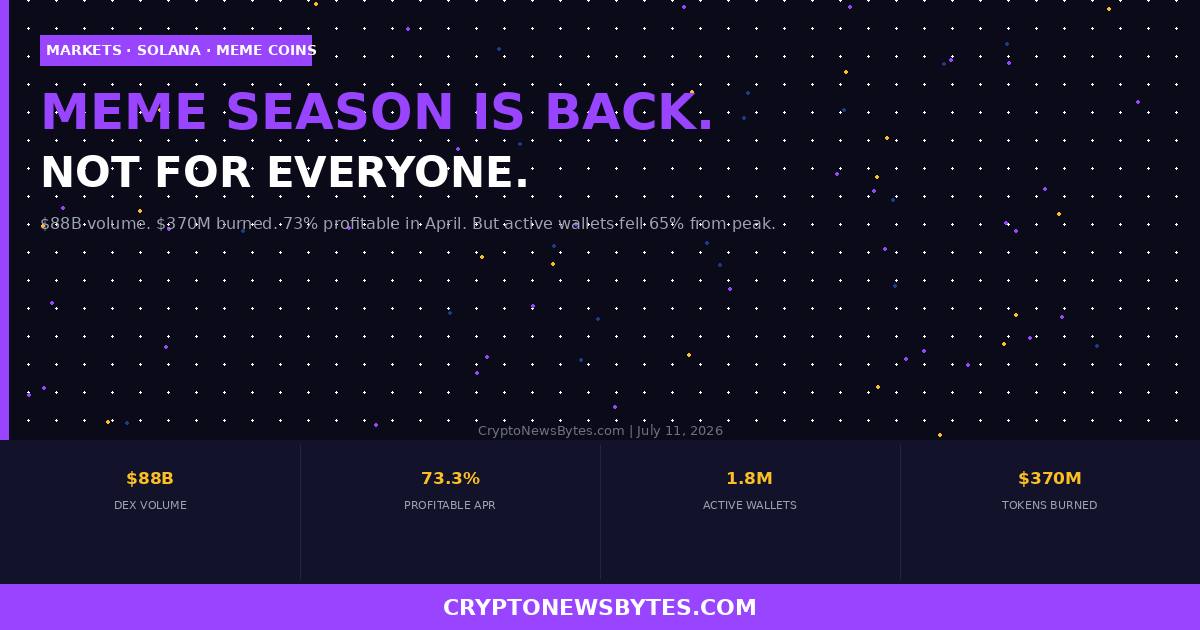
The platform itself has genuine achievements: $88 billion in cumulative DEX volume since launch, approximately $1 billion in protocol revenue, and a $370 million PUMP token burn in April 2026 representing 36% of circulating supply. In April, 73.3% of wallets exiting positions on the platform did so profitably per CoinGecko’s profitability report. But the same data shows monthly active wallets fell from a peak of 5.2 million in May 2025 to 1.8 million at the December 2025 trough. The recovery in 2026 has not returned to prior highs.
The PUMP governance token itself is down 84% from its September 2025 all-time high of $0.00893, currently trading at $0.001449. A major PUMP token unlock is scheduled for the second week of July 2026, per CoinGecko token release tracking, which could introduce additional supply pressure. The casino is smaller than it was in 2025. The remaining players are more experienced. Whether that is a floor or just a less crowded exit depends on whether Alpenglow and broader Solana momentum bring new participants back in.
What Pump.fun Actually Is and How It Works
Pump.fun is a permissionless token launchpad on Solana. Anyone can create a memecoin in under 60 seconds for approximately $2 in fees, with no coding, no liquidity bootstrapping, no presale and no team allocation. Tokens launch on a bonding curve: as buyers enter, price rises automatically against the curve. When a token reaches a market cap threshold of around $69,000, it graduates to PumpSwap, Pump.fun’s own DEX. Pump.fun earns a 1% swap fee on all trades and 1.5 SOL per graduation.
The platform launched in January 2024 and has driven a disproportionate share of Solana’s on-chain activity. During the week of June 12 to 18, Solana’s DEXs processed $7.19 billion in spot volume, topping Coinbase at $6.39 billion and Kraken at $4.37 billion for the same period. Only Binance and Bybit stayed ahead among centralized platforms. The PUMP governance token launched in 2025, raising $600 million in 12 minutes. In April 2026, Pump.fun announced it had burned all previously repurchased PUMP tokens and introduced a buyback-and-burn program funded by 50% of future net revenue.
Pump.fun Trader Profitability: The 2025-2026 Reversal
Monthly share of profitable wallets exiting Pump.fun | Sources: CoinGecko May 2026 | @cryptonewsbytes
Sources: CoinGecko May 2026 profitability report, CoinGecko Jul 13 2026 | @cryptonewsbytes. Not financial advice.
The Pump.fun SOL Sell: What It Means for SOL Price
Pump.fun sold another 122,498 SOL worth approximately $10.08 million in a single day on July 8, bringing cumulative liquidations to 4.656 million SOL per on-chain tracking, roughly $794.8 million at an average disposal price of $170.7. That average is well above the current $77 price, meaning the bulk of Pump.fun’s SOL was sold at significantly higher levels. The current selling represents protocol revenue conversion at lower prices, an ongoing structural supply overhang distinct from broader market selling pressure.
SOL exchange inflows jumped roughly 25x between June 11 and June 25, 2026, from 57,336 SOL to approximately 1,410,650 SOL in net exchange position change per BeInCrypto’s on-chain analysis. Network activity rose 39% in the same period while the SOL price fell 20%. That divergence, higher activity alongside falling price, reflects the meme coin ecosystem generating transaction volume and fee revenue while simultaneously liquidating SOL. The two trends are linked, not contradictory. The regulatory backdrop matters here too: the SEC and CFTC declaring Solana a digital commodity in March 2026 removed the securities classification risk that previously deterred some institutional participants, providing a structural floor the meme ecosystem sits on even while it generates sell pressure from above.
The CNB coverage of SEC and CFTC declaring most crypto not securities in March 2026 explained why that ruling matters specifically for proof-of-stake networks: on-chain staking was explicitly cleared, which benefits the Solana validator ecosystem that meme trading volume helps sustain through fees. And the broader tokenization race CNB tracked with JPMorgan’s JLTXX tokenized Treasury fund on Ethereum illustrates the institutional layer operating in parallel: while meme traders play Pump.fun, institutions are choosing settlement chains for trillions in assets, and Solana’s 95% tokenized equity volume share is the institutional Solana story running alongside the retail one.
Who Is Actually Winning on Pump.fun Right Now
CoinGecko’s April 2026 profitability breakdown puts the distribution precisely. The largest cohort of profitable wallets, roughly 2.05 million or 65.1% of the profitable group, earned between $1 and $500. Around 87,000 wallets (2.8%) made $500 to $1,000. Approximately 169,000 wallets (5.4%) booked gains above $1,000. This is not people getting rich. It is a smaller, more disciplined trader base extracting consistent small profits from a market that once included millions of participants making large losing bets.
The traders consistently winning share structural characteristics: speed using tools like Photon and BullX to enter in the first seconds of a launch, information to distinguish genuine social momentum from bot volume, and capital sized correctly to exit without moving the market. The 73.3% April profitability figure is for wallets that exited positions. It does not capture wallets still holding underwater positions, or wallets that stopped trading entirely after losses. The honest read: the market cleaned itself up over 18 months of bear conditions. The remaining participants are sharper. The annualised fee revenue of $268.83 million per DeFiLlama shows the platform remains economically meaningful. Whether new participants arrive to restore the 5.2 million active wallet peak depends on factors beyond Pump.fun’s control: SOL price, macro sentiment, and whether Alpenglow delivers on its late 2026 promise.
Solana Meme Market Cap and Pump.fun Volume: Key Milestones
2025 to July 2026 | Sources: CoinGecko, DeFiLlama, on-chain data | @cryptonewsbytes
Sources: CoinGecko Jul 13 2026, DeFiLlama, on-chain tracking Jul 8 2026 | @cryptonewsbytes. Not financial advice.
Frequently Asked Questions
How does Pump.fun’s bonding curve work?
When a token launches on Pump.fun, it starts on an automated bonding curve where price rises as buyers enter. There is no order book and no market maker. The curve runs until the token reaches approximately $69,000 in market cap, at which point it graduates to PumpSwap where it trades freely. Most tokens never graduate. The bonding curve phase is where the fastest gains and fastest losses happen, and where early-entry advantage is most pronounced.
Why is Pump.fun selling so much SOL?
Pump.fun earns protocol revenue in SOL, as a 1% swap fee on PumpSwap trades and 1.5 SOL per token graduation. Converting that revenue to other assets requires selling SOL. The 4.656 million SOL sold ($794.8M) at an average of $170.7 represents revenue realisation over time, not a single event. Current selling continues at prices well below that average, reflecting ongoing conversion of lower-value revenue.
What is the PUMP token unlock in July 2026?
CoinGecko’s token release tracker lists Pump.fun among projects with significant token unlocks in the second week of July 2026. The PUMP-specific unlock amount was not disclosed in available public sources. Token unlocks increase circulating supply, which can create downward price pressure if unlocked holders choose to sell.
Further Reading
Solana named a digital commodity under CFTC oversight. The ruling explicitly clearing on-chain staking that the Solana validator ecosystem depends on.
The institutional side of on-chain finance running in parallel with Pump.fun’s retail layer. JPMorgan chose Ethereum for domestic reserve management while Solana leads equity volume.
This article is for informational purposes only and does not constitute financial advice. Sources: 99Bitcoins Jul 8 2026 and Jun 25 2026, CoinGecko Jul 13 2026, BeInCrypto Jun 2026, CoinGecko meme profitability report May 2026, DeFiLlama annualised fees Apr 2026, Coinbase/CoinGecko PUMP token price data. Published July 2, 2026.