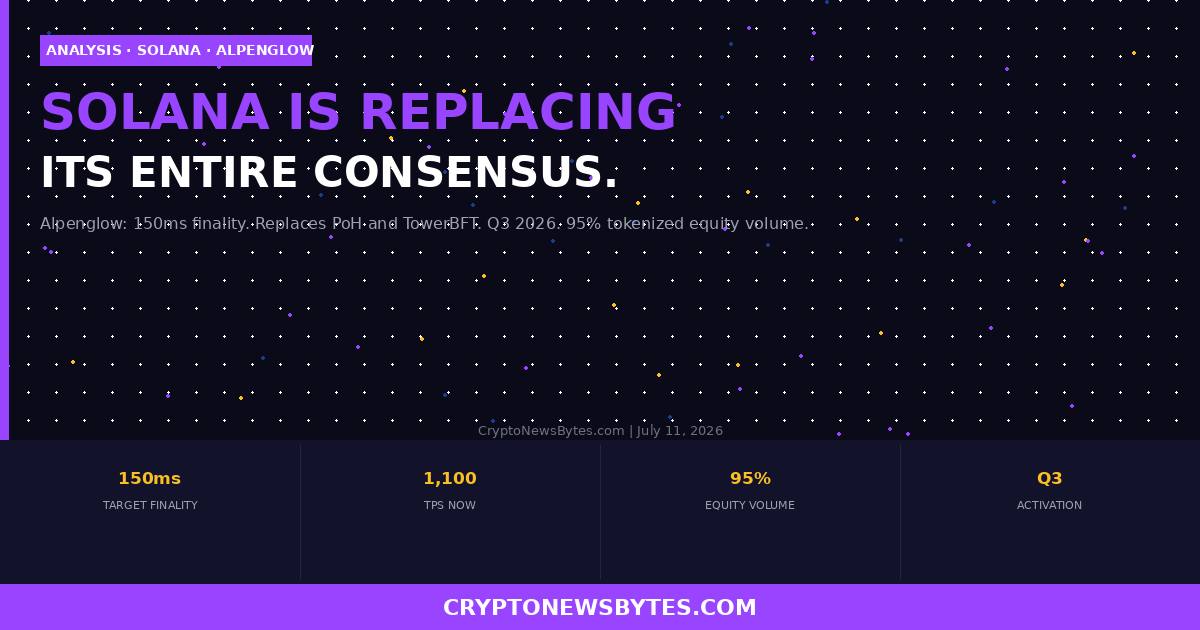
Solana is replacing its entire consensus layer in late 2026. The Alpenglow upgrade, formalized as SIMD-0326 and developed by Anza, Solana’s core engineering team, scraps Proof of History and TowerBFT and replaces them with two new components: Votor, a voting and finalization system, and Rotor, a block propagation layer. The target is transaction finality at approximately 100 to 150 milliseconds, down from the current 12.8 seconds. That is roughly a 100x reduction. A Visa transaction settles in around 100 milliseconds. Solana after Alpenglow would match that. On a public blockchain. At scale.
The upgrade passed Solana community governance in September 2025 with 98.27% of participating stake voting yes, on 52% total stake turnout. In May 2026, Anza confirmed Alpenglow was live on a community test cluster, and Solana co-founder Anatoly Yakovenko said at Consensus Miami 2026 that mainnet activation could arrive as soon as Q3 if testing continued smoothly. The timeline has since extended: Agave 4.1 targets Q3 2026 for release, with community testing and security audits running through Q4, and mainnet activation expected late 2026.
SOL trades near $77.2 as of July 13, 2026, down 73.9% from its all-time high of $293.31. Active addresses are approaching 7 million and transactions per second are nearing 1,100, both approaching all-time highs. The divergence between network activity and token price is the setup Alpenglow is being built into.
What Proof of History Was and Why It Is Being Replaced
Proof of History is Solana’s original timing mechanism, a cryptographic clock that sequences events before consensus. Combined with TowerBFT, it allowed fast transaction processing but created 12.8-second finality. A deeper problem is that on-chain vote transactions currently consume approximately 75% of Solana’s block space. Validators must publish every vote on-chain, bloating the ledger and consuming capacity that could serve user transactions. Alpenglow eliminates on-chain votes entirely.
Under the new Votor mechanism, validators exchange votes off-chain in compact certificates, freeing that 75% of block space for actual user activity. Votor runs two finalization paths simultaneously. If 80% of staked validators agree, a block finalizes in a single round at roughly 100ms. If only 60% participate, two rounds finalize at roughly 150ms. Rotor, the data propagation component, replaces Turbine with stake-weighted relay paths and erasure coding, with simulations showing block propagation completing in as little as 18 milliseconds.
One significant economic change sits alongside the speed improvement. The minimum stake required to run a validator drops from 4,850 SOL to 450 SOL, a 90% reduction that opens the validator set to significantly smaller operators. The validator set will be capped at 2,000 active validators. Vote transaction fees, currently roughly 1 SOL per day per validator, are expected to fall to approximately 0.8 SOL via Validator Admission Tickets that are 100% burned. Alchemy’s technical breakdown confirms the research originated from Professor Wattenhofer’s distributed systems lab at ETH Zurich. Votes consuming ~75% of block space is the existing system’s defining constraint. Alpenglow removes it.
Solana Alpenglow: What Changes and What the Numbers Show
Late 2026 upgrade scope | Sources: Alchemy, BCW Group, Backpack Exchange, CoinDesk | @cryptonewsbytes
Sources: Alchemy blog Apr 2026, BCW Group Jul 2026, CoinDesk May 2026 | @cryptonewsbytes
The Institutional Layer Already Building Before Alpenglow Lands
Alpenglow is coming into an ecosystem already attracting serious institutional attention. Clearstream, Deutsche Börse’s post-trade arm, added SOL to its MiCA-licensed institutional custody offering on July 8, allowing banks and asset managers to hold SOL within existing regulated accounts in Luxembourg. Morgan Stanley filed for a Solana ETF at a record-low 0.14% management fee. Solana captured 95% of tokenized equity trading volume across all blockchains in the week of June 22, processing $1.29 billion. That dominance is built on 12-second finality. This institutional momentum connects directly to the broader regulatory clarity CNB covered when the SEC and CFTC jointly declared most crypto not securities in March 2026, specifically naming Solana as a digital commodity under CFTC oversight.
The honest questions remain open. Alpenglow is not live. The timeline extended from Q3 to late 2026 as testing requirements became clearer. Bitcoin developer Jeff Garzik has said achieving sub-second finality at global scale risks security tradeoffs tied to physical propagation limits. These are not dismissals of Alpenglow. They are the calibration a reader needs before pricing in late 2026 activation as a certainty. Firedancer, Jump Crypto’s independent validator client, is live and improving client diversity, but is still rolling out cautiously. Solana has a history of network outages that its critics cite consistently. Both the opportunity and the risk are real and running in parallel.
SOL Price History: From Launch to July 13, 2026
Year-end closes and ATH moments | Sources: CoinGecko, CoinMarketCap | @cryptonewsbytes
Sources: CoinGecko Jul 13 2026, CoinMarketCap historical data | @cryptonewsbytes. Not financial advice.
What Needs to Happen Before Mainnet
The path: Agave 4.1 release in Q3 2026, community testing and security audits through Q4, mainnet activation late 2026. Three components from the full Alpenglow whitepaper are deferred to future proposals: Rotor’s full implementation, slashing mechanisms (community discussion hints at a 2027 proposal), and additional MEV-resistance features. SIMD-0326, what is actually going to mainnet, covers Votor consensus changes only. Rotor lands later. The 150ms finality improvement comes from Votor alone. The 18ms block propagation in simulations requires the full system including Rotor. Builders designing applications around Alpenglow assumptions need that distinction. The tokenized asset race CNB has tracked, including JPMorgan’s JLTXX tokenized Treasury fund on Ethereum and Stellar’s DTCC partnership, continues to intensify while Alpenglow tests. Solana’s 95% equity volume share faces well-capitalised competition through H2 2026 regardless of when the upgrade activates.
Frequently Asked Questions
When exactly does Alpenglow activate on Solana mainnet?
Late 2026. Agave 4.1, the validator client version containing Alpenglow’s Votor consensus changes, is targeted for Q3 2026 release. Community testing and security audits then run through Q4 2026 before mainnet activation. Yakovenko said at Consensus Miami 2026 that Q3 was possible if testing went smoothly, but developer teams as of July 2026 point to late 2026 as the realistic expectation.
What is the difference between Votor and Rotor in Alpenglow?
Votor is the consensus system replacing TowerBFT. It moves validator voting off-chain and delivers 100-150ms finality via one or two rounds of voting. Rotor is the block propagation system replacing Turbine, using stake-weighted relay paths and erasure coding. SIMD-0326 covers Votor only for the mainnet activation. Rotor is a separate proposal coming later. The 150ms finality comes from Votor alone.
Why does Alpenglow lower the validator minimum stake from 4,850 SOL to 450 SOL?
Eliminating on-chain vote transactions removes the dominant operational cost for validators. Hardware requirements fall alongside the software change, making it viable to run a validator with far less capital. The 90% stake minimum reduction is balanced by a validator set cap of 2,000 to keep consensus message sizes manageable.
Further Reading
Solana named a digital commodity under CFTC oversight. The regulatory clarity enabling institutional custody, ETF filings and staking without legal risk.
The institutional tokenization infrastructure competing with Solana’s equity volume dominance. JPMorgan chose Ethereum for domestic reserve management and XRPL for cross-border settlement.
This article is for informational purposes only and does not constitute financial advice. Sources: CoinDesk May 11 2026, Alchemy blog Apr 2026, BCW Group Jul 2026, CoinGecko Jul 13 2026, Bitcoin.com Mar 2026, Solana Compass Jun 2025, CoinMarketCap Solana updates Jul 2026. Published July 2, 2026.