Key Points
- TRM Labs identified nine YouTube tutorial videos across separate channels, all using nearly identical scripts, AI-generated presenters, and fabricated testimonials promising a Claude-powered crypto arbitrage bot.
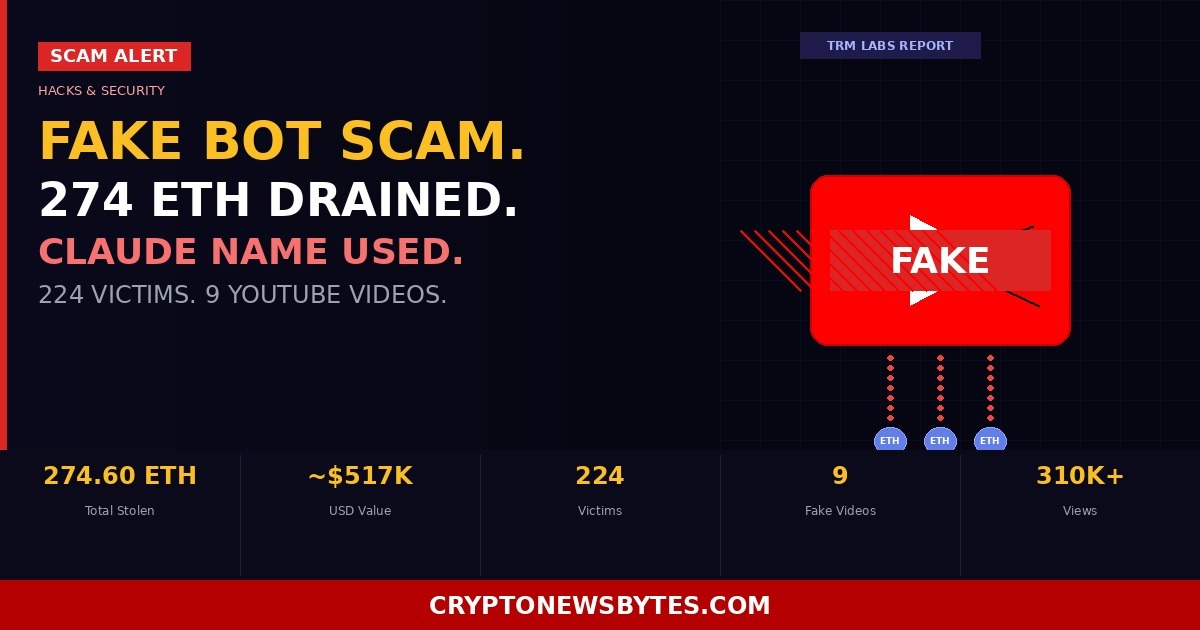
- The videos had 310,474 views as of September 2026. Between February 12 and August 11, 224 victims deployed 234 smart contracts and collectively lost 274.60 ETH (~$517,205).
- The self-draining smart contracts contained no trading logic. They forwarded any balance above 0.05 ETH to six operator-controlled addresses when victims pressed Start or Withdraw.
- A fake compiler site styled to resemble Remix discarded the source code victims pasted and instead deployed a malicious contract fetched silently from the operator’s server.
- Victims authorized every transaction themselves. No phishing link, malicious approval, or wallet connection was involved, making the scam invisible to standard wallet security tools.
- Claude AI was not involved. TRM found no Anthropic product or functionality in any contract or compiler site. The name was used purely as marketing. Earlier 2025 versions used ChatGPT branding with the same mechanics.
- Stolen funds moved through DeFi swaps (into Dai), cross-chain bridges, and a mixer. No centralized exchange appeared in the outbound flow.
A YouTube crypto scam that deployed victims as unwitting participants in their own theft drained 274.60 ETH from 224 wallets between February and August 2026, according to a new report from blockchain intelligence firm TRM Labs. The scheme borrowed the name of Anthropic’s Claude AI model as a marketing lure to attract users hoping to profit from crypto arbitrage automation, but deployed no AI functionality whatsoever.
What made this campaign operationally distinct was its inversion of the typical crypto scam structure. Rather than hacking an exchange, draining a protocol, or phishing victims into signing malicious approvals, the operators designed a scheme where each victim independently deployed and funded a smart contract that transferred their own assets to the attacker. The victim built the trap. The victim funded the trap. The victim activated it.
The Tutorial Funnel: AI Branding as the Entry Point
The nine videos identified by TRM Labs followed a near-identical production template: AI-generated presenters and voiceovers, screen-recorded walkthroughs, visible source code, comment sections populated with fabricated testimonials, and claims of daily returns from automated arbitrage. The consistency of scripts, claimed profit figures, and on-screen steps across separate channels suggests a common production source or operator coordinating the campaign.
Claude was named in video titles, descriptions, and spoken scripts as the AI powering the bot’s trading logic. TRM found no Anthropic product, Claude API call, or AI model interaction anywhere in the deployed contracts or associated infrastructure. The name was selected because it signals technical sophistication to a target audience interested in AI-powered trading. In 2025, the same campaign template ran using ChatGPT branding before switching to Claude.
“Claude appears only in titles, descriptions, and scripts as a marketing lure. TRM found no Anthropic product or AI functionality in the contracts or compiler sites.”
TRM Labs, October 2026
Videos were distributed across YouTube channels that appeared distinct but shared production characteristics. Written guides replicating the same steps were hosted on Telegraph, Amazon S3, and Google Cloud Storage, extending reach beyond video platforms. URLs were embedded in video descriptions rather than spoken aloud, allowing the same recording to be reused across multiple deployment environments.
The Fake Compiler: Where the Swap Happened
The technical mechanism that converted a legitimate-looking tutorial into a theft required one additional layer: a fake smart contract compiler site styled to resemble Remix, Ethereum’s widely used browser-based development environment.
Tutorials directed victims to paste Solidity source code into what appeared to be a code editor. The code displayed on screen appeared functional and, to a non-developer, plausibly consistent with an arbitrage contract. However, the fake compiler site discarded the pasted source code entirely. When the victim clicked compile and deploy, the site retrieved a different contract from the operator’s server and deployed that instead.
How the swap worked
The victim sees clean, readable Solidity code in what looks like Remix. The site silently fetches the operator’s malicious bytecode from a remote server. The victim’s wallet signs and broadcasts the deployment transaction. The deployed contract on-chain is not the code the victim read. There is no visible indication that the swap occurred.
Once deployed, the contract’s logic was simple: any balance above 0.05 ETH sent to the contract address was forwarded to one of six operator-controlled addresses when the victim pressed a button labeled Start or Withdraw in the tutorial interface. The 0.05 ETH threshold was likely set to avoid draining negligible test amounts that might prompt the victim to investigate before committing meaningful funds.
The Second Drain: Fake Error Messages
After the initial drain, some victims received a follow-up prompt from the fake site displaying an error message requesting additional ETH, framed as a required fee to unlock trading functionality or resolve a “gas nonce liquidity issue.”
TRM Labs note
Gas nonce liquidity is not an Ethereum concept. The error message exists for one purpose: to extract a second transfer from victims who have already lost their initial deposit. Some victims complied.
Why Standard Security Tools Missed It
The scam bypassed the most common layers of crypto security defense because it required no malicious action from the attacker at the point of victim interaction. There was no phishing domain to blocklist. No malicious contract approval for a wallet to flag. No spoofed dApp connection. No seed phrase request.
Every transaction the victim signed was, from a wallet’s perspective, a legitimate user-initiated action: deploying a contract they chose to deploy, sending ETH to a contract address they chose to fund, pressing a button they chose to press. The fraud existed in the social engineering layer, not in the on-chain mechanics. This made it resistant to the automated detection most users rely on.
Fund Flow: DeFi, Bridges, Mixer
TRM Labs identified 234 victim-deployed contracts linking to six operator addresses that received the 274.60 ETH. The median victim loss was 1 ETH. The earliest recorded drain was February 12, 2026; the latest was August 11, 2026. The six-month operational window, consistent fund routing, and coordinated video production suggest an organized operation rather than an opportunistic individual.
AI Branding as a Scam Accelerant
The shift from ChatGPT to Claude as the named AI in these tutorials reflects a deliberate tracking of public attention. As Claude gained mainstream recognition through 2025 and into 2026, the campaign updated its marketing to match. The underlying scam architecture, the tutorial format, the fake compiler, the self-deploying drainer contract, the fabricated testimonials, remained unchanged.
This pattern has implications beyond this specific campaign. AI model names have become credibility signals to non-technical audiences. A tutorial promising a Claude-powered bot carries an implicit authority claim that a generic crypto bot tutorial does not. Scam operators have identified this and are systematically exploiting it. TRM noted that similar campaigns are likely to continue updating their AI branding as model name recognition shifts.
The self-deploying drainer model is also notable for its scalability and deniability. Operators never directly interact with victim wallets. There is no hack, no unauthorized access, no phishing. Victims sign every transaction voluntarily. This creates legal and investigative complications: it is harder to characterize as unauthorized access when the victim executed every step.
What to Watch For
Frequently Asked Questions
Was Claude AI actually used in these scams?
No. TRM Labs found no Anthropic product, Claude API integration, or AI functionality anywhere in the deployed contracts or associated infrastructure. Claude was named in video titles and scripts purely as a marketing lure. The same campaign used ChatGPT branding in 2025 with identical mechanics before switching to Claude as that name gained wider recognition.
How did victims lose money if they deployed the contracts themselves?
The fake compiler site showed victims readable source code but silently swapped it for a different malicious contract fetched from the operator’s server at deployment time. What was deployed on-chain was not the code the victim reviewed. The deployed contract forwarded any balance above 0.05 ETH to operator addresses when the victim pressed Start or Withdraw.
What was the total loss?
TRM Labs identified 274.60 ETH drained from 234 victim-deployed contracts linked to 224 wallets, between February 12 and August 11, 2026. At transfer-time ETH prices, this totalled approximately $517,205 USD. The median individual loss was 1 ETH.
Why didn’t wallet security tools flag the transactions?
Standard wallet security tools flag phishing sites, malicious contract approvals, and spoofed connections. This scam used none of those vectors. Every transaction was a legitimate user-initiated action: a contract deployment, an ETH transfer to a self-chosen address, a button press. The fraud occurred in the tutorial and compiler layer, not in the on-chain mechanics.
How can I verify a smart contract before deploying it?
Use only the official Remix IDE at remix.ethereum.org, accessed directly, never through a link from a tutorial. Read the contract source code and verify it does what you expect. Check for any function that forwards balances to external addresses. If you cannot read Solidity, do not deploy code you found in a YouTube tutorial. No legitimate arbitrage bot requires you to deploy your own contract and fund it directly.
Further Reading
The broader AI trust and identity problem that makes AI branding effective as a scam vector. Confidential computation as a structural response.
Automated vulnerability discovery infrastructure for AI agent systems, directly relevant to detecting AI-branded scam infrastructure.
The regulatory context for blockchain oversight, including how self-custody risks and social engineering threats are being addressed at the international policy level.
Sources: TRM Labs (“Fake AI Trading Bots Are Getting Victims to Build Their Own Drainers”, October 2026), Crypto Briefing, PA News / PaNews, Finwire, CoinOtag | Published October 13, 2026 | CryptoNewsBytes.com | Not financial advice.