Key Points
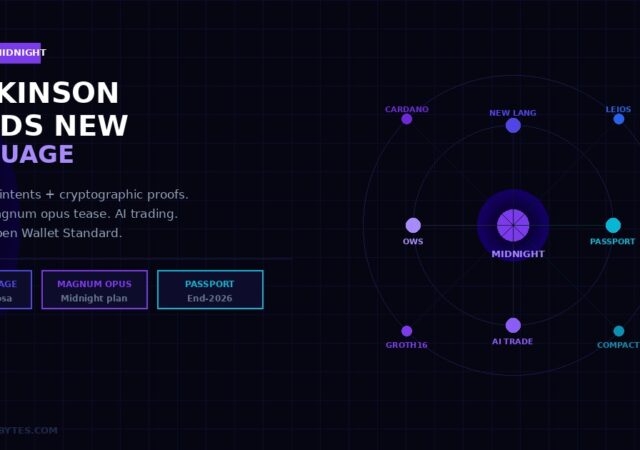
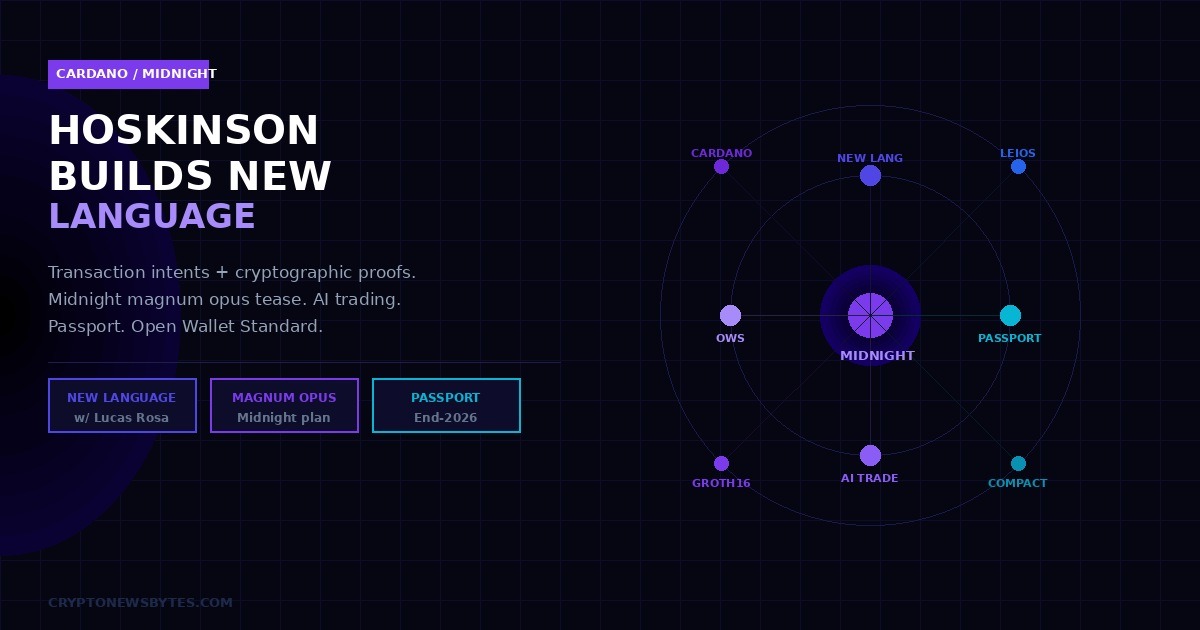
▶ Charles Hoskinson and IOG engineer Lucas Rosa are personally developing a new, unnamed Cardano programming language that pairs transaction intents with cryptographic proofs using Groth16 and proof-carrying data.
▶ Hoskinson has described a forthcoming Midnight initiative as the magnum opus of his career, saying conceptual design is nearly complete. No details, release date, or connection to other Midnight plans have been disclosed.
▶ Midnight is planning AI-powered cross-chain trading through Midnight City, letting users set goals and strategies while AI agents execute autonomously across blockchains. A strategy marketplace and Open Wallet Standard adoption are part of the same roadmap.
▶ Midnight Passport, a digital identity layer linking AI agents to their human users, is targeted for an initial release before the end of 2026.
▶ Hoskinson separately said that after Leios, Cardano’s planned scalability upgrade, the network will have achieved everything he originally set out to build.
Hoskinson Is Personally Building a New Cardano Language. He Says a Midnight Plan Coming Is the Work of His Career.
Charles Hoskinson is personally coding a new programming language for Cardano alongside Input Output Global engineer Lucas Rosa. The language, which has no public name yet, is designed to let developers declare the outcome they want from a transaction — and attach a cryptographic proof that the rules governing that outcome were satisfied. Separately, Hoskinson has been teasing what he calls the magnum opus of his career: an undisclosed Midnight initiative whose conceptual design, he says, is nearly finished.
The two threads are running in parallel with a third: Midnight’s expanding roadmap of AI-powered cross-chain trading and digital identity infrastructure. Whether the unnamed language or the new initiative connects to that roadmap has not been confirmed.
The New Language: Transaction Intents Plus Cryptographic Proofs
Lucas Rosa co-created Aiken, one of Cardano’s two main smart contract languages currently in production. The new language under development takes a different approach to how users interact with on-chain logic.
Rather than requiring a developer to specify every execution step, a user or application declares the intended result — a token swap that executes only if the final price hits a defined target, for example. The language then attaches a cryptographic proof to the transaction verifying that whatever conditions governed the outcome were actually met.
The proof systems involved are Groth16, a zero-knowledge proving system that produces compact proofs that verify quickly without revealing the underlying data, and proof-carrying data, a method of bundling cryptographic evidence with data so a receiving application can check the proof rather than recomputing the original computation from scratch.
Cardano already has two smart contract languages in active use: Plutus, the original Haskell-based language, and Aiken. Midnight uses its own separate language, Compact. Where the new language would sit in relation to any of these, and whether it is intended for Cardano’s base layer or for Midnight specifically, has not been clarified. There is no public code, no name, and no stated release timeline.
The Midnight Tease: “Magnum Opus”
In a separate statement, Hoskinson said he is working on what he described as the signature work of his career through Midnight. He said the conceptual design is nearly complete. He has not named the initiative, described what problem it addresses, confirmed when it will be announced, or said whether it connects to any of Midnight’s currently disclosed roadmap items.
Hoskinson used similar language earlier in 2026 when discussing Midnight’s broader ambitions, calling it bigger than Zcash and positioning it as the project that would address what he sees as the fundamental failures of crypto’s first two decades — primarily the gap between technical capability and mass adoption, and the absence of compliant privacy infrastructure for institutional use.
Midnight’s Expanding Roadmap: AI Trading, Passport, Open Wallet Standard
Separately from the magnum opus tease, Midnight outlined three near-term roadmap items in an October 13 discussion:
Midnight City AI trading. Users fund a wallet, define their goals and risk parameters, and AI agents execute trades autonomously across multiple blockchains. Midnight is building a marketplace alongside this where users can discover and share strategy configurations. No specific launch date was given — the timeline cited was “in the coming months.”
Open Wallet Standard adoption. Midnight is implementing the Open Wallet Standard to give AI agents verified, interoperable wallet access across blockchains. The standard allows agents to authenticate and transact without requiring platform-specific integrations for each chain.
Midnight Passport. An identity layer designed to link AI agents to the real humans behind them. The system is intended to provide verifiable attribution for AI-executed transactions — establishing who authorized an action even when the execution itself was automated. An initial version is expected before the end of 2026.
On Cardano: “After Leios, Yes. It Has Everything I Wanted.”
Asked whether Cardano had achieved its original goals, Hoskinson said: “After Leios, yes. It has everything I wanted to do.” He listed the components of his original vision as decentralized consensus, on-chain governance, the eUTXO transaction model, Plutus smart contracts, scalability, security, and multiple independent node implementations.
Leios is Cardano’s forthcoming scalability upgrade, designed to increase transaction throughput significantly without restructuring the network’s core architecture. No launch date has been announced. Hoskinson’s framing positions Midnight, not Cardano’s base layer, as the vehicle for his remaining ambitions.
Frequently Asked Questions
What is Hoskinson’s new programming language for Cardano?
An unnamed language being built by Hoskinson and IOG’s Lucas Rosa that lets developers declare a transaction’s intended outcome, then attaches a Groth16 zero-knowledge proof verifying the governing rules were satisfied. No name, no code, no release date has been made public.
What is Midnight and how does it relate to Cardano?
Midnight is a privacy-preserving partner chain to Cardano that launched on mainnet in 2026. It uses zero-knowledge proofs to enable selective data disclosure, targeting compliance and confidentiality use cases. It has its own language, Compact, and its own token, NIGHT.
What is Midnight City and the AI trading plan?
Midnight City is a feature in development allowing AI agents to trade crypto across multiple blockchains autonomously based on user-defined goals. A strategy marketplace and Open Wallet Standard adoption are planned alongside it. Timing is described as “in the coming months.”
What is Midnight Passport?
A digital identity system that links AI agents to the humans who authorized them. Designed to provide verifiable attribution for AI-executed transactions. An initial version is targeted before the end of 2026.
What did Hoskinson mean by magnum opus?
Hoskinson described an undisclosed Midnight initiative as the defining work of his career. Conceptual design is reportedly nearly done. No details — what it is, when it launches, or whether it ties to AI trading or Passport — have been made public.
Further Reading
Hoskinson’s broader regulatory framework argument — the institutional context he is building Midnight to operate inside.
The privacy-preserving computation argument directly underlying Midnight Passport and the AI agent identity infrastructure now in development.
The broader AI agent security landscape that Midnight Passport is entering. How competing chains are approaching autonomous agent identity and risk.
Sources: The Currency Analytics (Hoskinson and Rosa language, October 19, 2026), The Crypto Basic (Hoskinson magnum opus statement, October 18, 2026), Digital Today (Midnight City AI trading and Passport, October 13, 2026), CoinDesk (Midnight mainnet, March 2026), ZyCrypto (Hoskinson Midnight magnum opus) | Published October 19, 2026 | CryptoNewsBytes.com | Not financial advice.