What Atkins Told CNBC
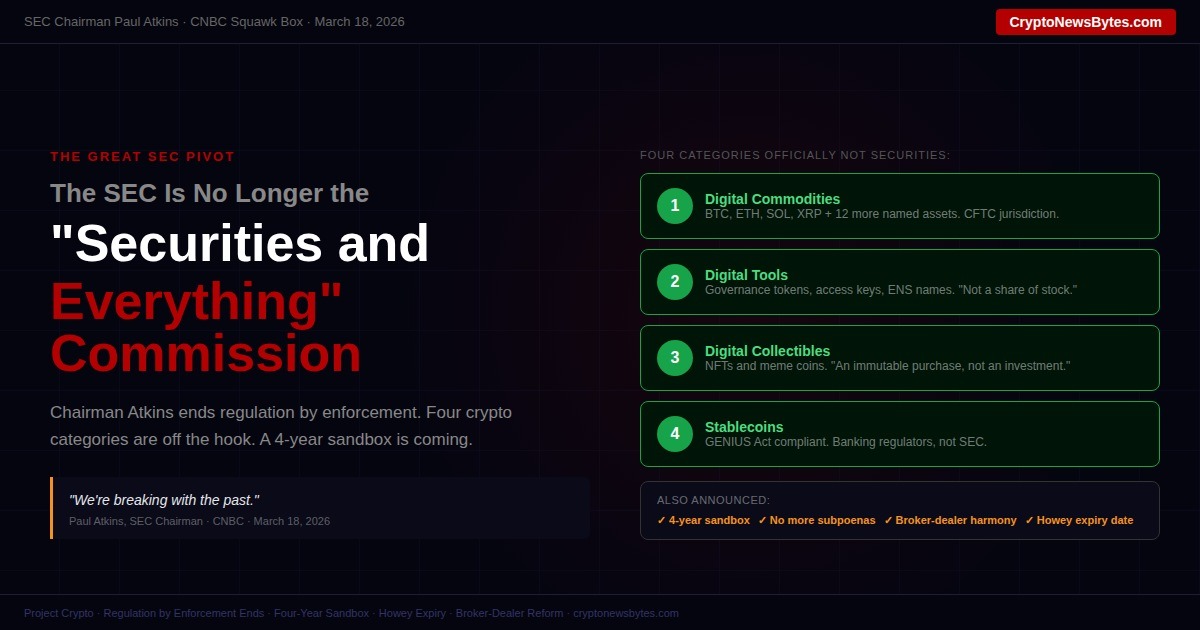
- SEC Chairman Paul Atkins confirmed on CNBC Squawk Box that “We’re breaking with the past” and the SEC is no longer the “Securities and Everything Commission”
- Four crypto categories are formally off the SEC’s hook as securities: Digital Commodities, Digital Tools, Digital Collectibles and Stablecoins
- The Howey Test has not been abandoned but its application has fundamentally changed. The token is not the security. The promise made at sale is. That status now has an expiry date
- A four-year regulatory sandbox is coming, giving startups a runway to experiment without immediate registration requirements
- Companies can now approach the SEC for guidance without a subpoena arriving the next day
SEC Atkins crypto 2026 marks a clean break from a decade of enforcement-first regulation. In a wide-ranging interview on CNBC Squawk Box on March 18, 2026, SEC Chairman Paul Atkins made the most direct statement any SEC chair has made about cryptocurrency in the agency’s history: most crypto assets are not securities, the SEC is not the regulator of everything digital, and the era of subpoenas as a substitute for rulemaking is over.
For executives, founders, and institutional investors who have spent years navigating a regulatory minefield where the rules were written after the enforcement actions, this is not a minor policy update. It is a structural reset. The question for boards is no longer “Is this legal?” The question is now “How fast can we build?”
The Core Pivot: Economic Reality Trumps Labels
The conceptual foundation of Atkins’ position is simple and powerful. Calling something a “token” or an “NFT” does not make it a security. But calling it a “utility token” does not automatically exempt it either. What matters, Atkins made clear, is economic reality. If an asset functions as a commodity, it is regulated as one. If a sale involves specific promises of profit from the efforts of a centralised team, that sale is an investment contract regardless of what the token is named.
“After more than a decade of uncertainty, this interpretation will provide market participants with a clear understanding of how the Commission treats crypto assets.”
SEC Chairman Paul Atkins, CNBC Squawk Box, March 18, 2026This framing dismantles the previous approach in one move. Under Gary Gensler, the SEC argued that almost every token was a potential security until proven otherwise, placing the burden of proof on founders and exchanges. Under Atkins, the default position is reversed. Most crypto assets are not securities. Only those that function as investment contracts or represent ownership stakes in an enterprise fall under the SEC’s remit.
The Four Categories That Are Off the Hook
Atkins laid out four specific categories that sit outside securities law. This is not a proposed rule or a draft framework. It is a published interpretation that takes effect immediately.
| Category | What It Covers | Atkins’ Framing |
|---|---|---|
| 1. Digital Commodities | Bitcoin, Ethereum, Solana, XRP and 12 other named assets. Value derives from programmatic operation and market demand. | These are commodities, not shares of stock. CFTC oversight going forward. |
| 2. Digital Tools | Governance tokens, access keys, ENS domain names, gas tokens. Anything that functions as a tool within a network. | “If it’s a tool for a network, it’s not a share of stock.” |
| 3. Digital Collectibles | NFTs and most meme coins. Atkins used a baseball card analogy: you buy it, you own it, it is not an investment contract. | “It’s an immutable purchase. It’s not something people are trading like another asset.” Exception: fractionalized collectibles with profit-sharing. |
| 4. Stablecoins | Dollar-backed and GENIUS Act compliant tokens. Banking regulators, not the SEC, have jurisdiction. | GENIUS Act, signed July 2025, formally moved these out of securities law. |
Why the Howey Narrative Just Changed
The Howey Test has governed US securities law since 1946. It defines a security as an investment of money in a common enterprise with an expectation of profit from the efforts of others. For years it was applied as a blunt instrument: if tokens were sold to raise money and investors expected profits, the entire project was potentially a securities offering in perpetuity.
Atkins introduced two critical refinements that change the landscape entirely.
First: the token is not the security. The security is the promise made at the time of sale. A Bitcoin mined today is not a security simply because someone sold tokens in 2017 with profit promises. The asset and the contract are separate things.
Second: securities status now has an expiry date. Once a project is functional and sufficiently decentralised, the investment contract ends. The security label falls away. The asset transitions to commodity status and moves to CFTC jurisdiction. This “detachment” principle is entirely new and resolves one of the most paralysing questions in crypto law: whether early-stage tokens that raised money could ever escape the securities framework even after the network was fully built.
No More Subpoenas: The New Open Door Policy
Beyond the taxonomy, the most operationally significant part of Atkins’ CNBC interview was his description of how the SEC will interact with the industry going forward. Three specific commitments stood out.
The Four-Year Regulatory Sandbox
Atkins confirmed that a formal regulatory sandbox is coming, giving startups up to four years to experiment with crypto products and business models without immediate registration requirements. The sandbox will require transparency disclosures but will not impose the full weight of securities-law compliance on early-stage projects. This is a direct response to the previous era where founders had no legal path to launch and faced enforcement actions for attempting to find one.
Open Doors Without Subpoenas
One of the most striking moments in the CNBC interview was Atkins’ direct acknowledgement that the previous SEC approach had poisoned the relationship between the agency and the industry. Companies had learned not to seek regulatory clarity because approaching the SEC risked triggering an investigation. Atkins explicitly reversed this: firms can now seek guidance without fear of an enforcement response. The joint SEC-CFTC framework published March 17 formalises this open-door posture in writing.
Broker-Dealer Harmony
Atkins confirmed that firms will soon be able to handle both crypto and traditional securities assets under a single, unified licensing structure. This removes one of the most significant operational barriers for institutional firms that want to offer both asset classes: the need to maintain separate legal entities, compliance programmes, and regulatory relationships for each.
The Boardroom Implication: From Minefield to Roadmap
For executives and boards who have spent years asking legal counsel whether their crypto strategy is permissible, the shift in framing is profound. The previous era required lawyers to answer a fundamentally unanswerable question: is this token a security under a test that the SEC applied inconsistently and without written guidance? The answer was always “maybe,” which meant the answer was always “wait.”
The new framework gives boards a checklist rather than a minefield. Does the asset derive value from programmatic operation? Digital commodity. Does the token provide access to a specific service? Digital tool. Is the token sold with explicit promises of profit from a centralised team’s efforts? Investment contract, temporarily. Has the network since become functional and decentralised? The security label can expire.
As we move into what we have called the Final Million era of Bitcoin and a clearer regulatory landscape in the US, the strategic question for institutions is no longer about legal permissibility. It is about competitive positioning. The US has signalled that it wants to be where crypto is built. The framework gives builders the certainty they need to act on that signal.