
What Just Happened
- Morgan Stanley filed a second S-1 amendment with the SEC for the Morgan Stanley Bitcoin Trust, locking in ticker MSBT on NYSE Arca. This is a refinement of its original January 6, 2026 application and signals the SEC review is active
- This makes Morgan Stanley the first major US bank to attempt direct issuance of a spot Bitcoin ETF. Every existing Bitcoin ETF was issued by an asset management firm. MSBT would be the first bank-issued product
- The fund infrastructure names Coinbase Custody as Bitcoin custodian (cold storage) and BNY Mellon as cash custodian, administrator and transfer agent. Virtu Americas, Jane Street Capital and Macquarie Capital will serve as authorised participants
- MSBT is one element of a much broader institutional crypto build-out: Morgan Stanley also filed S-1s for Ethereum and Solana trusts in January and applied for a National Trust Bank Charter in February 2026
- Morgan Stanley manages $1.9 trillion in assets and runs one of the largest financial advisor networks in the US. Its advisors have been able to recommend third-party Bitcoin ETFs since 2024. MSBT would redirect the management fee to the bank itself
The Morgan Stanley Bitcoin ETF is not just another filing. It represents a structural shift in who issues crypto investment products in the United States. Every spot Bitcoin ETF currently trading, BlackRock’s IBIT, Fidelity’s FBTC, Invesco’s BTCO, VanEck’s HODL, was issued by an asset management firm. Morgan Stanley is a bank. If MSBT receives SEC approval, it will be the first bank-issued spot Bitcoin ETF in US history, and the management fee will flow to Morgan Stanley rather than to a third-party fund manager.
The second S-1 amendment filed on March 18, 2026 is a meaningful regulatory signal. An amended S-1 is not just paperwork. It means the SEC is asking questions and Morgan Stanley is answering them. That is an active conversation, not a waiting game. The refinements in this filing, including the confirmed ticker, basket size, seed structure, and custodian appointments, suggest the application is progressing through the review process rather than stalling.
The MSBT Fund: What the Filing Reveals
The prospectus specifies several key elements, including a seed capital of one million dollars and the creation of 50,000 initial shares. At a starting price of $20.00 per share, this gives the fund a modest initial capitalisation designed to establish stable bid-ask pricing at launch rather than to reflect the fund’s eventual scale.
| Detail | Specification |
|---|---|
| Ticker | MSBT |
| Exchange | NYSE Arca |
| Fund type | Passive spot Bitcoin trust, tracks BTC price through direct holdings |
| Basket size | 10,000 shares per creation/redemption basket |
| Seed basket | 50,000 shares raising approximately $1 million |
| Initial share price | $20.00 per share |
| Bitcoin custodian | Coinbase Custody Trust Company (cold storage) |
| Cash custodian and administrator | BNY Mellon |
| Authorised participants | Virtu Americas LLC, Jane Street Capital, Macquarie Capital (USA) Inc. |
| Management fee | Not yet disclosed in the filing |
| Audit purchase | Morgan Stanley bought 2 shares on March 9, 2026 for auditing purposes |
| Original S-1 filing date | January 6, 2026 |
| Second amendment date | March 18, 2026 |
| Status | Pending SEC approval |
The choice of Coinbase Custody as Bitcoin custodian is notable. Coinbase holds Bitcoin for the majority of US spot Bitcoin ETFs including BlackRock’s IBIT. Most of the Bitcoin will be held in cold storage, where private keys remain offline. BNY Mellon, already a significant player in institutional digital asset custody, handles the cash and administrative functions.
Why This Is Different: Bank vs Asset Manager
Every major Bitcoin ETF currently trading in the US was issued by an asset management firm, BlackRock, Fidelity, Invesco, VanEck. Morgan Stanley manages approximately $1.9 trillion in assets and runs one of the largest financial advisor networks in the country. Since 2024, those advisors have been permitted to recommend third-party Bitcoin ETFs, products where the management fee flows to BlackRock or Fidelity. MSBT would redirect that fee.
This is the commercial logic behind the filing. Morgan Stanley’s advisors already have client demand for Bitcoin exposure. They have been meeting that demand by recommending IBIT and FBTC. Every dollar invested in those products generates fee revenue for BlackRock and Fidelity. MSBT would keep that revenue at Morgan Stanley. At the scale of the firm’s advisor network, even a modest AUM in MSBT would represent hundreds of millions in annual fee income that currently flows to competitors.
The Bigger Picture: Morgan Stanley’s Full Crypto Build
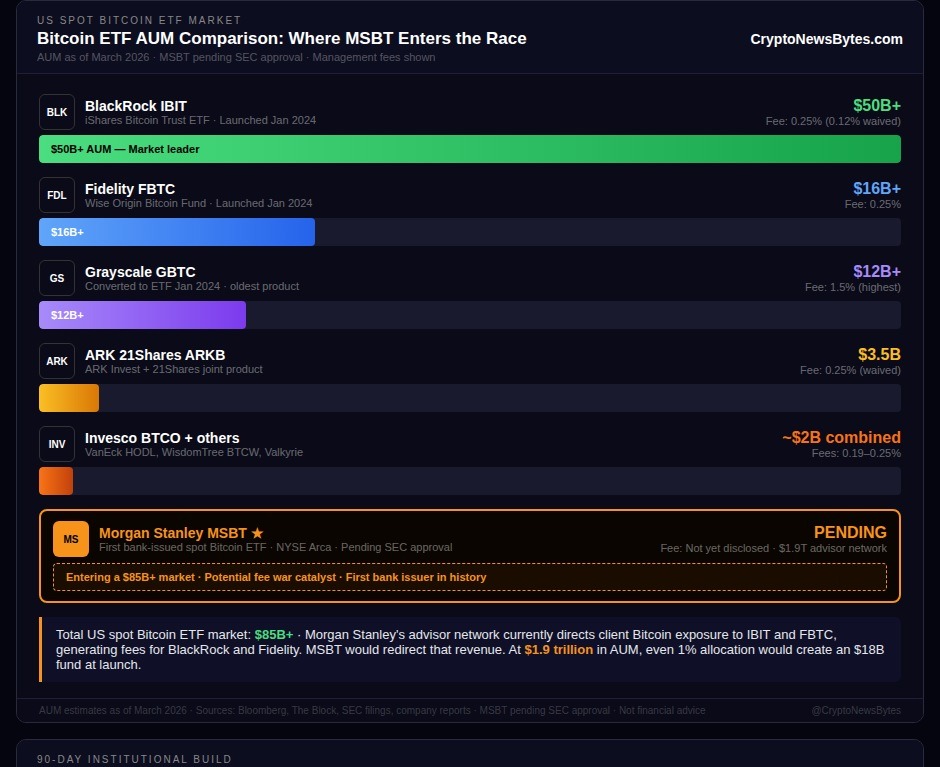
The MSBT filing is one piece of a much larger institutional infrastructure Morgan Stanley has been assembling. In January, the bank filed S-1 registrations for both an Ethereum trust and a Solana trust. In February, it applied to the OCC for a National Trust Bank Charter. The proposed entity, Morgan Stanley Digital, would give the bank the regulatory infrastructure to custody digital assets directly and offer a full suite of crypto financial services under a single licensed entity.
Together, these moves describe a bank that is not dabbling in crypto. It is building native infrastructure across custody, issuance, and distribution simultaneously.
| Move | Date | Significance |
|---|---|---|
| Bitcoin Trust S-1 filed | January 6, 2026 | First bank-issued spot Bitcoin ETF application |
| Ethereum Trust S-1 filed | January 2026 | Expanding beyond Bitcoin to the broader crypto market |
| Solana Trust S-1 filed | January 2026 | SOL now named a digital commodity under SEC framework |
| OCC National Trust Bank Charter applied | February 2026 | Would enable direct custody and crypto banking under one licence |
| Bitcoin Trust S-1 second amendment | March 18, 2026 | Locks in MSBT ticker, basket size, custodians. Active SEC review. |
The Wall Street Bitcoin Race: Where Everyone Stands
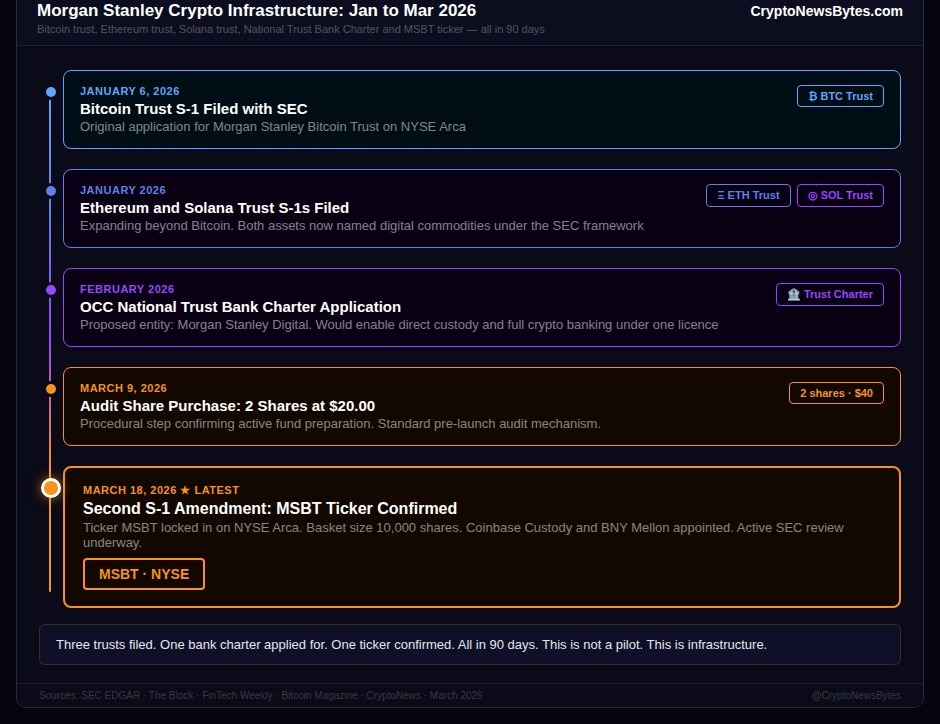
Morgan Stanley’s MSBT filing arrives as Wall Street’s crypto ambitions have become impossible to ignore. Wells Fargo has filed a WFUSD stablecoin trademark. JPMorgan has its JPMD deposit token. BlackRock’s BUIDL tokenized fund holds over $1 billion on Ethereum. And now Morgan Stanley is moving from distributing other firms’ Bitcoin products to issuing its own.
| Institution | Crypto Product | Status | AUM or Size |
|---|---|---|---|
| BlackRock | IBIT (Bitcoin ETF) + BUIDL (tokenized fund) | Live | IBIT: $50B+ AUM |
| Fidelity | FBTC (Bitcoin ETF) | Live | FBTC: $16B+ AUM |
| JPMorgan | JPMD deposit token | Live | $1B+ daily repo transactions |
| Wells Fargo | WFUSD stablecoin trademark | Filed March 2026 | Pending launch |
| Morgan Stanley | MSBT (Bitcoin ETF) + ETH trust + SOL trust + National Trust Charter | SEC review | Pending approval |
| Franklin Templeton | BENJI (tokenized money market) | Live | Multi-chain, growing |
What Happens Next
The second S-1 amendment is not a launch. It is a step in the SEC review process. The original application was filed on January 6, 2026. The SEC typically has 240 days to approve or deny an ETF application, though the agency has historically moved faster when applications are well-structured and the market infrastructure is established. With Coinbase and BNY Mellon already serving as custodians for existing ETFs, the operational questions are well-understood.
No management fee has been disclosed in the filing, which is unusual. This is likely being held back until the competitive landscape becomes clearer, allowing Morgan Stanley to price MSBT relative to what BlackRock and Fidelity are charging at the time of launch rather than locking in a fee months before approval.
If approved, MSBT would be distributed across Morgan Stanley’s advisor network to its millions of clients, placing it in direct competition with IBIT and FBTC for institutional and high-net-worth retail Bitcoin exposure. The question for the market is not whether MSBT will attract assets. It is how much it will take from existing products and whether the fee war it triggers will benefit all Bitcoin ETF investors.